Absorption Chiller
ProductOverview
Absorption chillers use thermal energy (steam, hot water, or combustion heat) instead of mechanical compression to drive a refrigeration cycle. The working fluid is typically lithium bromide (salt) dissolved in water: water acts as the refrigerant, evaporating and condensing at low pressures, while the lithium bromide solution acts as an absorbent. An external heat source drives water vapor out of the solution in a generator; the vapor then condenses in a conventional condenser coil and evaporates in an evaporator to produce chilled water. The now-weak solution flows back to the absorber, where it reabsorbs the evaporated water vapor, and is then pumped back to the generator, completing the cycle.
Absorption chillers are particularly valuable where low-cost waste heat or process steam is available, industrial plants, district energy systems, cogeneration plants, and buildings with simultaneous heating and cooling demands. Single-effect machines achieve a coefficient of performance (COP) of 0.6–0.8, and double-effect machines (using recovered heat from the condenser to preheat the generator inlet) reach 1.0–1.3. Modern units are nearly silent (no compressor vibration) and can be cooled by cooling towers or once-through water from rivers or utility supplies, making them attractive for noise-sensitive applications.
How it works
Generator: Hot steam or water supplied to the generator at 5–20 psia or 180–220 °F heats the lithium bromide-water solution. The water component in the solution evaporates, creating a refrigerant vapor. The concentrated lithium bromide solution (now lacking water) flows downward into the absorber; the water vapor rises into the condenser.
Condenser: The water vapor from the generator enters the condenser, where cooling water (supplied by a cooling tower) flows through the internal tubes. The vapor condenses into liquid water. A small amount of water condensate may be recycled back to the generator via a rectifier tube to minimize solution carryover.
Evaporator: Liquid water from the condenser flows to a low-pressure evaporator where chilled water (destined for the building) flows through internal tubes. The low pressure (0.5–1.5 psia absolute) in the evaporator shell causes the water to evaporate at roughly 44–50 °F, absorbing sensible heat from the building's return chilled water. The refrigerant water vapor rises into the absorber.
Absorber: The now-weak lithium bromide solution from the generator and the refrigerant water vapor from the evaporator meet in the absorber. Cooling water flowing through internal tubes cools this chamber. The cold weak solution readily reabsorbs the water vapor, becoming a concentrated solution again. This exothermic absorption process releases heat, which cooling water carries away. The reconstituted strong solution drains to the pump.
Solution pump: A small centrifugal pump (1–3 hp) lifts the weak solution from the absorber sump and pressurizes it to ~20 psia, pushing it through the solution cooler and into the generator. The pump is the only moving part (versus a reciprocating or scroll compressor in mechanical chillers), making absorption machines inherently reliable and long-lived.
Solution cooler (economizer): In higher-efficiency designs, an economizer uses cold solution returning from the absorber to pre-cool the hot weak solution leaving the generator, improving cycle COP. This internal heat recovery is critical for double-effect machines.
Subsystems
Generator Assembly accepts the external heat source (steam, hot water, or combustion heat). Evaporator Assembly produces the chilled water delivered to the building. Solution Circulation Pump is the only active mechanical component; its reliability far exceeds that of a mechanical compressor. Solution Cooler (Economizer) improves efficiency by internal heat transfer and is essential in double-effect designs.
Common failures
Lithium bromide solution can crystallize if the machine operates at part-load for too long or if the heat input falls below the minimum required; the entire circuit must then be thermally cycled to redissolve the crystals. Tube fouling (mineral deposits on the inside of cooling water tubes) occurs if untreated cooling water or sediment enters the machine; chemical cleaning is necessary. The solution pump seal can leak due to vibration or crystallization damage; mechanical seal replacement is required. Corrosion of steel internals from oxygen ingress (through a leak) requires passivation or part replacement.
Installation and commissioning
Absorption chillers are delivered pre-charged with lithium bromide solution and require field connections of chilled water supply and return, condenser water inlet and outlet, steam or hot water inlet, and electrical power for the pump and controls. A relief valve must be installed on the steam inlet, and a condensate return line is needed for hot water systems. The solution pump suction must be primed before first startup, typically by gravity feed from the absorber sump. Commissioning includes verification of heat input rate, measurement of chilled water temperature and flow, and confirmation that the machine remains below the crystallization point during part-load operation.
Load matching and integration
Absorption machines are best suited to constant-load operation or slow load changes. A multi-chiller configuration with one absorption unit (for base load on waste heat) and a mechanical chiller (for peaking) provides flexibility. Variable capacity can be achieved via hot water modulation valve or via steam on-off control, though part-load efficiency is lower than a fully variable mechanical chiller with VFD. In hybrid systems, the absorption chiller may operate 24/7 on waste steam while the mechanical unit cycles to meet additional demand.
Absorption Chiller parts and their functions
9 top-level parts · 78 parts in total · full bill of materials below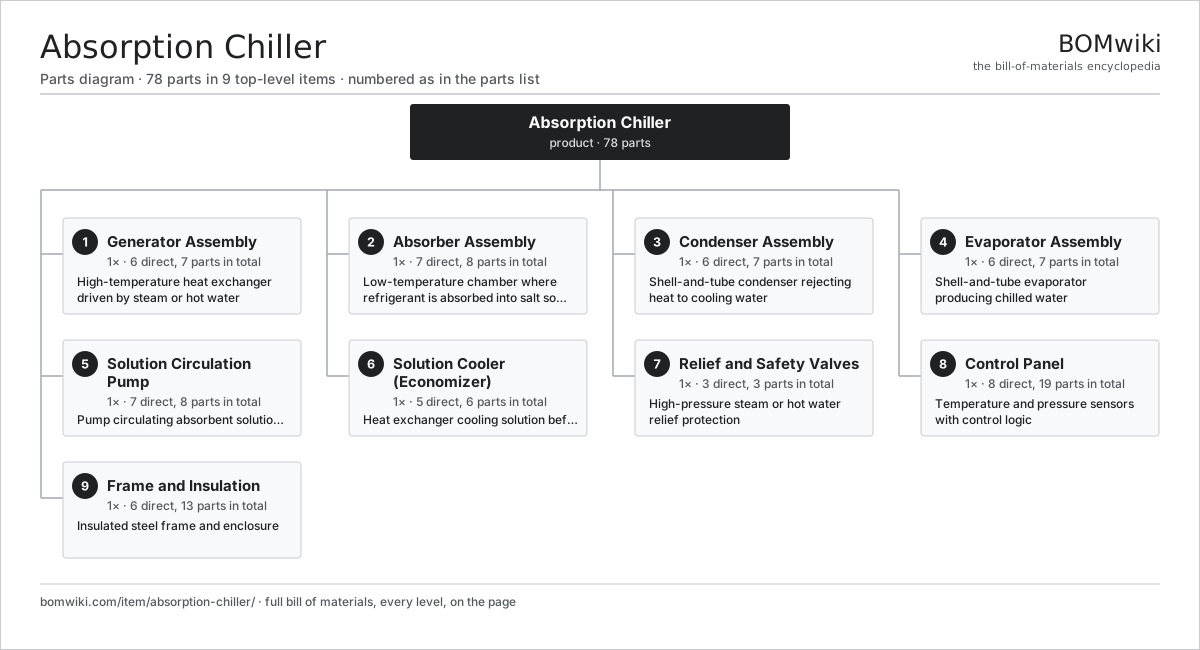
| # | Part | Qty | What it does |
|---|---|---|---|
| 1 | Generator Assembly 6 parts | 1× | High-temperature heat exchanger driven by steam or hot water |
| 2 | Absorber Assembly 7 parts | 1× | Low-temperature chamber where refrigerant is absorbed into salt solution |
| 3 | Condenser Assembly 6 parts | 1× | Shell-and-tube condenser rejecting heat to cooling water |
| 4 | Evaporator Assembly 6 parts | 1× | Shell-and-tube evaporator producing chilled water |
| 5 | Solution Circulation Pump 7 parts | 1× | Pump circulating absorbent solution from absorber to generator |
| 6 | Solution Cooler (Economizer) 5 parts | 1× | Heat exchanger cooling solution before the absorber |
| 7 | Relief and Safety Valves 3 parts | 1× | High-pressure steam or hot water relief protection |
| 8 | Control Panel 8 parts | 1× | Temperature and pressure sensors with control logic |
| 9 | Frame and Insulation 6 parts | 1× | Insulated steel frame and enclosure |
3D model
No 3D model yet. Have a CAD file of this? Add a 3D model. STL renders right on this page; STEP, FreeCAD, and OpenSCAD sources are welcome too (openly licensed, like all 3D models on BOMwiki).
Build & assembly graph
expand / collapse · shared sub-assemblies converge · links to related products · est. labourTap an assembly to expand/collapse · tap a part to open it · use “Open page” for any node · drag to pan, scroll to zoom.
Bill of materials for Absorption Chiller
9 top-level lines · 63 rows shown · 78 parts total · indented to 3 levels| # | Item / sub-assembly | Part no. | Qty/assy | Ext. qty | Parts | Type |
|---|---|---|---|---|---|---|
| 1 | Generator Assembly 6 parts | absorption-chiller-generator | 1× | 1 | 7 | assembly |
| 1.1 | Generator Shell | absorption-chiller-generator-shell | 1× | 1 | · | part |
| 1.2 | Generator Tubes | absorption-chiller-generator-tubes | 1× | 1 | · | part |
| 1.3 | Generator Tube Plate | absorption-chiller-generator-tube-plate | 2× | 2 | · | part |
| 1.4 | Generator Baffle | absorption-chiller-generator-baffle | 1× | 1 | · | part |
| 1.5 | Generator Outlet Connection | absorption-chiller-generator-outlet | 1× | 1 | · | part |
| 1.6 | Generator Refrigerant Outlet | absorption-chiller-generator-refrigerant-outlet | 1× | 1 | · | part |
| 2 | Absorber Assembly 7 parts | absorption-chiller-absorber | 1× | 1 | 8 | assembly |
| 2.1 | Absorber Shell | absorption-chiller-absorber-shell | 1× | 1 | · | part |
| 2.2 | Absorber Spray Header | absorption-chiller-absorber-spray-header | 1× | 1 | · | part |
| 2.3 | Absorber Tubes | absorption-chiller-absorber-tubes | 1× | 1 | · | part |
| 2.4 | Absorber Tube Plate | absorption-chiller-absorber-tube-plate | 2× | 2 | · | part |
| 2.5 | Absorber Baffle | absorption-chiller-absorber-baffle | 1× | 1 | · | part |
| 2.6 | Absorber Outlet | absorption-chiller-absorber-outlet | 1× | 1 | · | part |
| 2.7 | Absorber Drain and Level Switch | absorption-chiller-absorber-drain | 1× | 1 | · | part |
| 3 | Condenser Assembly 6 parts | absorption-chiller-condenser | 1× | 1 | 7 | assembly |
| 3.1 | Condenser Shell | absorption-chiller-condenser-shell | 1× | 1 | · | part |
| 3.2 | Condenser Tubes | absorption-chiller-condenser-tubes | 1× | 1 | · | part |
| 3.3 | Condenser Tube Plate | absorption-chiller-condenser-tube-plate | 2× | 2 | · | part |
| 3.4 | Condenser Baffle | absorption-chiller-condenser-baffle | 1× | 1 | · | part |
| 3.5 | Condenser Liquid Outlet | absorption-chiller-condenser-outlet | 1× | 1 | · | part |
| 3.6 | Condenser Vent Valve | absorption-chiller-condenser-vent | 1× | 1 | · | part |
| 4 | Evaporator Assembly 6 parts | absorption-chiller-evaporator | 1× | 1 | 7 | assembly |
| 4.1 | Evaporator Shell | absorption-chiller-evaporator-shell | 1× | 1 | · | part |
| 4.2 | Evaporator Tubes | absorption-chiller-evaporator-tubes | 1× | 1 | · | part |
| 4.3 | Evaporator Tube Plate | absorption-chiller-evaporator-tube-plate | 2× | 2 | · | part |
| 4.4 | Evaporator Baffle | absorption-chiller-evaporator-baffle | 1× | 1 | · | part |
| 4.5 | Evaporator Vapor Outlet | absorption-chiller-evaporator-outlet | 1× | 1 | · | part |
| 4.6 | Evaporator Level Switch | absorption-chiller-evaporator-level-switch | 1× | 1 | · | part |
| 5 | Solution Circulation Pump 7 parts | absorption-chiller-solution-pump | 1× | 1 | 8 | assembly |
| 5.1 | Pump Body | absorption-chiller-pump-body | 1× | 1 | · | part |
| 5.2 | Pump Impeller | absorption-chiller-pump-impeller | 1× | 1 | · | part |
| 5.3 | Pump Motor | absorption-chiller-pump-motor | 1× | 1 | · | part |
| 5.4 | Pump Coupling | absorption-chiller-pump-coupling | 1× | 1 | · | part |
| 5.5 | Ball Bearing | ball-bearing | 2× | 2 | · | part |
| 5.6 | Pump Seal | absorption-chiller-pump-seal | 1× | 1 | · | part |
| 5.7 | Pump Check Valve | absorption-chiller-pump-check-valve | 1× | 1 | · | part |
| 6 | Solution Cooler (Economizer) 5 parts | absorption-chiller-solution-cooler | 1× | 1 | 6 | assembly |
| 6.1 | Solution Cooler Shell | absorption-chiller-solution-cooler-shell | 1× | 1 | · | part |
| 6.2 | Solution Cooler Hot Tubes | absorption-chiller-solution-cooler-hot-side-tubes | 1× | 1 | · | part |
| 6.3 | Solution Cooler Cold Tubes | absorption-chiller-solution-cooler-cold-side-tubes | 1× | 1 | · | part |
| 6.4 | Solution Cooler Tube Plate | absorption-chiller-solution-cooler-tube-plate | 2× | 2 | · | part |
| 6.5 | Solution Cooler Outlet | absorption-chiller-solution-cooler-outlet | 1× | 1 | · | part |
| 7 | Relief and Safety Valves 3 parts | absorption-chiller-relief-valve | 1× | 1 | 3 | assembly |
| 7.1 | Generator Relief Valve | absorption-chiller-relief-generator | 1× | 1 | · | part |
| 7.2 | Evaporator Relief Valve | absorption-chiller-relief-evaporator | 1× | 1 | · | part |
| 7.3 | Heat Input Isolation Valve | absorption-chiller-isolation-valve | 1× | 1 | · | part |
| 8 | Control Panel 8 parts | absorption-chiller-control-panel | 1× | 1 | 19 | assembly |
| 8.1 | Main Controller | absorption-chiller-main-controller | 1× | 1 | · | part |
| 8.2 | Temperature Sensor | absorption-chiller-temperature-sensor | 5× | 5 | · | part |
| 8.3 | Pressure Transducer | absorption-chiller-pressure-transducer | 3× | 3 | · | part |
| 8.4 | Level Switch | absorption-chiller-level-switch | 2× | 2 | · | part |
| 8.5 | Flow Meter | absorption-chiller-flow-meter | 1× | 1 | · | part |
| 8.6 | Relay | relay | 4× | 4 | · | part |
| 8.7 | Solenoid Valve | absorption-chiller-solenoid-valve | 2× | 2 | · | part |
| 8.8 | Control Display | absorption-chiller-display | 1× | 1 | · | part |
| 9 | Frame and Insulation 6 parts | absorption-chiller-casing | 1× | 1 | 13 | assembly |
| 9.1 | Structural Frame | absorption-chiller-frame | 1× | 1 | · | part |
| 9.2 | Insulation Board | absorption-chiller-insulation-board | 1× | 1 | · | part |
| 9.3 | Outer Casing Panel | absorption-chiller-outer-casing | 4× | 4 | · | part |
| 9.4 | Access Panel | absorption-chiller-access-panel | 2× | 2 | · | part |
| 9.5 | Vibration Isolator | absorption-chiller-vibration-isolator | 4× | 4 | · | part |
| 9.6 | Drain Pan | absorption-chiller-drain-pan | 1× | 1 | · | part |
Something wrong in this list? Report a problem with this BOM.
Related products
same domain, ranked by shared parts Air Curtain
115 parts · shares 2 with this page
Air Curtain
115 parts · shares 2 with this page
 Air Handling Unit
631 parts · shares 2 with this page
Air Handling Unit
631 parts · shares 2 with this page
 Ceiling Cassette AC
395 parts · shares 2 with this page
Ceiling Cassette AC
395 parts · shares 2 with this page
 Centrifugal Chiller
340 parts · shares 2 with this page
Centrifugal Chiller
340 parts · shares 2 with this page
 Cleanroom Air Shower
166 parts · shares 2 with this page
Cleanroom Air Shower
166 parts · shares 2 with this page
 Commercial Boiler Burner
42 parts · shares 2 with this page
Commercial Boiler Burner
42 parts · shares 2 with this page
Sourcing: possible vendors
Browse the supplier directory → Prices, MOQ, and lead times are algorithmic estimates, not quotes, and not claims about these companies. Company mappings are curated by keyword; est. price band $100–$20k. How estimates work| Vendor | HQ | Specialty | MOQ | Lead time |
|---|---|---|---|---|
|
🇺🇸Carrier
carrier.com ↗
|
Palm Beach Gardens, US | HVAC | 500 units | 8–14 wks |
| tranetechnologies.com ↗ | Davidson, US | HVAC | 500 units | 8–14 wks |
|
🇯🇵Daikin
daikin.com ↗
|
Osaka, JP | HVAC | 500 units | 8–14 wks |
|
🇺🇸Lennox
lennox.com ↗
|
Richardson, US | HVAC | 500 units | 8–14 wks |
| johnsoncontrols.com ↗ | Milwaukee, US | Building systems | 500 units | 8–14 wks |
894-word article