Adjustable Steel Props
ProductOverview
The Acrow prop (also called adjustable steel prop or universal prop) is the most versatile and widely deployed temporary vertical support in construction worldwide. These simple telescoping columns, rated 30–100 kN depending on size, serve as the backbone of slab formwork, facade shoring, temporary beam support, and scaffolding systems across billions of square meters of construction annually.
Named after the Acrow company (a UK manufacturer that pioneered the design in the mid-20th century), the prop has become genericized, nearly all major rental companies rent identical designs under different brand names. The prop's success derives from four core features: simplicity (no welding or assembly required), adjustability (telescoping and screw collar allow exact height), reliability (50+ year service history with minimal maintenance), and economics (amortized cost under USD 1 per deployment).
Structural Design & Load Path
The Inner Load Tube is the primary load-bearing column, typically 60–100 mm diameter (outside dimension) and 1.5–3.0 m long in the nominal collapsed state. Wall thickness ranges from 2.5–4.0 mm depending on the load class: lighter props (30–40 kN) use 2.5 mm wall; heavier props (70–100 kN) use 3.5–4.0 mm.
Load rating is a function of column slenderness (height-to-diameter ratio) and material yield strength. A 60 mm diameter prop at 3.0 m height has a slenderness ratio L/D ≈ 50, which is still within the elastic buckling regime (Euler critical stress ~250 MPa for steel). However, practical rating is typically conservative, set at 50–60% of theoretical buckling load to account for eccentricity, corrosion, and tolerance buildup.
The Outer Extension Tube, typically 70–110 mm diameter, telescopes over the inner tube with a tight fit (0.2–0.5 mm radial clearance). This fit is critical: too loose and the prop can buckle unpredictably; too tight and assembly becomes difficult. Manufacturing tolerance of the diameters and straightness is typically ±2 mm, allowing the outer tube to slide with minimal play while avoiding jamming.
The total load path flows downward through the inner tube, across the Top Head Plate at the top (connecting to formwork beams or frames), and through the Bottom Base Plate at the bottom (contacting ground or lower formwork). Both head and base plates are welded to the inner tube and typically 10–15 mm thick, providing bearing areas of 150×150 mm to 300×300 mm depending on the application.
Height Adjustment Mechanisms
The Collar Adjustment System provides two levels of height adjustment:
Coarse adjustment via Coarse Position Pins: The inner tube is pre-drilled with holes at 100–200 mm vertical intervals. The operator can insert a pin (cotter pin or safety pin, 8–10 mm diameter) through a hole and the corresponding hole in the outer tube, locking the outer tube at a coarse position. This step reduces the required fine adjustment range.
Fine adjustment via Adjustment Collar: A threaded collar is fitted around the outer tube, with a mating thread on the outer tube itself. The thread pitch is typically 2 mm (one full turn = 2 mm height change), allowing precise leveling ±5–10 mm. For a 1000 m² formwork layout with 100 props, the operator typically levels all props to within ±10 mm of each other, ensuring the formwork plane is flat and free of sag.
The threaded collar is rotated using a simple tool, often a wrench or socket on a nut at the collar, or a lever arm welded to the collar. Manual rotation is rated to handle torques up to 50 Nm without risk of stripping or damage.
Bearing Surfaces & Load Distribution
The Top Head Plate distributes load from the prop to the formwork structure above (typically a beam or secondary formwork frame). The plate is welded directly to the top of the inner tube and is sized to distribute load over sufficient area to avoid crushing the concrete or distorting the beam flange. Typical bearing pressure ranges from 500–1000 kPa on firm soil, or 10–20 MPa on reinforced concrete (which can sustain much higher local bearing).
In soft ground or on lower formwork, rubber or neoprene pads (10–20 mm thick, durometer 60–70 Shore A) are sometimes placed under the head plate to improve contact distribution and reduce point-loading damage to timber or soil.
The Bottom Base Plate is similarly sized, typically 200–300 mm square, providing bearing areas of 0.04–0.09 m². On firm soil, this gives bearing pressures of 300–700 kPa (safe for most clay and sand); on loose fill or soft ground, larger plates or timber timber cribbing may be needed to prevent settling.
Manufacturing Variants & Load Classes
Acrow props are typically manufactured in discrete load classes, each optimized for a specific duty:
Class 1 (30–40 kN): Lightweight props, 60 mm inner diameter, 2.5 mm wall. Used for light interior formwork, partition support, and temporary bracing. Weight ~15 kg. Cost ~USD 200–300 per prop.
Class 2 (50–70 kN): Standard props, 80 mm inner diameter, 3.0 mm wall. Workhorse for slab formwork, facade shoring, and general purpose support. Weight ~25 kg. Cost ~USD 400–600.
Class 3 (80–100 kN): Heavy-duty props, 100 mm inner diameter, 3.5–4.0 mm wall. Used for deep soffit falsework, shoring of cantilever slabs, and industrial structures. Weight ~40 kg. Cost ~USD 700–1000.
Each class is available in multiple nominal heights (e.g., 1.5 m, 2.0 m, 2.5 m, 3.0 m), allowing the formwork designer to select the appropriate prop for the application. A typical construction site might rent 500–1000 props of a single class for a large slab formwork project, requiring careful inventory management.
Assembly & Field Deployment
Prop deployment is straightforward:
Base placement (5 min per prop): The base plate is placed on level ground (or a timber shim if the ground is uneven). If on soft ground, the base plate may be placed on a timber pad or concrete block.
Initial height setting (2 min per prop): Using a tape measure and the pre-drilled hole positions, the operator selects the closest hole in the inner tube that is below the target height. A pin is inserted through this hole and the corresponding hole in the outer tube, locking the outer tube at a rough height.
Fine adjustment (1 min per prop): The threaded collar is rotated using a wrench or lever, raising or lowering the prop incrementally until the top of the inner tube (and its head plate) is at the exact target elevation, verified with a transit level or laser level.
Load verification (1 min per prop): The operator verifies that the head plate is in full contact with the beam or formwork above (no rocking or tilt), and torques the collar nut to a standard torque (typically 20–30 Nm) to ensure it does not rotate under vibration.
Load transfer (immediate): Once in contact, the prop transfers load and can sustain the full rated load indefinitely, as long as the prop remains plumb (vertical) and the base is on firm ground.
For a 1000 m² slab requiring 100 props, a 4-person crew can set all props to final elevation in 4–6 hours. Teardown is similarly rapid: props are unloaded (load transferred to lower formwork or ground), the collar nut is loosened, the pin is removed, and the prop is extracted and stacked for reuse or return to the rental company.
Maintenance & Service Life
Acrow props are remarkably durable, with service lives routinely exceeding 20–30 years and 100+ complete redeployments per prop. Routine maintenance is minimal:
Visual inspection: Before each use, the prop is inspected for visible cracks (especially at the weld of the head and base plates), corrosion, and straightness. A bent prop should not be used (bent props buckle unpredictably under load).
Corrosion prevention: Rust is the primary failure mode in wet or coastal climates. Rental companies often apply a light coating of rust-preventive oil or paint to props after cleaning; marine-grade epoxy coatings are available for highly corrosive environments.
Thread maintenance: The adjustment collar thread is periodically cleaned and light grease is applied to prevent corrosion and ensure smooth rotation. The thread pitch (2 mm) is coarse enough that corrosion buildup rarely jams the collar.
Weld inspection: The welds joining the head plate, base plate, and outer-tube stop collar to the inner tube are the most fatigue-prone areas. For props with 50+ years of service, ultrasonic or dye-penetrant testing may be performed on high-stress welds.
End-of-life props are recycled as scrap steel, recovering 80–90% of material value.
Variants & Specialized Applications
- Folding props: Props with a hinged inner tube, collapsing to less than 0.5 m length for storage in confined spaces.
- Steel shore jacks: Props with integral hydraulic jacks and hand pumps, enabling controlled lowering (load descent) at stripping time, rather than sudden unloading.
- Adjustable shoring posts: Larger diameter props (120–150 mm) rated for 150–200 kN, used in mine shoring and deep tunneling.
- Aluminum props: Lighter alternative (40–50% weight reduction), used in confined spaces or when manual handling is required; more expensive and less durable than steel.
The Acrow prop remains the most cost-effective temporary structural support globally, with estimated 50 million+ units in active service across all rental companies, cumulative usage exceeding 10 billion installation-days annually.
Adjustable Steel Props parts and their functions
6 top-level parts · 7 parts in total · full bill of materials below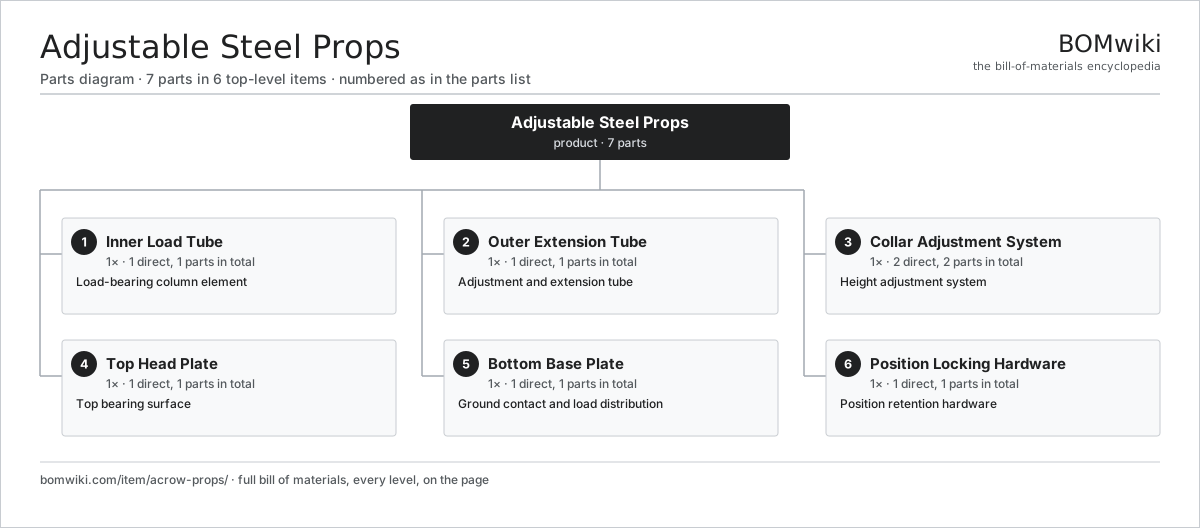
| # | Part | Qty | What it does |
|---|---|---|---|
| 1 | Inner Load Tube 1 parts | 1× | Load-bearing column element |
| 2 | Outer Extension Tube 1 parts | 1× | Adjustment and extension tube |
| 3 | Collar Adjustment System 2 parts | 1× | Height adjustment system |
| 4 | Top Head Plate 1 parts | 1× | Top bearing surface |
| 5 | Bottom Base Plate 1 parts | 1× | Ground contact and load distribution |
| 6 | Position Locking Hardware 1 parts | 1× | Position retention hardware |
3D model
No 3D model yet. Have a CAD file of this? Add a 3D model. STL renders right on this page; STEP, FreeCAD, and OpenSCAD sources are welcome too (openly licensed, like all 3D models on BOMwiki).
Build & assembly graph
expand / collapse · shared sub-assemblies converge · links to related products · est. labourTap an assembly to expand/collapse · tap a part to open it · use “Open page” for any node · drag to pan, scroll to zoom.
Bill of materials for Adjustable Steel Props
6 top-level lines · 13 rows shown · 7 parts total · indented to 3 levels| # | Item / sub-assembly | Part no. | Qty/assy | Ext. qty | Parts | Type |
|---|---|---|---|---|---|---|
| 1 | Inner Load Tube 1 parts | acrow-props-inner-tube | 1× | 1 | 1 | assembly |
| 1.1 | Steel Column Tube | acrow-props-tube-material | 1× | 1 | · | part |
| 2 | Outer Extension Tube 1 parts | acrow-props-outer-tube | 1× | 1 | 1 | assembly |
| 2.1 | Extension Column Tube | acrow-props-extension-tube | 1× | 1 | · | part |
| 3 | Collar Adjustment System 2 parts | acrow-props-collar-mechanism | 1× | 1 | 2 | assembly |
| 3.1 | Adjustment Collar | acrow-props-threaded-collar | 1× | 1 | · | part |
| 3.2 | Coarse Position Pins | acrow-props-locking-pins | 1× | 1 | · | part |
| 4 | Top Head Plate 1 parts | acrow-props-head-plate | 1× | 1 | 1 | assembly |
| 4.1 | Head Bearing Plate | acrow-props-head-bearing | 1× | 1 | · | part |
| 5 | Bottom Base Plate 1 parts | acrow-props-base-plate | 1× | 1 | 1 | assembly |
| 5.1 | Base Bearing Plate | acrow-props-base-bearing | 1× | 1 | · | part |
| 6 | Position Locking Hardware 1 parts | acrow-props-locking-system | 1× | 1 | 1 | assembly |
| 6.1 | Safety Locking Clips | acrow-props-safety-clips | 1× | 1 | · | part |
Something wrong in this list? Report a problem with this BOM.
Sourcing: possible vendors
Browse the supplier directory → Prices, MOQ, and lead times are algorithmic estimates, not quotes, and not claims about these companies. Company mappings are curated by keyword; est. price band $15k–$2M. How estimates work| Vendor | HQ | Specialty | MOQ | Lead time |
|---|---|---|---|---|
| caterpillar.com ↗ | Irving, US | Construction & mining equipment | made to order | 16–28 wks |
|
🇯🇵Komatsu
komatsu.com ↗
|
Tokyo, JP | Construction & mining equipment | made to order | 16–28 wks |
|
🇸🇪Volvo CE
volvoce.com ↗
|
Gothenburg, SE | Construction equipment | made to order | 16–28 wks |
|
🇨🇭Liebherr
liebherr.com ↗
|
Bulle, CH | Cranes & heavy equipment | made to order | 16–28 wks |
|
🇨🇳XCMG
xcmg.com ↗
|
Xuzhou, CN | Construction machinery | made to order | 16–28 wks |
1,591-word article