Adaptive Optics System
ProductOverview
Adaptive optics (AO) is a technique that corrects atmospheric wavefront distortion in real-time, achieving diffraction-limited (or near-diffraction-limited) imaging from ground-based telescopes. Without AO, atmospheric turbulence (seeing) blurs images to ~0.5 arcsecond resolution, far below the telescope's diffraction limit. With AO, large telescopes achieve 0.02–0.1 arcsecond resolution, matching space observatories.
The Adaptive Optics System senses wavefront distortion at kHz rates and commands a Deformable Mirror to apply real-time corrective phase, canceling turbulence before light reaches the science camera. AO is essential for exoplanet imaging, stellar spectroscopy, and galactic-center observations.
How it works
Wavefront Sensing
The Wavefront Sensor analyzes incoming light to measure wavefront tilt and higher-order aberrations (defocus, astigmatism, spherical aberration, etc.). The most common design is a Shack-Hartmann sensor:
A Lenslet Array, a 37×37 to 88×88 grid of tiny lenses, subdivides the telescope pupil into 1000s of "subapertures." Each lenslet focuses light from its subaperture onto a high-speed CCD or sCMOS camera (100–1000 fps). A tilted wavefront shifts the focal spot position within each lenslet, revealing wavefront slope. The Sensor Optics relay optics ensure 1:1 magnification between the telescope pupil and the lenslet plane.
At each frame, the sensor camera records 1000s of spot positions, computing wavefront slopes in x and y at each subaperture. Zernike polynomial fitting reconstructs the full 2D wavefront phase map.
Deformable Mirror Correction
The Deformable Mirror is a thin optical surface supported by 37–1600 piezoelectric or electrostatic actuators arranged in a grid. Each actuator can deflect the mirror surface by ±50 µm, introducing phase corrections up to ±λ across the optical beam.
The Real-Time Controller FPGA receives wavefront slopes from the sensor, computes optimal actuator voltages to flatten the wavefront, and commands the mirror at 100–500 Hz. The closed-loop correction reduces atmospheric phase errors from ~5–10 microns RMS to ~50–100 nm RMS, approaching diffraction limit.
Laser Guide Star
Natural stars (e.g., a bright star in the field) suffice for sensing if one is nearby. However, for arbitrary sky regions, a Laser Guide Star artificial reference is needed. A sodium or UV laser projects a bright point toward the sky, exciting sodium atoms (sodium D lines, 589 nm) or Rayleigh-scattering air molecules (355 nm). The laser launch telescope collimates the beam, and the sky returns scattered light as a quasi-stellar source for AO sensing.
Laser-guide-star AO enables observations anywhere on the sky, not just near bright stars. The tradeoff: laser-generated spots have angular extent and elongation effects (parallax, non-common-path aberrations) that reduce AO performance compared to point-source natural guide stars.
Optical Bench Integration
The entire AO system, Optical Bench, must maintain precise optical alignment. The optical bench is a 1–2 m precision-ground granite or aluminum table. 3-point kinematic mounts hold the Deformable Mirror, Dichroic Beamsplitter, and Wavefront Sensor in fixed conjugate planes.
The Dichroic Beamsplitter separates guide-star light (for wavefront sensing) from science light (for imaging). A dichroic mirror reflects, say, 589 nm sodium light to the wavefront sensor while transmitting longer wavelengths to the science instrument. This allows simultaneous sensing and imaging without chromatic aberration.
Vibration Isolation
Mechanical vibrations from the telescope structure or wind must not jitter the AO optical bench. The Vibration Isolation subsystem isolates the bench from structural vibration via:
- Passive isolation: air springs or elastomer isolation platforms attenuating vibrations >5 Hz.
- Active damping: accelerometers detect residual vibration; a servo loop applies corrective forces (via piezo pushers or voice-coil actuators), canceling low-frequency disturbances (<10 Hz).
AO Performance Metrics
Strehl ratio: the ratio of peak intensity in an AO-corrected point-spread function (PSF) to the diffraction-limited PSF. Strehl 0.4–0.8 is typical for ground-based AO; space telescopes achieve Strehl >0.9.
Residual wavefront error (RMS): typical ~50–150 nm after correction. The Deformable Mirror has finite stroke and actuator density, limiting correction to frequencies <~500 Hz and spatial scales >2–3 actuator spacings.
Angular resolution: diffraction limit θ ~ λ/D. For a 10 m telescope at 1 µm wavelength, diffraction limit is ~20 mas (milliarcseconds). With AO, achieving Strehl >0.5 at 1 µm requires wavefront error <λ/10 (~100 nm).
Science Applications
- Exoplanet imaging: contrasting planets 10⁻⁶–10⁻⁹ times the star's brightness; requires Strehl >0.7.
- Spectroscopy of crowded fields: stellar kinematics in galactic nuclei.
- Adaptive secondary mirrors: some large telescopes replace the primary mirror with an AO system integrated into the secondary, achieving full-aperture correction.
Calibration
The Calibration Optics (internal flat mirror and reticle) allow closed-loop characterization without sky observations: introducing known phase patterns (via the reticle) and measuring sensor response, engineers tune the Real-Time Controller gains and modal reconstructor matrix. This ensures stable feedback and optimal correction before on-sky use.
Adaptive Optics System parts and their functions
8 top-level parts · 35 parts in total · full bill of materials below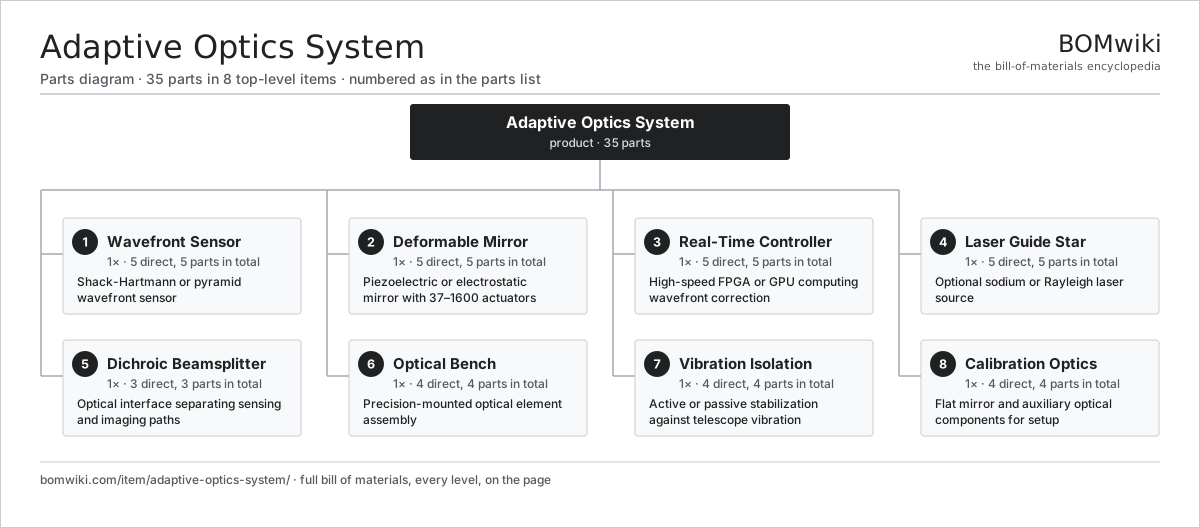
| # | Part | Qty | What it does |
|---|---|---|---|
| 1 | Wavefront Sensor 5 parts | 1× | Shack-Hartmann or pyramid wavefront sensor |
| 2 | Deformable Mirror 5 parts | 1× | Piezoelectric or electrostatic mirror with 37–1600 actuators |
| 3 | Real-Time Controller 5 parts | 1× | High-speed FPGA or GPU computing wavefront correction |
| 4 | Laser Guide Star 5 parts | 1× | Optional sodium or Rayleigh laser source |
| 5 | Dichroic Beamsplitter 3 parts | 1× | Optical interface separating sensing and imaging paths |
| 6 | Optical Bench 4 parts | 1× | Precision-mounted optical element assembly |
| 7 | Vibration Isolation 4 parts | 1× | Active or passive stabilization against telescope vibration |
| 8 | Calibration Optics 4 parts | 1× | Flat mirror and auxiliary optical components for setup |
3D model
No 3D model yet. Have a CAD file of this? Add a 3D model. STL renders right on this page; STEP, FreeCAD, and OpenSCAD sources are welcome too (openly licensed, like all 3D models on BOMwiki).
Build & assembly graph
expand / collapse · shared sub-assemblies converge · links to related products · est. labourTap an assembly to expand/collapse · tap a part to open it · use “Open page” for any node · drag to pan, scroll to zoom.
Bill of materials for Adaptive Optics System
8 top-level lines · 43 rows shown · 35 parts total · indented to 3 levels| # | Item / sub-assembly | Part no. | Qty/assy | Ext. qty | Parts | Type |
|---|---|---|---|---|---|---|
| 1 | Wavefront Sensor 5 parts | adaptive-optics-wavefront-sensor | 1× | 1 | 5 | assembly |
| 1.1 | Sensor Camera | adaptive-optics-sensor-camera | 1× | 1 | · | part |
| 1.2 | Lenslet Array | adaptive-optics-lenslet-array | 1× | 1 | · | part |
| 1.3 | Sensor Optics | adaptive-optics-sensor-optics | 1× | 1 | · | part |
| 1.4 | Sensor Filter | adaptive-optics-sensor-filter | 1× | 1 | · | part |
| 1.5 | Power Supply | power-supply | 1× | 1 | · | part |
| 2 | Deformable Mirror 5 parts | adaptive-optics-deformable-mirror | 1× | 1 | 5 | assembly |
| 2.1 | Mirror Substrate | adaptive-optics-mirror-substrate | 1× | 1 | · | part |
| 2.2 | Actuator Array | adaptive-optics-actuator-array | 1× | 1 | · | part |
| 2.3 | Mirror Backing | adaptive-optics-mirror-backing | 1× | 1 | · | part |
| 2.4 | Mirror Connector | adaptive-optics-mirror-connector | 1× | 1 | · | part |
| 2.5 | Power Supply | power-supply | 1× | 1 | · | part |
| 3 | Real-Time Controller 5 parts | adaptive-optics-real-time-controller | 1× | 1 | 5 | assembly |
| 3.1 | FPGA Card | adaptive-optics-fpga-card | 1× | 1 | · | part |
| 3.2 | GPU Accelerator | adaptive-optics-gpu-accelerator | 1× | 1 | · | part |
| 3.3 | Wavefront Software | adaptive-optics-wavefront-software | 1× | 1 | · | part |
| 3.4 | Memory Module | adaptive-optics-memory-ddr4 | 1× | 1 | · | part |
| 3.5 | Power Supply | power-supply | 1× | 1 | · | part |
| 4 | Laser Guide Star 5 parts | adaptive-optics-laser-guide-star | 1× | 1 | 5 | assembly |
| 4.1 | Laser Source | adaptive-optics-laser-source | 1× | 1 | · | part |
| 4.2 | Laser Projection | adaptive-optics-laser-projection-optics | 1× | 1 | · | part |
| 4.3 | Laser Safeguard | adaptive-optics-laser-safeguard | 1× | 1 | · | part |
| 4.4 | Laser Cooling | adaptive-optics-laser-cooling | 1× | 1 | · | part |
| 4.5 | Power Supply | power-supply | 1× | 1 | · | part |
| 5 | Dichroic Beamsplitter 3 parts | adaptive-optics-dichroic-beamsplitter | 1× | 1 | 3 | assembly |
| 5.1 | Dichroic Coating | adaptive-optics-dichroic-coating | 1× | 1 | · | part |
| 5.2 | Beamsplitter Mount | adaptive-optics-beamsplitter-mount | 1× | 1 | · | part |
| 5.3 | Optical Adhesive | adaptive-optics-optical-adhesive | 1× | 1 | · | part |
| 6 | Optical Bench 4 parts | adaptive-optics-optical-bench | 1× | 1 | 4 | assembly |
| 6.1 | Bench Baseplate | adaptive-optics-bench-baseplate | 1× | 1 | · | part |
| 6.2 | Kinematic Mounts | adaptive-optics-kinematic-mounts | 1× | 1 | · | part |
| 6.3 | Flexure Supports | adaptive-optics-flexure-supports | 1× | 1 | · | part |
| 6.4 | Mirror Holders | adaptive-optics-mirror-holders | 1× | 1 | · | part |
| 7 | Vibration Isolation 4 parts | adaptive-optics-vibration-isolation | 1× | 1 | 4 | assembly |
| 7.1 | Isolation Table | adaptive-optics-isolation-table | 1× | 1 | · | part |
| 7.2 | Servo Damper | adaptive-optics-servo-damper | 1× | 1 | · | part |
| 7.3 | Accelerometer Sensor | adaptive-optics-accelerometer-sensor | 1× | 1 | · | part |
| 7.4 | Power Supply | power-supply | 1× | 1 | · | part |
| 8 | Calibration Optics 4 parts | adaptive-optics-calibration-optics | 1× | 1 | 4 | assembly |
| 8.1 | Flat Mirror | adaptive-optics-flat-mirror | 1× | 1 | · | part |
| 8.2 | Calibration Reticle | adaptive-optics-calibration-reticle | 1× | 1 | · | part |
| 8.3 | Calibration Selector | adaptive-optics-calibration-selector | 1× | 1 | · | part |
| 8.4 | Fastener Set | fastener-set | 1× | 1 | · | part |
Something wrong in this list? Report a problem with this BOM.
Related products
same domain, ranked by shared parts Camera Motion Control Rig
210 parts · shares 1 with this page
Camera Motion Control Rig
210 parts · shares 1 with this page
 Digital Cinema Camera
305 parts · shares 1 with this page
Digital Cinema Camera
305 parts · shares 1 with this page
 Document Camera
247 parts · shares 1 with this page
Document Camera
247 parts · shares 1 with this page
 High-Speed Camera
183 parts · shares 1 with this page
High-Speed Camera
183 parts · shares 1 with this page
 Industrial 3D Scanner
149 parts · shares 1 with this page
Industrial 3D Scanner
149 parts · shares 1 with this page
 Laser Tracker
142 parts · shares 1 with this page
Laser Tracker
142 parts · shares 1 with this page
Sourcing: possible vendors
Browse the supplier directory → Prices, MOQ, and lead times are algorithmic estimates, not quotes, and not claims about these companies. Company mappings are curated by keyword; est. price band $100–$8k. How estimates work| Vendor | HQ | Specialty | MOQ | Lead time |
|---|---|---|---|---|
|
🇯🇵Canon
canon.com ↗
|
Tokyo, JP | Imaging & optics | 500 units | 10–16 wks |
|
🇯🇵Nikon
nikon.com ↗
|
Tokyo, JP | Imaging & optics | 500 units | 10–16 wks |
|
🇩🇪ZEISS
zeiss.com ↗
|
Oberkochen, DE | Optics & optoelectronics | 500 units | 10–16 wks |
| leica-camera.com ↗ | Wetzlar, DE | Cameras & optics | 500 units | 10–16 wks |
| flir.com ↗ | Wilsonville, US | Thermal imaging | 500 units | 10–16 wks |
860-word article