Adjustable Kettlebell
ProductOverview
An adjustable kettlebell condenses five or six fixed bells into one body. The user lifts a permanent Handle and Core Unit, handle, central mast, and a fixed core mass, and a dial decides how many of the surrounding Nested Shell Set segments come along. A common range is 3.5 to 18 kg in five steps; heavier competition-style versions reach 36 kg. Unlike plate-loaded screw-collar kettlebells, a selectorized bell changes weight in about two seconds and keeps a sealed, swing-safe exterior at every setting.
The governing requirement is ballistic loading. A kettlebell is snatched and swung, so peak handle forces reach 3–4 times the static weight at the bottom of a swing. Every captured shell must be positively locked, not friction-held, and nothing may rattle loose at the top of a snatch. This is why the mechanism uses rotating lugs under machined ledges rather than the hook-and-tab engagement found in adjustable dumbbells.
Geometry
The body diameter is fixed at roughly 220–240 mm whatever the setting, because the outer shell is always present in form even when its mass is deselected on some designs, or because deselected shells simply remain on the base on others. The handle is cast with a 33–38 mm grip and a window large enough for two-handed swings. One compromise is unavoidable: at light settings the bell is the size of a heavy bell, so it sits differently in the racked position than a small fixed kettlebell would. Horn Pad inserts keep the shells from clacking against the handle horns during cleans.
Selection mechanism
Turning the top-mounted Selection Dial rotates the Cam Shaft running down the Central Mast. The shaft carries one Lock Lug Tier per shell at staggered angular offsets. At the minimum setting every lug sits clear of its Shell Lock Ledge; each click of the Detent Ring swings one more tier of lugs under its ledge, capturing that shell. Because the lugs are staggered, a single shaft rotation engages shells strictly from the inside out, the mechanism cannot capture shell 3 without shells 1 and 2, which keeps the mass distribution symmetric and the centre of gravity on the bell axis.
The load path under swing forces runs from shell ledge, through the lug, into the cam shaft and mast, and up into the handle casting. The dial and its Coil Spring detents only position the shaft; they never carry weight.
Lock and base
The Engagement Lock makes mid-swing release mechanically impossible rather than merely unlikely. A spring-loaded Lock Pawl sits in the detent ring at all times; it withdraws only when the Lock Release Button is actuated, and on base-interlocked models the button itself is enabled by a Base Sense Pin that is depressed only while the bell sits on its Docking Base. Lifted, the dial is frozen.
The Base Plate does the quiet precision work. Each deselected shell drops onto a Shell Guide Rib rib that holds it concentric and clocked so its ledge faces the lugs correctly. When the user lowers the core back in and turns the dial, the lugs must find every ledge within a couple of degrees of rotation, base alignment tolerance is what separates a smooth product from one that needs jiggling. Rubber Base Foot pads keep the tray put when the bell is docked hard after a final rep.
Shells
Each Weight Shell is a cast-iron or steel segment, machined on its ledge face and often powder-coated. A polymer Shell Liner sits between neighbours so the stack is silent under impact; rattle is the first complaint on worn units. The current setting reads through the Shell Cutaway Window on the Weight Scale Window, visible from the racked position.
Failure modes
Drops are the killer. The mechanism tolerates swings but not concrete: a fall from chest height can crack lug tiers or shift the cam shaft timing so lugs no longer align with all ledges. Detent springs and the lock pawl are the routine wear parts, and grit between shells degrades nesting. Manufacturers rate these bells for controlled lowering only, and most service kits consist of the cam shaft, springs, and a Fastener Set for the mast, the cast shells essentially never wear out.
Adjustable Kettlebell parts and their functions
6 top-level parts · 47 parts in total · full bill of materials below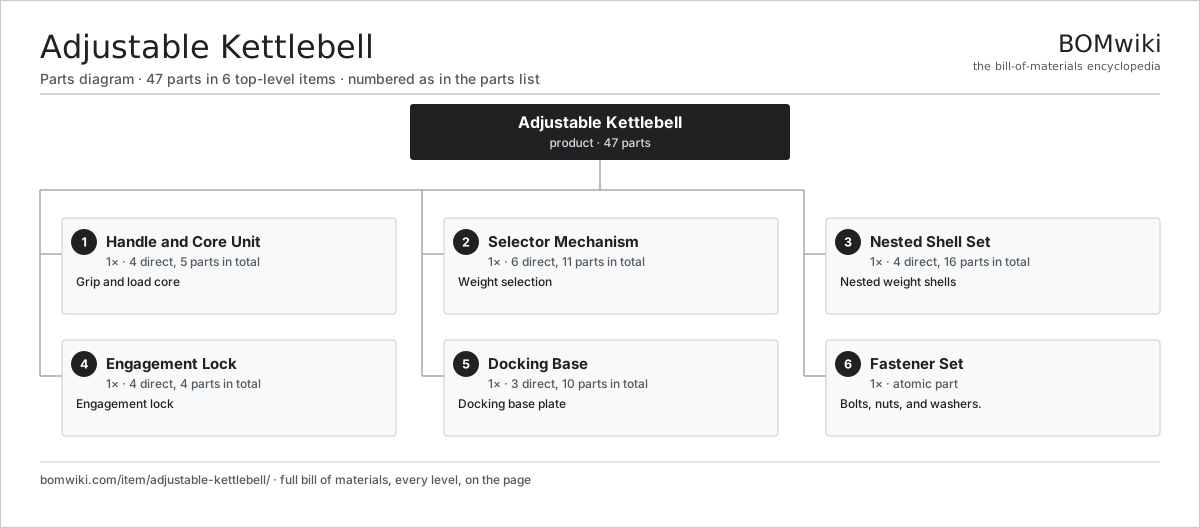
| # | Part | Qty | What it does |
|---|---|---|---|
| 1 | Handle and Core Unit 4 parts | 1× | Grip and load core |
| 2 | Selector Mechanism 6 parts | 1× | Weight selection |
| 3 | Nested Shell Set 4 parts | 1× | Nested weight shells |
| 4 | Engagement Lock 4 parts | 1× | Engagement lock |
| 5 | Docking Base 3 parts | 1× | Docking base plate |
| 6 | Fastener Set | 1× | Bolts, nuts, and washers. |
3D model
No 3D model yet. Have a CAD file of this? Add a 3D model. STL renders right on this page; STEP, FreeCAD, and OpenSCAD sources are welcome too (openly licensed, like all 3D models on BOMwiki).
Build & assembly graph
expand / collapse · shared sub-assemblies converge · links to related products · est. labourTap an assembly to expand/collapse · tap a part to open it · use “Open page” for any node · drag to pan, scroll to zoom.
Bill of materials for Adjustable Kettlebell
6 top-level lines · 27 rows shown · 47 parts total · indented to 3 levels| # | Item / sub-assembly | Part no. | Qty/assy | Ext. qty | Parts | Type |
|---|---|---|---|---|---|---|
| 1 | Handle and Core Unit 4 parts | adjustable-kettlebell-handle-core | 1× | 1 | 5 | assembly |
| 1.1 | Kettlebell Handle | adjustable-kettlebell-handle | 1× | 1 | · | part |
| 1.2 | Central Mast | adjustable-kettlebell-mast | 1× | 1 | · | part |
| 1.3 | Core Weight | adjustable-kettlebell-core-weight | 1× | 1 | · | part |
| 1.4 | Horn Pad | adjustable-kettlebell-horn-pad | 2× | 2 | · | part |
| 2 | Selector Mechanism 6 parts | adjustable-kettlebell-selector-mech | 1× | 1 | 11 | assembly |
| 2.1 | Selection Dial | adjustable-kettlebell-dial | 1× | 1 | · | part |
| 2.2 | Cam Shaft | adjustable-kettlebell-cam-shaft | 1× | 1 | · | part |
| 2.3 | Lock Lug Tier | adjustable-kettlebell-lug-tier | 5× | 5 | · | part |
| 2.4 | Detent Ring | adjustable-kettlebell-detent-ring | 1× | 1 | · | part |
| 2.5 | Coil Spring | coil-spring | 2× | 2 | · | part |
| 2.6 | Weight Scale Window | adjustable-kettlebell-weight-scale | 1× | 1 | · | part |
| 3 | Nested Shell Set 4 parts | adjustable-kettlebell-shell-set | 1× | 1 | 16 | assembly |
| 3.1 | Weight Shell | adjustable-kettlebell-shell | 5× | 5 | · | part |
| 3.2 | Shell Lock Ledge | adjustable-kettlebell-shell-ledge | 5× | 5 | · | part |
| 3.3 | Shell Liner | adjustable-kettlebell-shell-liner | 5× | 5 | · | part |
| 3.4 | Shell Cutaway Window | adjustable-kettlebell-shell-window | 1× | 1 | · | part |
| 4 | Engagement Lock 4 parts | adjustable-kettlebell-lock | 1× | 1 | 4 | assembly |
| 4.1 | Lock Release Button | adjustable-kettlebell-lock-button | 1× | 1 | · | part |
| 4.2 | Lock Pawl | adjustable-kettlebell-lock-pawl | 1× | 1 | · | part |
| 4.3 | Base Sense Pin | adjustable-kettlebell-base-pin | 1× | 1 | · | part |
| 4.4 | Coil Spring | coil-spring | 1× | 1 | · | part |
| 5 | Docking Base 3 parts | adjustable-kettlebell-base | 1× | 1 | 10 | assembly |
| 5.1 | Base Plate | adjustable-kettlebell-base-plate | 1× | 1 | · | part |
| 5.2 | Shell Guide Rib | adjustable-kettlebell-shell-guide | 5× | 5 | · | part |
| 5.3 | Base Foot | adjustable-kettlebell-base-foot | 4× | 4 | · | part |
| 6 | Fastener Set | fastener-set | 1× | 1 | · | part |
Something wrong in this list? Report a problem with this BOM.
Related products
same domain, ranked by shared parts Adjustable Dumbbell
113 parts · shares 1 with this page
Belt Squat Machine
49 parts · shares 1 with this page
Adjustable Dumbbell
113 parts · shares 1 with this page
Belt Squat Machine
49 parts · shares 1 with this page
 Climbing Auto-Belay
49 parts · shares 1 with this page
Hack Squat Machine
61 parts · shares 1 with this page
Climbing Auto-Belay
49 parts · shares 1 with this page
Hack Squat Machine
61 parts · shares 1 with this page
 Inversion Table
42 parts · shares 1 with this page
Inversion Table
42 parts · shares 1 with this page
 Leg Press Machine
54 parts · shares 1 with this page
Leg Press Machine
54 parts · shares 1 with this page
Sourcing: possible vendors
Browse the supplier directory → Prices, MOQ, and lead times are algorithmic estimates, not quotes, and not claims about these companies. Company mappings are curated by keyword; est. price band $100–$10k. How estimates work| Vendor | HQ | Specialty | MOQ | Lead time |
|---|---|---|---|---|
| lifefitness.com ↗ | Rosemont, US | Fitness equipment | 200 units | 8–14 wks |
| technogym.com ↗ | Cesena, IT | Fitness equipment | 200 units | 8–14 wks |
|
🇺🇸Peloton
onepeloton.com ↗
|
New York, US | Connected fitness | 200 units | 8–14 wks |
| johnsonhealthtech.com ↗ | Taichung, TW | Fitness (Matrix) | 200 units | 8–14 wks |
|
🇺🇸Precor
precor.com ↗
|
Woodinville, US | Fitness equipment | 200 units | 8–14 wks |
742-word article