Adjustable Weight Bench
ProductOverview
An adjustable weight bench supports a lifter's torso during pressing, rowing, and accessory exercises, and lets the back rest lock anywhere from a slight decline to nearly upright. The whole product is structural: there are no motors or electronics, only a steel Bench Frame, two upholstered pads, and a self-locking angle mechanism. Commercial benches are tested to EN ISO 20957 class S, which requires the structure to survive repeated loading well beyond the rated capacity; a typical rating is 270 kg for home units and 450–600 kg for gym units, counting both the user and the barbell.
The bench's geometry matters as much as its strength. The flat pad height sits around 430–450 mm so that a lifter can keep both feet planted while bench pressing, and the gap between the Seat Cushion and the Back Pad is kept as small as possible, since a large gap lets the hips sink during flat pressing.
Frame
The Bench Frame is a welded weldment of rectangular steel tube, usually 2–3 mm wall. A single Main Spine Rail runs the length of the bench in a tripod or T layout: the Front Foot Tube crosses under the seat and the wider Rear Stabilizer Foot sits under the head end, where incline pressing pushes the center of mass rearward. The Pivot Tower Bracket is welded near mid-span and carries the back pad's Main Pivot Pin in Pivot Bushing sleeves. Each foot ends in a Rubber Foot Cap of molded rubber so the bench grips the floor and does not mark it.
Ladder adjustment mechanism
The defining mechanism is the Ladder Adjustment Mechanism. A Ladder Rack of 6–10 round rungs is welded to the frame in an arc centered on the main pivot. Under the back pad, a hinged Swing Support Leg hangs from the Leg Pivot Joint; at its free end is the Catch Crossbar, a transverse bar that drops into whichever rung the user selects.
The geometry is self-energizing. User load on the back pad pushes the support leg into the rung, not out of it, so the joint cannot release under load, the lifter must first unload the pad, lift it slightly, and swing the leg to another rung. Each rung corresponds to a fixed angle, typically in 5–15° steps from −10° decline to about 85°. Because the catch bar simply rests in a half-round saddle, the mechanism has no springs, cables, or pins to fail; its only wear items are the Anti-Rattle Pad pads that keep the bar seated quietly. The same principle appears in deck chairs and is favored over pull-pin systems on benches because it adjusts in one motion and is impossible to leave half-engaged.
Pads and seat
The Back Pad Assembly sandwiches a High-Density Foam slab of 60–80 kg/m³ polyurethane between an 18 mm Pad Backing Board and a stapled Vinyl Cover cover. Foam in this density range compresses a few millimetres under a 100 kg lifter, firm enough that the shoulders stay stable under a barbell, soft enough for comfort. The board bolts to the steel Back Pad Carrier Frame, which is the member actually connecting pivot pin to support leg.
The Seat Pad Assembly tilts independently on its own Seat Pivot Pin, using a slotted Seat Adjustment Bracket with 3–4 detents. On steep inclines the seat is raised 15–30° so the lifter wedges into the corner between seat and back instead of sliding down the vinyl.
Decline attachment and transport
For decline pressing and sit-ups, a removable Leg Hold-Down Attachment slots into the front of the frame. Its Roller Post is cross-drilled for height settings retained by a Spring Pop-Pin, and a pair of dense Foam Roller cylinders clamp the user's ankles so the torso can hang head-down without sliding.
Since a stout bench weighs 25–45 kg, a Transport Kit kit is standard: two nylon Transport Wheel discs on a common Wheel Axle at the rear foot, and a Lift Handle at the front. Tilting the bench onto the wheels turns it into a hand truck for one-person moves.
Failure modes and maintenance
Benches fail at predictable points: vinyl seams split from sweat and abrasion, pivot bushings ovalize and introduce wobble, and welds at the pivot tower crack on units that see dropped dumbbells. Maintenance is minimal, periodic re-torque of the Fastener Set hardware, inspection of the catch bar saddles for peening, and replacement of foot caps once they harden. Pads are deliberately a bolt-off service item, since upholstery wears out long before the steel does.
Adjustable Weight Bench parts and their functions
7 top-level parts · 38 parts in total · full bill of materials below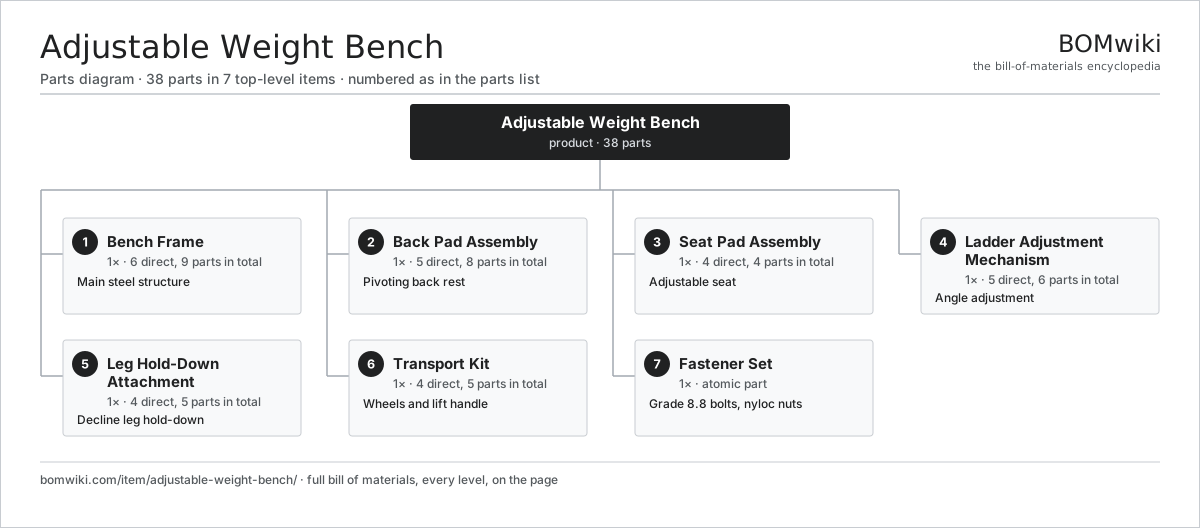
| # | Part | Qty | What it does |
|---|---|---|---|
| 1 | Bench Frame 6 parts | 1× | Main steel structure |
| 2 | Back Pad Assembly 5 parts | 1× | Pivoting back rest |
| 3 | Seat Pad Assembly 4 parts | 1× | Adjustable seat |
| 4 | Ladder Adjustment Mechanism 5 parts | 1× | Angle adjustment |
| 5 | Leg Hold-Down Attachment 4 parts | 1× | Decline leg hold-down |
| 6 | Transport Kit 4 parts | 1× | Wheels and lift handle |
| 7 | Fastener Set | 1× | Grade 8.8 bolts, nyloc nuts |
3D model
No 3D model yet. Have a CAD file of this? Add a 3D model. STL renders right on this page; STEP, FreeCAD, and OpenSCAD sources are welcome too (openly licensed, like all 3D models on BOMwiki).
Build & assembly graph
expand / collapse · shared sub-assemblies converge · links to related products · est. labourTap an assembly to expand/collapse · tap a part to open it · use “Open page” for any node · drag to pan, scroll to zoom.
Bill of materials for Adjustable Weight Bench
7 top-level lines · 38 rows shown · 38 parts total · indented to 3 levels| # | Item / sub-assembly | Part no. | Qty/assy | Ext. qty | Parts | Type |
|---|---|---|---|---|---|---|
| 1 | Bench Frame 6 parts | adjustable-weight-bench-frame | 1× | 1 | 9 | assembly |
| 1.1 | Main Spine Rail | adjustable-weight-bench-main-rail | 1× | 1 | · | part |
| 1.2 | Front Foot Tube | adjustable-weight-bench-front-foot | 1× | 1 | · | part |
| 1.3 | Rear Stabilizer Foot | adjustable-weight-bench-rear-foot | 1× | 1 | · | part |
| 1.4 | Pivot Tower Bracket | adjustable-weight-bench-pivot-tower | 1× | 1 | · | part |
| 1.5 | Rubber Foot Cap | adjustable-weight-bench-foot-cap | 4× | 4 | · | part |
| 1.6 | Sheet Metal Panel | sheet-panel | 1× | 1 | · | part |
| 2 | Back Pad Assembly 5 parts | adjustable-weight-bench-back-pad-assy | 1× | 1 | 8 | assembly |
| 2.1 | Back Pad 3 parts | adjustable-weight-bench-back-pad | 1× | 1 | 3 | assembly |
| 2.1.1 | Pad Backing Board | adjustable-weight-bench-pad-board | 1× | 1 | · | part |
| 2.1.2 | High-Density Foam | adjustable-weight-bench-pad-foam | 1× | 1 | · | part |
| 2.1.3 | Vinyl Cover | adjustable-weight-bench-pad-vinyl | 1× | 1 | · | part |
| 2.2 | Back Pad Carrier Frame | adjustable-weight-bench-back-carrier | 1× | 1 | · | part |
| 2.3 | Main Pivot Pin | adjustable-weight-bench-pivot-pin | 1× | 1 | · | part |
| 2.4 | Pivot Bushing | adjustable-weight-bench-pivot-bushing | 2× | 2 | · | part |
| 2.5 | Fastener Set | fastener-set | 1× | 1 | · | part |
| 3 | Seat Pad Assembly 4 parts | adjustable-weight-bench-seat-pad-assy | 1× | 1 | 4 | assembly |
| 3.1 | Seat Cushion | adjustable-weight-bench-seat-pad | 1× | 1 | · | part |
| 3.2 | Seat Adjustment Bracket | adjustable-weight-bench-seat-bracket | 1× | 1 | · | part |
| 3.3 | Seat Pivot Pin | adjustable-weight-bench-seat-pin | 1× | 1 | · | part |
| 3.4 | Fastener Set | fastener-set | 1× | 1 | · | part |
| 4 | Ladder Adjustment Mechanism 5 parts | adjustable-weight-bench-ladder-mech | 1× | 1 | 6 | assembly |
| 4.1 | Ladder Rack | adjustable-weight-bench-ladder-rack | 1× | 1 | · | part |
| 4.2 | Swing Support Leg | adjustable-weight-bench-support-leg | 1× | 1 | · | part |
| 4.3 | Catch Crossbar | adjustable-weight-bench-catch-bar | 1× | 1 | · | part |
| 4.4 | Leg Pivot Joint | adjustable-weight-bench-leg-pivot | 1× | 1 | · | part |
| 4.5 | Anti-Rattle Pad | adjustable-weight-bench-anti-rattle | 2× | 2 | · | part |
| 5 | Leg Hold-Down Attachment 4 parts | adjustable-weight-bench-leg-roller | 1× | 1 | 5 | assembly |
| 5.1 | Roller Post | adjustable-weight-bench-roller-post | 1× | 1 | · | part |
| 5.2 | Foam Roller | adjustable-weight-bench-foam-roller | 2× | 2 | · | part |
| 5.3 | Spring Pop-Pin | adjustable-weight-bench-pop-pin | 1× | 1 | · | part |
| 5.4 | O-Ring Set | oring-set | 1× | 1 | · | part |
| 6 | Transport Kit 4 parts | adjustable-weight-bench-transport | 1× | 1 | 5 | assembly |
| 6.1 | Transport Wheel | adjustable-weight-bench-wheel | 2× | 2 | · | part |
| 6.2 | Wheel Axle | adjustable-weight-bench-axle | 1× | 1 | · | part |
| 6.3 | Lift Handle | adjustable-weight-bench-handle | 1× | 1 | · | part |
| 6.4 | Fastener Set | fastener-set | 1× | 1 | · | part |
| 7 | Fastener Set | fastener-set | 1× | 1 | · | part |
Something wrong in this list? Report a problem with this BOM.
Related products
same domain, ranked by shared parts Glute-Ham Developer
41 parts · shares 2 with this page
Curved Manual Treadmill
411 parts · shares 1 with this page
Push Sled
42 parts · shares 1 with this page
Glute-Ham Developer
41 parts · shares 2 with this page
Curved Manual Treadmill
411 parts · shares 1 with this page
Push Sled
42 parts · shares 1 with this page
 Anti-Gravity Treadmill
96 parts · shares 1 with this page
Anti-Gravity Treadmill
96 parts · shares 1 with this page
 Climbing Auto-Belay
49 parts · shares 1 with this page
Hydraulic Circuit Trainer
61 parts · shares 1 with this page
Climbing Auto-Belay
49 parts · shares 1 with this page
Hydraulic Circuit Trainer
61 parts · shares 1 with this page
Sourcing: possible vendors
Browse the supplier directory → Prices, MOQ, and lead times are algorithmic estimates, not quotes, and not claims about these companies. Company mappings are curated by keyword; est. price band $100–$10k. How estimates work| Vendor | HQ | Specialty | MOQ | Lead time |
|---|---|---|---|---|
| lifefitness.com ↗ | Rosemont, US | Fitness equipment | 200 units | 8–14 wks |
| technogym.com ↗ | Cesena, IT | Fitness equipment | 200 units | 8–14 wks |
|
🇺🇸Peloton
onepeloton.com ↗
|
New York, US | Connected fitness | 200 units | 8–14 wks |
| johnsonhealthtech.com ↗ | Taichung, TW | Fitness (Matrix) | 200 units | 8–14 wks |
|
🇺🇸Precor
precor.com ↗
|
Woodinville, US | Fitness equipment | 200 units | 8–14 wks |
855-word article