Aerial Silk Rig
ProductOverview
An aerial silk rig is a portable apparatus for aerial acrobatics using long fabric lengths suspended from a tensioned frame. Unlike the flying trapeze, which uses rigid bars, aerial silks rely on the performer wrapping and climbing the fabric itself, executing drops, spirals, and sustained poses through body tension and friction. The standard configuration uses two parallel silk lengths suspended from a central apex, suspended above foam crash padding.
The rig balances portability with safety and rigidity. The A-frame structure weighs 400–800 lbs and disassembles into transportable sections. The silks themselves are lightweight nylon or specialty blend, chosen for grip and durability. The swivel hardware at the apex rotates freely, allowing the silks to spin with the performer's momentum without twisting and tangling. Guy-line anchors and tensioners stabilize the frame against sway, critical for control during delicate poses.
How it works
Frame Assembly and Stabilization. The A-Frame Structure consists of two angled legs forming an A-shape, cross-braced for rigidity and fitted with spreading feet. In pre-rigging, the legs are positioned vertical (standing on feet) or angled (leaning, using tensioners). The frame must be level and plumb; even slight tilt affects silk alignment and performer safety. Stabilizer Guy Line guy-lines from mid-frame to ground anchors prevent lateral sway as the performer moves.
Silk Suspension and Attachment. Each Silk Pair element, two continuous lengths of nylon, is threaded through the Apex Fitting hub at the top of the frame. The threads or grommets at each silk's end pass through a Connector Ring, which connects to the swivel hardware via carabiners. The Swivel Ball Joint bearing allows the silks to rotate independently, spinning at high speed without tangling.
Performer Interaction. The performer gathers one or both silks and wraps them around their body (typically legs or torso), creating friction that supports their weight. As they climb higher, they advance their grip up the silk, folding the fabric under their arms or between their legs. Descent is controlled by gradually releasing wraps, allowing the silk to slip at a rate the performer manages with friction. The figure-8 or spacing hardware keeps the two silks separated, preventing them from forming a twisted knot around the performer.
Force Distribution and Safety. Load from the performer is distributed across the apex hardware and frame. The Suspension Hardware components, swivels, carabiners, shackles, share load symmetrically between the two silks. If one silk slips or tears, the Safety Cable backup line arrests motion. The Crash Mat System beneath absorbs impact from drops or slips at lower altitudes.
Material and Durability
Aerial silk is typically 100% nylon ripstop, chosen for its grip characteristics and resistance to abrasion from performer hands and legs. Some rigs use silk-nylon blends or specialized aerial fabrics. Griping (hand friction) gradually threads the nylon, weakening it; commercial rigs expect 2–3 year lifespans before replacement. UV exposure degrades nylon; silks used outdoors degrade faster.
The Connector Ring and rigging hardware are stainless steel or hot-dip galvanized to resist corrosion, especially in outdoor or humid venues. The Figure-Eight Hardware spacer must rotate freely and be inspected for bearing wear quarterly.
Training and Technique
Aerial silk instruction typically begins with body awareness and grip training at lower heights (8–12 feet) before progressing to full apparatus height. Students learn wrapping techniques (leg wrap, hip wrap, chest wrap), climbs, and controlled drops. Inversion and sustained poses require significant grip strength and body control. Typical training progression is 6–12 months to basic proficiency; advanced acrobatics (flips, synchronized partnerships) require years of practice.
Installation and Teardown
Setup of a portable aerial silk rig takes 2–4 hours: frame assembly, silk threading, rigging check, anchor tensioning, and mat deployment. Takedown takes 1–2 hours. The apparatus must be inspected visually before each session: silks checked for tears, rivets and stitching examined, all hardware torqued and lock-pinned. The swivel bearing is lubricated with light machine oil every 50 hours of use.
Aerial Silk Rig parts and their functions
7 top-level parts · 60 parts in total · full bill of materials below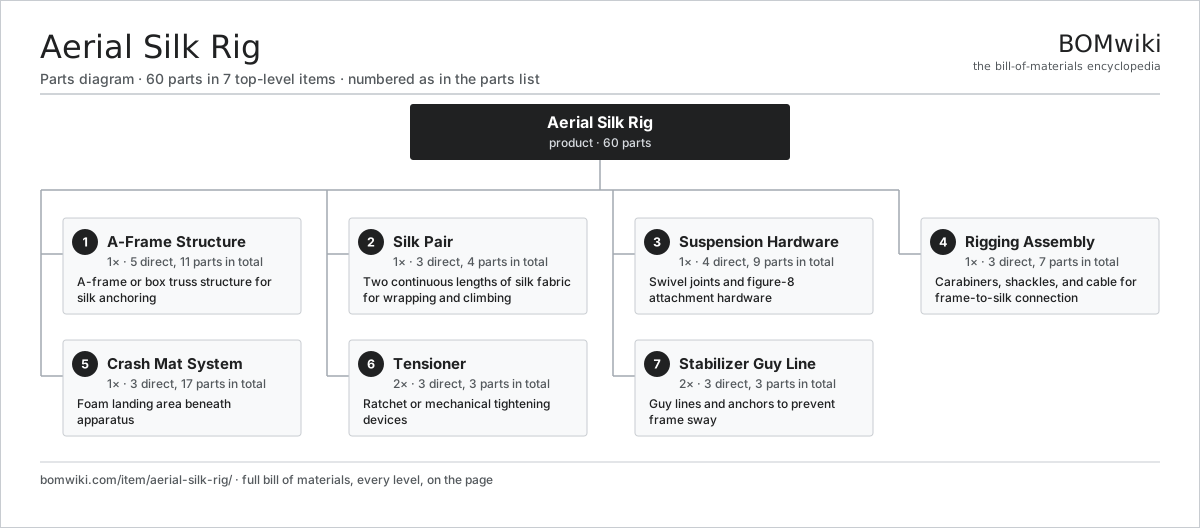
| # | Part | Qty | What it does |
|---|---|---|---|
| 1 | A-Frame Structure 5 parts | 1× | A-frame or box truss structure for silk anchoring |
| 2 | Silk Pair 3 parts | 1× | Two continuous lengths of silk fabric for wrapping and climbing |
| 3 | Suspension Hardware 4 parts | 1× | Swivel joints and figure-8 attachment hardware |
| 4 | Rigging Assembly 3 parts | 1× | Carabiners, shackles, and cable for frame-to-silk connection |
| 5 | Crash Mat System 3 parts | 1× | Foam landing area beneath apparatus |
| 6 | Tensioner 3 parts | 2× | Ratchet or mechanical tightening devices |
| 7 | Stabilizer Guy Line 3 parts | 2× | Guy lines and anchors to prevent frame sway |
3D model
No 3D model yet. Have a CAD file of this? Add a 3D model. STL renders right on this page; STEP, FreeCAD, and OpenSCAD sources are welcome too (openly licensed, like all 3D models on BOMwiki).
Build & assembly graph
expand / collapse · shared sub-assemblies converge · links to related products · est. labourTap an assembly to expand/collapse · tap a part to open it · use “Open page” for any node · drag to pan, scroll to zoom.
Bill of materials for Aerial Silk Rig
7 top-level lines · 31 rows shown · 60 parts total · indented to 3 levels| # | Item / sub-assembly | Part no. | Qty/assy | Ext. qty | Parts | Type |
|---|---|---|---|---|---|---|
| 1 | A-Frame Structure 5 parts | aerial-silk-rig-frame | 1× | 1 | 11 | assembly |
| 1.1 | Main Leg | aerial-silk-rig-main-leg | 2× | 2 | · | part |
| 1.2 | Cross Brace | aerial-silk-rig-cross-brace | 2× | 2 | · | part |
| 1.3 | Apex Fitting | aerial-silk-rig-apex-fitting | 1× | 1 | · | part |
| 1.4 | Foot Pad | aerial-silk-rig-foot-pad | 2× | 2 | · | part |
| 1.5 | Fastener Set | fastener-set | 4× | 4 | · | part |
| 2 | Silk Pair 3 parts | aerial-silk-rig-silk-pair | 1× | 1 | 4 | assembly |
| 2.1 | Silk Length A | aerial-silk-rig-silk-length-a | 1× | 1 | · | part |
| 2.2 | Silk Length B | aerial-silk-rig-silk-length-b | 1× | 1 | · | part |
| 2.3 | Silk Stitching | aerial-silk-rig-silk-stitching | 2× | 2 | · | part |
| 3 | Suspension Hardware 4 parts | aerial-silk-rig-hardware | 1× | 1 | 9 | assembly |
| 3.1 | Figure-Eight Hardware | aerial-silk-rig-figure-eight | 2× | 2 | · | part |
| 3.2 | Swivel Ball Joint | aerial-silk-rig-swivel-ball | 1× | 1 | · | part |
| 3.3 | Connector Ring | aerial-silk-rig-connector-ring | 4× | 4 | · | part |
| 3.4 | Ball Bearing | ball-bearing | 2× | 2 | · | part |
| 4 | Rigging Assembly 3 parts | aerial-silk-rig-rigging | 1× | 1 | 7 | assembly |
| 4.1 | Carabiner Set | aerial-silk-rig-carabiner-set | 4× | 4 | · | part |
| 4.2 | Shackle Set | aerial-silk-rig-shackle-set | 2× | 2 | · | part |
| 4.3 | Safety Cable | aerial-silk-rig-safety-cable | 1× | 1 | · | part |
| 5 | Crash Mat System 3 parts | aerial-silk-rig-crash-mat | 1× | 1 | 17 | assembly |
| 5.1 | Foam Block | aerial-silk-rig-mat-foam-block | 12× | 12 | · | part |
| 5.2 | Mat Cover | aerial-silk-rig-mat-cover | 1× | 1 | · | part |
| 5.3 | Mat Edging | aerial-silk-rig-mat-edging | 4× | 4 | · | part |
| 6 | Tensioner 3 parts | aerial-silk-rig-tensioner | 2× | 2 | 3 | assembly |
| 6.1 | Ratchet Winch | aerial-silk-rig-ratchet-winch | 1× | 2 | · | part |
| 6.2 | Tensioner Cable | aerial-silk-rig-tensioner-cable | 1× | 2 | · | part |
| 6.3 | Winch Mount | aerial-silk-rig-winch-mount | 1× | 2 | · | part |
| 7 | Stabilizer Guy Line 3 parts | aerial-silk-rig-stabilizer | 2× | 2 | 3 | assembly |
| 7.1 | Guy Rope | aerial-silk-rig-guy-rope | 1× | 2 | · | part |
| 7.2 | Ground Anchor | aerial-silk-rig-ground-anchor | 1× | 2 | · | part |
| 7.3 | Turnbuckle | aerial-silk-rig-turnbuckle | 1× | 2 | · | part |
Something wrong in this list? Report a problem with this BOM.
Sourcing: possible vendors
Browse the supplier directory → Prices, MOQ, and lead times are algorithmic estimates, not quotes, and not claims about these companies. Company mappings are curated by keyword; est. price band $20–$3k. How estimates work| Vendor | HQ | Specialty | MOQ | Lead time |
|---|---|---|---|---|
|
🇩🇰LEGO
lego.com ↗
|
Billund, DK | Construction toys | 2,000 units | 6–10 wks |
|
🇺🇸Mattel
mattel.com ↗
|
El Segundo, US | Toys | 2,000 units | 6–10 wks |
|
🇺🇸Hasbro
hasbro.com ↗
|
Pawtucket, US | Toys & games | 2,000 units | 6–10 wks |
| bandainamco.co.jp ↗ | Tokyo, JP | Toys & amusement | 2,000 units | 6–10 wks |
| spinmaster.com ↗ | Toronto, CA | Toys | 2,000 units | 6–10 wks |
691-word article