Aggregate Wash Plant
ProductOverview
An aggregate wash plant is a fixed or mobile processing system designed to upgrade raw quarry blast or dredge material into saleable aggregate by removing clay, silt, and other contaminants. Using a combination of high-frequency vibrating screens, spiral classifiers, and hydrocyclones, wash plants separate material by size while simultaneously removing fines via circulation of washwater. The end result is clean, well-graded aggregate meeting construction sand and gravel specifications. Production rates range from 50–200 tonnes per hour, and the system can accommodate raw feed with 30–60% clay content, reducing fines to below 3% in the final product. Wash plants are economically justified when:
- Raw material has excessive clay or silt (>15% fines)
- Quality specifications require <3% passing 75 microns
- Stockpile material must be upgraded before sale
- Processing blasting byproducts into sellable grades
Process Flow
Raw material from a feed conveyor is gravity-fed or belt-elevated to the top of the wash plant. The material lands on the first screening deck, a high-frequency vibrating screen that separates coarse aggregate (>10 mm) from fines and washwater. The coarse product discharges over the side for truck loading or stockpiling; the undersize material drops to the next deck.
The second deck further sizes material into 5–10 mm and 2–5 mm fractions. Material finer than 2 mm becomes a slurry and is sent to the spiral classifier, where a rotating screw transports material upward while washwater injected at the base washes away clay particles and silt. Coarser sand (100 microns to 2 mm) is efficiently washed and discharged from the spiral into a product hopper or conveyor.
The washwater now enriched with clay slurry is pumped to a bank of hydrocyclones that spin the slurry at high speed. Dense sand particles settle to the underflow and are sent to a dewatering screen for drying. Excess water and fine clays exit the cyclone overflow into a settling pond or clarifier where particles settle, allowing washwater to be recycled back to the water circulation pump.
The dewatering screen, a high-frequency vibrating deck with 1 mm mesh, removes surface moisture from washed sand product, bringing it to 5–12% moisture before discharge to a product belt conveyor or stockpile.
Wet Screening and Classification
The heart of the wash plant is its vibrating screen deck. These decks are typically inclined at 20–30°, with mesh opening sizes of 10 mm, 5 mm, and 2 mm selected based on market grades. The vibrator motor driving each deck oscillates the screen at 1200–1800 oscillations per minute, with 3–6 mm stroke amplitude. This frequency is fast enough to keep material moving downslope while preventing fine material from bridging across the mesh.
Mesh panels are replaceable polyurethane or rubber-coated wire. Polyurethane panels are preferred because they resist impact from sharp rock, last 6–12 months in heavy service, and reduce product degradation. Steel mesh is cheaper but wears faster and can break when struck by oversized boulders, causing unplanned downtime.
The spiral classifier is a passive washing device. As the material spirals upward, washwater jets injected at the tank base dislodge clay from particle surfaces. Hydrophilic clay adheres to fine quartz sand and is suspended in the water column, while denser sand particles settle and are mechanically advanced upward by the rotating screw. The spiral handles material finer than 2 mm efficiently without plugging, processing 5–15 tonnes per hour per meter of tank length.
Hydrocyclone Technology
Hydrocyclones are simple conical vessels exploiting centrifugal force to concentrate particles by density. Slurry is pumped into the cyclone tangentially at 1.5–2.5 bar, creating a vortex. Heavy sand particles (density 2.65 g/cm³) are pushed outward and downward to the underflow apex; light clay and silt (density 2.4–2.6 g/cm³) follow slower spiral paths upward and exit as overflow slurry.
Typical wash plants use 4–6 cyclones in parallel. Each cyclone processes 3–5 tonnes per hour, making a six-cyclone bank rated for 18–30 tonnes per hour of slurry. The slurry pump circulates this high-density feed at 15–25 bar through the cyclone manifold and back.
Cyclone efficiency improves with feed solids concentration (around 70% solids by weight) and inlet velocity (1.5–2 meters per second). If feed is too dilute, fine clays short-circuit through the overflow without settling. Experienced operators monitor cyclone pressure and adjust inlet pressure and water dilution to optimize separation.
Water Recirculation and Environmental Management
Most wash plants are designed to minimize freshwater consumption. Water exiting the cyclone overflow, laden with fine clay, is directed to a sump or lagoon where clay settles over 2–4 hours. Clear water from the lagoon is recycled by the circulation pump back to the washwater nozzles on the screens and spiral.
Typical freshwater makeup is 1–3 liters per tonne of processed material, far less than if all water were discarded. However, clay-rich ponds require regular sludge removal and disposal. Some modern plants employ separate dewatering screens for pond sludge, pressing slurry to 20–25% moisture before trucking off-site for landfill or construction fill.
Environmental regulations in most jurisdictions require that wash plant discharge water meet turbidity limits (typically <50 NTU, nephelometric turbidity units) and pH levels. Many plants now include level and pressure sensors that automatically shut down the circulation pump if pond depth exceeds safe limits, preventing overflow.
Power and Control
Conveyor motors (feed and discharge) typically run continuously at full speed, consuming 5–10 kW each. The screen vibrator motor is sized 7.5–15 kW depending on deck length and material hardness. The slurry pump is the largest consumer, requiring 10–20 kW to overcome 20 bar cyclone pressure and lift slurry.
Modern plants employ variable-frequency drives (VFDs) on motors, allowing operators to adjust:
- Feed rate: Varying conveyor speed matches raw material feed rate to wash plant capacity.
- Vibration intensity: Reducing screen vibration frequency for fragile aggregate, increasing it for dense stone.
- Cyclone pressure: Adjusting slurry pump speed optimizes separation without energy waste.
The control panel contains soft starters for each motor, overload protection, and pressure and level switches that interlock the system. An emergency stop button is required at the operator station, halting all equipment within 5 seconds per safety standards.
Product Specifications and Quality Control
Raw material with 40% fines (passing 75 microns) typically yields:
- 10 mm+ coarse: 25% (direct from screen)
- 5–10 mm sand: 35% (intermediate screen)
- 2–5 mm sand: 25% (fine screen + spiral)
- <2 mm fines (discarded or sold as fill): 15%
After washing and dewatering, product fines are typically <3%, meeting ISO 12103 "ISO Medium Sand" and ASTM C33 natural sand grades. Moisture content post-dewatering is 5–12%, acceptable for most applications (concrete requires <8% moisture).
Quality varies with washwater circulation efficiency and pond settling time. Plants with inadequate water recirculation or short sump residence time may discharge 5–10% fines, unsuitable for high-grade concrete. Increasing sump area or adding a secondary clarifier raises settling time and improves final sand grade.
Maintenance and Wear Items
Wash plants are rugged but face continuous wear:
- Mesh panels: Replaced every 6–12 months depending on rock type and operational hours.
- Cyclone liners: Rubber or ceramic liners protect the cone; replaced every 3–5 years or when erosion pits exceed 3 mm depth.
- Conveyor rollers: Bearings last 2–3 years in wet, dusty service; seals require quarterly re-greasing.
- Spiral flights: Bonded or welded to shaft; full spiral replacement every 5–7 years.
- Conveyor belts: Splice failure or cover wear necessitates replacement every 3–5 years; belt tracking adjustment is monthly.
Preventive maintenance includes monthly water recirculation tests (ensuring pond isn't bypassing settles), quarterly bearing re-greasing, annual screen mesh replacement, and biennial equipment paint and weld crack inspection.
Applications and Market Grades
Wash plants supply six primary markets:
- Concrete producers: Requiring <3% fines, ISO 12103 or C33 grading.
- Asphalt concrete plants: Needing 5–10 mm coarse aggregate and washed fines-free sand.
- Railway ballast: Dense, crushed aggregate washed free of clay dust.
- Fill and construction: Lower-grade products acceptable for compaction or building pad.
- Specialty applications: Glass manufacturing (high silica sand), foundry cores, fillers.
- Recycled aggregate: Wash plants also process demolished concrete, road millings, and asphalt RAP (reclaimed asphalt pavement).
A single wash plant configured for sand and gravel can supply a concrete batch plant, asphalt plant, and ready-mix distributor simultaneously, feeding 50–100 trucks per day in high-production regions.
Aggregate Wash Plant parts and their functions
9 top-level parts · 115 parts in total · full bill of materials below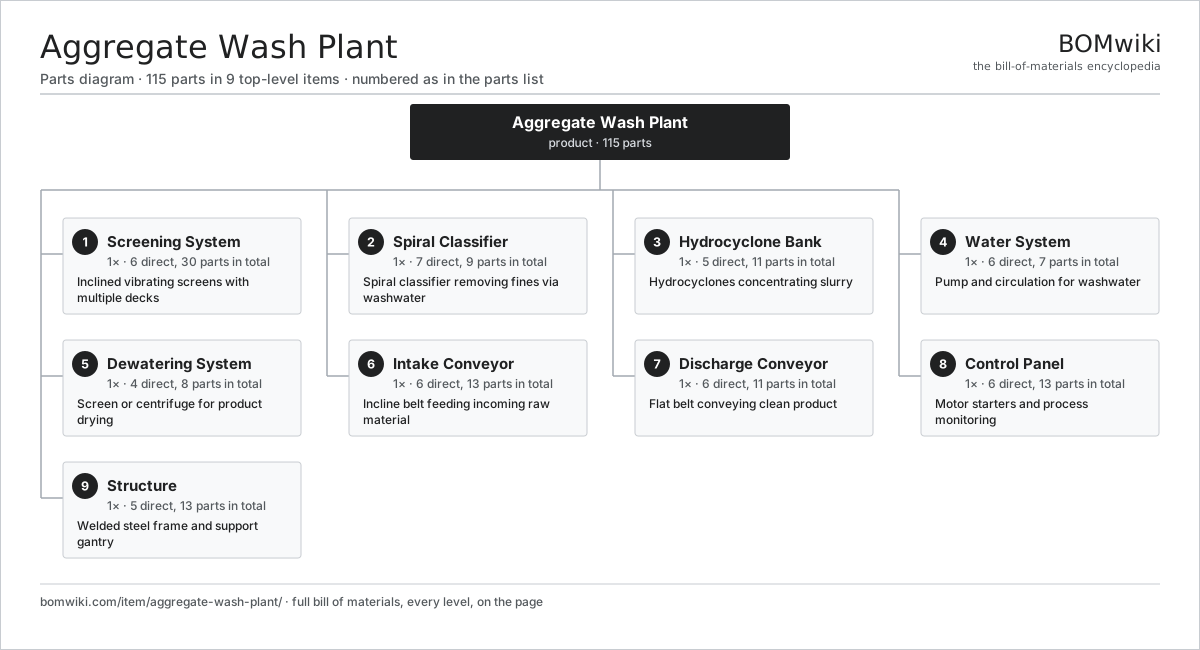
| # | Part | Qty | What it does |
|---|---|---|---|
| 1 | Screening System 6 parts | 1× | Inclined vibrating screens with multiple decks |
| 2 | Spiral Classifier 7 parts | 1× | Spiral classifier removing fines via washwater |
| 3 | Hydrocyclone Bank 5 parts | 1× | Hydrocyclones concentrating slurry |
| 4 | Water System 6 parts | 1× | Pump and circulation for washwater |
| 5 | Dewatering System 4 parts | 1× | Screen or centrifuge for product drying |
| 6 | Intake Conveyor 6 parts | 1× | Incline belt feeding incoming raw material |
| 7 | Discharge Conveyor 6 parts | 1× | Flat belt conveying clean product |
| 8 | Control Panel 6 parts | 1× | Motor starters and process monitoring |
| 9 | Structure 5 parts | 1× | Welded steel frame and support gantry |
3D model
No 3D model yet. Have a CAD file of this? Add a 3D model. STL renders right on this page; STEP, FreeCAD, and OpenSCAD sources are welcome too (openly licensed, like all 3D models on BOMwiki).
Build & assembly graph
expand / collapse · shared sub-assemblies converge · links to related products · est. labourTap an assembly to expand/collapse · tap a part to open it · use “Open page” for any node · drag to pan, scroll to zoom.
Bill of materials for Aggregate Wash Plant
9 top-level lines · 60 rows shown · 115 parts total · indented to 3 levels| # | Item / sub-assembly | Part no. | Qty/assy | Ext. qty | Parts | Type |
|---|---|---|---|---|---|---|
| 1 | Screening System 6 parts | aggregate-wash-plant-screening | 1× | 1 | 30 | assembly |
| 1.1 | Screen Frame | aggregate-wash-plant-screen-frame | 1× | 1 | · | part |
| 1.2 | Screen Deck | aggregate-wash-plant-screen-deck | 3× | 3 | · | part |
| 1.3 | Vibrator Motor | aggregate-wash-plant-vibrator-motor | 2× | 2 | · | part |
| 1.4 | Eccentric Bearing | aggregate-wash-plant-screen-bearing | 4× | 4 | · | part |
| 1.5 | Isolating Spring | aggregate-wash-plant-screen-spring | 8× | 8 | · | part |
| 1.6 | Mesh Panel | aggregate-wash-plant-mesh-panel | 12× | 12 | · | part |
| 2 | Spiral Classifier 7 parts | aggregate-wash-plant-spiral-washer | 1× | 1 | 9 | assembly |
| 2.1 | Spiral Tank | aggregate-wash-plant-spiral-tank | 1× | 1 | · | part |
| 2.2 | Spiral Shaft | aggregate-wash-plant-spiral-shaft | 1× | 1 | · | part |
| 2.3 | Spiral Flight | aggregate-wash-plant-spiral-blade | 2× | 2 | · | part |
| 2.4 | Spiral Drive Motor | aggregate-wash-plant-spiral-motor | 1× | 1 | · | part |
| 2.5 | Spiral Bearing | aggregate-wash-plant-spiral-bearing | 2× | 2 | · | part |
| 2.6 | Spiral Drive Coupling | aggregate-wash-plant-spiral-drive | 1× | 1 | · | part |
| 2.7 | Pressure Sensor | pressure-sensor | 1× | 1 | · | part |
| 3 | Hydrocyclone Bank 5 parts | aggregate-wash-plant-cyclone-bank | 1× | 1 | 11 | assembly |
| 3.1 | Cyclone Manifold | aggregate-wash-plant-cyclone-manifold | 1× | 1 | · | part |
| 3.2 | Hydrocyclone | aggregate-wash-plant-cyclone-unit | 4× | 4 | · | part |
| 3.3 | Cyclone Liner | aggregate-wash-plant-cyclone-liners | 4× | 4 | · | part |
| 3.4 | Sump Tank | aggregate-wash-plant-sump-tank | 1× | 1 | · | part |
| 3.5 | Centrifugal Pump | aggregate-wash-plant-centrifugal-pump | 1× | 1 | · | part |
| 4 | Water System 6 parts | aggregate-wash-plant-water-system | 1× | 1 | 7 | assembly |
| 4.1 | Water Supply Pump | aggregate-wash-plant-water-pump | 1× | 1 | · | part |
| 4.2 | Pipeline | aggregate-wash-plant-pipeline | 1× | 1 | · | part |
| 4.3 | Distribution Manifold | aggregate-wash-plant-distribution-manifold | 1× | 1 | · | part |
| 4.4 | Pressure Gauge | aggregate-wash-plant-pressure-gauge | 2× | 2 | · | part |
| 4.5 | Pressure Relief Valve | aggregate-wash-plant-pressure-regulator | 1× | 1 | · | part |
| 4.6 | Suction Strainer | aggregate-wash-plant-strainer | 1× | 1 | · | part |
| 5 | Dewatering System 4 parts | aggregate-wash-plant-dewatering | 1× | 1 | 8 | assembly |
| 5.1 | Dewatering Screen | aggregate-wash-plant-dewater-screen | 1× | 1 | · | part |
| 5.2 | Dewater Motor | aggregate-wash-plant-dewater-motor | 1× | 1 | · | part |
| 5.3 | Dewater Bearing | aggregate-wash-plant-dewater-bearing | 2× | 2 | · | part |
| 5.4 | Dewater Isolation Spring | aggregate-wash-plant-dewater-spring | 4× | 4 | · | part |
| 6 | Intake Conveyor 6 parts | aggregate-wash-plant-conveyor-intake | 1× | 1 | 13 | assembly |
| 6.1 | Conveyor Belt | aggregate-wash-plant-conveyor-belt | 1× | 1 | · | part |
| 6.2 | Conveyor Motor | aggregate-wash-plant-conveyor-motor | 1× | 1 | · | part |
| 6.3 | Conveyor Drive | aggregate-wash-plant-conveyor-drive | 1× | 1 | · | part |
| 6.4 | Conveyor Roller | aggregate-wash-plant-roller | 8× | 8 | · | part |
| 6.5 | Drive Belt | drive-belt | 1× | 1 | · | part |
| 6.6 | Conveyor Frame | aggregate-wash-plant-conveyor-frame | 1× | 1 | · | part |
| 7 | Discharge Conveyor 6 parts | aggregate-wash-plant-conveyor-discharge | 1× | 1 | 11 | assembly |
| 7.1 | Conveyor Belt | aggregate-wash-plant-conveyor-belt | 1× | 1 | · | part |
| 7.2 | Conveyor Motor | aggregate-wash-plant-conveyor-motor | 1× | 1 | · | part |
| 7.3 | Conveyor Drive | aggregate-wash-plant-conveyor-drive | 1× | 1 | · | part |
| 7.4 | Conveyor Roller | aggregate-wash-plant-roller | 6× | 6 | · | part |
| 7.5 | Drive Belt | drive-belt | 1× | 1 | · | part |
| 7.6 | Conveyor Frame | aggregate-wash-plant-conveyor-frame | 1× | 1 | · | part |
| 8 | Control Panel 6 parts | aggregate-wash-plant-control-panel | 1× | 1 | 13 | assembly |
| 8.1 | Panel Enclosure | aggregate-wash-plant-panel-enclosure | 1× | 1 | · | part |
| 8.2 | Motor Starter | aggregate-wash-plant-motor-starter | 4× | 4 | · | part |
| 8.3 | Overload Relay | aggregate-wash-plant-overload-relay | 4× | 4 | · | part |
| 8.4 | Emergency Stop Button | aggregate-wash-plant-emergency-stop | 1× | 1 | · | part |
| 8.5 | Pressure Switch | aggregate-wash-plant-pressure-switch | 2× | 2 | · | part |
| 8.6 | LCD Panel | lcd-panel | 1× | 1 | · | part |
| 9 | Structure 5 parts | aggregate-wash-plant-structure | 1× | 1 | 13 | assembly |
| 9.1 | Main Beam | aggregate-wash-plant-main-beam | 2× | 2 | · | part |
| 9.2 | Cross Brace | aggregate-wash-plant-cross-brace | 4× | 4 | · | part |
| 9.3 | Access Platform | aggregate-wash-plant-platform | 2× | 2 | · | part |
| 9.4 | Sheet Metal Panel | sheet-panel | 4× | 4 | · | part |
| 9.5 | Foundation Pads | aggregate-wash-plant-foundation | 1× | 1 | · | part |
Something wrong in this list? Report a problem with this BOM.
Related products
same domain, ranked by shared parts Gravity Concentrating Table
184 parts · shares 2 with this page
Magnetic Drum Separator
144 parts · shares 2 with this page
Mechanized Scaling Rig
530 parts · shares 2 with this page
Gravity Concentrating Table
184 parts · shares 2 with this page
Magnetic Drum Separator
144 parts · shares 2 with this page
Mechanized Scaling Rig
530 parts · shares 2 with this page
 Mobile Crushing Plant
143 parts · shares 2 with this page
Mobile Crushing Plant
143 parts · shares 2 with this page
 Mobile Screening Plant
205 parts · shares 2 with this page
Mobile Screening Plant
205 parts · shares 2 with this page
Sourcing: possible vendors
Browse the supplier directory → Prices, MOQ, and lead times are algorithmic estimates, not quotes, and not claims about these companies. Company mappings are curated by keyword; est. price band $200k–$5M. How estimates work| Vendor | HQ | Specialty | MOQ | Lead time |
|---|---|---|---|---|
| caterpillar.com ↗ | Irving, US | Construction & mining equipment | made to order | 20–36 wks |
|
🇯🇵Komatsu
komatsu.com ↗
|
Tokyo, JP | Construction & mining equipment | made to order | 20–36 wks |
|
🇸🇪Sandvik
rocktechnology.sandvik ↗
|
Stockholm, SE | Mining & rock technology | made to order | 20–36 wks |
|
🇸🇪Epiroc
epiroc.com ↗
|
Stockholm, SE | Mining & drilling equipment | made to order | 20–36 wks |
|
🇫🇮Metso
metso.com ↗
|
Helsinki, FI | Crushing & minerals processing | made to order | 20–36 wks |
1,596-word article