Solar Crop Dryer
ProductOverview
Solar crop dryers harness direct sun heat for agricultural post-harvest drying, replacing energy-intensive fossil fuel or wood-fired dryers. The technology reduces grain and fruit spoilage, extends shelf life, improves market value, and cuts operating cost to near-zero fuel (only circulating fan electricity, powered by small PV).
A typical batch dryer handles 10–30 kg wet crop (grain at 20–25% moisture), reducing it to 12–14% moisture (safe for storage) in 8–24 hours depending on weather, crop type, and ambient humidity. Capital cost is 1,500–5,000 USD; payback through reduced spoilage loss is 2–4 years in regions with high seasonal rain and humid post-harvest climate (West Africa, Southeast Asia).
Solar dryers are particularly valuable in smallholder farming regions where electricity grid access is absent, eliminating the need for diesel generators or labor-intensive sun-drying on open ground (exposing crop to pests, contamination).
How it works
The Collector Panel is a simple flat-plate solar air heater, a black Absorber Plate with aluminum Absorber Riser tubes facing south (equator-ward). Sunlight heats the plate to 70–80°C; Circulation Fans draw ambient air through the Absorber Riser tubes, raising air temperature 20–40°C in full sun.
This warm air enters the Drying Chamber, where the crop is spread thinly on Tray System racks. Air flows horizontally through the crop at 0.5–2.0 m³/s. The moisture content difference (saturated air at crop surface vs. drier bulk air) drives evaporation; the air absorbs moisture and exits via Vents exhaust ports.
The Inlet Fan pulls fresh ambient air through the collector; the Exhaust Fan pushes warm humid air out the top. The Control System regulates fan speed (via PWM controller) and Vents dampers based on chamber temperature (thermometer) and humidity (hygrometer). Simple rule: if T>60°C and RH>80%, open exhaust damper fully and run fans at 100% to remove moisture; if T<50°C or RH<40%, reduce fan speed or open inlet damper to increase fresh air moisture content.
All power comes from a Power Supply, a small 20–50 W solar panel and 24 V battery. Fans consume 20–50 W continuously during daylight; the battery backs up operation on cloudy periods or at night (typically <4 hours autonomy is adequate, as most drying occurs during daytime peak sun).
The Insulation (50–100 mm foam or rockwool) reduces heat loss, maintaining 5–10°C temperature gain above ambient even during cloudy mornings or evenings. Without insulation, nighttime temperature drops and humidity spikes, reversing drying progress.
Drying Curves & Crop Types
Grains (rice, maize, sorghum):
- Target moisture: 12–14% (safe for 6+ month storage)
- Initial moisture: 20–25% (freshly harvested)
- Drying time: 12–24 hours at 50–55°C
- Critical: Do NOT exceed 65°C (grain fissures and cracks)
Pulses (beans, lentils, chickpeas):
- Target: 11–13%
- Drying time: 16–32 hours at 50–60°C
- Sensitive to rapid drying; gentle air flow preferred
Fruits (mangoes, papayas, bananas):
- Target: 15–20% (semi-dried fruit)
- Drying time: 24–72 hours at 60–70°C
- Slower initial phase (osmotic dehydration), rapid final phase
Vegetables (chili, turmeric, herbs):
- Target: <10%
- Temperature: 50–60°C (preserve flavor compounds)
- Drying time: 12–48 hours depending on thickness
Psychrometric Design
Drying rate depends on the difference between air absolute humidity and air saturation humidity at crop temperature. A Absorber Plate heating ambient air 40°C increases its saturation humidity ratio ~4× (example: 15°C, 80% RH → 55°C, <20% RH). This large driving potential pulls moisture from the crop rapidly.
Conversely, humid ambient air (>80% RH) requires higher drying temperature to maintain suitably low relative humidity. Tropical regions with post-harvest humidity 80–95% may need 60–70°C air; temperate regions (40–60% RH) dry effectively at 45–55°C.
Passive vs. Active Systems
Passive (no fans): Natural convection and wind-driven draft. Lower cost (~500 USD), no electricity, but slower drying (2–3 days) and weather-dependent. Suitable for non-perishable crops (grains) in semi-arid climates.
Active (with fans): Forced-air circulation via Circulation Fans. Higher cost (~2,000 USD), but 2–3× faster drying and more predictable. Suitable for high-value crops (fruits, spices) and humid climates.
Most modern designs are hybrid: natural convection during peak sun, fans ramp to maintain stable temperature/humidity during variable sun or evening.
Maintenance & Longevity
- Glazing Cover polycarbonate degrades ~1–2% transmittance per year; clean quarterly.
- Absorber Plate black paint fades; repaint every 3–5 years.
- Bearings and fan motors last 5–10 years; standard replacement parts.
- Insulation Material foam compresses slightly over time; R-value drops ~10% per decade.
- Overall system lifespan: 15–25 years with component maintenance.
Economics & Impact
- Capital: 1,500–5,000 USD (commercial factory-made); 500–1,500 USD (locally fabricated)
- Operating: <1 USD/batch (electricity for fans only)
- Payback: 2–4 years through reduced spoilage (typical 20–30% loss reduction) and premium pricing for sun-dried quality
- Labor: <2 hours per batch (loading, monitoring, unloading)
A cooperative of 20 smallholders sharing one 100 kg dryer can dry 200–300 ton grain per season, recovering 30–60 ton material that would otherwise spoil, worth 5,000–15,000 USD at local grain prices.
Environmental Benefits
Solar drying eliminates 2–5 ton CO₂ per 100 ton crop vs. fuel-fired driers. It also reduces fungal infection risk (Aflatoxin in humid-dried grains) and improves nutritional quality (sun exposure enhances vitamin D in some crops).
Regional Adoption
Countries investing in solar drying networks: India (1000+ dryers deployed via NARI), Kenya, Rwanda, and Ethiopia. The technology is aligned with UN Sustainable Development Goal 12 (reduce food waste) and Goal 7 (clean energy).
Solar Crop Dryer parts and their functions
8 top-level parts · 70 parts in total · full bill of materials below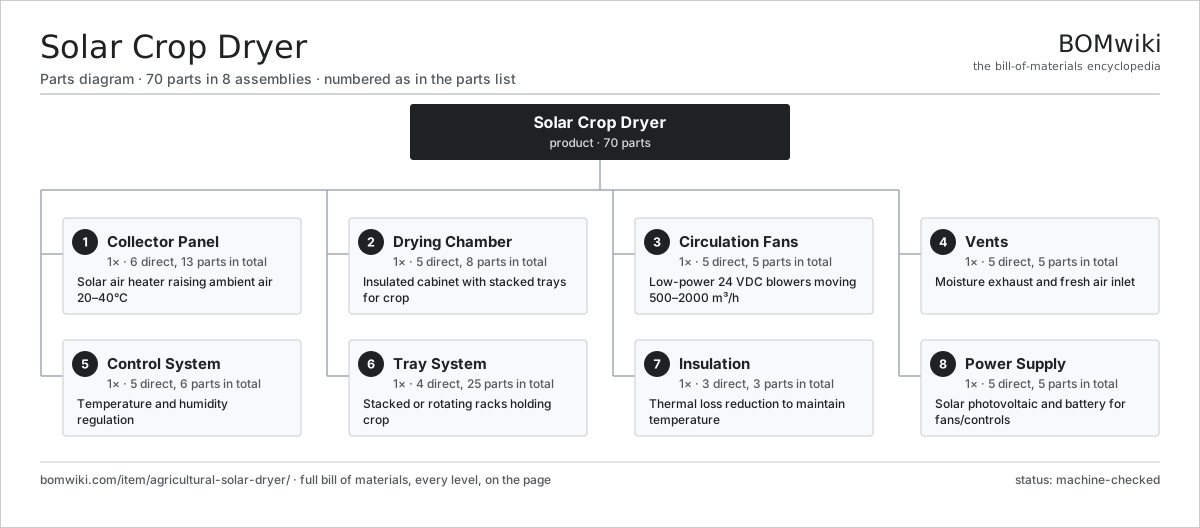
| # | Part | Qty | What it does |
|---|---|---|---|
| 1 | Collector Panel 6 parts | 1× | Solar air heater raising ambient air 20–40°C |
| 2 | Drying Chamber 5 parts | 1× | Insulated cabinet with stacked trays for crop |
| 3 | Circulation Fans 5 parts | 1× | Low-power 24 VDC blowers moving 500–2000 m³/h |
| 4 | Vents 5 parts | 1× | Moisture exhaust and fresh air inlet |
| 5 | Control System 5 parts | 1× | Temperature and humidity regulation |
| 6 | Tray System 4 parts | 1× | Stacked or rotating racks holding crop |
| 7 | Insulation 3 parts | 1× | Thermal loss reduction to maintain temperature |
| 8 | Power Supply 5 parts | 1× | Solar photovoltaic and battery for fans/controls |
3D model
No 3D model yet. Have a CAD file of this? Add a 3D model — STL renders right on this page; STEP, FreeCAD, and OpenSCAD sources are welcome too (openly licensed, like all 3D models on BOMwiki).
Build & assembly graph
expand / collapse · shared sub-assemblies converge · links to related products · est. labourTap an assembly to expand/collapse · tap a part to open it · use “Open page” for any node · drag to pan, scroll to zoom.
Bill of materials for Solar Crop Dryer
8 top-level lines · 46 rows shown · 70 parts total · indented to 3 levels| # | Item / sub-assembly | Part no. | Qty/assy | Ext. qty | Parts | Type |
|---|---|---|---|---|---|---|
| 1 | Collector Panel 6 parts | agricultural-solar-dryer-collector-panel | 1× | 1 | 13 | assembly |
| 1.1 | Absorber Plate | agricultural-solar-dryer-absorber-plate | 1× | 1 | · | part |
| 1.2 | Absorber Riser | agricultural-solar-dryer-absorber-riser | 8× | 8 | · | part |
| 1.3 | Glazing Cover | agricultural-solar-dryer-glazing-cover | 1× | 1 | · | part |
| 1.4 | Insulation Backing | agricultural-solar-dryer-insulation-backing | 1× | 1 | · | part |
| 1.5 | Collector Frame | agricultural-solar-dryer-collector-frame | 1× | 1 | · | part |
| 1.6 | Fastener Set | fastener-set | 1× | 1 | · | part |
| 2 | Drying Chamber 5 parts | agricultural-solar-dryer-drying-chamber | 1× | 1 | 8 | assembly |
| 2.1 | Chamber Frame | agricultural-solar-dryer-chamber-frame | 1× | 1 | · | part |
| 2.2 | Chamber Walls | agricultural-solar-dryer-chamber-walls | 4× | 4 | · | part |
| 2.3 | Chamber Door | agricultural-solar-dryer-chamber-door | 1× | 1 | · | part |
| 2.4 | Chamber Sealing | agricultural-solar-dryer-chamber-sealing | 1× | 1 | · | part |
| 2.5 | Fastener Set | fastener-set | 1× | 1 | · | part |
| 3 | Circulation Fans 5 parts | agricultural-solar-dryer-circulation-fans | 1× | 1 | 5 | assembly |
| 3.1 | Inlet Fan | agricultural-solar-dryer-inlet-fan | 1× | 1 | · | part |
| 3.2 | Exhaust Fan | agricultural-solar-dryer-exhaust-fan | 1× | 1 | · | part |
| 3.3 | Ductwork | agricultural-solar-dryer-ductwork | 1× | 1 | · | part |
| 3.4 | Fan Controller | agricultural-solar-dryer-fan-controller | 1× | 1 | · | part |
| 3.5 | Fastener Set | fastener-set | 1× | 1 | · | part |
| 4 | Vents 5 parts | agricultural-solar-dryer-vents | 1× | 1 | 5 | assembly |
| 4.1 | Inlet Vent | agricultural-solar-dryer-inlet-vent | 1× | 1 | · | part |
| 4.2 | Inlet Damper | agricultural-solar-dryer-inlet-damper | 1× | 1 | · | part |
| 4.3 | Exhaust Vent | agricultural-solar-dryer-exhaust-vent | 1× | 1 | · | part |
| 4.4 | Exhaust Damper | agricultural-solar-dryer-exhaust-damper | 1× | 1 | · | part |
| 4.5 | Fastener Set | fastener-set | 1× | 1 | · | part |
| 5 | Control System 5 parts | agricultural-solar-dryer-control-system | 1× | 1 | 6 | assembly |
| 5.1 | Thermometer | agricultural-solar-dryer-thermometer | 1× | 1 | · | part |
| 5.2 | Hygrometer | agricultural-solar-dryer-hygrometer | 1× | 1 | · | part |
| 5.3 | Controller | agricultural-solar-dryer-controller | 1× | 1 | · | part |
| 5.4 | Relay | agricultural-solar-dryer-relay | 2× | 2 | · | part |
| 5.5 | Power Supply | power-supply | 1× | 1 | · | part |
| 6 | Tray System 4 parts | agricultural-solar-dryer-tray-system | 1× | 1 | 25 | assembly |
| 6.1 | Tray Frame | agricultural-solar-dryer-tray-frame | 10× | 10 | · | part |
| 6.2 | Tray Mesh | agricultural-solar-dryer-tray-mesh | 10× | 10 | · | part |
| 6.3 | Tray Roller | agricultural-solar-dryer-tray-roller | 4× | 4 | · | part |
| 6.4 | Fastener Set | fastener-set | 1× | 1 | · | part |
| 7 | Insulation 3 parts | agricultural-solar-dryer-insulation | 1× | 1 | 3 | assembly |
| 7.1 | Insulation Material | agricultural-solar-dryer-insulation-material | 1× | 1 | · | part |
| 7.2 | Insulation Covering | agricultural-solar-dryer-insulation-covering | 1× | 1 | · | part |
| 7.3 | Fastener Set | fastener-set | 1× | 1 | · | part |
| 8 | Power Supply 5 parts | agricultural-solar-dryer-power-supply | 1× | 1 | 5 | assembly |
| 8.1 | PV Panel | agricultural-solar-dryer-pv-panel | 1× | 1 | · | part |
| 8.2 | Charge Controller | agricultural-solar-dryer-charge-controller | 1× | 1 | · | part |
| 8.3 | Battery | agricultural-solar-dryer-battery | 1× | 1 | · | part |
| 8.4 | Inverter | agricultural-solar-dryer-inverter | 1× | 1 | · | part |
| 8.5 | Fastener Set | fastener-set | 1× | 1 | · | part |
Related products
same domain, ranked by shared parts Battery Energy Storage System
17,429 parts · shares 1 with this page
Biogas Upgrading Unit
110 parts · shares 1 with this page
Battery Energy Storage System
17,429 parts · shares 1 with this page
Biogas Upgrading Unit
110 parts · shares 1 with this page
 Biomass Pellet Plant
404 parts · shares 1 with this page
Biomass Pellet Plant
404 parts · shares 1 with this page
 Concentrated Solar Power Receiver
855 parts · shares 1 with this page
Concentrated Solar Power Receiver
855 parts · shares 1 with this page
 Floating Offshore Wind Turbine
608 parts · shares 1 with this page
Floating Offshore Wind Turbine
608 parts · shares 1 with this page
Sourcing: possible vendors
Prices, MOQ, and lead times are algorithmic estimates, not quotes, and not claims about these companies. Company mappings are curated by keyword; est. price band $100–$20M. How estimates work| Vendor | HQ | Specialty | MOQ | Lead time |
|---|---|---|---|---|
|
🇩🇰Vestas
vestas.com ↗
|
Aarhus, DK | Wind turbines | 500 units | 12–24 wks |
| firstsolar.com ↗ | Tempe, US | PV modules | 500 units | 12–24 wks |
|
🇨🇳LONGi
longi.com ↗
|
Xi'an, CN | Solar wafers & modules | 500 units | 12–24 wks |
| enphase.com ↗ | Fremont, US | Microinverters & storage | 500 units | 12–24 wks |
|
🇨🇳Sungrow
sungrowpower.com ↗
|
Hefei, CN | Solar inverters & storage | 500 units | 12–24 wks |
1,007-word article