Air Knife
ProductOverview
An air knife is a precision nozzle that converts regulated compressed air into a thin, high-velocity curtain for drying, cleaning, and deflecting liquid and solid particles. The design is elegantly simple: a Plenum Chamber distributes air uniformly, then accelerates it through a Precision Slot ground to micron tolerance. At pressures of 5–8 bar, the exiting air reaches 80–120 m/s, faster than sound at sea level, creating an intense shock wave that peels liquid from surfaces or blows away contaminants. Air knives are ubiquitous in food packaging, automotive painting, print finishing, and wafer cleaning.
How it works
Regulated supply air enters the Inlet Port Assembly and flows into the Plenum Chamber, a high-volume cavity that evens out pressure across the width. The Plenum Divider Baffle baffle encourages uniform distribution so that no one part of the slot receives preferentially higher pressure than another. Air then enters the Precision Slot, a carefully machined converging passage (0.3–0.8 mm wide). As the flow area decreases, air velocity increases; by the time it exits the slot, the air has accelerated to near-sonic speeds.
The Slot Body is machined from aluminum or ductile iron to a tolerance of ±0.025 mm, ensuring that the slot width is uniform across its entire length (100 mm to meters, depending on product). The slot's Exit Lip, a sharp edge with radius < 0.05 mm, minimizes flow separation and shock losses. Just beyond the exit, a Diffuser Section with a gentle 10–15° half-angle expands the flow area. This divergence converts dynamic pressure back into static pressure, reducing back-pressure on the plenum and allowing efficient use of the supply air.
Applications
Drying: A water-coated surface is hit by the air knife jet. The shock-compressed air at the leading edge of the curtain peels the water layer, and the expanding low-pressure wake behind sucks the droplets away. Exit wetness on bottles, cans, or films is reduced from 10–50 mg/cm² to < 1 mg/cm².
Cleaning: Dust, lint, and light particles stuck to a surface are blasted loose by the high shear stress. The same knife often incorporates a recovery duct so expelled particles are immediately suctioned, containing them.
Deflecting: Light materials (labels, tissue) are blown sideways or upward by the knife, redirecting them without contact damage.
Sizing and control
Air knife capacity scales with slot length. A 500 mm knife at 6 bar might consume 800 L/min; a 3000 mm knife could draw 3000 L/min. Drying force varies roughly with pressure squared (doubling pressure quadruples force), so pressure regulators are essential for tuning performance. Some designs include Port Orifices to meter flow and reduce noise.
Noise is inherent: the air accelerating through the slot generates frequencies around 3–5 kHz. The Diffuser Section and downstream ducts provide some attenuation, but silencers on the exhaust are standard in enclosed applications.
Edge effects at the slot's ends are minimized by End Cap Assembly, which prevent air from spilling out the sides and ensure a uniform curtain across the full width.
Air Knife parts and their functions
7 top-level parts · 30 parts in total · full bill of materials below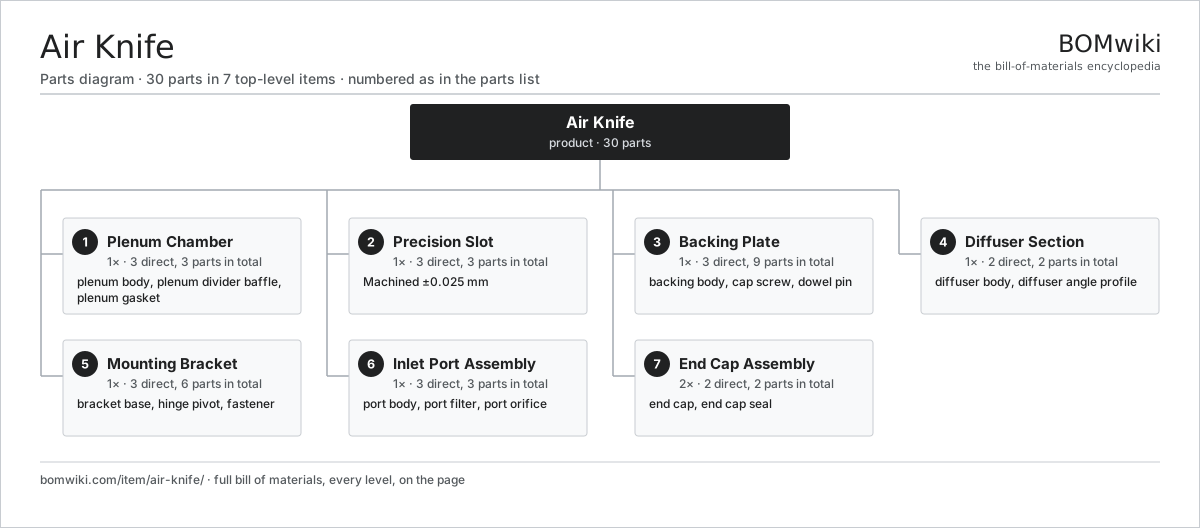
| # | Part | Qty | What it does |
|---|---|---|---|
| 1 | Plenum Chamber 3 parts | 1× | Pressurized cavity distributing air uniformly across the slot width. |
| 2 | Precision Slot 3 parts | 1× | Machined ±0.025 mm |
| 3 | Backing Plate 3 parts | 1× | Ductile-iron or aluminum plate that seals and supports the slot body. |
| 4 | Diffuser Section 2 parts | 1× | Diverging chamber behind the slot that expands exhausted air, reducing back-pressure. |
| 5 | Mounting Bracket 3 parts | 1× | Aluminum extrusion bracket with adjustable angle for positioning the air jet. |
| 6 | Inlet Port Assembly 3 parts | 1× | SAE or ISO threaded connection to the supply line. |
| 7 | End Cap Assembly 2 parts | 2× | Aluminum end seals containing the air stream and covering the slot edges. |
3D model
No 3D model yet. Have a CAD file of this? Add a 3D model. STL renders right on this page; STEP, FreeCAD, and OpenSCAD sources are welcome too (openly licensed, like all 3D models on BOMwiki).
Build & assembly graph
expand / collapse · shared sub-assemblies converge · links to related products · est. labourTap an assembly to expand/collapse · tap a part to open it · use “Open page” for any node · drag to pan, scroll to zoom.
Bill of materials for Air Knife
7 top-level lines · 26 rows shown · 30 parts total · indented to 3 levels| # | Item / sub-assembly | Part no. | Qty/assy | Ext. qty | Parts | Type |
|---|---|---|---|---|---|---|
| 1 | Plenum Chamber 3 parts | air-knife-plenum-chamber | 1× | 1 | 3 | assembly |
| 1.1 | Plenum Body | air-knife-plenum-body | 1× | 1 | · | part |
| 1.2 | Plenum Divider Baffle | air-knife-plenum-divider | 1× | 1 | · | part |
| 1.3 | Plenum Gasket | air-knife-plenum-gasket | 1× | 1 | · | part |
| 2 | Precision Slot 3 parts | air-knife-precision-slot | 1× | 1 | 3 | assembly |
| 2.1 | Slot Body | air-knife-slot-body | 1× | 1 | · | part |
| 2.2 | Tolerance Grade | air-knife-slot-tolerance | 1× | 1 | · | part |
| 2.3 | Exit Lip | air-knife-lip-sharpness | 1× | 1 | · | part |
| 3 | Backing Plate 3 parts | air-knife-backing-plate | 1× | 1 | 9 | assembly |
| 3.1 | Backing Body | air-knife-backing-body | 1× | 1 | · | part |
| 3.2 | Cap Screw | air-knife-backing-fastener | 6× | 6 | · | part |
| 3.3 | Dowel Pin | air-knife-backing-dowel | 2× | 2 | · | part |
| 4 | Diffuser Section 2 parts | air-knife-diffuser-section | 1× | 1 | 2 | assembly |
| 4.1 | Diffuser Body | air-knife-diffuser-body | 1× | 1 | · | part |
| 4.2 | Diffuser Angle Profile | air-knife-diffuser-angle | 1× | 1 | · | part |
| 5 | Mounting Bracket 3 parts | air-knife-mounting-bracket | 1× | 1 | 6 | assembly |
| 5.1 | Bracket Base | air-knife-bracket-base | 1× | 1 | · | part |
| 5.2 | Hinge Pivot | air-knife-bracket-hinge | 1× | 1 | · | part |
| 5.3 | Fastener | air-knife-bracket-fastener | 4× | 4 | · | part |
| 6 | Inlet Port Assembly 3 parts | air-knife-inlet-port | 1× | 1 | 3 | assembly |
| 6.1 | Port Body | air-knife-port-body | 1× | 1 | · | part |
| 6.2 | Port Filter | air-knife-port-filter | 1× | 1 | · | part |
| 6.3 | Port Orifice | air-knife-port-orifice | 1× | 1 | · | part |
| 7 | End Cap Assembly 2 parts | air-knife-end-caps | 2× | 2 | 2 | assembly |
| 7.1 | End Cap | air-knife-end-cap-body | 1× | 2 | · | part |
| 7.2 | End Cap Seal | air-knife-end-cap-seal | 1× | 2 | · | part |
Something wrong in this list? Report a problem with this BOM.
Sourcing: possible vendors
Browse the supplier directory → Prices, MOQ, and lead times are algorithmic estimates, not quotes, and not claims about these companies. Company mappings are curated by keyword; est. price band $50–$50k. How estimates work| Vendor | HQ | Specialty | MOQ | Lead time |
|---|---|---|---|---|
|
🇩🇰Grundfos
grundfos.com ↗
|
Bjerringbro, DK | Pumps | 200 units | 6–12 wks |
|
🇺🇸Xylem
xylem.com ↗
|
Washington, US | Water technology | 200 units | 6–12 wks |
| flowserve.com ↗ | Irving, US | Pumps & valves | 200 units | 6–12 wks |
|
🇩🇪KSB
ksb.com ↗
|
Frankenthal, DE | Pumps & valves | 200 units | 6–12 wks |
| parker.com ↗ | Cleveland, US | Motion & fluid control | 200 units | 6–12 wks |
539-word article