Air Vane Motor
ProductOverview
A pneumatic vane motor converts compressed air directly into continuous rotational motion. Unlike pneumatic cylinders (which produce linear strokes), vane motors deliver torque and speed. The simplicity is remarkable: a rotor containing three or four sliding Rotor Vanes revolves inside an eccentric Motor Cylinder, with expanding and contracting air chambers driving the rotation. Vane motors are found in pneumatic power tools (die grinders, impact wrenches), assembly machinery, and anywhere compact, clean, explosion-proof rotation is needed.
How it works
The Rotor Disc is a steel disc with radial slots. Each slot carries a hardened steel Rotor Vane that slides freely, kept pressed against the Cylinder Bore Surface by an internal Vane Spring. The rotor is mounted eccentrically within the circular bore; this offset creates a varying gap between the rotor and bore wall.
Pressurized air enters through the Inlet Port, directed by a port in the Inlet End Plate into the growing chamber. As the rotor rotates, this chamber expands, increasing volume and reducing pressure, this expansion pulls the load. Simultaneously, on the opposite side, a shrinking chamber (formed between the trailing vane and bore) is connected to the exhaust port; air is expelled, allowing the rotor to roll forward. Each revolution contains three or four power strokes (one per vane).
The Motor Shaft, keyed to the rotor, rotates at speeds inversely proportional to the pressure and load torque. At light load and 6 bar, a small motor spins 3000 RPM; under heavy load, it slows to 200–500 RPM. This automatic load-sensing behavior makes vane motors self-adjusting: they accelerate when the load drops and slow when it rises, without requiring a governor.
Durability and lubrication
The Rotor Vane tips must maintain a seal against the bore; any wear causes leakage and power loss. Vane motors require oil mist lubrication, injected via the Lubrication System port. A typical setup feeds the motor with air from an FRL unit (filter-regulator-lubricator), whose oil mist coats the bore and vanes, reducing friction and wear. The Outlet Muffler exhausts air; mist and oil condense, so a downstream moisture separator is often added.
Bearing life depends on speed and preload. High-speed motors (used in power tools) may have roller bearings; lower-speed, high-torque motors (like winch drives) use angular-contact ball bearings with Bearing Preload stacks. Most motors are rated for 5000–10,000 hours before overhaul, though larger industrial units can run much longer.
Performance characteristics
Torque is highest at stall (zero speed), tapering as RPM rises. A motor rated "10 Nm at 1500 RPM" produces full torque only at lower speeds. Efficiency varies from 40–70% depending on size and speed. Smaller motors (< 100 W) tend to be less efficient; large industrial motors (5+ kW) can exceed 60% efficiency. Starting torque is excellent, making vane motors ideal for applications requiring rapid acceleration (e.g., spindle startup).
Control is simple: throttle the supply pressure with a regulator to adjust torque and speed. Some motors are bidirectional; most are unidirectional. Reversing a unidirectional motor requires a 4-way spool valve that swaps inlet and outlet.
Comparison to alternatives
Versus piston motors: piston motors offer higher pressure ratings (10+ bar) and better efficiency but are noisier and require precise maintenance. Versus electric motors: pneumatic motors are intrinsically safe in explosive atmospheres, require no wiring (safer in wet zones), are lighter weight, and respond instantly to pressure changes. The downside is lower efficiency and continuous air consumption.
Air Vane Motor parts and their functions
9 top-level parts · 47 parts in total · full bill of materials below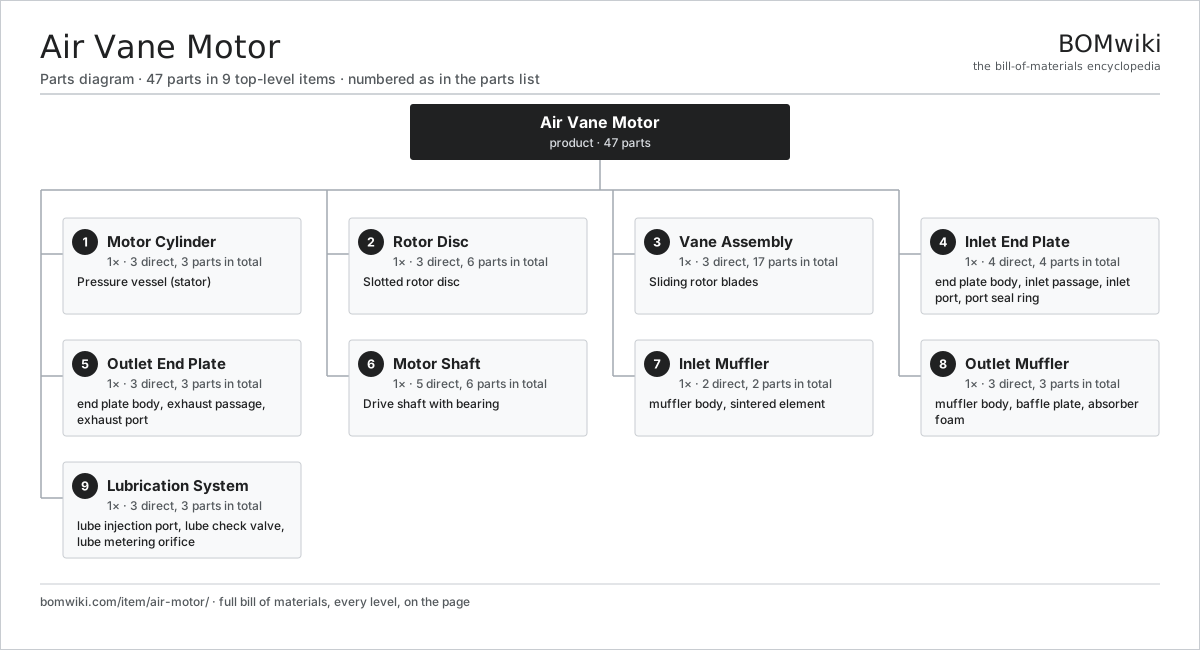
| # | Part | Qty | What it does |
|---|---|---|---|
| 1 | Motor Cylinder 3 parts | 1× | Pressure vessel (stator) |
| 2 | Rotor Disc 3 parts | 1× | Slotted rotor disc |
| 3 | Vane Assembly 3 parts | 1× | Sliding rotor blades |
| 4 | Inlet End Plate 4 parts | 1× | Front plate with air supply passages and port. |
| 5 | Outlet End Plate 3 parts | 1× | Rear plate with exhaust passages and muffler port. |
| 6 | Motor Shaft 5 parts | 1× | Drive shaft with bearing |
| 7 | Inlet Muffler 2 parts | 1× | Sintered bronze silencer on supply port, attenuating inlet noise. |
| 8 | Outlet Muffler 3 parts | 1× | Multi-stage silencer on exhaust port, absorbing motor noise. |
| 9 | Lubrication System 3 parts | 1× | Oil-misting injection port that supplies vane and bearing lubrication. |
3D model
No 3D model yet. Have a CAD file of this? Add a 3D model. STL renders right on this page; STEP, FreeCAD, and OpenSCAD sources are welcome too (openly licensed, like all 3D models on BOMwiki).
Build & assembly graph
expand / collapse · shared sub-assemblies converge · links to related products · est. labourTap an assembly to expand/collapse · tap a part to open it · use “Open page” for any node · drag to pan, scroll to zoom.
Bill of materials for Air Vane Motor
9 top-level lines · 41 rows shown · 47 parts total · indented to 3 levels| # | Item / sub-assembly | Part no. | Qty/assy | Ext. qty | Parts | Type |
|---|---|---|---|---|---|---|
| 1 | Motor Cylinder 3 parts | air-motor-cylinder | 1× | 1 | 3 | assembly |
| 1.1 | Cylinder Body | air-motor-cylinder-body | 1× | 1 | · | part |
| 1.2 | Cylinder Bore Surface | air-motor-cylinder-bore | 1× | 1 | · | part |
| 1.3 | Port Bore Drilling | air-motor-port-bore | 1× | 1 | · | part |
| 2 | Rotor Disc 3 parts | air-motor-rotor | 1× | 1 | 6 | assembly |
| 2.1 | Rotor Body | air-motor-rotor-body | 1× | 1 | · | part |
| 2.2 | Rotor Slot | air-motor-rotor-slot | 4× | 4 | · | part |
| 2.3 | Rotor Balance | air-motor-rotor-balance | 1× | 1 | · | part |
| 3 | Vane Assembly 3 parts | air-motor-vane-set | 1× | 1 | 17 | assembly |
| 3.1 | Rotor Vane 3 parts | air-motor-vane | 4× | 4 | 3 | assembly |
| 3.1.1 | Vane Body | air-motor-vane-body | 1× | 4 | · | part |
| 3.1.2 | Vane Tip Edge | air-motor-vane-tip | 1× | 4 | · | part |
| 3.1.3 | Coil Spring | coil-spring | 1× | 4 | · | part |
| 3.2 | Vane Spring | air-motor-vane-spring | 4× | 4 | · | part |
| 3.3 | Vane Keeper Ring | air-motor-vane-keeper | 1× | 1 | · | part |
| 4 | Inlet End Plate 4 parts | air-motor-end-plate-inlet | 1× | 1 | 4 | assembly |
| 4.1 | End Plate Body | air-motor-endplate-body | 1× | 1 | · | part |
| 4.2 | Inlet Passage | air-motor-inlet-passage | 1× | 1 | · | part |
| 4.3 | Inlet Port | air-motor-inlet-port | 1× | 1 | · | part |
| 4.4 | Port Seal Ring | air-motor-port-seal | 1× | 1 | · | part |
| 5 | Outlet End Plate 3 parts | air-motor-end-plate-outlet | 1× | 1 | 3 | assembly |
| 5.1 | End Plate Body | air-motor-endplate-body | 1× | 1 | · | part |
| 5.2 | Exhaust Passage | air-motor-exhaust-passage | 1× | 1 | · | part |
| 5.3 | Exhaust Port | air-motor-exhaust-port | 1× | 1 | · | part |
| 6 | Motor Shaft 5 parts | air-motor-shaft | 1× | 1 | 6 | assembly |
| 6.1 | Shaft Body | air-motor-shaft-body | 1× | 1 | · | part |
| 6.2 | Ball Bearing | ball-bearing | 2× | 2 | · | part |
| 6.3 | Bearing Preload | air-motor-bearing-preload | 1× | 1 | · | part |
| 6.4 | Shaft Seal | air-motor-shaft-seal | 1× | 1 | · | part |
| 6.5 | Shaft Coupling | air-motor-shaft-coupling | 1× | 1 | · | part |
| 7 | Inlet Muffler 2 parts | air-motor-muffler-inlet | 1× | 1 | 2 | assembly |
| 7.1 | Muffler Body | air-motor-muffler-body | 1× | 1 | · | part |
| 7.2 | Sintered Element | air-motor-sintered-element | 1× | 1 | · | part |
| 8 | Outlet Muffler 3 parts | air-motor-muffler-outlet | 1× | 1 | 3 | assembly |
| 8.1 | Muffler Body | air-motor-muffler-body | 1× | 1 | · | part |
| 8.2 | Baffle Plate | air-motor-muffler-baffle | 1× | 1 | · | part |
| 8.3 | Absorber Foam | air-motor-muffler-absorber | 1× | 1 | · | part |
| 9 | Lubrication System 3 parts | air-motor-lubrication-system | 1× | 1 | 3 | assembly |
| 9.1 | Lube Injection Port | air-motor-lube-port | 1× | 1 | · | part |
| 9.2 | Lube Check Valve | air-motor-lube-check-valve | 1× | 1 | · | part |
| 9.3 | Lube Metering Orifice | air-motor-lube-orifice | 1× | 1 | · | part |
Something wrong in this list? Report a problem with this BOM.
Related products
same domain, ranked by shared parts Control Valve
46 parts · shares 1 with this page
Directional Control Valve
32 parts · shares 1 with this page
Control Valve
46 parts · shares 1 with this page
Directional Control Valve
32 parts · shares 1 with this page
 High-Pressure Plunger Pump
115 parts · shares 1 with this page
High-Pressure Plunger Pump
115 parts · shares 1 with this page
 Hydraulic Power Unit
91 parts · shares 1 with this page
Hydraulic Test Bench
77 parts · shares 1 with this page
Hydraulic Power Unit
91 parts · shares 1 with this page
Hydraulic Test Bench
77 parts · shares 1 with this page
 Irrigation Pump Station
1,881 parts · shares 1 with this page
Irrigation Pump Station
1,881 parts · shares 1 with this page
Sourcing: possible vendors
Browse the supplier directory → Prices, MOQ, and lead times are algorithmic estimates, not quotes, and not claims about these companies. Company mappings are curated by keyword; est. price band $50–$50k. How estimates work| Vendor | HQ | Specialty | MOQ | Lead time |
|---|---|---|---|---|
|
🇩🇰Grundfos
grundfos.com ↗
|
Bjerringbro, DK | Pumps | 200 units | 6–12 wks |
|
🇺🇸Xylem
xylem.com ↗
|
Washington, US | Water technology | 200 units | 6–12 wks |
| flowserve.com ↗ | Irving, US | Pumps & valves | 200 units | 6–12 wks |
|
🇩🇪KSB
ksb.com ↗
|
Frankenthal, DE | Pumps & valves | 200 units | 6–12 wks |
| parker.com ↗ | Cleveland, US | Motion & fluid control | 200 units | 6–12 wks |
597-word article