Air Start Unit
ProductOverview
An air start unit (ASU) supplies high-pressure hot air to aircraft main engines during cold start (engines not yet running, unable to self-generate compressor air). The ASU delivers 40 psi bleed air at 280–400 °C through an umbilical hose to the aircraft air-start valve, which directs compressed air into the engine's air starter (high-torque pneumatic motor), spinning the engine core to 15–20% N1 (compressor RPM), allowing fuel injection and ignition to commence.
ASUs are essential at:
- High-altitude airports (Denver, Bogota, Lhasa) where thin air reduces engine self-start capability.
- Cold-weather operations (−30 °C and lower) where engine viscosity resists initial rotation.
- Aircraft with failed onboard APU (auxiliary power unit), requiring external start air.
- Rapid turnaround situations where multiple aircraft need simultaneous starts (fleet of ASUs ensures on-time departures).
Modern ASUs use gas-turbine designs (self-powered, no external electrical input) favored over electrically-driven piston compressors (noisy, require heavy power cable).
Gas Turbine Compressor Design
The Compressor Unit is typically a single-shaft turbine: a small gas turbine engine optimized for compressor duty, not propulsion.
Operating principle:
- Fuel ignition: Operator starts electric starter motor, spinning the turbine rotor to 10,000+ RPM.
- Self-sustaining combustion: At ~15% speed, fuel injectors spray kerosene/diesel into combustor, ignition occurs (spark plug or hot surface ignition), combustion gases drive turbine wheel.
- Steady state: Turbine auto-accelerates to 50,000–70,000 RPM (no governor control), centrifugal compressor stage on rotor shaft compresses intake air to 40 psi.
Advantages over piston compressors:
- Simpler (single rotating assembly, fewer moving parts → reliability).
- Smaller and lighter (centrifugal compressor more compact than multi-stage reciprocating).
- Quieter rotary motion vs. piston impact noise.
- Faster response (turbine ramps to full pressure in 30–60 seconds vs. 2–3 minutes for piston).
Disadvantages:
- Fuel consumption higher (10–20 L/hour vs. 5–8 L/hour piston).
- Thermal stresses on rotor (creep at 1200+ °C blade temperature).
- Combustor carbon buildup if fuel quality poor (requires regular maintenance).
Pressure & Temperature Control
The Air Regulation Manifold maintains:
- Pressure: 40 ± 2 psi (280 kPa) per aircraft specification. Pressure Regulator (pilot-operated valve) bleeds excess flow if turbine tends to overpressurize.
- Temperature: 280–400 °C (aircraft-dependent). Temperature Control bleed valve opens if exhaust temperature exceeds safe limit (350 °C typical), bypassing some air directly overboard (reducing discharge energy but preventing aircraft thermal damage).
Temperature importance:
- Too cold (<250 °C): Dense air, less energy for engine start, insufficient for high-altitude.
- Too hot (>400 °C): Engine air-start valve seals deteriorate, compressor blades risk thermal stress.
Modern ASUs include thermocouple feedback to Control Panel, allowing operator to adjust bleed valve position (manual rheostat) maintaining optimal 350 ± 20 °C.
Air Hose & Quick-Disconnect
The Air Hose Reel stores 50–100 m of specialty hose (Teflon or silicone composite, rated 50 psi, 400 °C continuous). Unlike standard rubber hose (melts at ~200 °C), high-temperature hose maintains flexibility and integrity throughout start sequence.
Hose configuration:
- 3" or 4" diameter (larger diameter = lower pressure drop over distance).
- Insulated outer sleeve (reduces operator burn risk, slows heat loss).
- Quick-disconnect couplers at both ends (Connector, Eaton or Parker standard aircraft type).
Connection procedure:
- ASU positioned 20–30 m from aircraft nose (clearance from propellers/intake ingestion hazard).
- Operator unreels hose, walks to aircraft air-start receptacle (typically located below cockpit or on fuselage exterior).
- Connects hose quick-coupling (audible click confirms seal).
- Signals pilot via radio: "Air start ready."
- Pilot commands air-start valve open (flight deck switch).
- ASU throttle increased (manual or automatic), compressing air.
- Pilot observes engine N1 gauge rising (air-starter motor spinning engine core). At ~20% N1, ignition commences, engine begins self-sustaining combustion.
- ASU disconnected after engine reaches stable idle (typically 1–2 minutes after initial rotation).
Cold-Weather Operation
At −30 °C ambient, several challenges arise:
Fuel viscosity: Diesel gels, kerosene thickens. Fuel Supply includes fuel heater (immersion electric element) warming fuel to −5 °C before injection, preventing injector blockage.
Turbine acceleration delay: Cold air density (1.5× sea-level standard) means turbine needs longer to accelerate. Cold-start procedure:
- Start turbine at idle throttle, allow 3–5 minute preheat.
- Monitor pressure/temperature gauges (should stabilize at 35–40 psi, 280+ °C).
- Only then approach aircraft for connection.
Moisture in compressed air: Moisture Trap (cyclone or coalescing filter) removes water droplets. Frozen water can block aircraft air-start valve, causing start failure and flight delay.
Operational Patterns
Typical narrow-body (Boeing 737) cold start (5 minutes):
- Position ASU (1 min): Park 20+ m from aircraft, position upwind (smoke blows away from tarmac).
- Start ASU (1 min): Operator presses start button, turbine accelerates. Monitor gauges: pressure should reach 38–42 psi within 60 seconds, temperature 300–350 °C.
- Connect hose (1 min): Unreel hose, walk to aircraft air-start receptacle, connect quick-coupling.
- Start aircraft (2 min): Pilot commands air-start valve, engine begins to turn. ASU operator maintains throttle at fixed setting. At 20% N1, ignition occurs, fuel flow ramps up. Engine reaches idle thrust (~25% N1) within 1–2 minutes.
- Disconnect (0 min): Once engine stabilized at idle, operator signals pilot, pilot commands air-start valve closed. Operator disconnects hose, reels back to ASU.
Failure scenarios:
- Low pressure: Turbine not reaching 35 psi → check turbine rotation, fuel flow, air inlet blockage.
- High temperature (>400 °C): Bleed valve may be stuck closed, or fuel flow too rich. Operator should reduce throttle, open bleed manually.
- No engine start: After air flowing 30+ seconds, engine should show N1 rise. If N1 remains 0%, air-start valve may be faulty or hose disconnected.
Power Source Advantage (Gas Turbine)
Unlike piston compressors (require 100+ amp electrical supply and heavy cable), gas-turbine ASUs are self-powered:
- No airport power requirement (remote aprons without electrical service can still start aircraft).
- Faster deployment (no cable management, plug-and-play positioning).
- Suitable for emergency/standby use (APU failure, need backup start).
This autonomy makes gas-turbine ASU the dominant choice at modern hubs, despite higher fuel cost.
Maintenance & Lifespan
| Component | Service Interval | Cost |
|---|---|---|
| Air Filter | 250 h | $150–250 |
| Fuel Filter | 500 h | $200–300 |
| Combustor Inspection | 1000 h | $1500–2500 (carbon cleaning) |
| Turbine Blade Inspection | 2000 h | $3000–5000 (crack detection, rework) |
| Compressor Bearing Overhaul | 5000 h | $8000–12,000 |
| Major Overhaul | 8000 h / 10 years | $40,000–60,000 |
Lifespan: ASUs operate 10–15 years (6000–10,000 service hours) before turbine blade creep and combustor deterioration force major overhaul or retirement. High-temperature operation (600+ °C internal) and thermal cycling (preheat/idle/full power) cause material fatigue.
Competitive Variants
- Piston compressor ASU: Electrically driven, lower fuel consumption, quieter operation (if soundproofed), higher capital cost ($100k+ vs. $60k gas-turbine).
- Hybrid GPU/ASU: Ground Power Unit and Air Start Unit combined into single mobile unit (cost-effective for small terminals, but bulkier).
- Aircraft APU backup: Some modern aircraft carry redundant APUs specifically to avoid ASU dependency; however, cost and weight limit this to widebody aircraft.
Modern ASU evolution trends:
- Cleaner combustion: Dual-fuel capable (diesel/kerosene switchable) improving operability.
- Noise reduction: Larger compressor stages at lower RPM + acoustic shrouds approaching 85 dB(A).
- Condition monitoring: Onboard instrumentation logging pressure/temperature/fuel flow for predictive maintenance.
Air Start Unit parts and their functions
8 top-level parts · 33 parts in total · full bill of materials below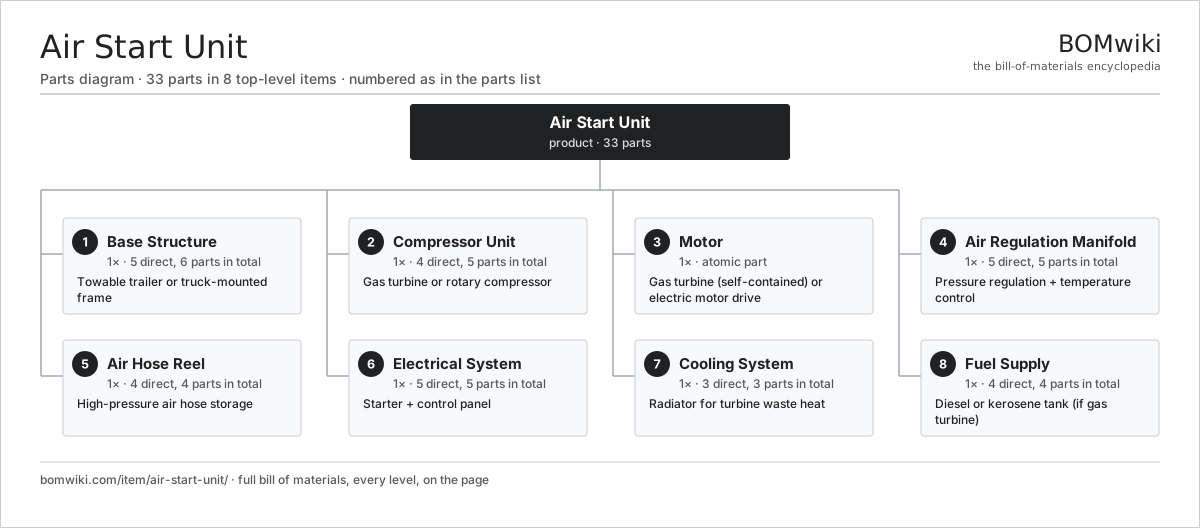
| # | Part | Qty | What it does |
|---|---|---|---|
| 1 | Base Structure 5 parts | 1× | Towable trailer or truck-mounted frame |
| 2 | Compressor Unit 4 parts | 1× | Gas turbine or rotary compressor |
| 3 | Motor | 1× | Gas turbine (self-contained) or electric motor drive |
| 4 | Air Regulation Manifold 5 parts | 1× | Pressure regulation + temperature control |
| 5 | Air Hose Reel 4 parts | 1× | High-pressure air hose storage |
| 6 | Electrical System 5 parts | 1× | Starter + control panel |
| 7 | Cooling System 3 parts | 1× | Radiator for turbine waste heat |
| 8 | Fuel Supply 4 parts | 1× | Diesel or kerosene tank (if gas turbine) |
3D model
No 3D model yet. Have a CAD file of this? Add a 3D model. STL renders right on this page; STEP, FreeCAD, and OpenSCAD sources are welcome too (openly licensed, like all 3D models on BOMwiki).
Build & assembly graph
expand / collapse · shared sub-assemblies converge · links to related products · est. labourTap an assembly to expand/collapse · tap a part to open it · use “Open page” for any node · drag to pan, scroll to zoom.
Bill of materials for Air Start Unit
8 top-level lines · 38 rows shown · 33 parts total · indented to 3 levels| # | Item / sub-assembly | Part no. | Qty/assy | Ext. qty | Parts | Type |
|---|---|---|---|---|---|---|
| 1 | Base Structure 5 parts | air-start-unit-base | 1× | 1 | 6 | assembly |
| 1.1 | Trailer Frame | air-start-unit-frame | 1× | 1 | · | part |
| 1.2 | Wheels | air-start-unit-wheels | 2× | 2 | · | part |
| 1.3 | Coupling | air-start-unit-coupling | 1× | 1 | · | part |
| 1.4 | Stabilizing Feet | air-start-unit-feet | 1× | 1 | · | part |
| 1.5 | Umbilical Connector | air-start-unit-umbilical-connector | 1× | 1 | · | part |
| 2 | Compressor Unit 4 parts | air-start-unit-compressor | 1× | 1 | 5 | assembly |
| 2.1 | Prime Mover | air-start-unit-turbine-engine | 1× | 1 | · | part |
| 2.2 | Compression Stage | air-start-unit-compressor-stage | 2× | 2 | · | part |
| 2.3 | Combustor | air-start-unit-combustor | 1× | 1 | · | part |
| 2.4 | Air Inlet | air-start-unit-air-inlet | 1× | 1 | · | part |
| 3 | Motor | air-start-unit-motor | 1× | 1 | · | part |
| 4 | Air Regulation Manifold 5 parts | air-start-unit-air-manifold | 1× | 1 | 5 | assembly |
| 4.1 | Pressure Regulator | air-start-unit-pressure-regulator | 1× | 1 | · | part |
| 4.2 | Temperature Control | air-start-unit-temperature-control | 1× | 1 | · | part |
| 4.3 | Isolation Valve | air-start-unit-isolation-valve | 1× | 1 | · | part |
| 4.4 | Moisture Trap | air-start-unit-moisture-trap | 1× | 1 | · | part |
| 4.5 | Check Valve | air-start-unit-check-valve | 1× | 1 | · | part |
| 5 | Air Hose Reel 4 parts | air-start-unit-hose-reel | 1× | 1 | 4 | assembly |
| 5.1 | Reel Drum | air-start-unit-hose-reel-drum | 1× | 1 | · | part |
| 5.2 | Air Hose | air-start-unit-hose | 1× | 1 | · | part |
| 5.3 | Connector | air-start-unit-hose-connector | 1× | 1 | · | part |
| 5.4 | Reel Motor | air-start-unit-reel-motor | 1× | 1 | · | part |
| 6 | Electrical System 5 parts | air-start-unit-electrical-system | 1× | 1 | 5 | assembly |
| 6.1 | Battery | air-start-unit-battery | 1× | 1 | · | part |
| 6.2 | Starter Motor | air-start-unit-starter-motor | 1× | 1 | · | part |
| 6.3 | Control Panel | air-start-unit-control-panel | 1× | 1 | · | part |
| 6.4 | Pressure Gauge | air-start-unit-pressure-gauge | 1× | 1 | · | part |
| 6.5 | Temperature Gauge | air-start-unit-temp-gauge | 1× | 1 | · | part |
| 7 | Cooling System 3 parts | air-start-unit-cooling-system | 1× | 1 | 3 | assembly |
| 7.1 | Radiator | air-start-unit-radiator | 1× | 1 | · | part |
| 7.2 | Cooling Fan | air-start-unit-cooling-fan | 1× | 1 | · | part |
| 7.3 | Thermostat | air-start-unit-thermostat | 1× | 1 | · | part |
| 8 | Fuel Supply 4 parts | air-start-unit-fuel-system | 1× | 1 | 4 | assembly |
| 8.1 | Fuel Tank | air-start-unit-fuel-tank | 1× | 1 | · | part |
| 8.2 | Fuel Pump | air-start-unit-fuel-pump | 1× | 1 | · | part |
| 8.3 | Fuel Filter | air-start-unit-fuel-filter | 1× | 1 | · | part |
| 8.4 | Fuel Injector | air-start-unit-injector-unit | 1× | 1 | · | part |
Something wrong in this list? Report a problem with this BOM.
Sourcing: possible vendors
Browse the supplier directory → Prices, MOQ, and lead times are algorithmic estimates, not quotes, and not claims about these companies. Company mappings are curated by keyword; est. price band $30k–$1.5M. How estimates work| Vendor | HQ | Specialty | MOQ | Lead time |
|---|---|---|---|---|
| oshkoshaerotech.com ↗ | Orlando, US | Airport ground support | made to order | 16–30 wks |
| tld-group.com ↗ | Paris, FR | Ground support equipment | made to order | 16–30 wks |
| textrongse.txtsv.com ↗ | Augusta, US | Ground support equipment | made to order | 16–30 wks |
| vestergaardcompany.com ↗ | Skanderborg, DK | De-icers & GSE | made to order | 16–30 wks |
| mallaghangse.com ↗ | Dungannon, GB | Ground support equipment | made to order | 16–30 wks |
1,251-word article