Airborne Wind Energy Kite
ProductOverview
Airborne wind energy (AWE) exploits stronger, more consistent winds at 200–600 m altitude, accessible without tall mast infrastructure. A tethered kite operates in crosswind or figure-eight cycles, generating a lift force that pulls the Tether and drives the ground winch as a generator during reel-in (power stroke). During reel-out (recovery stroke), the motor briefly reels out tether, repositioning the kite for the next cycle.
Because wind speed increases with altitude (wind shear), a 400 m kite encounters 2–3× higher average wind speed than a 100 m turbine tower in the same location. Power scales as the cube of wind speed, so this altitude gain translates to 8–27× more energy potential. However, AWE systems cycle continuously (unlike stationary turbines), with periods of 20–60 seconds between traction and recovery, and require complex autonomous control to manage the kite in variable winds.
Airborne Platform
The Kite Wing is a rigid or semi-rigid lifting surface with active control surfaces. Modern designs are fixed-wing aircraft-like machines (15–50 m² wing area) rather than soft kites, enabling higher power density and autonomous flight.
The Wing Structure is a carbon-fiber primary spar with internal ribs, designed to flex at ~1–2% strain under operational loading while maintaining aerodynamic shape. The skin is ripstop nylon or composite sailcloth with mylar leading-edge reinforcement. Control surfaces include ailerons (wing-tip flaps for roll), an elevator (pitch control at the empennage), and a vertical fin for yaw.
An embedded Inertial Measurement Unit (inertial measurement unit) with accelerometers, gyroscopes, magnetometer, and barometer provides 100 Hz feedback to the onboard autopilot, enabling autonomous figure-eight or crosswind flight. The tether attachment is a distributed bridle system preventing high point loads on the fuselage.
Tether and Mechanical Power Transfer
The Tether is the lifeline and power conduit. Modern designs use high-modulus synthetic fibers, Dyneema (high-density polyethylene) or Vectran (aromatic polyester), in a braided bundle sized to 16–24 mm diameter. The synthetic core provides 30–100 kN tensile strength at 1.5–2 ton/mm² specific strength, roughly 1.5× higher than steel of equivalent weight.
The tether experiences cyclic loading (tension pulses every 20–60 seconds), so fatigue strength dominates design. A ceramic-ball-bearing swivel at the ground connection eliminates torsional stress accumulation from the kite's yaw cycling. The UV-resistant polyethylene sheath protects the synthetic fibers from photodegradation; exposure to unprotected UV reduces strength by ~50% over 2–5 years.
During the traction phase (figure-eight loop), the tether lengthens 200–400 m, pulling the winch drum under tension. The motor acts as a generator, fed current from the mechanical rotation; this electrical power is rectified and inverted to grid AC. During recovery, the motor briefly acts as a motor, reeling in tether at high speed (lower tension and torque) to reposition the kite for the next cycle. The net power output is the traction energy minus recovery motor input, typically a 60–70% duty cycle on the generator output.
Winch and Power Conversion
The Ground Winch is the mechanical interface. A large-diameter drum (1–2 m) layers tether helically to prevent overlap and tangling. A variable-frequency-drive AC motor (100–500 kW) both motors and generates, with reversible power flow.
The motor is coupled through a reducer (20:1 to 50:1 ratio) providing torque multiplication and speed reduction. A fail-safe multi-disk brake (spring-applied, hydraulic-release) holds the winch in the event of power loss, preventing uncontrolled descent of the kite. A rotary encoder on the motor shaft tracks tether payout, allowing calculation of kite altitude and velocity. Most critically, a load cell on the tether at the winch inlet provides real-time load feedback, enabling the onboard autopilot to manage cross-wind carving amplitude and prevent kite stalling or overshoot.
Power Electronics
The electrical path converts mechanical power to grid-compatible AC. During traction (reel-in), the motor/generator spins, generating back-EMF that is rectified by a three-phase diode bridge into DC. An intermediate DC link (500–1000 µF capacitor bank) filters ripple and enables peak shaving. A three-level or modular inverter (200–500 kW) then synchronizes the DC to 480 V three-phase grid AC (or charges an isolated battery).
During recovery, the motor switches to motoring mode, consuming grid power or battery energy to reel in tether rapidly. Advanced systems add supercapacitor energy storage to smooth out the power ripple between traction and recovery cycles, reducing harmonic content and grid-tie inverter stress.
Flight Control and Autonomy
The Flight Computer is the heart of autonomous operation. An embedded ARM processor runs real-time control loops (altitude hold, cross-wind carving) at 100 Hz. Inputs include:
- Kite IMU: pitch, roll, yaw, altitude
- Tether tension: feedback for load management
- Tether payout: altitude calculation
- Ground command link: operator override or mission changes
Outputs include servo commands to three proportional hydraulic or electric actuators (aileron, elevator, rudder) that modulate lift and drag, steering the kite through its flight path.
Control laws are typically:
- Traction phase: Carve cross-wind (side to side) to maximize lift and tether tension while climbing.
- Recovery phase: Spiral upward (figure-eight) while motor reels in, minimizing drag and recovery power.
The 868 MHz or 2.4 GHz RF link provides low-bandwidth telemetry (wind speed, power, altitude) and uplink commands, achieving 20 km line-of-sight range. Battery endurance is 2–4 hours; the LiPo pack powers the autopilot and servos continuously.
Launch and Recovery
The deployment system is critical for safety and reliability. A reinforced deck or ramp stages the kite. During launch (low wind), a robotic handler or aerodyne drone stabilizes the kite horizontally while the winch slowly reels out tether, allowing the kite to climb to altitude. Above 10 m altitude, the autopilot assumes control.
During normal operation, the system cycles: traction (reel-in, 20–40 s), transition (carve setup, 5 s), recovery (reel-out, 20–40 s). If wind exceeds 25 m/s, a high-speed emergency winch rapidly descends the kite onto a arresting net, preventing structural damage.
Foundation and Site Requirements
The ground anchor is a large reinforced-concrete slab (2–4 m × 3–5 m, 1 m deep) anchored with large studs (ASTM F1554 Grade 55), resisting 500+ kN horizontal and vertical loads during traction phases. Typical installation footprint is 50–100 m², substantially smaller than a 1 MW wind turbine (tower footprint ~10 m, rotor swept area ~3000 m²).
Power and signal cables route underground through a conduit trench to the control station and grid-tie inverter cabinet.
Advantages and Limitations
Advantages:
- Access to stronger upper-level winds (2–3× speed advantage over tower)
- Smaller ground footprint (useful in constrained locations: urban, mountainous, offshore platforms)
- Modular: farms can stack units in close proximity due to staggered flight envelopes
- Scalable: designs range 50 kW to 500 kW; can aggregate to multi-MW farms
- No moving infrastructure (no rotating shaft or continuous mechanical stress like turbines)
Limitations:
- Complex autonomous control; failure modes less well understood than mature wind turbines
- Tether fatigue and replacement cost (major service every 5–10 years)
- High development cost; only ~5–10 commercial suppliers globally as of 2024
- Regulatory uncertainty (airspace, aviation safety)
- Average capacity factor lower than land-based wind turbines (30–40% vs. 35–45%) in typical sites
- Requires skilled operations teams for daily launch/recovery cycles
Commercial traction is concentrated in high-wind sites (coastal regions, mountain passes) and niche markets (remote power generation, islands, developing regions). Prototypes from Makani Power (now Alphabet subsidiary), Skysails, and Ampyx Power have logged 10,000+ operating hours. Cost reduction and regulatory clarity are key drivers for broader adoption.
Airborne Wind Energy Kite parts and their functions
8 top-level parts · 49 parts in total · full bill of materials below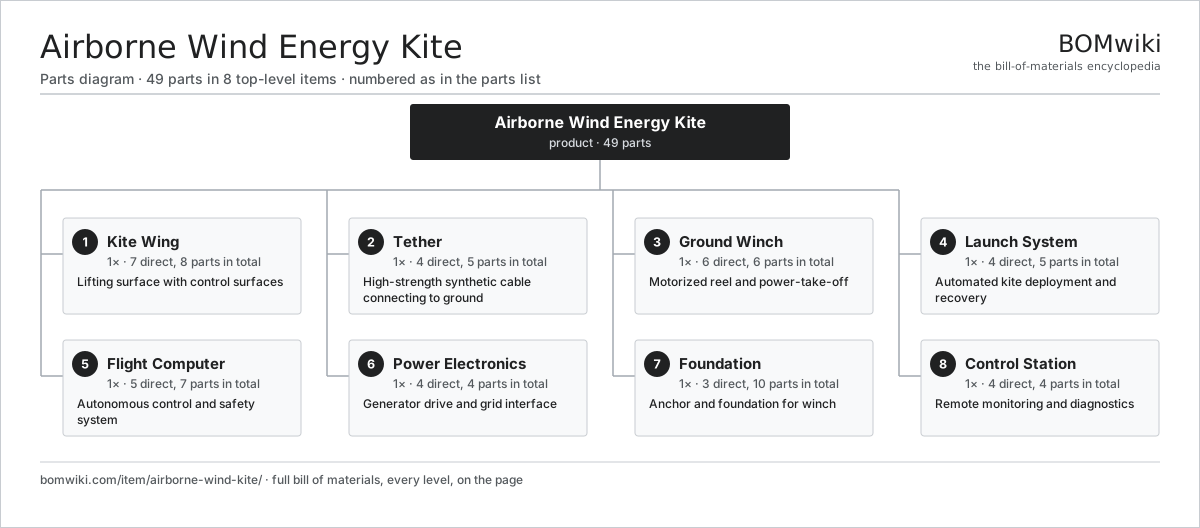
| # | Part | Qty | What it does |
|---|---|---|---|
| 1 | Kite Wing 7 parts | 1× | Lifting surface with control surfaces |
| 2 | Tether 4 parts | 1× | High-strength synthetic cable connecting to ground |
| 3 | Ground Winch 6 parts | 1× | Motorized reel and power-take-off |
| 4 | Launch System 4 parts | 1× | Automated kite deployment and recovery |
| 5 | Flight Computer 5 parts | 1× | Autonomous control and safety system |
| 6 | Power Electronics 4 parts | 1× | Generator drive and grid interface |
| 7 | Foundation 3 parts | 1× | Anchor and foundation for winch |
| 8 | Control Station 4 parts | 1× | Remote monitoring and diagnostics |
3D model
No 3D model yet. Have a CAD file of this? Add a 3D model. STL renders right on this page; STEP, FreeCAD, and OpenSCAD sources are welcome too (openly licensed, like all 3D models on BOMwiki).
Build & assembly graph
expand / collapse · shared sub-assemblies converge · links to related products · est. labourTap an assembly to expand/collapse · tap a part to open it · use “Open page” for any node · drag to pan, scroll to zoom.
Bill of materials for Airborne Wind Energy Kite
8 top-level lines · 45 rows shown · 49 parts total · indented to 3 levels| # | Item / sub-assembly | Part no. | Qty/assy | Ext. qty | Parts | Type |
|---|---|---|---|---|---|---|
| 1 | Kite Wing 7 parts | airborne-wind-kite-wing | 1× | 1 | 8 | assembly |
| 1.1 | Wing Structure | airborne-wind-wing-structure | 1× | 1 | · | part |
| 1.2 | Wing Skin | airborne-wind-wing-skin | 1× | 1 | · | part |
| 1.3 | Aileron | airborne-wind-aileron | 2× | 2 | · | part |
| 1.4 | Elevator | airborne-wind-elevator | 1× | 1 | · | part |
| 1.5 | Rudder | airborne-wind-rudder | 1× | 1 | · | part |
| 1.6 | Tether Attachment | airborne-wind-tether-attachment | 1× | 1 | · | part |
| 1.7 | Inertial Measurement Unit | airborne-wind-imu | 1× | 1 | · | part |
| 2 | Tether 4 parts | airborne-wind-tether | 1× | 1 | 5 | assembly |
| 2.1 | Tether Core | airborne-wind-tether-core | 1× | 1 | · | part |
| 2.2 | Tether Insulation | airborne-wind-tether-insulation | 1× | 1 | · | part |
| 2.3 | Tether Swivel | airborne-wind-tether-swivel | 1× | 1 | · | part |
| 2.4 | Tether Termination | airborne-wind-tether-termination | 2× | 2 | · | part |
| 3 | Ground Winch 6 parts | airborne-wind-ground-winch | 1× | 1 | 6 | assembly |
| 3.1 | Winch Drum | airborne-wind-winch-drum | 1× | 1 | · | part |
| 3.2 | Winch Motor | airborne-wind-winch-motor | 1× | 1 | · | part |
| 3.3 | Winch Gearbox | airborne-wind-winch-gearbox | 1× | 1 | · | part |
| 3.4 | Winch Brake | airborne-wind-winch-brake | 1× | 1 | · | part |
| 3.5 | Winch Encoder | airborne-wind-winch-encoder | 1× | 1 | · | part |
| 3.6 | Tension Sensor | airborne-wind-tension-sensor | 1× | 1 | · | part |
| 4 | Launch System 4 parts | airborne-wind-launch-system | 1× | 1 | 5 | assembly |
| 4.1 | Launch Pad | airborne-wind-launch-pad | 1× | 1 | · | part |
| 4.2 | Ground Handler | airborne-wind-ground-handler | 2× | 2 | · | part |
| 4.3 | Launcher Winch | airborne-wind-launcher-winch | 1× | 1 | · | part |
| 4.4 | Safety Net | airborne-wind-safety-net | 1× | 1 | · | part |
| 5 | Flight Computer 5 parts | airborne-wind-flight-computer | 1× | 1 | 7 | assembly |
| 5.1 | Autopilot MCU | airborne-wind-autopilot-mcu | 1× | 1 | · | part |
| 5.2 | Servo Driver | airborne-wind-servo-driver | 3× | 3 | · | part |
| 5.3 | Power Module | airborne-wind-power-module | 1× | 1 | · | part |
| 5.4 | Radio Modem | airborne-wind-radio-modem | 1× | 1 | · | part |
| 5.5 | Flight Battery | airborne-wind-battery | 1× | 1 | · | part |
| 6 | Power Electronics 4 parts | airborne-wind-power-electronics | 1× | 1 | 4 | assembly |
| 6.1 | Generator Motor | airborne-wind-generator-motor | 1× | 1 | · | part |
| 6.2 | Power Rectifier | airborne-wind-power-rectifier | 1× | 1 | · | part |
| 6.3 | DC Bus | airborne-wind-dc-bus | 1× | 1 | · | part |
| 6.4 | Grid Inverter | airborne-wind-grid-inverter | 1× | 1 | · | part |
| 7 | Foundation 3 parts | airborne-wind-foundation | 1× | 1 | 10 | assembly |
| 7.1 | Anchor Mat | airborne-wind-anchor-mat | 1× | 1 | · | part |
| 7.2 | Anchor Studs | airborne-wind-anchor-studs | 8× | 8 | · | part |
| 7.3 | Cable Trench | airborne-wind-cable-trench | 1× | 1 | · | part |
| 8 | Control Station 4 parts | airborne-wind-control-station | 1× | 1 | 4 | assembly |
| 8.1 | HMI Cabinet | airborne-wind-hmi-cabinet | 1× | 1 | · | part |
| 8.2 | SCADA Controller | airborne-wind-scada-controller | 1× | 1 | · | part |
| 8.3 | Data Logger | airborne-wind-data-logger | 1× | 1 | · | part |
| 8.4 | Emergency Stop | airborne-wind-emergency-stop | 1× | 1 | · | part |
Something wrong in this list? Report a problem with this BOM.
Sourcing: possible vendors
Browse the supplier directory → Prices, MOQ, and lead times are algorithmic estimates, not quotes, and not claims about these companies. Company mappings are curated by keyword; est. price band $100–$20M. How estimates work| Vendor | HQ | Specialty | MOQ | Lead time |
|---|---|---|---|---|
|
🇩🇰Vestas
vestas.com ↗
|
Aarhus, DK | Wind turbines | 500 units | 12–24 wks |
| firstsolar.com ↗ | Tempe, US | PV modules | 500 units | 12–24 wks |
|
🇨🇳LONGi
longi.com ↗
|
Xi'an, CN | Solar wafers & modules | 500 units | 12–24 wks |
| enphase.com ↗ | Fremont, US | Microinverters & storage | 500 units | 12–24 wks |
|
🇨🇳Sungrow
sungrowpower.com ↗
|
Hefei, CN | Solar inverters & storage | 500 units | 12–24 wks |
1,459-word article