Analog Alarm Clock
ProductOverview
An analog alarm clock pairs the cheapest accurate timekeeper ever made, the quartz stepping movement, with an alarm mechanism that is still essentially mechanical: a cam, a contact, and a hammer beating on steel bells. One AA cell runs the time side for more than a year because the movement draws microamps; the alarm motor, which draws far more, runs only for the seconds or minutes the bells are actually ringing.
The clock breaks down into the Quartz Movement that keeps time, the Alarm Mechanism that wakes the owner, the Dial & Hands and Controls for reading and setting, and the Case and Power System system around them.
Keeping time
The timebase is the Quartz Crystal, a tiny tuning fork sealed in a metal can, cut so it vibrates at exactly 32,768 Hz, a power of two chosen so that a chain of 15 flip-flops divides it to precisely 1 Hz. The Driver IC performs that division and, once per second, sends a short pulse of alternating polarity through the Copper Winding on the Lavet Stator.
The stepper is a Lavet motor, the same architecture used in quartz wristwatches. The stator's air gap is deliberately asymmetric: notches cut into the soft iron make the Rotor Pinion's magnetic rest position sit slightly off the pole axis, so each pulse can only swing the rotor 180° in one direction. Two pulses give one revolution; the Reduction Gear Train then divides that down so the Second Hand steps once per second, the Minute Hand turns once per hour, and the Hour Hand once per 12 hours. Everything is located by the snap-together Movement Frame; the only adjustment in the whole movement is a trim capacitor among the SMD Passive (R/C/L). Typical accuracy is ±20 ppm, under two seconds a day, drifting mainly with temperature.
The alarm
Alarm timing is mechanical. The Alarm Cam is a notched disc geared to the hour wheel; turning the rear Alarm-Set Knob rotates the cam (and the dial-side Alarm Hand) so the notch will line up under the follower at the chosen time. Once per 12 hours the sprung Trip Contact drops into the notch and closes the alarm circuit, which is why a cam-set alarm rings at 7:00 both morning and evening unless switched off, and why its setting resolution is only about ten minutes.
When the contact closes (and the Alarm Switch is armed), the battery drives the Alarm Motor, a small DC motor spinning at several thousand RPM. Its Eccentric Pin pin converts that rotation into oscillation of the Hammer Arm, which whips back and forth between the two Bell Domes 50–100 times a second. Each dome is a drawn, nickel-plated steel hemisphere whose pitch is set by its diameter and wall thickness; the slight detuning between the pair produces the characteristic clattering ring at roughly 80 dB one metre away. Bell-less variants substitute the Piezo Buzzer, a piezo sounder, often ramping volume in stages; some twin-bell clocks use it as a quieter first stage before the bells fire.
The Snooze Button on top simply opens the alarm circuit for a fixed interval and, on most models, lights the Backlight LED behind the Dial Face while held.
Setting and power
The rear Time-Set Knob turns the minute wheel through a friction clutch, dragging both time hands without disturbing the stepping train. Hands are friction-fitted to their arbors under the convex Lens, so a dropped clock usually needs nothing more than the hands pressed back on.
Power is a single AA cell in the Battery Holder, retained by sprung Battery Contacts behind the Battery Door. The movement averages around 25 µA, a 2,500 mAh alkaline cell is good for well over a year, while the alarm motor draws tens of milliamps, so heavy snooze users change batteries noticeably more often. A short Wire Bundle links the movement board, trip contact, switch, and motor.
Case
The Case Shell is drawn steel or ABS, around 120 mm across, with the bezel formed at the front and posts on top carrying the bells and the pivoted Carry Handle. Two splayed Foot legs keep the clock from walking across the nightstand under hammer vibration, a real failure mode, since the hammer mechanism shakes the whole case. The Back Cover carries the knobs and battery compartment and removes with the screws of a standard Fastener Set, making the clock one of the few modern devices still trivially user-serviceable.
Analog Alarm Clock parts and their functions
6 top-level parts · 38 parts in total · full bill of materials below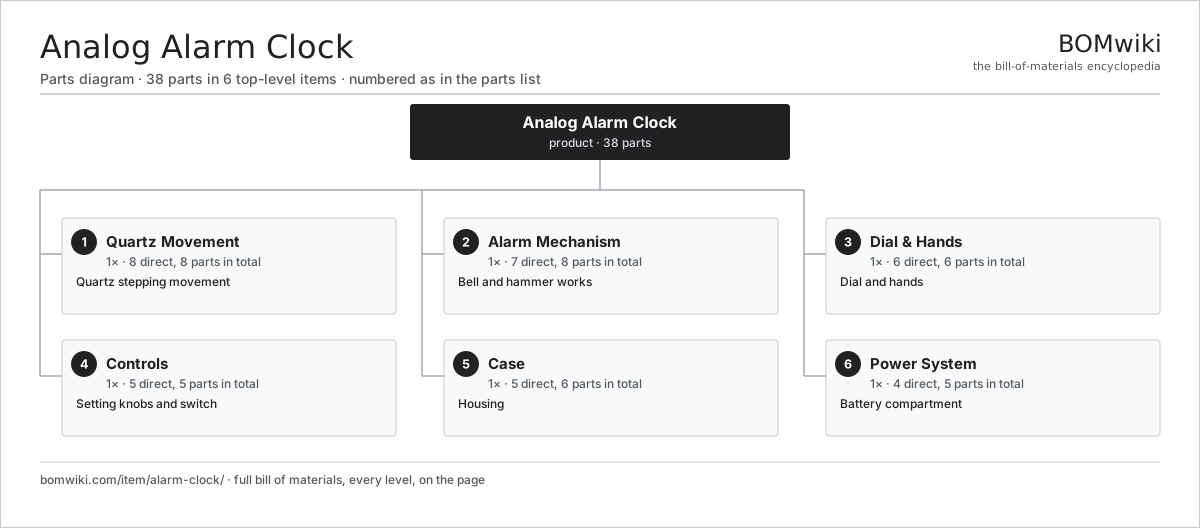
| # | Part | Qty | What it does |
|---|---|---|---|
| 1 | Quartz Movement 8 parts | 1× | Quartz stepping movement |
| 2 | Alarm Mechanism 7 parts | 1× | Bell and hammer works |
| 3 | Dial & Hands 6 parts | 1× | Dial and hands |
| 4 | Controls 5 parts | 1× | Setting knobs and switch |
| 5 | Case 5 parts | 1× | Housing |
| 6 | Power System 4 parts | 1× | Battery compartment |
3D model
No 3D model yet. Have a CAD file of this? Add a 3D model. STL renders right on this page; STEP, FreeCAD, and OpenSCAD sources are welcome too (openly licensed, like all 3D models on BOMwiki).
Build & assembly graph
expand / collapse · shared sub-assemblies converge · links to related products · est. labourTap an assembly to expand/collapse · tap a part to open it · use “Open page” for any node · drag to pan, scroll to zoom.
Bill of materials for Analog Alarm Clock
6 top-level lines · 41 rows shown · 38 parts total · indented to 3 levels| # | Item / sub-assembly | Part no. | Qty/assy | Ext. qty | Parts | Type |
|---|---|---|---|---|---|---|
| 1 | Quartz Movement 8 parts | alarm-clock-movement | 1× | 1 | 8 | assembly |
| 1.1 | Quartz Crystal | alarm-clock-quartz-crystal | 1× | 1 | · | part |
| 1.2 | Driver IC | alarm-clock-driver-ic | 1× | 1 | · | part |
| 1.3 | Lavet Stator | alarm-clock-lavet-stator | 1× | 1 | · | part |
| 1.4 | Copper Winding | copper-winding | 1× | 1 | · | part |
| 1.5 | Rotor Pinion | alarm-clock-rotor-pinion | 1× | 1 | · | part |
| 1.6 | Reduction Gear Train | alarm-clock-gear-train | 1× | 1 | · | part |
| 1.7 | Movement Frame | alarm-clock-movement-frame | 1× | 1 | · | part |
| 1.8 | SMD Passive (R/C/L) | smd-passives | 1× | 1 | · | part |
| 2 | Alarm Mechanism 7 parts | alarm-clock-alarm-mechanism | 1× | 1 | 8 | assembly |
| 2.1 | Alarm Cam | alarm-clock-alarm-cam | 1× | 1 | · | part |
| 2.2 | Trip Contact | alarm-clock-trip-contact | 1× | 1 | · | part |
| 2.3 | Alarm Motor | alarm-clock-alarm-motor | 1× | 1 | · | part |
| 2.4 | Eccentric Pin | alarm-clock-eccentric | 1× | 1 | · | part |
| 2.5 | Hammer Arm | alarm-clock-hammer-arm | 1× | 1 | · | part |
| 2.6 | Bell Dome | alarm-clock-bell-dome | 2× | 2 | · | part |
| 2.7 | Piezo Buzzer | alarm-clock-buzzer | 1× | 1 | · | part |
| 3 | Dial & Hands 6 parts | alarm-clock-display | 1× | 1 | 6 | assembly |
| 3.1 | Dial Face | alarm-clock-dial-face | 1× | 1 | · | part |
| 3.2 | Hour Hand | alarm-clock-hour-hand | 1× | 1 | · | part |
| 3.3 | Minute Hand | alarm-clock-minute-hand | 1× | 1 | · | part |
| 3.4 | Second Hand | alarm-clock-second-hand | 1× | 1 | · | part |
| 3.5 | Alarm Hand | alarm-clock-alarm-hand | 1× | 1 | · | part |
| 3.6 | Lens | alarm-clock-lens | 1× | 1 | · | part |
| 4 | Controls 5 parts | alarm-clock-controls | 1× | 1 | 5 | assembly |
| 4.1 | Time-Set Knob | alarm-clock-time-set-knob | 1× | 1 | · | part |
| 4.2 | Alarm-Set Knob | alarm-clock-alarm-set-knob | 1× | 1 | · | part |
| 4.3 | Alarm Switch | alarm-clock-alarm-switch | 1× | 1 | · | part |
| 4.4 | Snooze Button | alarm-clock-snooze-button | 1× | 1 | · | part |
| 4.5 | Backlight LED | alarm-clock-backlight-led | 1× | 1 | · | part |
| 5 | Case 5 parts | alarm-clock-case | 1× | 1 | 6 | assembly |
| 5.1 | Case Shell | alarm-clock-case-shell | 1× | 1 | · | part |
| 5.2 | Back Cover | alarm-clock-back-cover | 1× | 1 | · | part |
| 5.3 | Carry Handle | alarm-clock-handle | 1× | 1 | · | part |
| 5.4 | Foot | alarm-clock-foot | 2× | 2 | · | part |
| 5.5 | Fastener Set | fastener-set | 1× | 1 | · | part |
| 6 | Power System 4 parts | alarm-clock-power | 1× | 1 | 5 | assembly |
| 6.1 | Battery Holder | alarm-clock-battery-holder | 1× | 1 | · | part |
| 6.2 | Battery Contact | alarm-clock-battery-contact | 2× | 2 | · | part |
| 6.3 | Battery Door | alarm-clock-battery-door | 1× | 1 | · | part |
| 6.4 | Wire Bundle | wire-bundle | 1× | 1 | · | part |
Something wrong in this list? Report a problem with this BOM.
Related products
same domain, ranked by shared parts Railway Station Clock
43 parts · shares 3 with this page
Railway Station Clock
43 parts · shares 3 with this page
 Flip Clock
119 parts · shares 2 with this page
Flip Clock
119 parts · shares 2 with this page
 World Time Clock
30 parts · shares 2 with this page
World Time Clock
30 parts · shares 2 with this page
 Chess Clock
47 parts · shares 2 with this page
Digital Desk Clock
33 parts · shares 2 with this page
GPS NTP Time Server
37 parts · shares 2 with this page
Chess Clock
47 parts · shares 2 with this page
Digital Desk Clock
33 parts · shares 2 with this page
GPS NTP Time Server
37 parts · shares 2 with this page
Sourcing: possible vendors
Browse the supplier directory → Prices, MOQ, and lead times are algorithmic estimates, not quotes, and not claims about these companies. Company mappings are curated by keyword; est. price band $20–$50k. How estimates work| Vendor | HQ | Specialty | MOQ | Lead time |
|---|---|---|---|---|
|
🇯🇵Seiko
seikowatches.com ↗
|
Tokyo, JP | Watches | 500 units | 8–14 wks |
|
🇯🇵Citizen
citizenwatch-global.com ↗
|
Tokyo, JP | Watches | 500 units | 8–14 wks |
|
🇯🇵Casio
casio.com ↗
|
Tokyo, JP | Watches & electronics | 500 units | 8–14 wks |
| swatchgroup.com ↗ | Biel, CH | Watches (Omega, Tissot) | 500 units | 8–14 wks |
| titancompany.in ↗ | Bengaluru, IN | Watches & timepieces | 500 units | 8–14 wks |
822-word article