Alpine Ski
ProductOverview
An alpine ski is a composite ski engineered for high-speed carving on groomed slopes, featuring a narrower waist width (65–80 mm) than all-mountain or powder skis, paired legs for independent steering, and a stiff, responsive construction. Unlike snowboards, which require the rider to stand sideways, skis position the rider facing downhill with feet separated, enabling precise weight distribution and edge control. The modern alpine ski employs a layered construction with a wood core surrounded by composite reinforcements (typically carbon fiber or kevlar), titanal metal layers for damping, polyethylene bases for gliding, and hardened steel edges for edge hold.
Alpine skiing emerged as a sport in the 1920s and evolved through the 20th century with advances in edge metallurgy, base materials, and construction techniques. Professional racing skis today are the result of decades of iterative engineering, producing tools capable of sustained speeds exceeding 200 km/h on ice and hard-pack. The fundamental design goal is to translate rider weight and body movement into precise edge control while minimizing undesired vibration and chatter.
How it works
The skier plants one ski at an angle (edge-set) and pressurizes it by shifting weight forward and lateral, causing the ski's steel edges to bite into the snow. The Core Assembly flexes under the rider's weight, and the Edge Assembly follows a curved path determined by the ski's sidecut radius and the rider's lean angle. As the skier increases edge angle further, the ski's edge contact lengthens, sharpening the radius of the turn and increasing grip.
The Topsheet and Sidewall Assembly protect the underlying laminate. The Base Assembly glides with minimal friction, courtesy of the sintered Ptex Base and Factory Wax. The Titanal Layer damps vibration caused by irregularities in the snow, allowing the skier to feel the terrain through the ski rather than experiencing noise and chatter.
The Binding Platform and Platform Inserts secure the binding, which connects the ski boot to the ski. The binding allows free forward-backward motion but releases (detaches the boot from the ski) if the rider falls, preventing injuries like knee torsion or tibia fracture that can result from being twisted while locked to the ski.
Materials and construction
The Wood Core is typically laminated spruce or poplar, chosen for weight and vibration-damping properties. Spruce, stronger and less prone to water absorption than poplar, is preferred for racing skis; poplar, lighter and more forgiving, suits recreational and all-mountain designs. The Composite Insert layers of carbon fiber or kevlar are positioned in high-stress zones (often near the binding area and edges) to increase torsional stiffness while keeping weight minimal.
The Titanal Layer is a proprietary innovation (first commercialized by Salomon and now standard in most performance skis) consisting of thin sheets of titanium-aluminum alloy bonded within the laminate. Titanal provides damping, reducing vibration and audible chatter, and stiffens the ski torsionally without significant weight penalty. The exact thickness and placement of titanal sheets is a key performance differentiator among models.
The Epoxy Resin matrix binds the core, composite inserts, and titanal layers. Most modern high-end skis use epoxy resin, valued for stiffness and durability; some budget models use polyester resin, which is less costly but offers lower performance.
The Topsheet is typically ABS or melamine, providing impact resistance and weather protection. Beneath it, the Sidewall Assembly (usually laminated wood or molded ABS) wraps the sides and edges, providing torsional bracing and isolating the core from moisture. The sidewalls on racing skis are reinforced to resist the extreme forces of high-speed carving and frequent hard impacts with gates.
The Base Assembly is sintered polyethylene (ptex), produced by heating polyethylene powder under pressure to form a dense, porous structure. Sintered bases absorb wax and glide faster than extruded bases; the trade-off is higher maintenance cost and greater fragility (sintered bases are prone to moisture damage if not waxed regularly). Many high-performance bases incorporate Graphite Insert, graphite particles that enhance gliding speed by reducing friction.
The Steel Edge is typically hardened tool steel (often 4340 or equivalent), heat-treated to a hardness of 45–55 HRC. The edges are bonded with Edge Glue, a two-part urethane adhesive, and often riveted or welded for safety redundancy. The edges on a racing ski can be beveled and sharpened to extreme angles (1° side bevel or sharper) for maximum hold, while recreational skis often use more conservative bevel angles (2–3°) for margin of safety.
The Tip Assembly is reinforced to withstand impact and rebound. The Tip Rocker (upward curve) reduces effective edge length at the tip, easing turn initiation and improving flotation in soft snow, though racing skis often employ camber (downward curve) for maximized edge contact. The Tail Assembly similarly provides camber or rocker depending on design philosophy.
The Binding Platform and Platform Inserts are critical for safety and performance. The platform must resist bending under the torsional forces of a high-speed turn or hard landing, and the inserts must provide secure anchor points that survive thousands of binding mount cycles. Modern inserts are stainless steel, threaded to ISO 5835 (M8 or M10 threads), and pressed into the core under heat and epoxy.
Performance characteristics
Flex rating in alpine skis varies by manufacturer (some use a 1–10 scale, others a 50–130 scale), making direct comparison difficult. Generally, stiffer skis (80+) demand precise technique but reward edge control and hold at speed; softer skis (40–60) are more forgiving and maneuverable. All-mountain or freeride skis fall in the medium range (60–80).
Sidecut radius (the radius of the arc that the ski edge naturally follows when tilted edge-on to the snow) ranges from 10 m for slalom racing skis to 25 m for giant slalom, and 35–50 m for downhill racing skis. A tighter sidecut allows quick direction change; a longer radius suits higher speeds and longer arcs.
Effective edge length (the portion of the edge actually in contact with snow when the ski is flat) is typically 140–180 cm, longer than a snowboard's, providing greater stability and hold. The sidecut depth (the maximum perpendicular distance from a straight line connecting tip and tail to the edge) is typically 20–30 mm, creating the geometry that enables the ski to carve.
Camber (a gentle upward bow through the center of the ski) increases edge contact pressure and provides edge hold on hard snow; rocker (upward curve at tip and tail) reduces edge contact in the tip and tail, easing turn initiation and improving soft-snow flotation. Most modern skis blend both profiles: camber in the center for carving, rocker in the tip and tail for maneuverability.
Base and edge maintenance
Alpine ski bases require regular waxing to maintain glide and protect the polyethylene from oxidation and sun damage. A fresh wax coat should be applied every 5–10 days of skiing for recreational riders, or every 1–2 days for racers. Wax is applied by iron or in a shop and then scraped flat; some riders prefer hard wax (paraffin) for durability, while others choose liquid or wax-based products for convenience.
Edges dull with use and benefit from periodic professional sharpening. Racing skis may be sharpened before every competition; recreational skis can go a full season without sharpening if used primarily on groomed slopes. Edge repair (grinding, filing, or welding) can restore damaged edges, but large delaminations or water damage to the core require professional assessment or replacement.
Seasonal storage should be in a cool, dry environment with the skis lightly flexed or supported on a base plate (not resting on edges or bases), as improper storage can cause warping. Many racers store their skis with cork or similar material around the edges to prevent edge corrosion. A well-maintained pair of alpine skis can last 5–10 seasons for recreational use, or 2–3 seasons for intensive racing.
Alpine Ski parts and their functions
9 top-level parts · 30 parts in total · full bill of materials below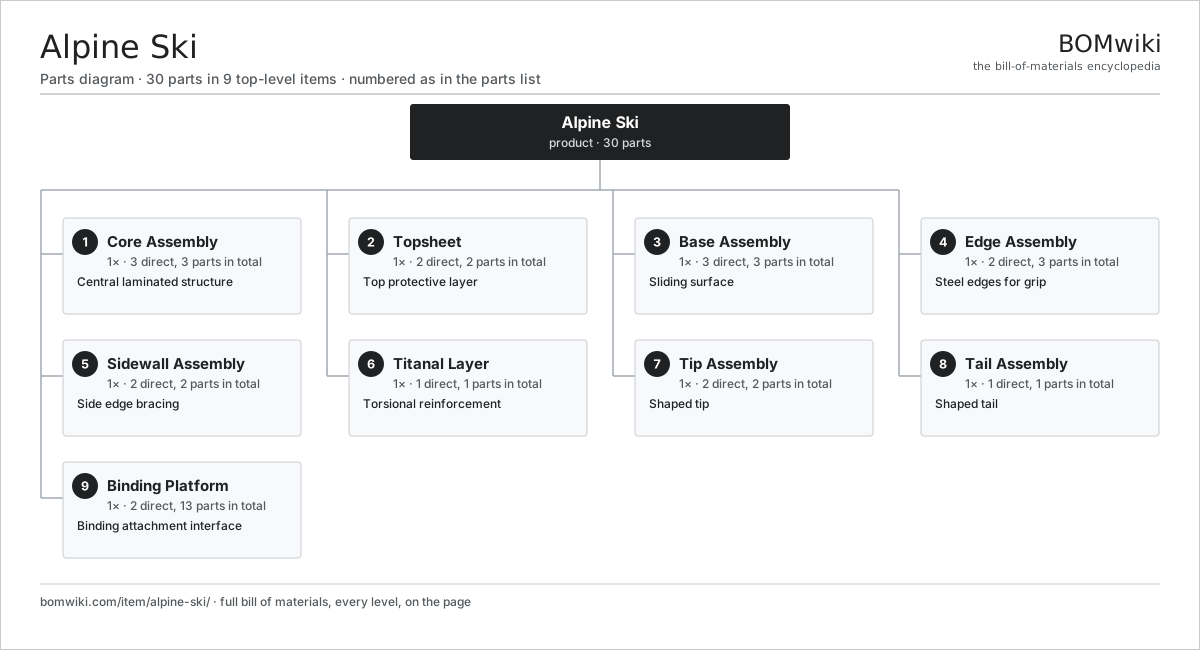
| # | Part | Qty | What it does |
|---|---|---|---|
| 1 | Core Assembly 3 parts | 1× | Central laminated structure |
| 2 | Topsheet 2 parts | 1× | Top protective layer |
| 3 | Base Assembly 3 parts | 1× | Sliding surface |
| 4 | Edge Assembly 2 parts | 1× | Steel edges for grip |
| 5 | Sidewall Assembly 2 parts | 1× | Side edge bracing |
| 6 | Titanal Layer 1 parts | 1× | Torsional reinforcement |
| 7 | Tip Assembly 2 parts | 1× | Shaped tip |
| 8 | Tail Assembly 1 parts | 1× | Shaped tail |
| 9 | Binding Platform 2 parts | 1× | Binding attachment interface |
3D model
No 3D model yet. Have a CAD file of this? Add a 3D model. STL renders right on this page; STEP, FreeCAD, and OpenSCAD sources are welcome too (openly licensed, like all 3D models on BOMwiki).
Build & assembly graph
expand / collapse · shared sub-assemblies converge · links to related products · est. labourTap an assembly to expand/collapse · tap a part to open it · use “Open page” for any node · drag to pan, scroll to zoom.
Bill of materials for Alpine Ski
9 top-level lines · 27 rows shown · 30 parts total · indented to 3 levels| # | Item / sub-assembly | Part no. | Qty/assy | Ext. qty | Parts | Type |
|---|---|---|---|---|---|---|
| 1 | Core Assembly 3 parts | alpine-ski-core-assembly | 1× | 1 | 3 | assembly |
| 1.1 | Wood Core | alpine-ski-wood-core | 1× | 1 | · | part |
| 1.2 | Composite Insert | alpine-ski-composite-insert | 1× | 1 | · | part |
| 1.3 | Epoxy Resin | alpine-ski-epoxy-resin | 1× | 1 | · | part |
| 2 | Topsheet 2 parts | alpine-ski-topsheet | 1× | 1 | 2 | assembly |
| 2.1 | ABS Layer | alpine-ski-abs-layer | 1× | 1 | · | part |
| 2.2 | UV Coat | alpine-ski-uv-coat | 1× | 1 | · | part |
| 3 | Base Assembly 3 parts | alpine-ski-base-assembly | 1× | 1 | 3 | assembly |
| 3.1 | Ptex Base | alpine-ski-ptex-base | 1× | 1 | · | part |
| 3.2 | Graphite Insert | alpine-ski-graphite-insert | 1× | 1 | · | part |
| 3.3 | Factory Wax | alpine-ski-factory-wax | 1× | 1 | · | part |
| 4 | Edge Assembly 2 parts | alpine-ski-edge-assembly | 1× | 1 | 3 | assembly |
| 4.1 | Steel Edge | alpine-ski-steel-edge | 2× | 2 | · | part |
| 4.2 | Edge Glue | alpine-ski-edge-glue | 1× | 1 | · | part |
| 5 | Sidewall Assembly 2 parts | alpine-ski-sidewall-assembly | 1× | 1 | 2 | assembly |
| 5.1 | Sidewall Material | alpine-ski-sidewall-material | 1× | 1 | · | part |
| 5.2 | Sidewall Seal | alpine-ski-sidewall-seal | 1× | 1 | · | part |
| 6 | Titanal Layer 1 parts | alpine-ski-titanal-layer | 1× | 1 | 1 | assembly |
| 6.1 | Titanal Sheet | alpine-ski-titanal-sheet | 1× | 1 | · | part |
| 7 | Tip Assembly 2 parts | alpine-ski-tip-assembly | 1× | 1 | 2 | assembly |
| 7.1 | Tip Rocker | alpine-ski-tip-rocker | 1× | 1 | · | part |
| 7.2 | Tip Core Insert | alpine-ski-tip-core-insert | 1× | 1 | · | part |
| 8 | Tail Assembly 1 parts | alpine-ski-tail-assembly | 1× | 1 | 1 | assembly |
| 8.1 | Tail Curve | alpine-ski-tail-curve | 1× | 1 | · | part |
| 9 | Binding Platform 2 parts | alpine-ski-binding-platform | 1× | 1 | 13 | assembly |
| 9.1 | Mounting Rails | alpine-ski-mounting-rails | 1× | 1 | · | part |
| 9.2 | Platform Inserts | alpine-ski-platform-inserts | 12× | 12 | · | part |
Something wrong in this list? Report a problem with this BOM.
Sourcing: possible vendors
Browse the supplier directory → Prices, MOQ, and lead times are algorithmic estimates, not quotes, and not claims about these companies. Company mappings are curated by keyword; est. price band $20–$2k. How estimates work| Vendor | HQ | Specialty | MOQ | Lead time |
|---|---|---|---|---|
|
🇺🇸Coleman
coleman.com ↗
|
Chicago, US | Camping gear | 1,000 units | 6–10 wks |
| thenorthface.com ↗ | Denver, US | Outdoor apparel & gear | 1,000 units | 6–10 wks |
|
🇺🇸YETI
yeti.com ↗
|
Austin, US | Coolers & drinkware | 1,000 units | 6–10 wks |
| decathlon.com ↗ | Villeneuve-d'Ascq, FR | Sporting goods | 1,000 units | 6–10 wks |
|
🇺🇸Garmin
garmin.com ↗
|
Olathe, US | GPS & wearables | 1,000 units | 6–10 wks |
1,373-word article