Antenna Alignment Tool
ProductOverview
An antenna alignment tool is a handheld device used by RF engineers to measure the true orientation of a cellular or broadcast antenna at installation or during maintenance. Rather than relying on mechanical protractors or visual alignment (which can introduce errors of 5–10°), the alignment tool uses a GNSS Receiver to establish true north and a IMU Sensors inertial measurement unit to measure the antenna's tilt, roll, and azimuth in three dimensions.
The device is clamped to the antenna pole via the Clamp Mount, and its Display Interface shows real-time orientation readings. The operator adjusts the antenna brackets while monitoring the tool, aiming to achieve the desired tilt (typically 0°–15° downward), roll (0°, or near-zero for sector antennas), and azimuth (e.g., 0°, 120°, 240° for three-sector coverage).
Precise antenna alignment is critical to cellular network performance: a 5° azimuth error can reduce coverage in the intended sector and cause interference in neighboring sectors. A 3° tilt error can degrade coverage at the cell edge. An alignment tool eliminates guesswork and reduces alignment errors to <0.5°, ensuring optimal coverage and capacity.
How It Works
The tool's GNSS Receiver continuously tracks satellites from multiple constellations (GPS, GLONASS, Galileo, BeiDou), computing its absolute position with ±0.5 m accuracy. This position data is used to establish true north (geomagnetic north is offset by local magnetic declination, which the tool corrects for using a Magnetometer).
The IMU Sensors measure gravitational acceleration (via Accelerometer), rotation rates (via Gyroscope), and magnetic field direction (via magnetometer). A sensor fusion algorithm in the Processing Unit (running a Kalman filter) combines these signals to compute the tool's 6-axis orientation: tilt (pitch), roll (bank), and heading (yaw relative to true north).
When the tool is clamped to an antenna pole, its orientation directly reflects the antenna's orientation. The Display Interface renders these values in real-time: "Tilt: 8.5°, Roll: 0.2°, Azimuth: 120.3° (True North)."
The operator adjusts the antenna bracket's tilt and azimuth bolts while watching the display. When the readings match the target (e.g., 10° tilt, 0° roll, 120° azimuth), the operator torques the bolts to specification and logs the final values. This entire process takes 5–15 minutes per antenna, compared to 30–45 minutes with mechanical protractors and compass sighting.
Calibration and Accuracy
A critical step in field use is compass calibration. The Magnetometer is sensitive to nearby ferrous metals (steel tower legs, rebar in concrete) and electrical systems (power lines, equipment). If not calibrated, compass-derived azimuth can drift by 5–10°. Most tools include a calibration routine: the technician rotates the tool slowly in a horizontal plane (or follows a figure-8 pattern) at the site, allowing the magnetometer to sample the local magnetic field and build a correction map.
Factory calibration of the IMU Sensors is performed using the Calibration Kit: the Reference Sphere establishes the tool's zero-point tilt and roll, and the Tilt Jig verifies accuracy across the measurement range. Calibration constants are stored in Calibration Storage (EEPROM).
With careful site calibration and RTK corrections (if available), tilt and roll accuracy improves from ±0.5° to ±0.2°, and azimuth from ±2° to ±0.5°. RTK (Real-Time Kinematic) is a technique where corrections transmitted from a base station 10–50 km away reduce position errors to centimeter-level, improving azimuth accuracy by refining true north.
Measurement Modes
Most tools support multiple measurement modes:
Standard Mode: Measures orientation relative to true north and gravity. Requires satellite lock (typically 10–30 seconds). Suitable for outdoor installations with clear sky view.
Compass Mode: Falls back to magnetometer-only azimuth if GNSS lock is unavailable (e.g., under dense trees or in urban canyons). Accuracy degrades to ±3–5° unless site-calibrated.
Relative Mode: Measures orientation change from a reference point. Useful for fine-tuning when initial azimuth is known (e.g., "current azimuth is 120°, adjust to 120.5°"). Does not require GNSS lock.
Recording Mode: Logs tilt, roll, and azimuth every second for 10–30 minutes, capturing antenna movement or swing from wind. Useful for dynamic analysis or documenting baseline conditions.
Practical Use and Limitations
Antenna alignment tools are most effective in open areas with clear sky view for GNSS. Performance degrades under trees or in urban canyons, where multipath reflections and signal blockage reduce accuracy. In such environments, technicians may rely more on compass and mechanical checks.
The Buzzer provides feedback when azimuth and tilt approach target values, helping the technician fine-tune without constantly looking at the display. Once both values are within ±0.3° of target, the buzzer emits a continuous tone, signaling "lock."
The Clamp Mount and Rotation Bearing must be smooth and low-friction. Any binding or play in the bearing can introduce measurement errors or prevent azimuth rotation. Regular inspection and cleaning are recommended, especially in salt-spray or dusty environments.
Battery life is typically 8–12 hours of continuous operation. The Battery Pack is rechargeable via USB-C, charged overnight between working days. A spare battery is recommended for all-day installations at multiple sites.
Cost and ROI
Antenna alignment tools range from $3,000–$8,000, depending on GNSS accuracy (RTK-capable tools are more expensive) and feature set. For a single technician aligning 50+ antennas per year, the tool pays for itself in reduced labor time (2–4 hours saved per antenna compared to manual methods) and improved quality (fewer alignment errors requiring rework).
Large operators with hundreds of sites maintain several tools distributed across regions, ensuring availability and reducing travel time to retrieve a shared instrument.
Antenna Alignment Tool parts and their functions
7 top-level parts · 23 parts in total · full bill of materials below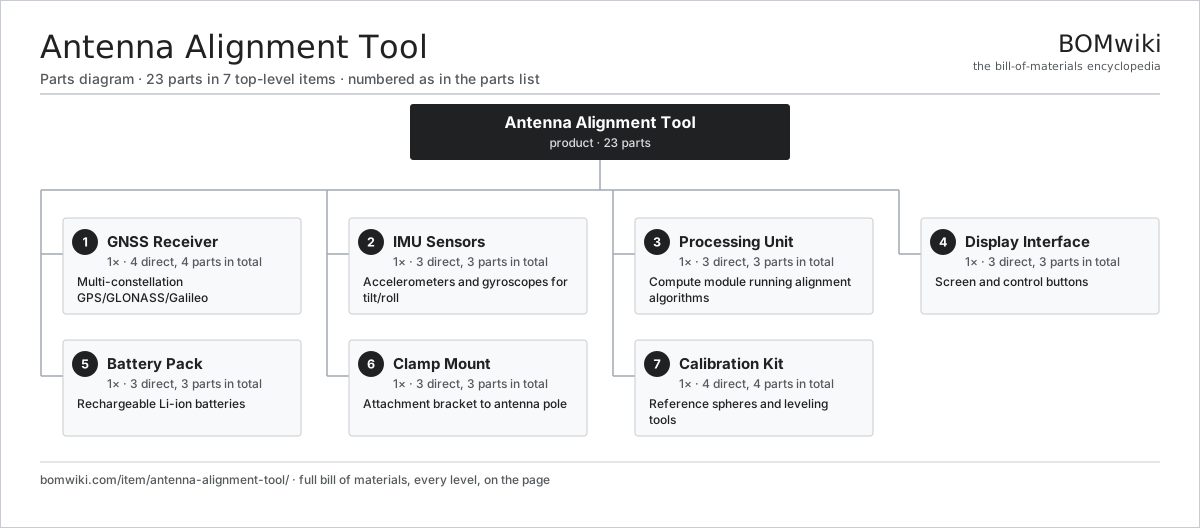
| # | Part | Qty | What it does |
|---|---|---|---|
| 1 | GNSS Receiver 4 parts | 1× | Multi-constellation GPS/GLONASS/Galileo |
| 2 | IMU Sensors 3 parts | 1× | Accelerometers and gyroscopes for tilt/roll |
| 3 | Processing Unit 3 parts | 1× | Compute module running alignment algorithms |
| 4 | Display Interface 3 parts | 1× | Screen and control buttons |
| 5 | Battery Pack 3 parts | 1× | Rechargeable Li-ion batteries |
| 6 | Clamp Mount 3 parts | 1× | Attachment bracket to antenna pole |
| 7 | Calibration Kit 4 parts | 1× | Reference spheres and leveling tools |
3D model
No 3D model yet. Have a CAD file of this? Add a 3D model. STL renders right on this page; STEP, FreeCAD, and OpenSCAD sources are welcome too (openly licensed, like all 3D models on BOMwiki).
Build & assembly graph
expand / collapse · shared sub-assemblies converge · links to related products · est. labourTap an assembly to expand/collapse · tap a part to open it · use “Open page” for any node · drag to pan, scroll to zoom.
Bill of materials for Antenna Alignment Tool
7 top-level lines · 30 rows shown · 23 parts total · indented to 3 levels| # | Item / sub-assembly | Part no. | Qty/assy | Ext. qty | Parts | Type |
|---|---|---|---|---|---|---|
| 1 | GNSS Receiver 4 parts | antenna-alignment-tool-gnss-receiver | 1× | 1 | 4 | assembly |
| 1.1 | GNSS Receiver Chip | antenna-alignment-tool-gnss-chip | 1× | 1 | · | part |
| 1.2 | GNSS Antenna | antenna-alignment-tool-gnss-antenna | 1× | 1 | · | part |
| 1.3 | RTK Correction Radio | antenna-alignment-tool-rtk-radio | 1× | 1 | · | part |
| 1.4 | Antenna Cable | antenna-alignment-tool-antenna-cable | 1× | 1 | · | part |
| 2 | IMU Sensors 3 parts | antenna-alignment-tool-imu-sensors | 1× | 1 | 3 | assembly |
| 2.1 | Accelerometer | antenna-alignment-tool-accelerometer | 1× | 1 | · | part |
| 2.2 | Gyroscope | antenna-alignment-tool-gyroscope | 1× | 1 | · | part |
| 2.3 | Magnetometer | antenna-alignment-tool-magnetometer | 1× | 1 | · | part |
| 3 | Processing Unit 3 parts | antenna-alignment-tool-processing-unit | 1× | 1 | 3 | assembly |
| 3.1 | Microcontroller | antenna-alignment-tool-mcu | 1× | 1 | · | part |
| 3.2 | Calibration Storage | antenna-alignment-tool-calibration-storage | 1× | 1 | · | part |
| 3.3 | Sensor Fusion Firmware | antenna-alignment-tool-sensor-fusion-sw | 1× | 1 | · | part |
| 4 | Display Interface 3 parts | antenna-alignment-tool-display-interface | 1× | 1 | 3 | assembly |
| 4.1 | Display Panel | antenna-alignment-tool-display-panel | 1× | 1 | · | part |
| 4.2 | Control Buttons | antenna-alignment-tool-control-buttons | 1× | 1 | · | part |
| 4.3 | Buzzer | antenna-alignment-tool-buzzer | 1× | 1 | · | part |
| 5 | Battery Pack 3 parts | antenna-alignment-tool-battery-pack | 1× | 1 | 3 | assembly |
| 5.1 | Li-Ion Cells | antenna-alignment-tool-li-cells | 1× | 1 | · | part |
| 5.2 | Charging Circuit | antenna-alignment-tool-charging-circuit | 1× | 1 | · | part |
| 5.3 | Battery Connector | antenna-alignment-tool-battery-connector | 1× | 1 | · | part |
| 6 | Clamp Mount 3 parts | antenna-alignment-tool-clamp-mount | 1× | 1 | 3 | assembly |
| 6.1 | Clamp Body | antenna-alignment-tool-clamp-body | 1× | 1 | · | part |
| 6.2 | Rotation Bearing | antenna-alignment-tool-rotation-bearing | 1× | 1 | · | part |
| 6.3 | Leveling Feet | antenna-alignment-tool-level-feet | 1× | 1 | · | part |
| 7 | Calibration Kit 4 parts | antenna-alignment-tool-calibration-kit | 1× | 1 | 4 | assembly |
| 7.1 | Reference Sphere | antenna-alignment-tool-reference-sphere | 1× | 1 | · | part |
| 7.2 | Spirit Level | antenna-alignment-tool-spirit-level | 1× | 1 | · | part |
| 7.3 | Tilt Jig | antenna-alignment-tool-tilt-jig | 1× | 1 | · | part |
| 7.4 | Calibration Software | antenna-alignment-tool-calibration-software | 1× | 1 | · | part |
Something wrong in this list? Report a problem with this BOM.
Sourcing: possible vendors
Browse the supplier directory → Prices, MOQ, and lead times are algorithmic estimates, not quotes, and not claims about these companies. Company mappings are curated by keyword; est. price band $30–$50k. How estimates work| Vendor | HQ | Specialty | MOQ | Lead time |
|---|---|---|---|---|
|
🇺🇸Cisco
cisco.com ↗
|
San Jose, US | Networking | 500 units | 8–14 wks |
|
🇺🇸Juniper
juniper.net ↗
|
Sunnyvale, US | Networking | 500 units | 8–14 wks |
| arista.com ↗ | Santa Clara, US | Networking | 500 units | 8–14 wks |
|
🇫🇮Nokia
nokia.com ↗
|
Espoo, FI | Telecom equipment | 500 units | 8–14 wks |
|
🇨🇳Huawei
huawei.com ↗
|
Shenzhen, CN | Networking & telecom | 500 units | 8–14 wks |
1,005-word article