Atomic Force Microscope
ProductOverview
An atomic force microscope (AFM) is a scanning probe instrument that measures nanometer-scale surface features by mechanically scanning a sharp tip across a sample while monitoring the interaction force between tip and surface. With vertical resolution approaching 0.1 nm (one-tenth of an atom) and lateral resolution of 10–50 nm, the AFM is unique in providing three-dimensional topographic maps and quantitative force curves. Unlike electron microscopes, AFMs operate in air or fluid, making them ideal for biological samples and soft materials that are incompatible with vacuum environments.
The AFM measurement chain operates as follows: a Cantilever Chip (100–200 μm long, 1–3 μm thick) carries a Probe Tip (sharper than any other mechanical tool, radius <10 nm). A Laser Diode reflects off the cantilever back and strikes a Photodiode Array, which reports the angle of deflection. As the Scanner Assembly moves the sample in the x–y plane and the Feedback System adjusts z-height to maintain constant force, a height map is built. The entire assembly sits on a Vibration Isolation air table to decouple building vibrations below 1 Hz.
How it works
In contact mode, the Probe Tip rests on the sample surface while a Laser Diode beam (typically 650–850 nm, <1 mW) is directed onto the back of the Cantilever Chip. The reflected beam is magnified by an optical system and hits a Photodiode Array, a four-quadrant position-sensitive detector. As the cantilever bends, the laser spot position shifts on the photodiode. A Photodiode Preamp converts this motion to an electrical signal.
The Scanner Assembly contains a piezoelectric tube that moves the sample (or the entire head, depending on design) in X, Y, and Z directions. The tube's outer surface is divided into quadrants and a center electrode. Applying voltage to the Y quadrants deflects the tube laterally (Y scan); X quadrants provide X scan; and Z electrode provides vertical motion. Scan amplitudes are typically ±5 μm in X–Y and ±1 μm in Z.
The Feedback System continuously compares the current cantilever deflection (from the photodiode) to a user-set Setpoint DAC value. The Feedback Controller is a PID servo that adjusts the Z-electrode voltage to maintain constant deflection (constant force) as the sample topography varies. The Piezo Driver amplifies the feedback signal to 0–200 V.
In non-contact mode, the cantilever oscillates near its resonance frequency (typically 100–300 kHz for stiff cantilevers) while the tip hovers above the surface. Van der Waals attractive forces reduce the oscillation amplitude as the tip approaches. The Lock-In Amplifier demodulates the oscillation at the drive frequency, extracting amplitude and phase, which feed back to Z control. This mode is gentler on soft samples.
Data from the Analog Interface and Signal Processor assembles a pixel-by-pixel height map as the raster scan completes. The Flow Cell Assembly allows scanning in liquid, where biological molecules and lipid membranes can be imaged without drying or fixing.
Mechanical design
The Cantilever Chip is lithographically etched from single-crystal silicon nitride, with thickness controlled to tune spring constant (typically 0.01–100 N/m). Thinner cantilevers are more sensitive but less stiff; stiffer cantilevers scan faster but require higher force. The Probe Tip is either part of the same lithography or glued on, and is sharpened to a radius of 5–10 nm by focused ion beam milling. Replacement cantilevers are consumables that wear or contaminate after hundreds of scans.
Vibration isolation below 1 Hz is critical: a 1 nm vertical vibration at 0.1 Hz appears as a 10 nm topographic artifact in a 10 μm scan. The Vibration Isolation air table floats on 80–90 psi pneumatic pressure, isolating the optical head from floor vibrations. The Cabinet Frame further shields against electromagnetic noise and room light.
Applications
AFM dominates soft-matter imaging: protein folding, lipid bilayers, DNA, and cell membranes can be imaged with nanometer resolution in physiological conditions (via Flow Cell Assembly chambers). The instrument also quantifies mechanical properties, stiffness, adhesion, friction, via force spectroscopy curves. In materials science, AFM is essential for surface roughness metrology, thin-film characterization, and failure analysis of nanostructures.
Atomic Force Microscope parts and their functions
6 top-level parts · 29 parts in total · full bill of materials below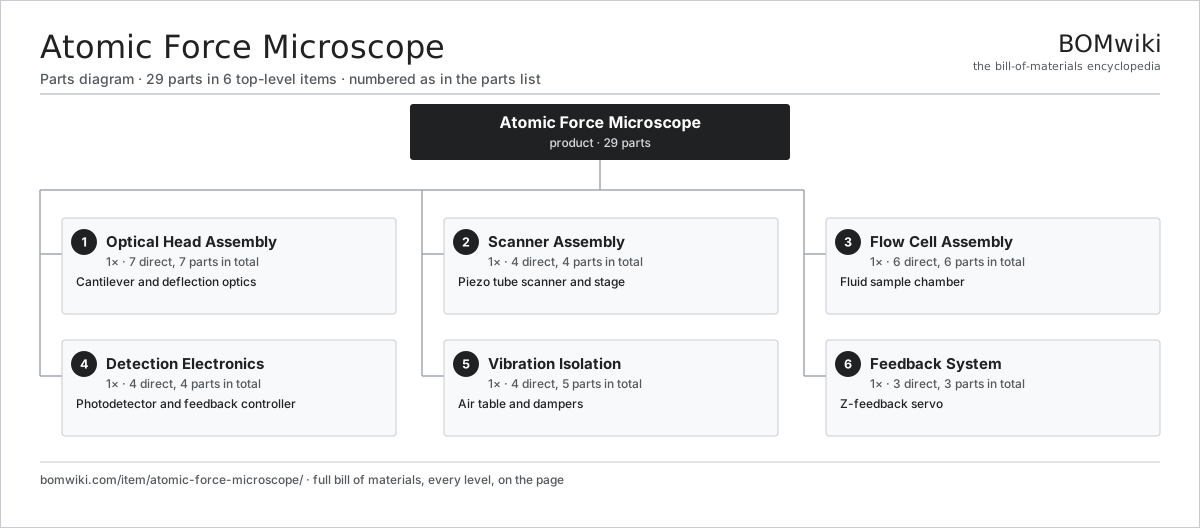
| # | Part | Qty | What it does |
|---|---|---|---|
| 1 | Optical Head Assembly 7 parts | 1× | Cantilever and deflection optics |
| 2 | Scanner Assembly 4 parts | 1× | Piezo tube scanner and stage |
| 3 | Flow Cell Assembly 6 parts | 1× | Fluid sample chamber |
| 4 | Detection Electronics 4 parts | 1× | Photodetector and feedback controller |
| 5 | Vibration Isolation 4 parts | 1× | Air table and dampers |
| 6 | Feedback System 3 parts | 1× | Z-feedback servo |
3D model
No 3D model yet. Have a CAD file of this? Add a 3D model. STL renders right on this page; STEP, FreeCAD, and OpenSCAD sources are welcome too (openly licensed, like all 3D models on BOMwiki).
Build & assembly graph
expand / collapse · shared sub-assemblies converge · links to related products · est. labourTap an assembly to expand/collapse · tap a part to open it · use “Open page” for any node · drag to pan, scroll to zoom.
Bill of materials for Atomic Force Microscope
6 top-level lines · 34 rows shown · 29 parts total · indented to 3 levels| # | Item / sub-assembly | Part no. | Qty/assy | Ext. qty | Parts | Type |
|---|---|---|---|---|---|---|
| 1 | Optical Head Assembly 7 parts | atomic-force-microscope-optical-head | 1× | 1 | 7 | assembly |
| 1.1 | Cantilever Chip | atomic-force-microscope-cantilever-chip | 1× | 1 | · | part |
| 1.2 | Probe Tip | atomic-force-microscope-probe-tip | 1× | 1 | · | part |
| 1.3 | Laser Diode | atomic-force-microscope-laser-diode | 1× | 1 | · | part |
| 1.4 | Laser Mount | atomic-force-microscope-laser-mount | 1× | 1 | · | part |
| 1.5 | Photodiode Array | atomic-force-microscope-photodiode | 1× | 1 | · | part |
| 1.6 | Optical Path | atomic-force-microscope-optical-path | 1× | 1 | · | part |
| 1.7 | Sample Holder | atomic-force-microscope-sample-holder | 1× | 1 | · | part |
| 2 | Scanner Assembly 4 parts | atomic-force-microscope-scanner-assembly | 1× | 1 | 4 | assembly |
| 2.1 | Piezo Tube | atomic-force-microscope-piezo-tube | 1× | 1 | · | part |
| 2.2 | Tube Electrodes | atomic-force-microscope-tube-electrodes | 1× | 1 | · | part |
| 2.3 | Scanner Base | atomic-force-microscope-scanner-base | 1× | 1 | · | part |
| 2.4 | Coarse Stage | atomic-force-microscope-coarse-stage | 1× | 1 | · | part |
| 3 | Flow Cell Assembly 6 parts | atomic-force-microscope-flow-cell | 1× | 1 | 6 | assembly |
| 3.1 | Cell Body | atomic-force-microscope-cell-body | 1× | 1 | · | part |
| 3.2 | Cell Window | atomic-force-microscope-cell-window | 1× | 1 | · | part |
| 3.3 | Inlet Tubing | atomic-force-microscope-inlet-tubing | 1× | 1 | · | part |
| 3.4 | Outlet Tubing | atomic-force-microscope-outlet-tubing | 1× | 1 | · | part |
| 3.5 | Heating Element | atomic-force-microscope-heating-element | 1× | 1 | · | part |
| 3.6 | Temperature Controller | atomic-force-microscope-temperature-controller | 1× | 1 | · | part |
| 4 | Detection Electronics 4 parts | atomic-force-microscope-detection-electronics | 1× | 1 | 4 | assembly |
| 4.1 | Photodiode Preamp | atomic-force-microscope-photodiode-preamp | 1× | 1 | · | part |
| 4.2 | Lock-In Amplifier | atomic-force-microscope-lock-in-amplifier | 1× | 1 | · | part |
| 4.3 | Analog Interface | atomic-force-microscope-analog-interface | 1× | 1 | · | part |
| 4.4 | Signal Processor | atomic-force-microscope-signal-processor | 1× | 1 | · | part |
| 5 | Vibration Isolation 4 parts | atomic-force-microscope-vibration-isolation | 1× | 1 | 5 | assembly |
| 5.1 | Air Table | atomic-force-microscope-air-table | 1× | 1 | · | part |
| 5.2 | Air Pump | atomic-force-microscope-air-pump | 1× | 1 | · | part |
| 5.3 | Vibration Damper | atomic-force-microscope-vibration-damper | 2× | 2 | · | part |
| 5.4 | Cabinet Frame | atomic-force-microscope-cabinet-frame | 1× | 1 | · | part |
| 6 | Feedback System 3 parts | atomic-force-microscope-feedback-system | 1× | 1 | 3 | assembly |
| 6.1 | Feedback Controller | atomic-force-microscope-feedback-controller | 1× | 1 | · | part |
| 6.2 | Setpoint DAC | atomic-force-microscope-setpoint-dac | 1× | 1 | · | part |
| 6.3 | Piezo Driver | atomic-force-microscope-piezo-driver | 1× | 1 | · | part |
Something wrong in this list? Report a problem with this BOM.
Sourcing: possible vendors
Browse the supplier directory → Prices, MOQ, and lead times are algorithmic estimates, not quotes, and not claims about these companies. Company mappings are curated by keyword; est. price band $1k–$500k. How estimates work| Vendor | HQ | Specialty | MOQ | Lead time |
|---|---|---|---|---|
| thermofisher.com ↗ | Waltham, US | Lab instruments | 100 units | 10–18 wks |
|
🇺🇸Agilent
agilent.com ↗
|
Santa Clara, US | Analytical instruments | 100 units | 10–18 wks |
|
🇺🇸Bruker
bruker.com ↗
|
Billerica, US | Scientific instruments | 100 units | 10–18 wks |
|
🇯🇵Shimadzu
shimadzu.com ↗
|
Kyoto, JP | Analytical instruments | 100 units | 10–18 wks |
|
🇺🇸Waters
waters.com ↗
|
Milford, US | Chromatography & MS | 100 units | 10–18 wks |
771-word article