Folding Attic Ladder
ProductOverview
A folding attic ladder packs a full climbing ladder into the thickness of a ceiling. The whole product ships as one boxed unit: a rectangular Hatch Box Frame that lines the rough opening between two trimmed joists, an insulated Insulated Door Panel hinged inside it, and three ladder Folding Ladder Sections folded flat onto the back of that door. Closed, only a white hatch panel and a strip of Architrave Trim Set trim show from the room below. Opened with the hooked Operating Pole, the door swings down on its Door Hinge Set and the sections unfold into a straight ladder reaching the floor at about 60–66 degrees.
The format is standardized enough that European units are tested to EN 14975, which sets the 150 kg rung load, cyclic durability, and dimensional requirements; the comparable US standard is ANSI ASC A14.9. Common opening sizes such as 540 × 1,130 mm are chosen to fit between joists at 600 mm centres with minimal trimming.
How it works
The unopened door carries 20–35 kg of panel and folded ladder, far too much to drop freely. The Spring Counterbalance Mechanism handles this: a tension Coil Spring on each side pulls on a stamped Pivot Arm linked to the door by an Arm Connecting Link. The arm geometry is laid out so the spring's moment about the hinge nearly matches the door's weight moment through the swing. Near closed, the springs win and snap the door up against the Door Latch; near open, gravity wins gently and the door settles onto its rubber-faced Opening End Stop at the working angle. A slotted Spring Anchor Plate gives several hook positions so the installer can retune preload after the ladder is trimmed to length.
The ladder itself is a concertina. The Top Ladder Section bolts permanently to the door skin through Door Mount Bracket angles; the Middle Ladder Section and Bottom Ladder Section fold back over it on steel Section Hinge Plate plates. Each hinge plate folds in one direction only and butts against a stop when the sections are pulled straight, so the deployed ladder behaves as a single rigid stick. Loads pass down the Ladder Stile rails into the rubber Anti-Slip Foot pads and up through the door hinges into the frame, which is why the Frame Side Rail members must be screwed solidly to the joists rather than relying on the Corner Bracket shipping braces.
Door and thermal performance
Because the hatch sits in the thermal envelope of the house, the door is built like a small insulated panel: two Door Skin Panel faces bonded to an Insulation Core of expanded polystyrene or polyurethane, 30–90 mm thick depending on the climate grade. A continuous Perimeter Door Seal gasket compresses against the frame when the Door Latch engages the Latch Keeper Plate, and better units reach airtightness class 4 under EN 12207. This matters more than the U-value in practice; an unsealed hatch leaks warm, moist room air into the cold attic, where it condenses on the underside of the roof. Fire-rated versions substitute intumescent edge seals and mineral cores to achieve EI30 or EI45 ratings for hatches that open into escape routes.
Installation and adjustment
The boxed unit is lifted into the opening, held on temporary battens, packed square with the Installation Shim Set, and screwed through the side rails into the joists. The bottom section is then trimmed: with the upper two sections deployed, the installer measures along the stile line to the floor and cuts the Bottom Ladder Section so all three sections form one straight line. Cutting too short leaves the feet hanging and bends the section hinges under load; the foot caps absorb only a few millimetres of error. Aluminium stiles are closed with an Stile End Cap after cutting.
The optional Handrail Kit clamps a 25 mm Handrail Tube to one stile via Handrail Clamp brackets, giving a grip point through the hatch where climbers transition from rungs to attic floor; this is the highest-risk moment of use and the reason most standards and manufacturers recommend the rail. Routine maintenance is minimal: keep the Hinge Bushing sleeves and Pivot Pin joints lightly greased, check the Ladder Rung rivets annually, and verify the springs still hold the door shut without slamming.
Folding Attic Ladder parts and their functions
8 top-level parts · 82 parts in total · full bill of materials below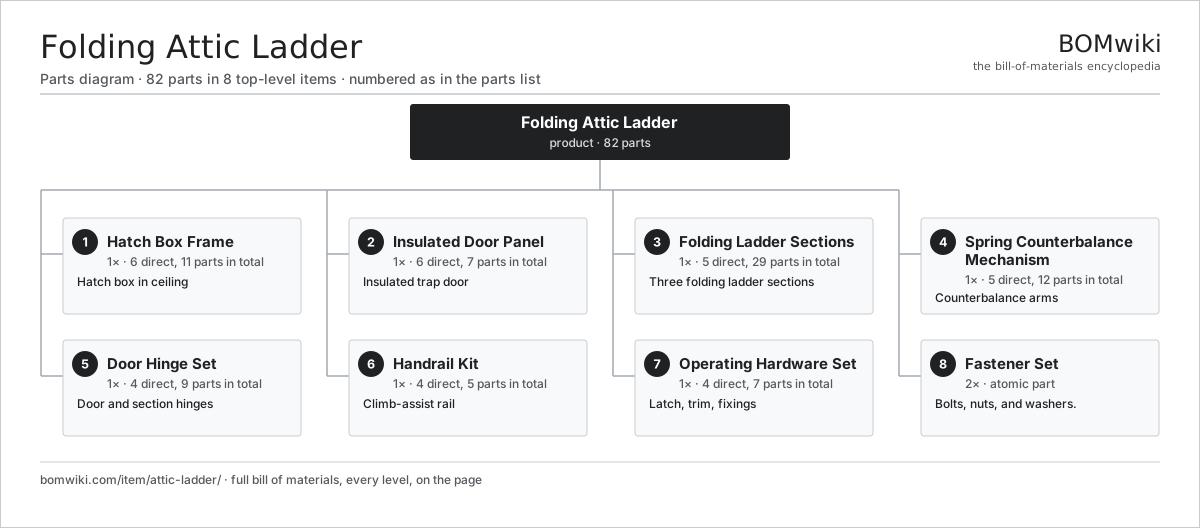
| # | Part | Qty | What it does |
|---|---|---|---|
| 1 | Hatch Box Frame 6 parts | 1× | Hatch box in ceiling |
| 2 | Insulated Door Panel 6 parts | 1× | Insulated trap door |
| 3 | Folding Ladder Sections 5 parts | 1× | Three folding ladder sections |
| 4 | Spring Counterbalance Mechanism 5 parts | 1× | Counterbalance arms |
| 5 | Door Hinge Set 4 parts | 1× | Door and section hinges |
| 6 | Handrail Kit 4 parts | 1× | Climb-assist rail |
| 7 | Operating Hardware Set 4 parts | 1× | Latch, trim, fixings |
| 8 | Fastener Set | 2× | Bolts, nuts, and washers. |
3D model
No 3D model yet. Have a CAD file of this? Add a 3D model. STL renders right on this page; STEP, FreeCAD, and OpenSCAD sources are welcome too (openly licensed, like all 3D models on BOMwiki).
Build & assembly graph
expand / collapse · shared sub-assemblies converge · links to related products · est. labourTap an assembly to expand/collapse · tap a part to open it · use “Open page” for any node · drag to pan, scroll to zoom.
Bill of materials for Folding Attic Ladder
8 top-level lines · 52 rows shown · 82 parts total · indented to 3 levels| # | Item / sub-assembly | Part no. | Qty/assy | Ext. qty | Parts | Type |
|---|---|---|---|---|---|---|
| 1 | Hatch Box Frame 6 parts | attic-ladder-frame | 1× | 1 | 11 | assembly |
| 1.1 | Frame Side Rail | attic-ladder-side-rail-frame | 2× | 2 | · | part |
| 1.2 | Frame End Rail | attic-ladder-end-rail-frame | 2× | 2 | · | part |
| 1.3 | Corner Bracket | attic-ladder-corner-bracket | 4× | 4 | · | part |
| 1.4 | Installation Shim Set | attic-ladder-shim-set | 1× | 1 | · | part |
| 1.5 | Architrave Trim Set | attic-ladder-architrave | 1× | 1 | · | part |
| 1.6 | Fastener Set | fastener-set | 1× | 1 | · | part |
| 2 | Insulated Door Panel 6 parts | attic-ladder-door | 1× | 1 | 7 | assembly |
| 2.1 | Door Skin Panel | attic-ladder-door-skin | 2× | 2 | · | part |
| 2.2 | Insulation Core | attic-ladder-insulation-core | 1× | 1 | · | part |
| 2.3 | Perimeter Door Seal | attic-ladder-door-seal | 1× | 1 | · | part |
| 2.4 | Door Latch | attic-ladder-latch | 1× | 1 | · | part |
| 2.5 | Pole Eyelet Handle | attic-ladder-pull-handle | 1× | 1 | · | part |
| 2.6 | Fastener Set | fastener-set | 1× | 1 | · | part |
| 3 | Folding Ladder Sections 5 parts | attic-ladder-sections | 1× | 1 | 29 | assembly |
| 3.1 | Top Ladder Section 4 parts | attic-ladder-top-section | 1× | 1 | 9 | assembly |
| 3.1.1 | Ladder Stile | attic-ladder-stile | 2× | 2 | · | part |
| 3.1.2 | Ladder Rung | attic-ladder-rung | 4× | 4 | · | part |
| 3.1.3 | Door Mount Bracket | attic-ladder-mount-bracket | 2× | 2 | · | part |
| 3.1.4 | Fastener Set | fastener-set | 1× | 1 | · | part |
| 3.2 | Middle Ladder Section 3 parts | attic-ladder-mid-section | 1× | 1 | 8 | assembly |
| 3.2.1 | Ladder Stile | attic-ladder-stile | 2× | 2 | · | part |
| 3.2.2 | Ladder Rung | attic-ladder-rung | 4× | 4 | · | part |
| 3.2.3 | Section Hinge Plate | attic-ladder-section-hinge | 2× | 2 | · | part |
| 3.3 | Bottom Ladder Section 3 parts | attic-ladder-bottom-section | 1× | 1 | 6 | assembly |
| 3.3.1 | Ladder Stile | attic-ladder-stile | 2× | 2 | · | part |
| 3.3.2 | Ladder Rung | attic-ladder-rung | 3× | 3 | · | part |
| 3.3.3 | Anti-Slip Foot | attic-ladder-foot-set | 1× | 1 | · | part |
| 3.4 | Section Hinge Plate | attic-ladder-section-hinge | 4× | 4 | · | part |
| 3.5 | Anti-Slip Foot | attic-ladder-foot-set | 2× | 2 | · | part |
| 4 | Spring Counterbalance Mechanism 5 parts | attic-ladder-spring-mech | 1× | 1 | 12 | assembly |
| 4.1 | Pivot Arm | attic-ladder-pivot-arm | 2× | 2 | · | part |
| 4.2 | Coil Spring | coil-spring | 2× | 2 | · | part |
| 4.3 | Spring Anchor Plate | attic-ladder-spring-anchor | 2× | 2 | · | part |
| 4.4 | Pivot Pin | attic-ladder-pivot-pin | 4× | 4 | · | part |
| 4.5 | Arm Connecting Link | attic-ladder-arm-link | 2× | 2 | · | part |
| 5 | Door Hinge Set 4 parts | attic-ladder-hinge-set | 1× | 1 | 9 | assembly |
| 5.1 | Main Door Hinge | attic-ladder-door-hinge | 2× | 2 | · | part |
| 5.2 | Hinge Bushing | attic-ladder-hinge-bush | 4× | 4 | · | part |
| 5.3 | Opening End Stop | attic-ladder-end-stop | 2× | 2 | · | part |
| 5.4 | Fastener Set | fastener-set | 1× | 1 | · | part |
| 6 | Handrail Kit 4 parts | attic-ladder-handrail | 1× | 1 | 5 | assembly |
| 6.1 | Handrail Tube | attic-ladder-rail-tube | 1× | 1 | · | part |
| 6.2 | Handrail Clamp | attic-ladder-rail-clamp | 2× | 2 | · | part |
| 6.3 | Handrail Grip Sleeve | attic-ladder-rail-grip | 1× | 1 | · | part |
| 6.4 | Fastener Set | fastener-set | 1× | 1 | · | part |
| 7 | Operating Hardware Set 4 parts | attic-ladder-hardware | 1× | 1 | 7 | assembly |
| 7.1 | Operating Pole | attic-ladder-operating-pole | 1× | 1 | · | part |
| 7.2 | Latch Keeper Plate | attic-ladder-latch-keeper | 1× | 1 | · | part |
| 7.3 | Stile End Cap | attic-ladder-rung-cap | 4× | 4 | · | part |
| 7.4 | Fastener Set | fastener-set | 1× | 1 | · | part |
| 8 | Fastener Set | fastener-set | 2× | 2 | · | part |
Something wrong in this list? Report a problem with this BOM.
Related products
same domain, ranked by shared parts Access Control Panel
52 parts · shares 1 with this page
Automatic Smoke Vent
60 parts · shares 1 with this page
Access Control Panel
52 parts · shares 1 with this page
Automatic Smoke Vent
60 parts · shares 1 with this page
 Automatic Swing Door Operator
43 parts · shares 1 with this page
Automatic Swing Door Operator
43 parts · shares 1 with this page
 Clay Brick Extruder
154 parts · shares 1 with this page
Concrete Pipe Making Machine
154 parts · shares 1 with this page
Clay Brick Extruder
154 parts · shares 1 with this page
Concrete Pipe Making Machine
154 parts · shares 1 with this page
 Deadbolt Assembly
41 parts · shares 1 with this page
Deadbolt Assembly
41 parts · shares 1 with this page
Sourcing: possible vendors
Browse the supplier directory → Prices, MOQ, and lead times are algorithmic estimates, not quotes, and not claims about these companies. Company mappings are curated by keyword; est. price band $50–$10k. How estimates work| Vendor | HQ | Specialty | MOQ | Lead time |
|---|---|---|---|---|
| assaabloy.com ↗ | Stockholm, SE | Locks & access | 1,000 units | 8–12 wks |
|
🇺🇸Allegion
allegion.com ↗
|
Dublin, US | Security products (Schlage) | 1,000 units | 8–12 wks |
| dormakaba.com ↗ | Rümlang, CH | Access & door systems | 1,000 units | 8–12 wks |
| honeywell.com ↗ | Charlotte, US | Building & safety tech | 1,000 units | 8–12 wks |
| hikvision.com ↗ | Hangzhou, CN | Surveillance & security | 1,000 units | 8–12 wks |
764-word article