Auger Drill Rig
ProductOverview
The auger drill rig is a direct-rotation percussion drilling tool that uses a continuously rotating, helical screw (auger) to bore holes through soft and moderately cohesive formations. As the auger flights (the helical blades) rotate, they simultaneously cut soil and rock at the bottom and lift the loosened cuttings up the auger shaft to the surface. The cuttings exit at the top of the auger and are discharged onto a pile or conveyed to a spoil truck.
Auger drilling dominates foundation drilling, exploration drilling for shallow boreholes, and geotechnical site investigation in soft ground. It is fast in clay and silt (drilling 3–8 meters per hour), simple to operate, and produces abundant cuttings samples for lithology identification. The method cannot be used in water-saturated sand (sand flows into the auger flights) or in hard rock (auger flights break easily).
How it works
The auger rig is a track-mounted machine with a vertical Mast Assembly (8–20 m tall). A large hydraulic motor at the top drives the kelly shaft, which couples to the top auger section. The motor rotates the entire auger string at 20–100 RPM with enormous torque (200–500 kN·m at the bit).
As the auger rotates, the cutting teeth at the bottom excavate soil. The continuous helical flight surrounding the auger pipe (the Flight Helix) acts as a screw conveyor: as the auger rotates, the flights push cuttings upward. A single meter of auger flight can lift ~100–200 kg of soil per rotation.
The operator controls downward feed force via hydraulic cylinders (100–200 tonne available). The drilling rate is controlled by modulating feed force and auger rotation speed. Heavy, sticky clay requires high feed force and moderate speed (30–50 RPM) to avoid auger stalling. Sandy clay requires lighter force and higher speed (60–100 RPM) for rapid cuttings lift.
As the hole deepens, additional auger sections are threaded onto the kelly one by one. At 10–20 meter depth, the first section is added; at 20 meters, the second, and so on. Some rigs can handle augers 100+ meters long, though operation becomes difficult (buckling risk, vibration, control challenges).
When the target depth is reached, the drill string must be extracted. The retraction winch (10–50 tonne capacity) grips the auger and slowly pulls it out of the hole while still rotating. The auger comes out in ~10–30 minutes depending on depth. As it exits, cuttings continue to be lifted and discharged.
Key systems
Rotary drive: The Rotary Drive Head is a heavy-duty hydraulic motor rated for continuous high-torque operation. A large displacement variable Hydraulic Motor (300–800 cc/rev) is geared down (typically 4:1 to 8:1) via a Reduction Gearbox to deliver 20–100 RPM at the auger while maintaining 200–500 kN·m torque. The rotation speed is infinitely variable, the operator adjusts it via a proportional directional valve and joystick, fine-tuning based on drilling conditions.
Mast and guides: The Mast Assembly is a heavy steel box section (0.5–1.0 m square, 8–20 m tall) with internal roller or bushing guides at multiple levels. These guides keep the rapidly rotating auger centered and prevent whip (lateral oscillation), which would crack the auger flights. The mast is welded to the main chassis frame and must be extremely rigid, any flex would cause eccentric rotation and rapid auger wear.
Kelly and coupling: The Kelly Drive Shaft is a square or hexagonal hollow shaft (75–100 mm across flats) that couples the rotary motor output to the top auger section. Kelly bushings grip the kelly and transmit torque. A quick-release coupling (square-drive or API-compatible) connects the kelly to the auger with no slippage.
Auger flights: The Auger Flights are stacked 4–10 meter sections of continuous-flight auger pipe. Each section is a hollow steel pipe (150–300 mm OD, 5–10 mm wall) with a continuously welded helical flight (40–80 mm pitch). The flight is typically a flat steel blade welded at an angle to the pipe, forming a screw conveyor. Pitch (distance advanced per rotation) is optimized for soil type: finer pitch (40 mm) for clay (better cuttings lift), coarser pitch (80 mm) for sand (less resistance, faster advance).
Auger Couplings couple successive sections: square-drive (simple, used for small augers) or threaded (stronger, used for deep holes). Each coupling must handle both tension (auger weight being pulled out) and torque (rotation).
Auger bit: The Auger Bit Head is a blunt cutting head with forward-pointing teeth. The bit design varies by formation:
- Clay/silt: relatively blunt "scoop" bit with minimal cutting teeth; clay flows around the bit with minimal effort.
- Sandy clay: sharper "pay-dirt" bit with prominent central teeth to cut sand grains.
- Hard clay/soft rock: carbide-tipped or hardened steel teeth to withstand abrasion.
Gauge teeth on the sides of the bit maintain hole diameter and prevent over-reaming.
Power system: A turbocharged diesel engine (150–250 kW) runs continuously at constant RPM. A variable displacement pump (200–350 cc/rev) supplies flow. As the operator demands higher torque (pushing the joystick harder), the pump increases displacement, supplying more flow to the motor at constant pressure. A hydraulic cooler maintains oil temperature at 45–55 °C.
Cuttings handling: Cuttings are discharged at high velocity from the top of the auger, often into a secondary discharge auger that conveys material away from the rig. The discharge auger is a lower-speed unit (20–30 RPM, driven by a small hydraulic motor) that can handle the high volume (5–15 m³/hour) without overflowing.
Chassis and stability: The Tracked Frame is a heavy tracked frame (30–50 tonne) similar to an excavator. Rubber tracks provide excellent ground grip and low ground pressure. Four hydraulic outrigger jacks level and stabilize the rig, critical because high-torque drilling induces intense reactionary forces that can tip an unleveled rig.
Applications and limitations
Auger drilling is ideal for:
- Foundation drilling: bore holes for building pilings, helical piers, or geothermal loops in clay and silt.
- Environmental investigation: rapid stratigraphic drilling with continuous cuttings samples.
- Shallow geotechnical boring: sampling soil profiles in the upper 100–200 meters.
Auger drilling cannot be used in:
- Water-saturated sand: sand flows into the auger flights, reducing lift and causing stalling.
- Hard rock: auger flights snap under rotational stress.
- Open boreholes in unstable sands: no containment (unlike cased rotary or cable tool), so cave-in is common.
Advantages and disadvantages
Advantages:
- Speed: 3–8 m/h in favorable clay.
- Simple operation: one operator controls everything.
- Abundant cuttings: every meter produces samples for geological logging.
- Low environmental impact: no drilling fluid.
- Mobility: tracked rigs go where trucks cannot.
Disadvantages:
- Cannot drill wet sand: auger flight lift is lost.
- Cannot drill hard rock: auger flights shatter.
- Limited depth: >300 m augers are rare and unstable.
- Cuttings handling: high-speed discharge creates dust and mess; requires secondary discharge system.
- Auger fatigue: continuous high torque causes flights to crack or welds to fail after 1000–2000 hours.
Modern auger rigs with real-time torque monitoring, variable-frequency drive motors, and hardened flights are improving reliability. Advanced high-strength steel augers and carbide-tipped bits extend service life. Despite these advances, auger drilling remains a low-tech, fast, and practical solution for soft-ground drilling in construction and geotechnical applications.
Auger Drill Rig parts and their functions
8 top-level parts · 59 parts in total · full bill of materials below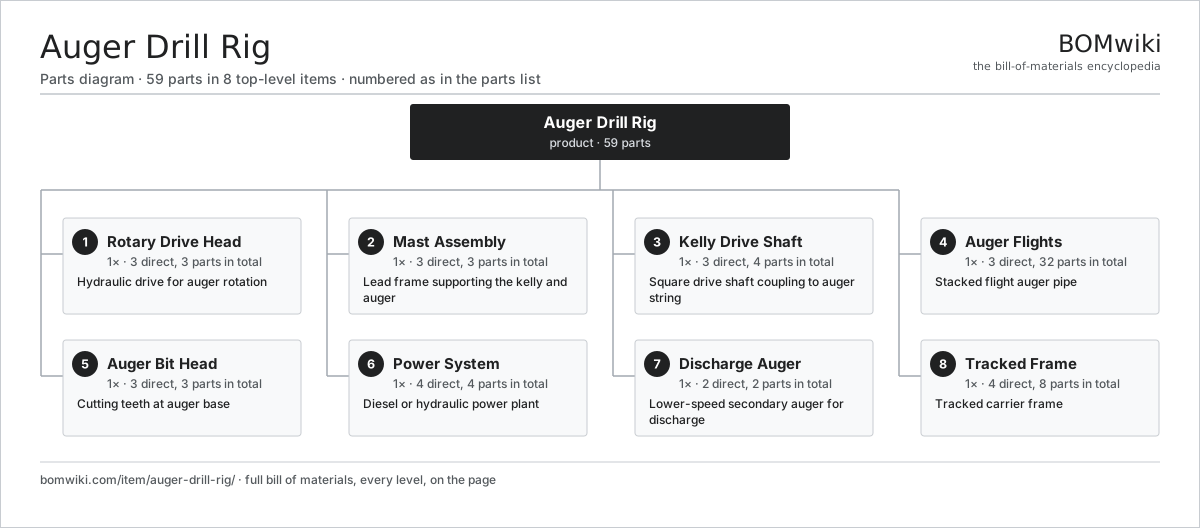
| # | Part | Qty | What it does |
|---|---|---|---|
| 1 | Rotary Drive Head 3 parts | 1× | Hydraulic drive for auger rotation |
| 2 | Mast Assembly 3 parts | 1× | Lead frame supporting the kelly and auger |
| 3 | Kelly Drive Shaft 3 parts | 1× | Square drive shaft coupling to auger string |
| 4 | Auger Flights 3 parts | 1× | Stacked flight auger pipe |
| 5 | Auger Bit Head 3 parts | 1× | Cutting teeth at auger base |
| 6 | Power System 4 parts | 1× | Diesel or hydraulic power plant |
| 7 | Discharge Auger 2 parts | 1× | Lower-speed secondary auger for discharge |
| 8 | Tracked Frame 4 parts | 1× | Tracked carrier frame |
3D model
No 3D model yet. Have a CAD file of this? Add a 3D model. STL renders right on this page; STEP, FreeCAD, and OpenSCAD sources are welcome too (openly licensed, like all 3D models on BOMwiki).
Build & assembly graph
expand / collapse · shared sub-assemblies converge · links to related products · est. labourTap an assembly to expand/collapse · tap a part to open it · use “Open page” for any node · drag to pan, scroll to zoom.
Bill of materials for Auger Drill Rig
8 top-level lines · 33 rows shown · 59 parts total · indented to 3 levels| # | Item / sub-assembly | Part no. | Qty/assy | Ext. qty | Parts | Type |
|---|---|---|---|---|---|---|
| 1 | Rotary Drive Head 3 parts | auger-drill-rig-rotary-drive | 1× | 1 | 3 | assembly |
| 1.1 | Hydraulic Motor | auger-drill-rig-rotary-motor | 1× | 1 | · | part |
| 1.2 | Reduction Gearbox | auger-drill-rig-rotary-gearbox | 1× | 1 | · | part |
| 1.3 | Drive Bearing | auger-drill-rig-rotary-bearing | 1× | 1 | · | part |
| 2 | Mast Assembly 3 parts | auger-drill-rig-mast | 1× | 1 | 3 | assembly |
| 2.1 | Mast Frame | auger-drill-rig-mast-frame | 1× | 1 | · | part |
| 2.2 | Auger Guides | auger-drill-rig-mast-guides | 1× | 1 | · | part |
| 2.3 | Retraction Winch | auger-drill-rig-retract-winch | 1× | 1 | · | part |
| 3 | Kelly Drive Shaft 3 parts | auger-drill-rig-kelly-bar | 1× | 1 | 4 | assembly |
| 3.1 | Kelly Shaft | auger-drill-rig-kelly-shaft | 1× | 1 | · | part |
| 3.2 | Kelly Bushing | auger-drill-rig-kelly-bushing | 2× | 2 | · | part |
| 3.3 | Kelly Coupling | auger-drill-rig-kelly-coupling | 1× | 1 | · | part |
| 4 | Auger Flights 3 parts | auger-drill-rig-auger-sections | 1× | 1 | 32 | assembly |
| 4.1 | Auger Pipe | auger-drill-rig-auger-pipe | 30× | 30 | · | part |
| 4.2 | Flight Helix | auger-drill-rig-flight-helix | 1× | 1 | · | part |
| 4.3 | Auger Couplings | auger-drill-rig-auger-connections | 1× | 1 | · | part |
| 5 | Auger Bit Head 3 parts | auger-drill-rig-auger-bit | 1× | 1 | 3 | assembly |
| 5.1 | Cutting Edge | auger-drill-rig-bit-cutting-edge | 1× | 1 | · | part |
| 5.2 | Bit Body | auger-drill-rig-bit-body | 1× | 1 | · | part |
| 5.3 | Gauge Teeth | auger-drill-rig-bit-gage-teeth | 1× | 1 | · | part |
| 6 | Power System 4 parts | auger-drill-rig-power-unit | 1× | 1 | 4 | assembly |
| 6.1 | Prime Mover | auger-drill-rig-engine | 1× | 1 | · | part |
| 6.2 | Main Pump | auger-drill-rig-main-pump | 1× | 1 | · | part |
| 6.3 | Hydraulic Cooler | auger-drill-rig-cooler | 1× | 1 | · | part |
| 6.4 | Fuel Tank | auger-drill-rig-fuel-tank | 1× | 1 | · | part |
| 7 | Discharge Auger 2 parts | auger-drill-rig-cuttings-auger | 1× | 1 | 2 | assembly |
| 7.1 | Discharge Motor | auger-drill-rig-discharge-motor | 1× | 1 | · | part |
| 7.2 | Discharge Flight | auger-drill-rig-discharge-auger-flight | 1× | 1 | · | part |
| 8 | Tracked Frame 4 parts | auger-drill-rig-track-chassis | 1× | 1 | 8 | assembly |
| 8.1 | Main Frame | auger-drill-rig-frame-chassis | 1× | 1 | · | part |
| 8.2 | Rubber Tracks | auger-drill-rig-rubber-tracks | 2× | 2 | · | part |
| 8.3 | Track Drive Motor | auger-drill-rig-track-motor | 1× | 1 | · | part |
| 8.4 | Stabilizer Jacks | auger-drill-rig-stabilizers | 4× | 4 | · | part |
Something wrong in this list? Report a problem with this BOM.
Sourcing: possible vendors
Browse the supplier directory → Prices, MOQ, and lead times are algorithmic estimates, not quotes, and not claims about these companies. Company mappings are curated by keyword; est. price band $15k–$2M. How estimates work| Vendor | HQ | Specialty | MOQ | Lead time |
|---|---|---|---|---|
| caterpillar.com ↗ | Irving, US | Construction & mining equipment | made to order | 16–28 wks |
|
🇯🇵Komatsu
komatsu.com ↗
|
Tokyo, JP | Construction & mining equipment | made to order | 16–28 wks |
|
🇸🇪Volvo CE
volvoce.com ↗
|
Gothenburg, SE | Construction equipment | made to order | 16–28 wks |
|
🇨🇭Liebherr
liebherr.com ↗
|
Bulle, CH | Cranes & heavy equipment | made to order | 16–28 wks |
|
🇨🇳XCMG
xcmg.com ↗
|
Xuzhou, CN | Construction machinery | made to order | 16–28 wks |
1,331-word article