Climbing Auto-Belay
ProductOverview
An auto-belay is a self-contained device mounted at the top of a climbing wall that replaces a human belayer. As the climber ascends, the Retraction System system winds slack webbing onto a drum, keeping a light constant tension on the line. When the climber lets go, deliberately or in a fall, their weight pulls webbing back off the drum, and the Eddy-Current Brake limits the descent to a gentle 1-2 m/s all the way to the ground. There is no user action at any point: no device to thread, no lever to hold. Modern units use magnetic eddy-current braking, which has no friction surfaces to wear and no engagement parts that can fail to engage.
Eddy-current braking
The brake works on induction. The webbing Webbing Drum drives a conductive Brake Rotor through a speed-increasing Helical Gear Pair, so even a slow descent spins the rotor fast. An array of Neodymium Magnet poles on the Magnet Carrier faces the rotor across a small air gap; relative motion induces eddy currents in the copper or aluminium, and those currents create an opposing field that drags on the rotor. Drag torque rises steeply with speed, which gives the brake its defining property: it is self-regulating. A 150 kg adult and a 15 kg child descend at similar speeds, because the heavier load simply spins the rotor a little faster until drag balances weight. Nothing touches; there are no pads, drums, or clutch faces to wear out, and braking force cannot fade with heat the way friction brakes do, the energy dissipates as resistive heating spread through the rotor body.
To keep climbing effort low, the magnets are mounted on pivoting Centrifugal Arm links held retracted by Coil Spring returns. Below the threshold rotor speed the magnets sit clear of the rotor and the climber feels only the retraction tension; above it, centrifugal force swings the arms out and braking begins. The transition is what a falling climber feels as the brief free drop (typically well under a metre) before the smooth catch.
Retraction
The Power Spring is a flat spiral spring, similar to a large clock mainspring, wound around the Spring Arbor on the Drum Shaft. Its geometry gives near-constant torque across the full 10-12 m of payout, holding roughly 2-5 kg of tension on the line whether the climber is at the floor or the top. The spring must retract faster than anyone can climb, dynamic moves can exceed 1 m/s, because slack in the line converts a caught fall into a shock load. A Pre-tension Lock preserves the factory initial wind, and the Spring Case contains the spring if it fractures. The Level-Wind Guide guide spreads wraps evenly across the drum so the webbing cannot pile up and jam against the housing.
Line and climber interface
The Webbing Line is high-tenacity nylon rated above 15 kN new, inspected daily by gym staff and replaced on a wear schedule; a Wear Sleeve protects the bottom metre, which suffers the most abrasion and UV. At the climber end, the Lanyard End stacks three safeguards: a Stitch Pack whose tear-out stitching rips at a set load to absorb energy if the system is ever shock-loaded, an Swivel Link to stop body rotation twisting the line, and a steel Triple-Action Carabiner requiring three distinct motions to open (EN 362), clipped to the harness belay loop. The single most common auto-belay accident is climbing without clipping in at all, so gyms hang large trapezoidal gates over the start holds that physically must be moved aside, and clipped to, before climbing.
Housing, mounting, and certification
The mechanism lives in a sealed cast-aluminium clamshell (Shell Half pair with O-Ring Set seals) that keeps out chalk dust, the dominant contaminant in climbing gyms. Webbing exits through a flared Exit Nozzle shaped so the line can pull off-axis on overhanging routes without edge-cutting. The Mount Kit hangs the unit from the wall structure plumb above the route through rated Anchor Shackle links, with an independent Backup Sling sling as a redundant load path. Devices are certified to EN 341 class A (descent devices) and ANSI/ASSE Z359, and the Inspection Window shows the recertification date, most manufacturers require the unit back at the factory or a service centre annually, with a 10-year service life ceiling.
Climbing Auto-Belay parts and their functions
7 top-level parts · 49 parts in total · full bill of materials below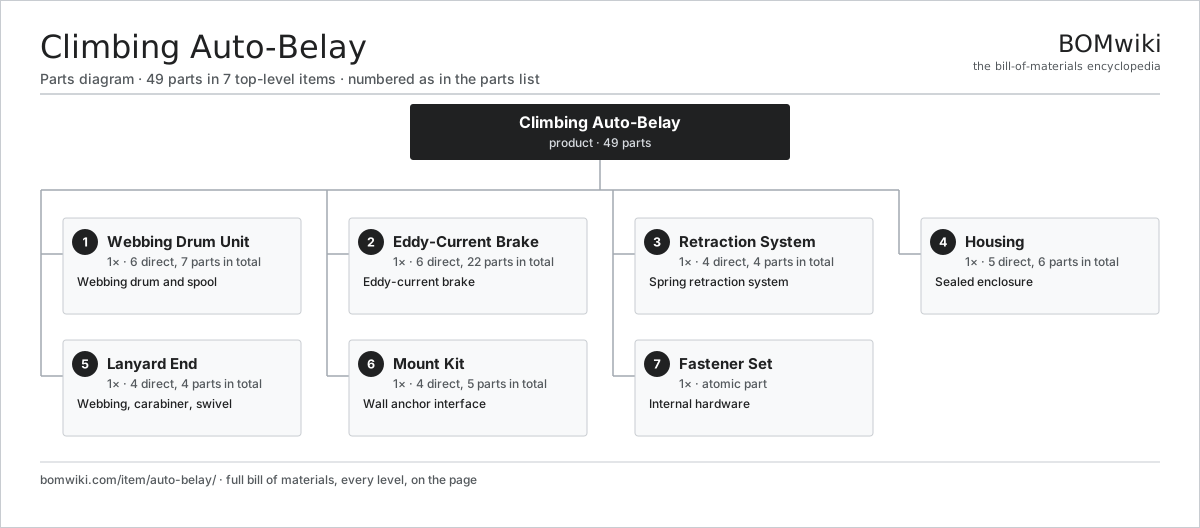
| # | Part | Qty | What it does |
|---|---|---|---|
| 1 | Webbing Drum Unit 6 parts | 1× | Webbing drum and spool |
| 2 | Eddy-Current Brake 6 parts | 1× | Eddy-current brake |
| 3 | Retraction System 4 parts | 1× | Spring retraction system |
| 4 | Housing 5 parts | 1× | Sealed enclosure |
| 5 | Lanyard End 4 parts | 1× | Webbing, carabiner, swivel |
| 6 | Mount Kit 4 parts | 1× | Wall anchor interface |
| 7 | Fastener Set | 1× | Internal hardware |
3D model
No 3D model yet. Have a CAD file of this? Add a 3D model. STL renders right on this page; STEP, FreeCAD, and OpenSCAD sources are welcome too (openly licensed, like all 3D models on BOMwiki).
Build & assembly graph
expand / collapse · shared sub-assemblies converge · links to related products · est. labourTap an assembly to expand/collapse · tap a part to open it · use “Open page” for any node · drag to pan, scroll to zoom.
Bill of materials for Climbing Auto-Belay
7 top-level lines · 36 rows shown · 49 parts total · indented to 3 levels| # | Item / sub-assembly | Part no. | Qty/assy | Ext. qty | Parts | Type |
|---|---|---|---|---|---|---|
| 1 | Webbing Drum Unit 6 parts | auto-belay-drum-unit | 1× | 1 | 7 | assembly |
| 1.1 | Webbing Drum | auto-belay-drum | 1× | 1 | · | part |
| 1.2 | Webbing Line | auto-belay-webbing | 1× | 1 | · | part |
| 1.3 | Drum Shaft | auto-belay-drum-shaft | 1× | 1 | · | part |
| 1.4 | Helical Gear Pair | gear-pair | 1× | 1 | · | part |
| 1.5 | Ball Bearing | ball-bearing | 2× | 2 | · | part |
| 1.6 | Level-Wind Guide | auto-belay-level-wind | 1× | 1 | · | part |
| 2 | Eddy-Current Brake 6 parts | auto-belay-brake-unit | 1× | 1 | 22 | assembly |
| 2.1 | Brake Rotor | auto-belay-brake-rotor | 1× | 1 | · | part |
| 2.2 | Neodymium Magnet | neodymium-magnet | 12× | 12 | · | part |
| 2.3 | Magnet Carrier | auto-belay-magnet-carrier | 1× | 1 | · | part |
| 2.4 | Centrifugal Arm | auto-belay-centrifugal-arm | 3× | 3 | · | part |
| 2.5 | Coil Spring | coil-spring | 3× | 3 | · | part |
| 2.6 | Ball Bearing | ball-bearing | 2× | 2 | · | part |
| 3 | Retraction System 4 parts | auto-belay-retraction | 1× | 1 | 4 | assembly |
| 3.1 | Power Spring | auto-belay-power-spring | 1× | 1 | · | part |
| 3.2 | Spring Arbor | auto-belay-spring-arbor | 1× | 1 | · | part |
| 3.3 | Spring Case | auto-belay-spring-case | 1× | 1 | · | part |
| 3.4 | Pre-tension Lock | auto-belay-pretension-lock | 1× | 1 | · | part |
| 4 | Housing 5 parts | auto-belay-housing | 1× | 1 | 6 | assembly |
| 4.1 | Shell Half | auto-belay-shell-half | 2× | 2 | · | part |
| 4.2 | Exit Nozzle | auto-belay-exit-nozzle | 1× | 1 | · | part |
| 4.3 | Inspection Window | auto-belay-inspection-window | 1× | 1 | · | part |
| 4.4 | O-Ring Set | oring-set | 1× | 1 | · | part |
| 4.5 | Fastener Set | fastener-set | 1× | 1 | · | part |
| 5 | Lanyard End 4 parts | auto-belay-lanyard-end | 1× | 1 | 4 | assembly |
| 5.1 | Triple-Action Carabiner | auto-belay-carabiner | 1× | 1 | · | part |
| 5.2 | Swivel Link | auto-belay-swivel | 1× | 1 | · | part |
| 5.3 | Stitch Pack | auto-belay-stitch-pack | 1× | 1 | · | part |
| 5.4 | Wear Sleeve | auto-belay-wear-sleeve | 1× | 1 | · | part |
| 6 | Mount Kit 4 parts | auto-belay-mount-kit | 1× | 1 | 5 | assembly |
| 6.1 | Mount Bracket | auto-belay-mount-bracket | 1× | 1 | · | part |
| 6.2 | Anchor Shackle | auto-belay-anchor-shackle | 2× | 2 | · | part |
| 6.3 | Backup Sling | auto-belay-backup-loop | 1× | 1 | · | part |
| 6.4 | Fastener Set | fastener-set | 1× | 1 | · | part |
| 7 | Fastener Set | fastener-set | 1× | 1 | · | part |
Something wrong in this list? Report a problem with this BOM.
Related products
same domain, ranked by shared parts Anti-Gravity Treadmill
96 parts · shares 2 with this page
Anti-Gravity Treadmill
96 parts · shares 2 with this page
 Adjustable Weight Bench
38 parts · shares 1 with this page
Adjustable Weight Bench
38 parts · shares 1 with this page
 Glute-Ham Developer
41 parts · shares 1 with this page
Hydraulic Circuit Trainer
61 parts · shares 1 with this page
Glute-Ham Developer
41 parts · shares 1 with this page
Hydraulic Circuit Trainer
61 parts · shares 1 with this page
 Rowing Machine
60 parts · shares 2 with this page
Rowing Machine
60 parts · shares 2 with this page
Sourcing: possible vendors
Browse the supplier directory → Prices, MOQ, and lead times are algorithmic estimates, not quotes, and not claims about these companies. Company mappings are curated by keyword; est. price band $100–$10k. How estimates work| Vendor | HQ | Specialty | MOQ | Lead time |
|---|---|---|---|---|
| lifefitness.com ↗ | Rosemont, US | Fitness equipment | 200 units | 8–14 wks |
| technogym.com ↗ | Cesena, IT | Fitness equipment | 200 units | 8–14 wks |
|
🇺🇸Peloton
onepeloton.com ↗
|
New York, US | Connected fitness | 200 units | 8–14 wks |
| johnsonhealthtech.com ↗ | Taichung, TW | Fitness (Matrix) | 200 units | 8–14 wks |
|
🇺🇸Precor
precor.com ↗
|
Woodinville, US | Fitness equipment | 200 units | 8–14 wks |
778-word article