Canning Line
ProductOverview
An automatic canning line is the fully integrated production system where empty cans enter one end and finished, labeled, and case-packed cans exit the other. The machinery handles depalletizing, singulation, filling with product, seaming lids, sterilization, labeling, and case-packing in a synchronized choreography, with each station timed to operate at the target throughput (50–200 cans/minute). The complexity lies not in any single machine, each component (filler, seamer, retort, labeler) is well-established, but in the coordination between them. Since retorts operate in batch cycles (30–60 minute residence time) while fillers and seamers operate continuously, the line requires accumulator buffers and indexing logic to smooth the workflow.
How it works
Depalletizing: A robotic arm with vacuum gripper or rotating turntable unloads layers of empty cans from pallets, depositing them onto an infeed hopper. A surge buffer (500–2,000 can capacity) decouples the depalletizer rhythm from the downstream line, allowing the robot to work at its own pace.
Singulation: A vibratory feeder orients cans into single-file rows. Spiral tracks inside the hopper prevent jamming and orient cans upright. An escapement gate (solenoid or air-actuated) releases one can per pulse into the main conveyor. A short centering belt ensures cans are aligned to the line centerline.
Filling: A rotary or linear indexing filler (typically six fill heads on a rotating turret) dispenses product into upright cans resting on a conveyor. Piston or peristaltic pump heads meter volume precisely (within ±5 mL). A product hopper (50–200 liter, stainless steel) maintains the product at controlled temperature (cooled for heat-sensitive items, heated for thick products). Vacuum-assist (optional) draws a weak vacuum in the can headspace before filling, reducing aeration and foam.
Seaming: Immediately after filling, the can rises into the double seamer's chuck. The synchronized seaming cycle (first op, second op) is triggered by a servo indexer that reads the line conveyor speed from a proximity sensor and adjusts seamer lift timing to ±2 milliseconds. This ensures cans are lifted into the rolls at the correct phase. A dedicated coolant chiller maintains roll temperature within ±3 °F, critical for consistent seam quality.
Accumulator and retort handoff: After seaming, sealed cans travel to an accumulator buffer (gravity or powered roller accumulator, 200–500 can capacity). The retort operates in batch cycles (e.g., 60 minutes total: 15 min come-up, 30 min hold, 15 min cool-down). The line PLC monitors the accumulator level and pauses the upstream (filler/seamer) stations when the accumulator is full, resuming when space opens (retort basket pushed out). A pneumatic or servo pusher transfers cans from the accumulator into the retort loading conveyor in blocks of 20–50 cans.
Labeling: After retort cooling, cans exit to the labeler, which applies front and back labels (or wrap labels for round cans). A two-head system is typical: front labels are applied as the can rotates under a pressure roller, then the can is rotated 180° and the back label applied. Pressure-sensitive adhesive (PSA) labels stick on contact; hot-melt labels require a heater pump.
Casing: Finished, labeled cans are pushed by a gripper or belt into collating trays or into a case-packing machine (which arranges cans in rows and stacks them into cardboard cases).
Control and coordination: A master PLC (Siemens S7-1200 or higher) monitors all stations via distributed I/O blocks. Each station (filler, seamer, retort, labeler) reports via Profibus or Ethernet. The PLC manages speed ramps, accumulator levels, solenoid/motor on-off timing, and emergency stops. A touch HMI displays production counts (good/reject), throughput, and alarm codes. Data logs production runs for traceability (FDA 21 CFR Part 11 compliance).
Synchronization challenges
Asynchronous stations: The retort is inherently asynchronous, it operates in discrete batch cycles independent of line speed. The line solves this via accumulators. When the retort is processing, the filler/seamer continues running, filling the accumulator. When the retort unloads and is ready for the next basket, the accumulator pushes its contents into the loading conveyor.
Seaming synchronization: The trickiest synchronization is seaming, because the seaming cycle must align with the line conveyor speed. If the seamer lifts the can at the wrong time (too early or too late), the can may not reach the correct height in the rolls, causing a poor seam. Solution: a servo indexer reads line speed from a proximity sensor (e.g., one pulse per can) and adjusts the seamer lift trigger in real-time, maintaining ±2 ms accuracy.
Filler-to-seamer: The filler deposits a can on the conveyor, which then travels (usually 2–5 seconds) to the seamer. If the filler rhythm is too fast, cans bunch up; if too slow, gaps appear. The filler speed is typically set slightly slower than the line speed, ensuring small gaps that the accumulator absorbs.
Common issues and troubleshooting
Retort bottleneck: If the retort cycle is too long (>2 hours total), the line spends a lot of idle time waiting to unload, reducing overall throughput. Solution: increase retort batch size or run smaller, faster retorts in parallel (two retorts with a switching interface).
Seam defects: Skewed or weak seams indicate seamer synchronization loss. Check the servo indexer sensor, verify line conveyor speed, and inspect seaming rolls for wear. Mismatched coolant temperature (>65 °F) also causes galling; check chiller effectiveness.
Filler overfill: If cans are slightly overfilled (>10 mL above target), the product foams during retort sterilization, pushing product past the seam into the headspace. Solution: calibrate filler piston length and tank pressure; reduce fill rate if product is aerated.
Label wrinkles: Wrinkled labels indicate misalignment or excessive pressure. Check that the can is centered on the labeler turret; verify pressure-roller preload; ensure label roll tension is correct.
Throughput calculations
For a 100 cans/minute target:
- Filler: 100 cans/min ÷ 6 heads = 16.7 cans per head per minute = 3.6 seconds per cycle.
- Seamer: synchronized to match filler (3.6 second pitch between cans).
- Retort: if batch is 500 cans and cycle is 60 minutes, retort output is 500/60 = 8.3 cans/min (much slower). Accumulator must supply line while retort is blocked, requiring 92 cans/min × 50 min = 4,600 can buffer capacity.
In practice, a 100 can/min line with a single batch retort will operate in a sawtooth pattern: fill fast for 40 minutes, pause while retort cycles, then resume.
Energy and efficiency
Total power draw is 30–60 kW depending on line size and retort type. A typical 8-hour shift running at 80% utilization (accounting for changeover, cleaning, stoppages) processes ~70,000–140,000 cans per day. At $0.05/kWh, energy cost is $40–$80 per day, or $10,000–$20,000 annually. Labor is 2–4 operators per shift for monitoring, troubleshooting, and case-packing.
Canning Line parts and their functions
8 top-level parts · 126 parts in total · full bill of materials below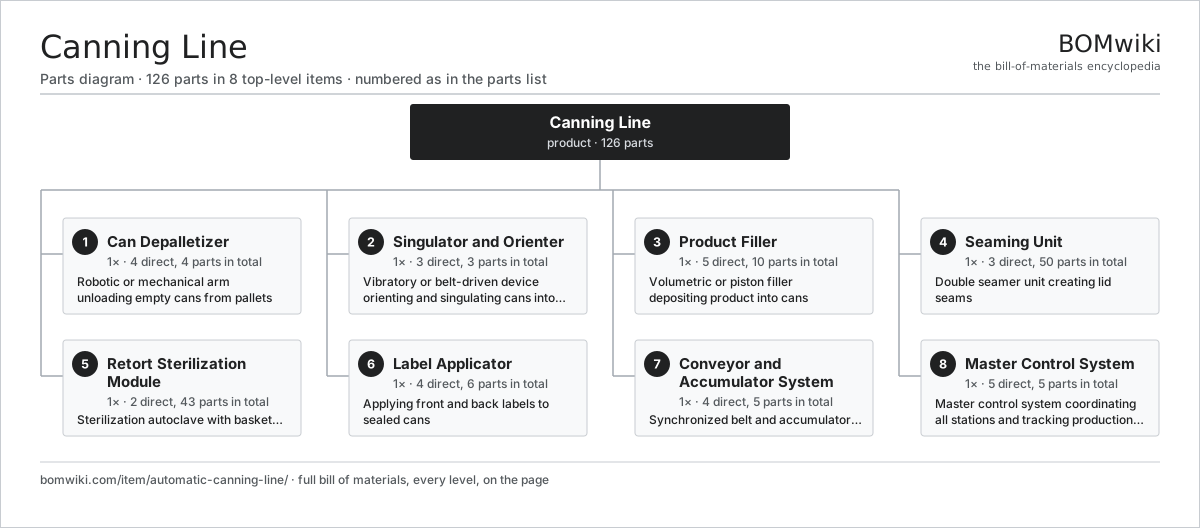
| # | Part | Qty | What it does |
|---|---|---|---|
| 1 | Can Depalletizer 4 parts | 1× | Robotic or mechanical arm unloading empty cans from pallets |
| 2 | Singulator and Orienter 3 parts | 1× | Vibratory or belt-driven device orienting and singulating cans into main conveyor |
| 3 | Product Filler 5 parts | 1× | Volumetric or piston filler depositing product into cans |
| 4 | Seaming Unit 3 parts | 1× | Double seamer unit creating lid seams |
| 5 | Retort Sterilization Module 2 parts | 1× | Sterilization autoclave with basket indexing system |
| 6 | Label Applicator 4 parts | 1× | Applying front and back labels to sealed cans |
| 7 | Conveyor and Accumulator System 4 parts | 1× | Synchronized belt and accumulator conveyors moving cans between stations |
| 8 | Master Control System 5 parts | 1× | Master control system coordinating all stations and tracking production data |
3D model
No 3D model yet. Have a CAD file of this? Add a 3D model. STL renders right on this page; STEP, FreeCAD, and OpenSCAD sources are welcome too (openly licensed, like all 3D models on BOMwiki).
Build & assembly graph
expand / collapse · shared sub-assemblies converge · links to related products · est. labourTap an assembly to expand/collapse · tap a part to open it · use “Open page” for any node · drag to pan, scroll to zoom.
Bill of materials for Canning Line
8 top-level lines · 54 rows shown · 126 parts total · indented to 3 levels| # | Item / sub-assembly | Part no. | Qty/assy | Ext. qty | Parts | Type |
|---|---|---|---|---|---|---|
| 1 | Can Depalletizer 4 parts | automatic-canning-line-depalletizer | 1× | 1 | 4 | assembly |
| 1.1 | Robot Arm | automatic-canning-line-robot-arm | 1× | 1 | · | part |
| 1.2 | Multi-Cup Gripper | automatic-canning-line-gripper-head | 1× | 1 | · | part |
| 1.3 | Pallet Conveyor | automatic-canning-line-pallet-dispenser | 1× | 1 | · | part |
| 1.4 | Can Buffer Hopper | automatic-canning-line-empty-can-buffer | 1× | 1 | · | part |
| 2 | Singulator and Orienter 3 parts | automatic-canning-line-singulator | 1× | 1 | 3 | assembly |
| 2.1 | Large Vibratory Bowl | automatic-canning-line-vibratory-bowl-large | 1× | 1 | · | part |
| 2.2 | Escapement Gate Valve | automatic-canning-line-escapement-gate | 1× | 1 | · | part |
| 2.3 | Centering Belt | automatic-canning-line-centering-belt | 1× | 1 | · | part |
| 3 | Product Filler 5 parts | automatic-canning-line-filler | 1× | 1 | 10 | assembly |
| 3.1 | Fill Pump Heads | automatic-canning-line-fill-heads | 6× | 6 | · | part |
| 3.2 | Filler Drive Motor | automatic-canning-line-fill-motor | 1× | 1 | · | part |
| 3.3 | Product Hopper | automatic-canning-line-product-tank | 1× | 1 | · | part |
| 3.4 | Tank Level Sensor | automatic-canning-line-level-sensor | 1× | 1 | · | part |
| 3.5 | Vacuum Assist System | automatic-canning-line-vacuum-assist | 1× | 1 | · | part |
| 4 | Seaming Unit 3 parts | automatic-canning-line-seamer | 1× | 1 | 50 | assembly |
| 4.1 | Double Seamer 8 parts | seamer-can-double | 1× | 1 | 48 | product |
| 4.1.1 | Base Frame Assembly 4 parts + deeper › | seamer-can-double-base-frame | 1× | 1 | 11 | assembly |
| 4.1.2 | Expanding Chuck System 4 parts + deeper › | seamer-can-double-chuck-system | 1× | 1 | 4 | assembly |
| 4.1.3 | Lifter Cam Mechanism 5 parts + deeper › | seamer-can-double-lifter-cam | 1× | 1 | 6 | assembly |
| 4.1.4 | First Operation Seaming Head 5 parts + deeper › | seamer-can-double-first-op-head | 1× | 1 | 6 | assembly |
| 4.1.5 | Second Operation Seaming Head 5 parts + deeper › | seamer-can-double-second-op-head | 1× | 1 | 6 | assembly |
| 4.1.6 | Lid Feed and Escapement System 5 parts + deeper › | seamer-can-double-feed-system | 1× | 1 | 5 | assembly |
| 4.1.7 | Main Drive Motor and Gearbox 5 parts + deeper › | seamer-can-double-drive-motor | 1× | 1 | 5 | assembly |
| 4.1.8 | Roll Cooling System 5 parts + deeper › | seamer-can-double-cooling-system | 1× | 1 | 5 | assembly |
| 4.2 | Seamer Indexing Servo | automatic-canning-line-seamer-indexing | 1× | 1 | · | part |
| 4.3 | Seamer Coolant Chiller | automatic-canning-line-seamer-coolant-system | 1× | 1 | · | part |
| 5 | Retort Sterilization Module 2 parts | automatic-canning-line-retort | 1× | 1 | 43 | assembly |
| 5.1 | Retort Autoclave 8 parts | retort-autoclave-canning | 1× | 1 | 42 | product |
| 5.1.1 | Pressure Vessel Chamber 5 parts + deeper › | retort-autoclave-canning-pressure-vessel | 1× | 1 | 6 | assembly |
| 5.1.2 | Steam Generation and Injection System 5 parts + deeper › | retort-autoclave-canning-steam-system | 1× | 1 | 5 | assembly |
| 5.1.3 | Basket Car Indexing System 5 parts + deeper › | retort-autoclave-canning-basket-car-system | 1× | 1 | 5 | assembly |
| 5.1.4 | Temperature Monitoring and Control 5 parts + deeper › | retort-autoclave-canning-temperature-control | 1× | 1 | 7 | assembly |
| 5.1.5 | Pressure Monitoring and Relief 5 parts + deeper › | retort-autoclave-canning-pressure-monitoring | 1× | 1 | 5 | assembly |
| 5.1.6 | Post-Sterilization Cooling System 5 parts + deeper › | retort-autoclave-canning-cooling-system | 1× | 1 | 5 | assembly |
| 5.1.7 | Door Lock and Safety Interlock 5 parts + deeper › | retort-autoclave-canning-door-lock | 1× | 1 | 5 | assembly |
| 5.1.8 | Condensate and Drainage System 4 parts + deeper › | retort-autoclave-canning-drainage | 1× | 1 | 4 | assembly |
| 5.2 | Retort Interface Buffer | automatic-canning-line-retort-conveyor-interface | 1× | 1 | · | part |
| 6 | Label Applicator 4 parts | automatic-canning-line-labeler | 1× | 1 | 6 | assembly |
| 6.1 | Label Feeder Roll | automatic-canning-line-label-feeder | 2× | 2 | · | part |
| 6.2 | Pressure Roller | automatic-canning-line-label-roller | 2× | 2 | · | part |
| 6.3 | Labeler Drive Motor | automatic-canning-line-label-motor | 1× | 1 | · | part |
| 6.4 | Adhesive System | automatic-canning-line-adhesive-applicator | 1× | 1 | · | part |
| 7 | Conveyor and Accumulator System 4 parts | automatic-canning-line-conveyor-system | 1× | 1 | 5 | assembly |
| 7.1 | Main Transport Belt | automatic-canning-line-main-conveyor | 1× | 1 | · | part |
| 7.2 | Gravity Accumulator | automatic-canning-line-accumulator-module | 2× | 2 | · | part |
| 7.3 | Main Line Motor | automatic-canning-line-conveyor-drive-motor | 1× | 1 | · | part |
| 7.4 | Accumulator Pusher | automatic-canning-line-can-pusher | 1× | 1 | · | part |
| 8 | Master Control System 5 parts | automatic-canning-line-control-plc | 1× | 1 | 5 | assembly |
| 8.1 | Master PLC | automatic-canning-line-master-plc | 1× | 1 | · | part |
| 8.2 | HMI Touch Panel | automatic-canning-line-hmi-screen | 1× | 1 | · | part |
| 8.3 | Distributed I/O Terminals | automatic-canning-line-distributed-io | 1× | 1 | · | part |
| 8.4 | Safety Relay | automatic-canning-line-emergency-stop | 1× | 1 | · | part |
| 8.5 | Production Meter | automatic-canning-line-production-counter | 1× | 1 | · | part |
Something wrong in this list? Report a problem with this BOM.
Related products
same domain, ranked by shared parts Retort Autoclave
42 parts · shares 47 with this page
Retort Autoclave
42 parts · shares 47 with this page
 Double Seamer
48 parts · shares 46 with this page
Aseptic Filler
1,020 parts · shares 1 with this page
Double Seamer
48 parts · shares 46 with this page
Aseptic Filler
1,020 parts · shares 1 with this page
 Automatic Espresso Tamper
45 parts · shares 1 with this page
Automatic Filleting Machine
73 parts · shares 1 with this page
Automatic Espresso Tamper
45 parts · shares 1 with this page
Automatic Filleting Machine
73 parts · shares 1 with this page
 Bakery Deck Oven
44 parts · shares 1 with this page
Bakery Deck Oven
44 parts · shares 1 with this page
Sourcing: possible vendors
Browse the supplier directory → Prices, MOQ, and lead times are algorithmic estimates, not quotes, and not claims about these companies. Company mappings are curated by keyword; est. price band $1k–$500k. How estimates work| Vendor | HQ | Specialty | MOQ | Lead time |
|---|---|---|---|---|
| gea.com ↗ | Düsseldorf, DE | Process technology | 20 units | 12–20 wks |
| buhlergroup.com ↗ | Uzwil, CH | Food & materials processing | 20 units | 12–20 wks |
| tetrapak.com ↗ | Pully, CH | Food packaging & processing | 20 units | 12–20 wks |
| jbtc.com ↗ | Chicago, US | Food processing equipment | 20 units | 12–20 wks |
| alfalaval.com ↗ | Lund, SE | Heat transfer & separation | 20 units | 12–20 wks |
1,136-word article