Automatic Fish Scaler
ProductOverview
An automatic fish scaler is a motorized abrasion machine that removes scales from freshly caught fish without damaging the underlying flesh. The device centers on a rotating stainless steel drum with transverse ridges that mechanically disrupt the scale-skin adhesion. The operator positions a live fish in the feed chute, which slides the fish against the spinning drum. Water spray simultaneously washes the loosened scales into a collection basin. The entire process takes 30–60 seconds per fish, far faster than manual scaling and with less flesh damage.
Drum Design and Abrasion Mechanism
The drum is the active element, a stainless steel 304 cylinder 4 inches in diameter and 6 inches wide, rotated at 600–1800 rpm by a motor-driven gearbox. The drum surface is machined with transverse ridges running perpendicular to the axis, ridges 0.5 inches tall separated by 0.25-inch valleys. This ridge-and-valley pattern is critical: when the fish is pressed against the drum, the ridges engage the scale bases and provide horizontal abrasion, while the valleys allow water to drain and prevent jamming.
The drum rotates such that the top surface moves toward the operator. As the fish presses against the drum (via the feed chute), the surface ridges abrade the scale bases. Fish scales are composed of collagen fibrils loosely anchored to the skin; the abrasion ruptures these fibrils, and the loosened scales are swept away by water spray.
The mechanical advantage of the drum is its peripheral speed. At 360 rpm (typical operating speed after 5:1 gearbox reduction), a 4-inch-diameter drum has a surface speed of π × 4 inches × 360 rpm = 4,523 inches per minute ≈ 377 feet per minute. This speed is fast enough to abrade scales efficiently but slow enough (below ~500 ft/min) to avoid lacerating flesh.
Scale Removal Efficiency and Fish Damage
Scale removal efficiency depends on species, fish size, and drum speed:
- Salmon and trout (soft scales): 30–45 seconds, >98% removal, <1% flesh damage.
- Bass and perch (medium scales): 45–60 seconds, 95% removal, 1–2% flesh damage.
- Catfish (few or no scales): 5 seconds for wash only, 0% scale removal (not applicable).
Fish size matters: small fish (0.5–1 lb) scale faster than large fish (10+ lb) because the feed chute can't position a large body evenly against the drum. Most commercial scalers include an adjustable depth plate that limits penetration, ensuring even contact along the drum width.
Flesh damage is minimal when operating at optimal speed (300–400 rpm) because the abrasion is diffuse across many ridges and the drum curvature prevents point loads. Operating too fast (>1000 rpm) causes lateral tearing and discoloration. Operating too slow (<200 rpm) requires excessive pressure and contact time, also causing damage.
Water System and Scale Management
The water system continuously sprays the drum and fish at 20 psi with 10–20 gpm flow. Two spray nozzles, one fixed and one rotating, deliver water to the drum surface and fish simultaneously. The water serves multiple purposes:
- Scale removal: High-pressure spray dislodges loosened scales from the drum surface.
- Fish cooling: Water keeps the fish from drying and reduces stress.
- Drum cleaning: Water flushes scale debris from the drum ridges, preventing buildup.
- Product recovery: Scales are valuable for cosmetics (scale-derived collagen) and animal feeds, so most commercial scalers recirculate water through a fine mesh strainer to trap and separate scales.
The catch basin slopes toward a drain valve at the low point. Gravity and the sloped bottom direct scales toward the drain, while an Archimedes screw can be optionally installed to actively push accumulated scales toward a discharge port. Without active discharge, manual clearing via the drain valve is necessary every 200–400 fish.
Motor and Transmission
The motor and gearbox is the power train. A 1.0 hp single-phase AC motor (1800 rpm, 120/240V) is connected via a flexible coupling to a worm-and-wheel gearbox with a 5:1 reduction ratio. This outputs approximately 360 rpm, optimal for most fish species.
A variable-frequency drive (VFD) allows the operator to adjust drum speed from 200 to 1800 rpm without replacing the motor. Lower speeds are used for delicate fish or hand-held operation; higher speeds are used for bulk processing. Modern scalers include a digital tachometer on the control panel displaying drum speed in real-time, allowing the operator to dial in the ideal speed for the species and size being processed.
Frame and Vibration Isolation
The entire assembly is mounted on a welded stainless steel frame that sits at bench height (36 inches to the drum center), allowing operators to feed fish comfortably. The frame includes elastomeric vibration isolators beneath the drum assembly, damping vibration and reducing noise to acceptable levels (typically 75–80 dB). Safety guards enclose the drum to prevent accidental hand contact.
Operating Sequence
Typical operation:
Start the machine: Operator presses the green start button. The drum accelerates to target speed (adjust via speed dial if needed).
Position the fish: Operator places a live fish head-first into the feed chute. The fish's natural thrashing pushes it toward the drum.
Scaling: The fish is pressed against the spinning drum by gravity and water pressure. In 30–60 seconds, scales are visibly removed from the head and body.
Discharge: Operator withdraws the fish by hand or allows it to slide out the bottom of the chute. The fish emerges scaled, wet, and calm (though alive until headed and gutted downstream).
Repeat: Operator feeds the next fish immediately, achieving a throughput of 200–400 fish per hour (depending on size).
Maintenance and Cleaning
Daily:
- Flush the drum and chute with fresh water after final use.
- Check drum surface for scale buildup; manual brush-cleaning if needed.
- Empty the catch basin drain valve.
Weekly:
- Inspect the drum bearings for leakage; tighten seals if needed.
- Check spray nozzles for clogs; clean or replace if spray pattern degrades.
Yearly:
- Replace drum seals and bearing lubrication.
- Inspect gearbox oil level and top up if needed.
- Re-sharpen or replace the drum if ridges wear below 0.3 inches height (indicates ~5,000+ fish processed).
Proper maintenance extends drum life to 5,000–10,000 fish. Replacement drums cost $300–$500.
Commercial and Scientific Use
Fish scalers are essential equipment in:
Commercial fisheries: Canneries and fish processors scale thousands of fish per day. Industrial scalers process 2,000+ fish per 8-hour shift.
Aquaculture: Fish farms scale harvest before processing. Automatic scaling reduces labor cost and ensures consistent product quality.
Research: Fisheries scientists scale fish to measure growth (scale growth rings are read under microscope), examine age structure, and assess population health. Scales are non-destructive (taken pre-processing), preserving the fish for further analysis.
The automatic scaler has become standard in the seafood industry, replacing hand-scaling labor (tedious, low pay) with mechanization that is faster, more consistent, and less fatiguing for workers.
Scale Recovery and Byproduct Value
Scales removed by the scaler are collected and separated from water by the strainer basket. Scales can be:
- Iridescent pigments: Guanine extracted from scales is used in cosmetics, nail polish, and automotive paint.
- Gelatin and collagen: Processed into supplements and skincare products.
- Animal feed additive: Whole scales are dried and added to pet food or livestock feed for calcium and minerals.
A typical 8-pound salmon yields 0.5–1 ounce of scales. At current market prices ($1–$3 per ounce), scale recovery generates $100–$400 per ton of fish processed, offsetting 10–20% of processing labor cost in high-volume facilities.
Automatic Fish Scaler parts and their functions
7 top-level parts · 39 parts in total · full bill of materials below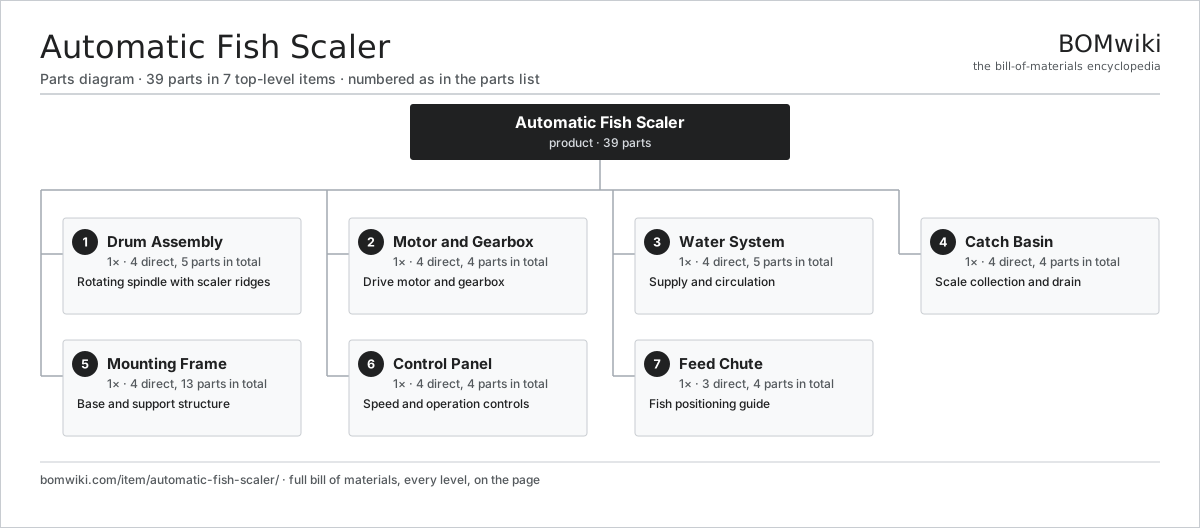
| # | Part | Qty | What it does |
|---|---|---|---|
| 1 | Drum Assembly 4 parts | 1× | Rotating spindle with scaler ridges |
| 2 | Motor and Gearbox 4 parts | 1× | Drive motor and gearbox |
| 3 | Water System 4 parts | 1× | Supply and circulation |
| 4 | Catch Basin 4 parts | 1× | Scale collection and drain |
| 5 | Mounting Frame 4 parts | 1× | Base and support structure |
| 6 | Control Panel 4 parts | 1× | Speed and operation controls |
| 7 | Feed Chute 3 parts | 1× | Fish positioning guide |
3D model
No 3D model yet. Have a CAD file of this? Add a 3D model. STL renders right on this page; STEP, FreeCAD, and OpenSCAD sources are welcome too (openly licensed, like all 3D models on BOMwiki).
Build & assembly graph
expand / collapse · shared sub-assemblies converge · links to related products · est. labourTap an assembly to expand/collapse · tap a part to open it · use “Open page” for any node · drag to pan, scroll to zoom.
Bill of materials for Automatic Fish Scaler
7 top-level lines · 34 rows shown · 39 parts total · indented to 3 levels| # | Item / sub-assembly | Part no. | Qty/assy | Ext. qty | Parts | Type |
|---|---|---|---|---|---|---|
| 1 | Drum Assembly 4 parts | automatic-fish-scaler-drum-assembly | 1× | 1 | 5 | assembly |
| 1.1 | Drum Shaft | automatic-fish-scaler-drum-shaft | 1× | 1 | · | part |
| 1.2 | Ridged Barrel | automatic-fish-scaler-drum-barrel | 1× | 1 | · | part |
| 1.3 | Drum Bearing | automatic-fish-scaler-drum-bearing | 2× | 2 | · | part |
| 1.4 | Drum Seal | automatic-fish-scaler-drum-seal | 1× | 1 | · | part |
| 2 | Motor and Gearbox 4 parts | automatic-fish-scaler-motor | 1× | 1 | 4 | assembly |
| 2.1 | Electric Motor | automatic-fish-scaler-electric-motor | 1× | 1 | · | part |
| 2.2 | Gearbox | automatic-fish-scaler-gearbox | 1× | 1 | · | part |
| 2.3 | Motor Coupling | automatic-fish-scaler-motor-coupling | 1× | 1 | · | part |
| 2.4 | Motor Bracket | automatic-fish-scaler-motor-bracket | 1× | 1 | · | part |
| 3 | Water System 4 parts | automatic-fish-scaler-water-system | 1× | 1 | 5 | assembly |
| 3.1 | Water Pump | automatic-fish-scaler-pump | 1× | 1 | · | part |
| 3.2 | Spray Nozzle | automatic-fish-scaler-spray-nozzle | 2× | 2 | · | part |
| 3.3 | Hose Bundle | automatic-fish-scaler-hose-bundle | 1× | 1 | · | part |
| 3.4 | Strainer | automatic-fish-scaler-strainer | 1× | 1 | · | part |
| 4 | Catch Basin 4 parts | automatic-fish-scaler-catch-basin | 1× | 1 | 4 | assembly |
| 4.1 | Collection Pan | automatic-fish-scaler-basin-pan | 1× | 1 | · | part |
| 4.2 | Drain Valve | automatic-fish-scaler-basin-drain | 1× | 1 | · | part |
| 4.3 | Overflow Standpipe | automatic-fish-scaler-basin-overflow | 1× | 1 | · | part |
| 4.4 | Scale Auger | automatic-fish-scaler-scale-auger | 1× | 1 | · | part |
| 5 | Mounting Frame 4 parts | automatic-fish-scaler-mounting-frame | 1× | 1 | 13 | assembly |
| 5.1 | Frame Beam | automatic-fish-scaler-frame-beam | 4× | 4 | · | part |
| 5.2 | Frame Foot | automatic-fish-scaler-frame-feet | 4× | 4 | · | part |
| 5.3 | Vibration Isolator | automatic-fish-scaler-frame-vibration-isolator | 4× | 4 | · | part |
| 5.4 | Safety Guard | automatic-fish-scaler-guard-cover | 1× | 1 | · | part |
| 6 | Control Panel 4 parts | automatic-fish-scaler-control-panel | 1× | 1 | 4 | assembly |
| 6.1 | Speed Control | automatic-fish-scaler-speed-control | 1× | 1 | · | part |
| 6.2 | Start-Stop Button | automatic-fish-scaler-start-stop-button | 1× | 1 | · | part |
| 6.3 | RPM Gauge | automatic-fish-scaler-rpm-gauge | 1× | 1 | · | part |
| 6.4 | Emergency Stop | automatic-fish-scaler-emergency-stop | 1× | 1 | · | part |
| 7 | Feed Chute 3 parts | automatic-fish-scaler-feed-chute | 1× | 1 | 4 | assembly |
| 7.1 | Chute Frame | automatic-fish-scaler-chute-frame | 1× | 1 | · | part |
| 7.2 | Depth Stop | automatic-fish-scaler-chute-depth-plate | 1× | 1 | · | part |
| 7.3 | Guide Roller | automatic-fish-scaler-chute-roller | 2× | 2 | · | part |
Something wrong in this list? Report a problem with this BOM.
Sourcing: possible vendors
Browse the supplier directory → Prices, MOQ, and lead times are algorithmic estimates, not quotes, and not claims about these companies. Company mappings are curated by keyword; est. price band $20–$2k. How estimates work| Vendor | HQ | Specialty | MOQ | Lead time |
|---|---|---|---|---|
|
🇺🇸Coleman
coleman.com ↗
|
Chicago, US | Camping gear | 1,000 units | 6–10 wks |
| thenorthface.com ↗ | Denver, US | Outdoor apparel & gear | 1,000 units | 6–10 wks |
|
🇺🇸YETI
yeti.com ↗
|
Austin, US | Coolers & drinkware | 1,000 units | 6–10 wks |
| decathlon.com ↗ | Villeneuve-d'Ascq, FR | Sporting goods | 1,000 units | 6–10 wks |
|
🇺🇸Garmin
garmin.com ↗
|
Olathe, US | GPS & wearables | 1,000 units | 6–10 wks |
1,374-word article