Patty Forming Machine
ProductOverview
A patty forming machine is a semi-automated or fully automated press system that shapes raw meat paste or sausage emulsion into uniform patties (hamburger patties, breakfast sausage patties, turkey patties). The key innovation is simultaneous multi-cavity forming: instead of forming one patty at a time, the machine presses 6–12 patties in parallel within a few seconds, then ejects all simultaneously. This dramatically increases throughput (100–400 kg/hour) compared to manual hand-forming or simple single-cavity presses.
The system integrates precise meat dosing (volumetric cup or load-cell weight), heated mold plates for easy release, automatic paper interleaving (preventing patty adhesion), and synchronized timing control (PLC). Modern machines achieve portion accuracy of ±10 g and can form diverse shapes (round, oval, embossed logos) via interchangeable mold plates.
How it Works
The process begins with chopped sausage or burger meat paste (from a bowl chopper) being loaded into the hopper. An metering auger (variable-speed, 5–50 rpm) meters the meat from the hopper into a volumetric fill cup or onto a weighing platform. When the cup is full (or load cell detects target weight, e.g., 100 g), an air or hydraulic ram ejects the meat into the upper mold plate cavity.
Simultaneously, the interleave feeder (motorized roll) positions a sheet of plastic or paper between the lower and upper mold plates. This interleave prevents adjacent patties from sticking together during pressing and allows easy separation in downstream packaging.
When the mold cavity is full and interleave is in place, an hydraulic or pneumatic press cylinder descends, clamping the upper mold tightly against the lower mold at 30–80 bar pressure. This pressure holds for 2–5 seconds, compressing the raw meat into a uniform, dense patty shaped by the cavity geometry (round, oval, embossed). The mold plates are chilled to 15–20 °C, which firms the patty surface slightly and facilitates release without sticking.
After the hold time, the press cylinder retracts, mold plates separate, and an automatic stripper plate advances, pushing all formed patties (6–12 simultaneously) onto a discharge conveyor. The cycle then repeats. Total cycle time is typically 6–15 seconds, producing 6–12 patties per cycle, yielding throughput of 100–400 kg/hour.
The PLC coordinates all stages: auger speed, fill cup refilling, interleave positioning, press cylinder timing (approach speed, hold pressure, retract speed), and eject timing. Advanced systems integrate a load cell for weight-based portioning, ensuring each patty is within ±10 g of target weight.
Mold Plate Design and Thermal Management
The upper and lower mold plates are typically aluminum (lightweight, excellent heat transfer) or ductile iron (durable, higher precision). Each plate has 6–12 cavities (hemispherical, oval, or custom shapes) with smooth walls and slight draft angles (1–3 degrees) allowing patties to release easily. Surface finish is critical: Ra <0.8 micrometers is necessary to prevent meat from gripping the cavity walls.
The cooling circuit circulates 15–20 °C glycol-water mixture through internal galleries within each plate. Cold plates firm the patty surface quickly, reducing stickiness and cook loss during subsequent cooking. If plates are too warm (>25 °C), fat melts and patties stick; if too cold (<10 °C), meat becomes brittle and cracks upon ejection. Optimal temperature is 15–20 °C, cold enough to firm the surface, warm enough to maintain plasticity.
Release coatings (typically Teflon/PTFE) reduce friction between meat and cavity wall, enabling clean ejection. However, PTFE wears over time (50,000–100,000 cycles), requiring periodic re-coating (~2000 EUR per mold plate). Some advanced machines use a hydraulic stripper bar that advances during mold separation, mechanically pushing patties out rather than relying on gravity or coating lubricity.
Fill System Precision and Dosing
Two fill methods are common:
Volumetric cup: A stainless cup (50–200 mL volume) is filled by the metering auger to a level indicator or mechanical stop. When full, a pneumatic ram ejects the meat into the mold cavity. Accuracy is ±5–10% (±5–15 g per 100 g patty) due to product density variation and air pockets in the meat paste.
Weight-based load cell: A load cell under the fill cup measures actual weight. The PLC monitors load cell signal and stops the auger when target weight (e.g., 100 g) is reached. Accuracy is ±3–5% (±3–5 g per 100 g patty), acceptable for retail packaged products. Load-cell systems cost ~3000 EUR more but are justified for high-volume producers where 5% weight variation across thousands of patties translates to significant cost variance.
Meat paste density varies with temperature and fat content: cold paste (0–4 °C) is denser than warm paste (15–20 °C); high-fat formulations are less dense than lean. Volumetric fill accommodates this poorly; weight-based dosing is superior. Some machines auto-adjust auger speed based on hopper weight, maintaining consistent dosing despite density changes.
Interleaving Technology
The paper or plastic interleave sheet is critical for preventing patty adhesion. Without interleave, adjacent patties (in a stack) bond during refrigeration or freezing as surface moisture condenses and freezes, freezing them together. Interleave sheets (typically 20–30 cm wide, 0.03–0.05 mm thick) are cut to the mold pattern (individual pieces corresponding to each cavity) or as a connected template.
The stepper motor advances the continuous roll by one mold-pattern distance per cycle. A rotary or reciprocating cutter trims the sheet to cavity size. A vacuum gripper or mechanical arm positions the trimmed sheet on the lower mold plate before the fill ram deposits meat.
Interleave positioning accuracy (±5 mm) is important: poorly positioned interleave leaves exposed patty edges that stick, or fails to cover the entire patty. Most machines achieve <5 mm accuracy via mechanical indexing (stepper motor moving a fixed distance per cycle) synchronized with mold plate index position.
Material choice:
- Plastic (PE, PP): Durable, reusable in scrap products (meat trim), no taint flavor. Cost ~€0.01–€0.02 per sheet.
- Paper (silicone-coated): Biodegradable, compostable, but dissolves if patties are washed pre-cooking. Cost ~€0.005 per sheet.
- Parchment (sulfite): Food-grade, no taste transfer, but less durable in re-processing. Cost €0.008 per sheet.
Volume: a 100 kg/hour patty line producing 100 g patties (1000 patties/hour) with 12 cavities per cycle requires 1000/12 ≈ 85 cycles/hour, using 85 interleave sheets. At €0.01 each = €0.85/hour interleave cost, or ~€0.008/kg product, negligible.
Press Cycle Control and Timing
The press cylinder operates in phases:
- Approach (1–2 sec): Cylinder descends at slow speed (0.1–0.2 m/s) to avoid meat splashing or deformation before clamping.
- Hold (2–5 sec): Mold plates clamp at set pressure (30–80 bar). Time is adjustable: longer hold (5 sec) produces denser patty; shorter hold (2 sec) produces lighter, more tender patty.
- Retract (1 sec): Cylinder retracts at fast speed to minimize cycle time.
- Eject (1 sec): Stripper plate advances, pushing patties onto discharge conveyor.
Total cycle time = approach + hold + retract + eject = ~6–15 seconds typical. Faster cycles (6 sec) sacrifice patty density uniformity; slower cycles (15 sec) reduce throughput but improve patty quality.
Press pressure is typically 30–80 bar, depending on meat paste viscosity and patty thickness:
- Soft paste, thin patties (10 mm): 30–40 bar (low pressure prevents extrusion and deformation)
- Stiff paste, thick patties (30 mm): 60–80 bar (high pressure needed for compaction and heat conduction)
Higher pressure increases cooling time (better contact between warm meat and cold mold) but risks extruding meat sideways and creating burrs on patty edges.
Integration in Burger and Sausage Production
Patty formers are used in two contexts:
Hamburger production: Raw ground beef (or beef/pork blend) is packed into casings or bins, then dumped into the patty former hopper. The auger meters the meat, and mold cavities shape it into 100–200 g patties. Patties are interleaved, frozen on a conveyor, and boxed. A single patty line (100–150 kg/hour) replaces 4–5 manual workers hand-forming patties.
Sausage patty production: Seasoned and cured sausage emulsion (from a bowl chopper and brine injector) is cooled to 0–4 °C, then fed to the patty former. Mold cavities shape it into 50–100 g breakfast patties. Patties are interleaved, chilled, and packaged for fresh or frozen retail sale.
A typical flow: Raw meat → Chopping → Brine injection (optional) → Patty forming → Interleaving → Freezing → Packaging
Capacity scales linearly with cycle time and cavity count:
- 12 cavities × 6-second cycles = 2 cycles/minute = 120 patties/minute
- 120 patties/min × 150 g/patty = 18 kg/min = 1080 kg/hour
Larger molds (16–24 cavities) with faster cycles (4 sec) achieve 2000+ kg/hour throughput but require larger press cylinders (increased cost, higher energy) and more robust cooling systems.
Mold and Plate Maintenance
Mold release coating (PTFE or silicone) gradually wears after 50,000–100,000 cycles. When patties begin sticking, re-coating (2000 EUR per mold set) is necessary. Some operators delay re-coating by applying release spray (silicone or vegetable oil-based) between cycles, but this is temporary and risks product contamination.
Mold cavity walls can develop score marks (scratches) from hard fragments (bone chips, grit) in the meat. Deep scratches prevent clean release and must be hand-polished or the mold re-faced (turning down 0.5–1 mm layer of the cavity surface). This is expensive (~3000 EUR per mold) and reduces cavity size slightly.
Cooling system maintenance is critical: glycol-water mixture can become contaminated with meat proteins, salt, or microbial growth, clogging the internal galleries. Annual flushing with hot water and periodic complete coolant changes (every 2–3 years) are necessary.
Flexibility and Mold Change
Different patty sizes or shapes require different mold plates. A plant producing multiple products (100 g hamburger, 75 g breakfast patty, 150 g gourmet burger) requires 2–3 mold sets. Changing molds takes 15–30 minutes: mold plates are unbolted, replaced, re-aligned, and PLC settings (fill time, press pressure, cycle time) are adjusted.
Some advanced machines have quick-change mold systems (mechanical pins and spring clamps instead of bolts), reducing changeover to 5–10 minutes. Cost premium is ~10,000–15,000 EUR but is justified in plants producing >5 different products.
Capacity and ROI
Patty formers are capital-intensive: mid-size machines (100–200 kg/hour) cost €40,000–€100,000; large machines (300–500 kg/hour) cost €150,000–€300,000.
ROI calculation:
- Manual hand-forming: 1 operator produces ~50 kg/hour = 2000 kg/day (four 8-hour shifts), labor cost €80/day per operator.
- Patty former: 100 kg/hour, requires 1 operator monitoring + 1 packaging = 800 kg/day (one 8-hour shift), labor cost €80/day.
- Savings: 2000 kg vs. 800 kg per day labor but improved consistency and reduced defects (±10 g vs. ±50 g hand-forming variation), 5% yield improvement from less trim waste.
At €5/kg meat cost, 1200 kg additional daily capacity = €6000/day incremental revenue. Capital payback: €100,000 / €6000 per day = ~17 days in a high-volume operation, or ~9–12 months in a typical meat plant running 200 days/year.
Payback improves significantly if the plant also operates a meat bandsaw, sausage stuffer, or other integrated automation: all these machines share common infrastructure (refrigeration, water supply, disposal) and achieve economies of scale in labor.
Patty Forming Machine parts and their functions
7 top-level parts · 36 parts in total · full bill of materials below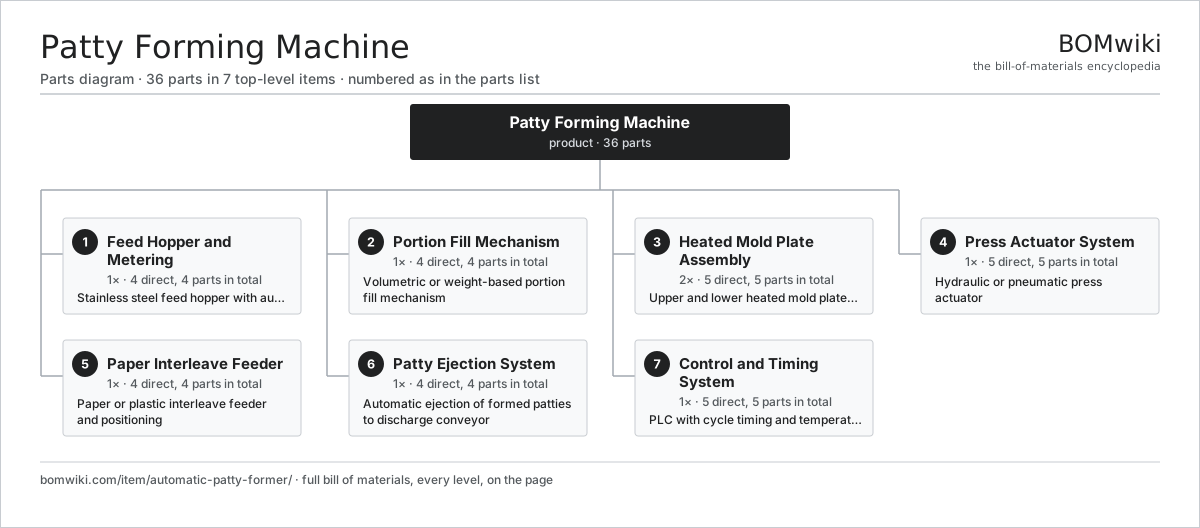
| # | Part | Qty | What it does |
|---|---|---|---|
| 1 | Feed Hopper and Metering 4 parts | 1× | Stainless steel feed hopper with auger metering |
| 2 | Portion Fill Mechanism 4 parts | 1× | Volumetric or weight-based portion fill mechanism |
| 3 | Heated Mold Plate Assembly 5 parts | 2× | Upper and lower heated mold plates with cavity pattern |
| 4 | Press Actuator System 5 parts | 1× | Hydraulic or pneumatic press actuator |
| 5 | Paper Interleave Feeder 4 parts | 1× | Paper or plastic interleave feeder and positioning |
| 6 | Patty Ejection System 4 parts | 1× | Automatic ejection of formed patties to discharge conveyor |
| 7 | Control and Timing System 5 parts | 1× | PLC with cycle timing and temperature controller |
3D model
No 3D model yet. Have a CAD file of this? Add a 3D model. STL renders right on this page; STEP, FreeCAD, and OpenSCAD sources are welcome too (openly licensed, like all 3D models on BOMwiki).
Build & assembly graph
expand / collapse · shared sub-assemblies converge · links to related products · est. labourTap an assembly to expand/collapse · tap a part to open it · use “Open page” for any node · drag to pan, scroll to zoom.
Bill of materials for Patty Forming Machine
7 top-level lines · 38 rows shown · 36 parts total · indented to 3 levels| # | Item / sub-assembly | Part no. | Qty/assy | Ext. qty | Parts | Type |
|---|---|---|---|---|---|---|
| 1 | Feed Hopper and Metering 4 parts | automatic-patty-former-hopper | 1× | 1 | 4 | assembly |
| 1.1 | Hopper Vessel | automatic-patty-former-hopper-body | 1× | 1 | · | part |
| 1.2 | Metering Auger Screw | automatic-patty-former-auger | 1× | 1 | · | part |
| 1.3 | Auger Drive Motor | automatic-patty-former-auger-motor | 1× | 1 | · | part |
| 1.4 | Metering Outlet | automatic-patty-former-hopper-outlet | 1× | 1 | · | part |
| 2 | Portion Fill Mechanism 4 parts | automatic-patty-former-fill-system | 1× | 1 | 4 | assembly |
| 2.1 | Volumetric Fill Cup | automatic-patty-former-fill-cup | 1× | 1 | · | part |
| 2.2 | Weight-Based Load Cell | automatic-patty-former-load-cell | 1× | 1 | · | part |
| 2.3 | Fill Ram Actuator | automatic-patty-former-fill-ram | 1× | 1 | · | part |
| 2.4 | Mold Position Sensor | automatic-patty-former-fill-sensor | 1× | 1 | · | part |
| 3 | Heated Mold Plate Assembly 5 parts | automatic-patty-former-mold-plate | 2× | 2 | 5 | assembly |
| 3.1 | Upper Mold Plate | automatic-patty-former-mold-upper | 1× | 2 | · | part |
| 3.2 | Lower Mold Plate | automatic-patty-former-mold-lower | 1× | 2 | · | part |
| 3.3 | Mold Plate Cooling | automatic-patty-former-mold-cooling | 1× | 2 | · | part |
| 3.4 | Release and Coating | automatic-patty-former-mold-release | 1× | 2 | · | part |
| 3.5 | Stripper Plate | automatic-patty-former-mold-stripper | 1× | 2 | · | part |
| 4 | Press Actuator System 5 parts | automatic-patty-former-press-cylinder | 1× | 1 | 5 | assembly |
| 4.1 | Press Cylinder | automatic-patty-former-press-cylinder-main | 1× | 1 | · | part |
| 4.2 | Proportional Control Valve | automatic-patty-former-press-control-valve | 1× | 1 | · | part |
| 4.3 | System Pressure Gauge | automatic-patty-former-pressure-gauge | 1× | 1 | · | part |
| 4.4 | Pressure Relief Valve | automatic-patty-former-pressure-relief | 1× | 1 | · | part |
| 4.5 | Hydraulic Accumulator | automatic-patty-former-accumulator | 1× | 1 | · | part |
| 5 | Paper Interleave Feeder 4 parts | automatic-patty-former-interleaver | 1× | 1 | 4 | assembly |
| 5.1 | Interleave Sheet Roll | automatic-patty-former-interleave-roll | 1× | 1 | · | part |
| 5.2 | Interleave Motor | automatic-patty-former-interleave-motor | 1× | 1 | · | part |
| 5.3 | Interleave Cutter | automatic-patty-former-interleave-cutter | 1× | 1 | · | part |
| 5.4 | Interleave Placement | automatic-patty-former-interleave-positioning | 1× | 1 | · | part |
| 6 | Patty Ejection System 4 parts | automatic-patty-former-knockout | 1× | 1 | 4 | assembly |
| 6.1 | Ejector Cylinder | automatic-patty-former-eject-cylinder | 1× | 1 | · | part |
| 6.2 | Discharge Conveyor | automatic-patty-former-discharge-conveyor | 1× | 1 | · | part |
| 6.3 | Ejection Safety Guard | automatic-patty-former-eject-guard | 1× | 1 | · | part |
| 6.4 | Patty Jam Detector | automatic-patty-former-product-sensor | 1× | 1 | · | part |
| 7 | Control and Timing System 5 parts | automatic-patty-former-controls | 1× | 1 | 5 | assembly |
| 7.1 | Main Control PLC | automatic-patty-former-main-plc | 1× | 1 | · | part |
| 7.2 | Cycle Time Programmable Timer | automatic-patty-former-cycle-timer | 1× | 1 | · | part |
| 7.3 | Mold Temperature Controller | automatic-patty-former-temperature-controller | 1× | 1 | · | part |
| 7.4 | Motor Soft-Starter | automatic-patty-former-motor-contactor | 1× | 1 | · | part |
| 7.5 | Emergency Stop Button | automatic-patty-former-emergency-stop | 1× | 1 | · | part |
Something wrong in this list? Report a problem with this BOM.
Sourcing: possible vendors
Browse the supplier directory → Prices, MOQ, and lead times are algorithmic estimates, not quotes, and not claims about these companies. Company mappings are curated by keyword; est. price band $1k–$500k. How estimates work| Vendor | HQ | Specialty | MOQ | Lead time |
|---|---|---|---|---|
| gea.com ↗ | Düsseldorf, DE | Process technology | 20 units | 12–20 wks |
| buhlergroup.com ↗ | Uzwil, CH | Food & materials processing | 20 units | 12–20 wks |
| tetrapak.com ↗ | Pully, CH | Food packaging & processing | 20 units | 12–20 wks |
| jbtc.com ↗ | Chicago, US | Food processing equipment | 20 units | 12–20 wks |
| alfalaval.com ↗ | Lund, SE | Heat transfer & separation | 20 units | 12–20 wks |
2,062-word article