Automatic Pocket Setter
ProductOverview
An automatic pocket setter is a specialized sewing machine that performs the repetitive and critical task of attaching pocket flaps and linings to garment fronts. The machine folds, positions and stitches pockets with precision and speed, completing 20–40 pockets per hour depending on stitch count and pocket complexity. This single operation can be a bottleneck in garment assembly, so automating it saves significant labor and improves consistency. The machine is typically placed upstream of the main sewing line, where completed garment pieces with stitched pockets move downstream for collar and sleeve attachment.
The Main Frame anchors all components. The Material Feeder System supply a pocket flap and lining to the machine via gravity hoppers. The Folding Station uses pneumatic actuators or cams to fold the flap into the correct shape (typically a triangle or rectangle). The Positioning Clamps secure the garment panel and position the folded flap at the exact location for sewing. The Sewing Head stitches the flap to the garment with a controlled stitch count, typically 20–50 stitches forming a rectangular or triangular stitch pattern. The Output Stacker removes the completed pocket and stacks it for hand finishing or transfer to the next machine. The Pneumatic System powers all clamps and actuators; the Control System coordinates all motion and safety.
How it works
The operator loads the garment panel (the front of a shirt, jacket, or trousers, already pre-cut and ready for pockets) into the work area. They also fill the Flap Hopper with pre-cut pocket flaps and the Lining Hopper with linings. They then input the pocket position, either by entering X/Y coordinates, or by performing a one-time teach by jog-moving the sewing head to the correct position and pressing "Store."
When the operator presses "Start," the Control System initiates a cycle:
The Feed Actuator advances one flap from the hopper into the Folding Station.
The Folder Actuator folds the flap to the correct shape, typically a triangle with the raw edges folded inward, or a rectangle with a fold at the top edge.
The garment is positioned on the Work Table and clamped by the Positioning Clamps.
The Sewing Head (driven by the Stitch Motor) is positioned over the pocket location. The Feed Dog advances the fabric, and the needle stitches the flap to the garment in a rectangular box stitch, typically 0.5 inches on all sides, creating 50–100 stitches depending on garment size. An Encoder on the motor counts stitches; the Control System stops the motor after the programmed stitch count.
The Clamp Actuator releases the garment, and the Stacker Arm removes it.
The cycle repeats.
Variations and options
Pocket styles determine the folding and stitching pattern. A classic flap pocket requires the flap to be folded so the seam allowance is on the back (hidden); the sewing head stitches a rectangular perimeter around the flap. A welt pocket is narrower, the welt is a thin band that appears as a single line on the garment. A patch pocket is not folded; it is simply positioned and stitched around its edges. Different pocket types require different program recipes.
Some machines support two-needle sewing, which stitches two parallel lines on the pocket, creating a "topstitched" appearance. Two-needle machines are more complex and slower but create a more finished look. The Sewing Head and Stitch Motor must have higher power to drive two needles.
Vision systems can enhance positioning accuracy. A camera above the Work Table captures the garment position and relays coordinates to the control system, which adjusts the sewing-head position automatically. This eliminates manual setup for each new batch and allows tolerances of ±2 mm instead of ±5 mm. However, vision systems add cost; many simpler machines rely on manual jog-positioning during setup.
Thread management
The Thread Tensioner maintains balanced upper and lower thread tension. Incorrect tension results in loops, missed stitches, or puckering. Polyester thread (40–60 weight) is standard; nylon is sometimes used for stretch fabrics. The Bobbin Case holds a pre-wound bobbin of lower thread; the Sewing Needle is loaded with upper thread from a spool. Thread breaks are the most common downtime; the Control System detects thread tension drops via current monitoring on the Stitch Motor and halts the machine if a break is detected.
Production rate and bottleneck analysis
A simple single-needle pocket takes 30–60 seconds to fold, position and stitch (1 minute includes operator move time for batch loading). At this rate, one machine produces 30–60 pockets per hour. A typical shirt requires one to four pockets, so one pocket-setter can supply pockets for 15–60 shirts per hour. If the main sewing line is faster, say, 60 complete shirts per hour, then the pocket station becomes the bottleneck and two machines are needed. This is a common situation, which is why garment facilities often deploy pocket setters in pairs or clusters.
Stitch count is the primary production driver. A 50-stitch box takes ~15 seconds of sewing time; a 20-stitch minimal stitching takes 8 seconds. Fast, simple pockets at 60 pockets/hour; fancy pockets with high stitch counts at 30 pockets/hour. The trade-off is appearance versus throughput.
Maintenance and needle wear
The Sewing Needle wears and dulls with every stitch; industrial machines often use bent or blunt needles after 8–10 hours of continuous sewing. Most facilities change the needle once or twice per 8-hour shift. The Feed Dog is driven by an Feed Dog linkage and can stick or bend if the machine stitches very heavy fabrics or hits a knot; the Presser Foot spring can weaken over time, reducing fabric pressure and causing skipped stitches.
Regular preventive maintenance, daily needle and bobbin changes, weekly feed-dog inspection, monthly tension recalibration, keeps machines running reliably. Breakdowns are costly because they stall the whole garment line.
Automatic Pocket Setter parts and their functions
8 top-level parts · 94 parts in total · full bill of materials below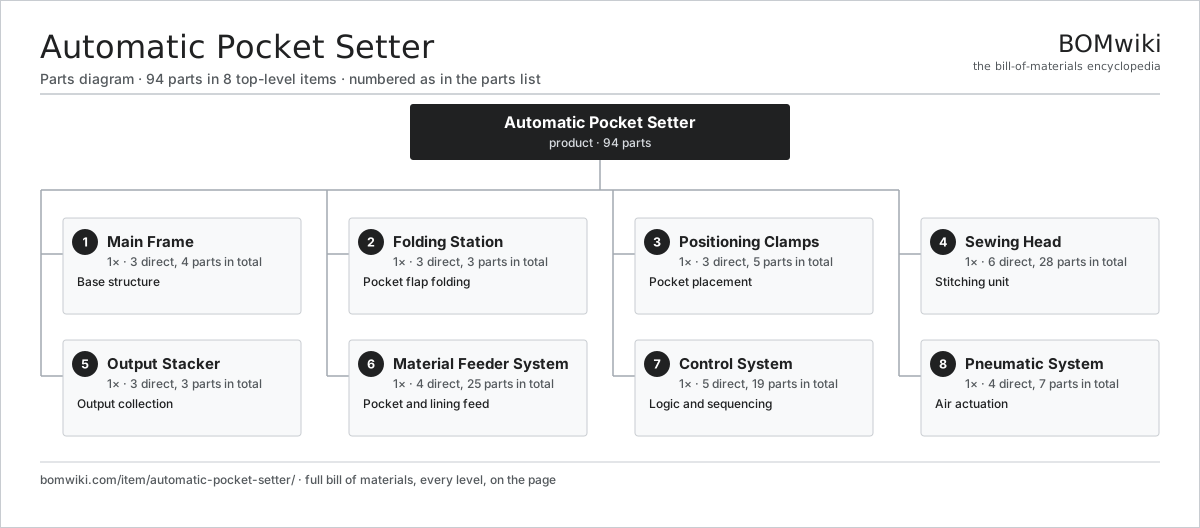
| # | Part | Qty | What it does |
|---|---|---|---|
| 1 | Main Frame 3 parts | 1× | Base structure |
| 2 | Folding Station 3 parts | 1× | Pocket flap folding |
| 3 | Positioning Clamps 3 parts | 1× | Pocket placement |
| 4 | Sewing Head 6 parts | 1× | Stitching unit |
| 5 | Output Stacker 3 parts | 1× | Output collection |
| 6 | Material Feeder System 4 parts | 1× | Pocket and lining feed |
| 7 | Control System 5 parts | 1× | Logic and sequencing |
| 8 | Pneumatic System 4 parts | 1× | Air actuation |
3D model
No 3D model yet. Have a CAD file of this? Add a 3D model. STL renders right on this page; STEP, FreeCAD, and OpenSCAD sources are welcome too (openly licensed, like all 3D models on BOMwiki).
Build & assembly graph
expand / collapse · shared sub-assemblies converge · links to related products · est. labourTap an assembly to expand/collapse · tap a part to open it · use “Open page” for any node · drag to pan, scroll to zoom.
Bill of materials for Automatic Pocket Setter
8 top-level lines · 44 rows shown · 94 parts total · indented to 3 levels| # | Item / sub-assembly | Part no. | Qty/assy | Ext. qty | Parts | Type |
|---|---|---|---|---|---|---|
| 1 | Main Frame 3 parts | automatic-pocket-setter-main-frame | 1× | 1 | 4 | assembly |
| 1.1 | Base Plate | automatic-pocket-setter-base-plate | 1× | 1 | · | part |
| 1.2 | Upright Post | automatic-pocket-setter-upright-posts | 2× | 2 | · | part |
| 1.3 | Work Table | automatic-pocket-setter-work-table | 1× | 1 | · | part |
| 2 | Folding Station 3 parts | automatic-pocket-setter-folding-station | 1× | 1 | 3 | assembly |
| 2.1 | Folder Blade | automatic-pocket-setter-folder-blade | 1× | 1 | · | part |
| 2.2 | Folder Actuator | automatic-pocket-setter-folder-actuator | 1× | 1 | · | part |
| 2.3 | Folder Sensor | automatic-pocket-setter-folder-sensor | 1× | 1 | · | part |
| 3 | Positioning Clamps 3 parts | automatic-pocket-setter-positioning-clamps | 1× | 1 | 5 | assembly |
| 3.1 | Clamp Arm | automatic-pocket-setter-clamp-arm | 2× | 2 | · | part |
| 3.2 | Clamp Actuator | automatic-pocket-setter-clamp-actuator | 2× | 2 | · | part |
| 3.3 | Position Sensor | automatic-pocket-setter-position-sensor | 1× | 1 | · | part |
| 4 | Sewing Head 6 parts | automatic-pocket-setter-sewing-head | 1× | 1 | 28 | assembly |
| 4.1 | Sewing Needle | automatic-pocket-setter-needle | 1× | 1 | · | part |
| 4.2 | Thread Tensioner | automatic-pocket-setter-thread-tensioner | 1× | 1 | · | part |
| 4.3 | Bobbin Case | automatic-pocket-setter-bobbin-case | 1× | 1 | · | part |
| 4.4 | Feed Dog | automatic-pocket-setter-feed-dog | 1× | 1 | · | part |
| 4.5 | Presser Foot | automatic-pocket-setter-presser-foot | 1× | 1 | · | part |
| 4.6 | Stitch Motor 3 parts | automatic-pocket-setter-stitch-motor | 1× | 1 | 23 | assembly |
| 4.6.1 | Stator Assembly 3 parts + deeper › | stator-assembly | 1× | 1 | 3 | assembly |
| 4.6.2 | Rotor Assembly 4 parts + deeper › | rotor-assembly | 1× | 1 | 19 | assembly |
| 4.6.3 | Encoder | encoder | 1× | 1 | · | part |
| 5 | Output Stacker 3 parts | automatic-pocket-setter-stacker | 1× | 1 | 3 | assembly |
| 5.1 | Stacker Arm | automatic-pocket-setter-stacker-arm | 1× | 1 | · | part |
| 5.2 | Stacker Motor | automatic-pocket-setter-stacker-motor | 1× | 1 | · | part |
| 5.3 | Output Bin | automatic-pocket-setter-bin-or-conveyor | 1× | 1 | · | part |
| 6 | Material Feeder System 4 parts | automatic-pocket-setter-material-feeders | 1× | 1 | 25 | assembly |
| 6.1 | Flap Hopper | automatic-pocket-setter-flap-hopper | 1× | 1 | · | part |
| 6.2 | Lining Hopper | automatic-pocket-setter-lining-hopper | 1× | 1 | · | part |
| 6.3 | Feeder Motor 2 parts | automatic-pocket-setter-feeder-motor | 1× | 1 | 22 | assembly |
| 6.3.1 | Stator Assembly 3 parts + deeper › | stator-assembly | 1× | 1 | 3 | assembly |
| 6.3.2 | Rotor Assembly 4 parts + deeper › | rotor-assembly | 1× | 1 | 19 | assembly |
| 6.4 | Feed Actuator | automatic-pocket-setter-feed-actuator | 1× | 1 | · | part |
| 7 | Control System 5 parts | automatic-pocket-setter-control-system | 1× | 1 | 19 | assembly |
| 7.1 | PLC Board | automatic-pocket-setter-plc | 1× | 1 | · | part |
| 7.2 | Servo Drive | automatic-pocket-setter-servo-drive | 1× | 1 | · | part |
| 7.3 | Relay | relay | 6× | 6 | · | part |
| 7.4 | Connector | connector | 10× | 10 | · | part |
| 7.5 | Power Supply | power-supply | 1× | 1 | · | part |
| 8 | Pneumatic System 4 parts | automatic-pocket-setter-pneumatic-system | 1× | 1 | 7 | assembly |
| 8.1 | Air Compressor | automatic-pocket-setter-air-compressor | 1× | 1 | · | part |
| 8.2 | Air Regulator | automatic-pocket-setter-regulator | 1× | 1 | · | part |
| 8.3 | Solenoid Valve | automatic-pocket-setter-solenoid-valve | 4× | 4 | · | part |
| 8.4 | Air Filter | automatic-pocket-setter-air-filter | 1× | 1 | · | part |
Something wrong in this list? Report a problem with this BOM.
Sourcing: possible vendors
Browse the supplier directory → Prices, MOQ, and lead times are algorithmic estimates, not quotes, and not claims about these companies. Company mappings are curated by keyword; est. price band $10k–$1M. How estimates work| Vendor | HQ | Specialty | MOQ | Lead time |
|---|---|---|---|---|
|
🇨🇭Rieter
rieter.com ↗
|
Winterthur, CH | Spinning machinery | 10 units | 14–24 wks |
| truetzschler.com ↗ | Mönchengladbach, DE | Textile machinery | 10 units | 14–24 wks |
|
🇧🇪Picanol
picanol.be ↗
|
Ypres, BE | Weaving machines | 10 units | 14–24 wks |
| karlmayer.com ↗ | Obertshausen, DE | Warp knitting machines | 10 units | 14–24 wks |
|
🇨🇭Saurer
saurer.com ↗
|
Arbon, CH | Spinning & embroidery | 10 units | 14–24 wks |
1,085-word article