Avalanche Probe
ProductOverview
An avalanche probe is a lightweight, segmented rod designed to locate buried avalanche victims through systematic probing of the snow surface. A searcher extends the probe to depth and pushes it vertically downward until it strikes a buried object, clothing, a backpack, or a body. The presence of resistance and the tactile "feel" confirm that something solid lies beneath the snow, distinguishing a victim from empty snow cavity. Avalanche probes are fundamental to backcountry rescue operations and are typically used in conjunction with an avalanche transceiver and a shovel to form the "rescue triangle."
The probe must be fast to deploy, lightweight for extended carrying, and rigid enough to transmit tactile feedback through several meters of snow. Modern probes achieve this through segmented design with an internal tension cable system that locks all segments into a single rigid rod when extended. The entire assembly collapses to 28–35 cm for storage in a backpack, requiring minimal space.
Design Architecture
Segmented Shaft Construction
The shaft segments are the primary load-bearing components, typically four to six aluminum 7075 or carbon-fiber tubes (18–22 mm OD, 1 mm wall thickness). Each segment is 40–60 cm long. Aluminum 7075 is preferred for rescue applications because it balances weight (380 g for a 3.2 m probe) with rigidity and impact resistance. Carbon fiber can reduce weight by 20% but is more brittle under sideways deflection in mixed debris fields.
The segments are tapered slightly (each inner segment is marginally smaller) so they nest inside one another when collapsed. A taper coupler at the base allows the smallest segment to fit inside the handle assembly, achieving ultra-compact storage. When extended, segments are locked together by segment connectors, rotating collars or toggle rings that must be twisted or flipped to lock and unlock.
Tension Cable Locking System
The tension cable is stainless steel aircraft cable (2 mm diameter, 7×7 stranding, rated 300 kg) that runs through the hollow center of all probe segments from the cable anchor in the handle to a crimp fitting at the tip. When the locking collar on the handle is rotated or toggled, it pulls the cable tight, which forces all segment connectors to lock and creates a rigid unified rod.
This design is crucial: segment connectors alone would be difficult to operate with gloved hands at high altitude, and mechanical indexing would require precise alignment. The cable system provides automatic locking, once the collar is engaged, all connectors simultaneously snap into position. A light spring return in the handle resets the collar to unlocked position with a single motion, allowing the segments to collapse again.
Handle and Control
The handle is typically 28–32 mm diameter aluminum 6061 tube, approximately 12 cm long, with a grip coating of closed-cell foam or rubberized material. This provides insulation and tactile grip with heavy gloves. The collar body wraps around the lower portion of the handle and is the primary control interface. A toggle lever or rotating ring on the collar applies cable tension. Probe designs vary between "twist-lock" (rotate the collar) and "push-lever" (flip a toggle) mechanisms; both achieve the same locking result.
Depth Markings and Tactile Feedback
Depth markings are printed or etched at 10 cm intervals along the shaft, with larger markers at 0.5 m, 1.0 m, 1.5 m, etc. As the searcher pushes the probe down, markings visible above the snow surface directly indicate burial depth. This is critical for triage: a victim buried 3 meters deep has <5% survival probability regardless of rescue speed, so rescuers prioritize victims at <1.5 m depth.
Tactile feedback is the second critical function. The tip is a hardened steel cone (10–15 mm diameter) or flat point designed to transmit the sensation of striking hard objects through the rigid probe shaft to the searcher's gloved hand. Snow transmits a dull, yielding resistance as the probe penetrates; a victim's body, backpack, or equipment feels distinctly harder and often produces an audible "thunk" or vibration.
Materials and Durability
Shaft tubes are aluminum 7075-T73 (yield ~430 MPa, density 2.81 g/cm³) or carbon-fiber reinforced polymer (CFRP) with epoxy resin. Aluminum provides better impact resistance and is serviceable after collision damage; carbon fiber is lighter but more brittle and non-repairable. Handles and collars are aluminum 6061-T6 or molded nylon for cost reduction. All exposed metal parts (cable, tip, collars) are stainless steel or anodized aluminum to prevent corrosion from repeated saltwater or high-altitude exposure.
Probes must meet ASTM F2081 (Standard Practice for Avalanche Rescue) or EN 13981 (Equipment for Avalanche Rescue). Testing includes drop tests from 2 m onto rock, tensile load tests on segment connectors (rated 1000+ kg), and full-probe collapse/extension cycles to 500 repetitions to ensure locking mechanism durability.
Operating Technique
Probe Deployment
- Deployment Time: A properly trained rescuer can deploy a probe to full extension in 8–10 seconds.
- Orientation: The probe is held vertically (or near-vertical) to the snow surface to maximize penetration through dense avalanche debris.
- Systematic Search: Rescuers space themselves 75 cm apart and move downslope or across slope, probing every 25–50 cm to cover the likely burial zone.
Tactile Feedback Interpretation
- Soft Resistance: Probing snow at depth feels yielding and uniform.
- Hard Contact: A victim, backpack, or rock produces immediate resistance, often with audible feedback.
- Secondary Probing: Once a hard object is located, rescuers mark the spot and may probe nearby to determine the victim's orientation before beginning excavation.
Excavation Integration
Once a probe strike confirms a victim location, the probe is left in place as a marker while the probe is withdrawn and a shovel is deployed. The probe mark shows rescuers exactly where to begin digging, reducing excavation time from minutes to seconds.
Limitations and Caveats
- Burial Depth Limit: Probes are effective only to 3–4 meters; burials deeper than this are rarely survivable anyway.
- False Positives: Rock, ice, or dense debris can produce probe strikes identical to a victim strike.
- Searcher Fatigue: Probing hundreds of snow columns in cold, high-altitude conditions is exhausting; teams must rotate positions.
- Weather Conditions: Heavy new snow can make probing slow; wind-slab avalanches may have dense, hard snow that resists probing.
Variations and Specializations
- Compact Probes (1.8–2.0 m): Lighter, faster deployment; popular for ski touring where weight is critical.
- Extended Probes (3.5–4.0 m): Longer reach for complex terrain with deep runout zones; heavier and slower to deploy.
- Flat-Tipped Probes: Designed to detect voids and sliding surfaces in ice avalanches.
- Integrated Probes: Some modern transceivers include a short built-in probe for quick victim location confirmation.
Avalanche Probe parts and their functions
7 top-level parts · 29 parts in total · full bill of materials below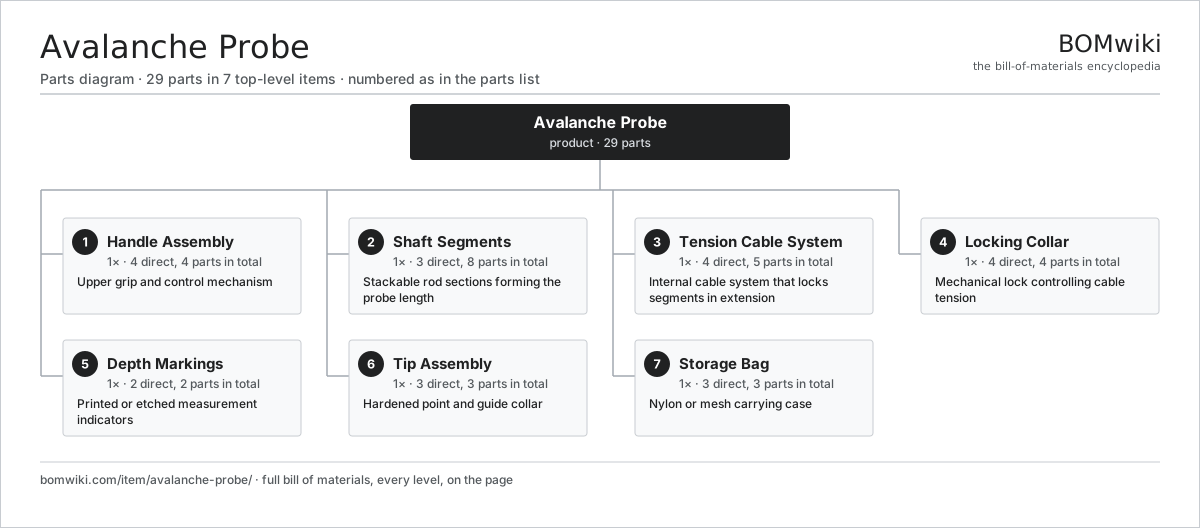
| # | Part | Qty | What it does |
|---|---|---|---|
| 1 | Handle Assembly 4 parts | 1× | Upper grip and control mechanism |
| 2 | Shaft Segments 3 parts | 1× | Stackable rod sections forming the probe length |
| 3 | Tension Cable System 4 parts | 1× | Internal cable system that locks segments in extension |
| 4 | Locking Collar 4 parts | 1× | Mechanical lock controlling cable tension |
| 5 | Depth Markings 2 parts | 1× | Printed or etched measurement indicators |
| 6 | Tip Assembly 3 parts | 1× | Hardened point and guide collar |
| 7 | Storage Bag 3 parts | 1× | Nylon or mesh carrying case |
3D model
No 3D model yet. Have a CAD file of this? Add a 3D model. STL renders right on this page; STEP, FreeCAD, and OpenSCAD sources are welcome too (openly licensed, like all 3D models on BOMwiki).
Build & assembly graph
expand / collapse · shared sub-assemblies converge · links to related products · est. labourTap an assembly to expand/collapse · tap a part to open it · use “Open page” for any node · drag to pan, scroll to zoom.
Bill of materials for Avalanche Probe
7 top-level lines · 30 rows shown · 29 parts total · indented to 3 levels| # | Item / sub-assembly | Part no. | Qty/assy | Ext. qty | Parts | Type |
|---|---|---|---|---|---|---|
| 1 | Handle Assembly 4 parts | avalanche-probe-handle-assembly | 1× | 1 | 4 | assembly |
| 1.1 | Handle Body | avalanche-probe-handle-body | 1× | 1 | · | part |
| 1.2 | Cable Anchor | avalanche-probe-cable-anchor | 1× | 1 | · | part |
| 1.3 | Grip Coating | avalanche-probe-grip-coating | 1× | 1 | · | part |
| 1.4 | Fastener Set | fastener-set | 1× | 1 | · | part |
| 2 | Shaft Segments 3 parts | avalanche-probe-shaft-segments | 1× | 1 | 8 | assembly |
| 2.1 | Segment Tube | avalanche-probe-segment-tube | 4× | 4 | · | part |
| 2.2 | Segment Connector | avalanche-probe-segment-connector | 3× | 3 | · | part |
| 2.3 | Taper Coupler | avalanche-probe-taper-coupler | 1× | 1 | · | part |
| 3 | Tension Cable System 4 parts | avalanche-probe-tension-cable | 1× | 1 | 5 | assembly |
| 3.1 | Cable Wire | avalanche-probe-cable-wire | 1× | 1 | · | part |
| 3.2 | Cable Crimp | avalanche-probe-cable-crimp | 2× | 2 | · | part |
| 3.3 | Cable Spring | avalanche-probe-cable-spring | 1× | 1 | · | part |
| 3.4 | Fastener Set | fastener-set | 1× | 1 | · | part |
| 4 | Locking Collar 4 parts | avalanche-probe-locking-collar | 1× | 1 | 4 | assembly |
| 4.1 | Collar Body | avalanche-probe-collar-body | 1× | 1 | · | part |
| 4.2 | Collar Cam | avalanche-probe-collar-cam | 1× | 1 | · | part |
| 4.3 | Coil Spring | coil-spring | 1× | 1 | · | part |
| 4.4 | Fastener Set | fastener-set | 1× | 1 | · | part |
| 5 | Depth Markings 2 parts | avalanche-probe-depth-markings | 1× | 1 | 2 | assembly |
| 5.1 | Marking Paint | avalanche-probe-marking-paint | 1× | 1 | · | part |
| 5.2 | Depth Label | avalanche-probe-marking-label | 1× | 1 | · | part |
| 6 | Tip Assembly 3 parts | avalanche-probe-tip-assembly | 1× | 1 | 3 | assembly |
| 6.1 | Tip Point | avalanche-probe-tip-point | 1× | 1 | · | part |
| 6.2 | Tip Guide | avalanche-probe-tip-guide | 1× | 1 | · | part |
| 6.3 | Fastener Set | fastener-set | 1× | 1 | · | part |
| 7 | Storage Bag 3 parts | avalanche-probe-storage-bag | 1× | 1 | 3 | assembly |
| 7.1 | Bag Fabric | avalanche-probe-bag-fabric | 1× | 1 | · | part |
| 7.2 | Bag Strap | avalanche-probe-bag-strap | 1× | 1 | · | part |
| 7.3 | Fastener Set | fastener-set | 1× | 1 | · | part |
Something wrong in this list? Report a problem with this BOM.
Related products
same domain, ranked by shared parts Backpacking Stove
32 parts · shares 2 with this page
Bow Sight
72 parts · shares 2 with this page
Clay Pigeon Thrower
47 parts · shares 2 with this page
Backpacking Stove
32 parts · shares 2 with this page
Bow Sight
72 parts · shares 2 with this page
Clay Pigeon Thrower
47 parts · shares 2 with this page
 Inflatable Kayak
71 parts · shares 2 with this page
Inflatable Kayak
71 parts · shares 2 with this page
 Portable Water Filter
23 parts · shares 2 with this page
Portable Water Filter
23 parts · shares 2 with this page
 Power Ice Auger
37 parts · shares 2 with this page
Power Ice Auger
37 parts · shares 2 with this page
Sourcing: possible vendors
Browse the supplier directory → Prices, MOQ, and lead times are algorithmic estimates, not quotes, and not claims about these companies. Company mappings are curated by keyword; est. price band $20–$2k. How estimates work| Vendor | HQ | Specialty | MOQ | Lead time |
|---|---|---|---|---|
|
🇺🇸Coleman
coleman.com ↗
|
Chicago, US | Camping gear | 1,000 units | 6–10 wks |
| thenorthface.com ↗ | Denver, US | Outdoor apparel & gear | 1,000 units | 6–10 wks |
|
🇺🇸YETI
yeti.com ↗
|
Austin, US | Coolers & drinkware | 1,000 units | 6–10 wks |
| decathlon.com ↗ | Villeneuve-d'Ascq, FR | Sporting goods | 1,000 units | 6–10 wks |
|
🇺🇸Garmin
garmin.com ↗
|
Olathe, US | GPS & wearables | 1,000 units | 6–10 wks |
1,194-word article