Axial Flow Pump
ProductOverview
An axial flow pump, or propeller pump, is the high-flow, low-head extreme of the rotodynamic pump family. Where a radial centrifugal pump slings water outward, an axial pump screws it straight along the shaft axis, like a ship's propeller working in a pipe. Specific speeds run from 9,000 to 15,000 (US units), heads from one to about twelve metres, and flows up to hundreds of thousands of cubic metres per hour through a single machine. That combination fits flood-control and storm-water lift stations, irrigation and drainage districts, power-station circulating water, dry-dock dewatering, and fish-passage facilities, anywhere enormous volumes must be raised a small height.
How it works
All the energy transfer happens at the Propeller Assembly. Three to five airfoil-section Propeller Blade castings on the Propeller Hub generate lift as water flows over them; the axial component of that lift force is the pumping head. Because lift, not centrifugal action, does the work, the head is low but the swallowing capacity is enormous. A Nose Cone fairs the hub upstream face, and on adjustable-pitch designs each blade sits on a sealed Blade Pivot Trunnion so the blade angle, and with it the entire head-capacity curve, can be reset at standstill to match seasonal duty. Torque enters through the Propeller Key.
Water reaches the blades through the Suction Bell, whose flared Bell Casting accelerates the flow uniformly; radial Splitter Vane ribs break up pre-swirl and submerged vortices, and a renewable Casing Liner ring surrounds the blade tips at 0.5–1.5 mm running clearance, tip clearance is the dominant internal loss, so this ring is a wear part.
The propeller discharge still rotates, and rotation is wasted energy. Immediately downstream, the Guide Vane Assembly fixes that: seven or so cambered Guide Vane blades between the Diffuser Bowl and central Vane Hub straighten the flow, recovering up to a tenth of the input power as pressure. The vane hub also houses a water-lubricated Bowl Sleeve Bearing steadying the shaft right behind the propeller. Peak efficiencies of 85–90% are achievable, but the curve is sharply peaked, and shaft power rises toward shutoff, the opposite of a radial pump, so axial pumps are never started against a closed valve.
Casing and shaft line
In the common vertical arrangement, flow leaves through the Elbow Casing: a long-radius Elbow Body that turns the column horizontal toward the Discharge Flange, sized for 2–3 m/s. The Main Shaft exits the water passage through a faired Shaft Tube in the elbow crown, and a bolted Inspection Cover lets crews examine the propeller without dismantling the pump.
The shaft line is conventional: a forged Main Shaft with hardened Shaft Sleeve journals, steadied by Guide Bearing supports, with the full hydraulic axial load, substantial, since the entire head acts on the propeller disc area, carried in an oil-bath Thrust Bearing Unit at the top. Sealing where the shaft leaves the elbow is a packed Stuffing Box: five Packing Ring turns compressed by a Gland Follower, with a Lantern Ring fed with clean flush water. A rigid Shaft Coupling connects up to the drive.
Drive
Propeller speeds are low, 200–700 rpm on large machines, set by tip-speed and cavitation limits, so the Drive Unit usually pairs a 4- or 6-pole induction motor with a Reduction Gearbox built around a hardened Helical Gear Pair. Direct drive through a variable-frequency drive is increasingly common and adds flow turndown without pitch adjustment. Diesel and right-angle gear drives serve flood stations where power failure during a storm is exactly when the pump must run.
Hydraulic and civil considerations
Intake design makes or breaks an axial pump installation. The propeller needs 1.5–2 diameters of submergence and an approach flow free of vortices and swirl; large stations are model-tested to HI 9.8. NPSH margins matter because the blade tips run fast and cavitation erodes aluminium-bronze quickly. Where duty varies widely, drainage districts with wet and dry seasons, adjustable blades or VFDs keep the operating point near the efficiency peak rather than riding up the steep part of the power curve.
Axial Flow Pump parts and their functions
7 top-level parts · 80 parts in total · full bill of materials below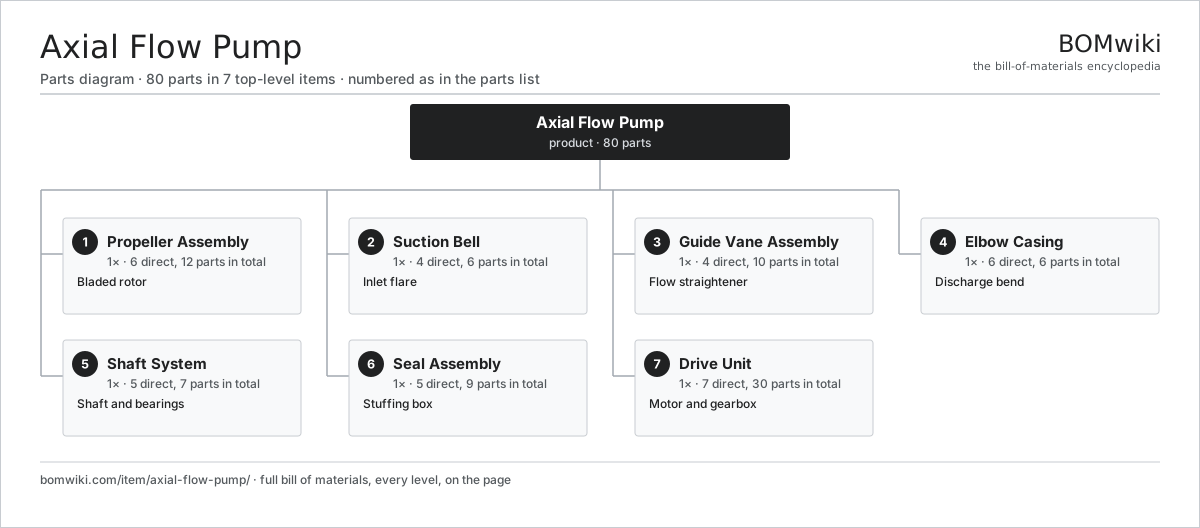
| # | Part | Qty | What it does |
|---|---|---|---|
| 1 | Propeller Assembly 6 parts | 1× | Bladed rotor |
| 2 | Suction Bell 4 parts | 1× | Inlet flare |
| 3 | Guide Vane Assembly 4 parts | 1× | Flow straightener |
| 4 | Elbow Casing 6 parts | 1× | Discharge bend |
| 5 | Shaft System 5 parts | 1× | Shaft and bearings |
| 6 | Seal Assembly 5 parts | 1× | Stuffing box |
| 7 | Drive Unit 7 parts | 1× | Motor and gearbox |
3D model
No 3D model yet. Have a CAD file of this? Add a 3D model. STL renders right on this page; STEP, FreeCAD, and OpenSCAD sources are welcome too (openly licensed, like all 3D models on BOMwiki).
Build & assembly graph
expand / collapse · shared sub-assemblies converge · links to related products · est. labourTap an assembly to expand/collapse · tap a part to open it · use “Open page” for any node · drag to pan, scroll to zoom.
Bill of materials for Axial Flow Pump
7 top-level lines · 51 rows shown · 80 parts total · indented to 3 levels| # | Item / sub-assembly | Part no. | Qty/assy | Ext. qty | Parts | Type |
|---|---|---|---|---|---|---|
| 1 | Propeller Assembly 6 parts | axial-flow-pump-propeller | 1× | 1 | 12 | assembly |
| 1.1 | Propeller Hub | axial-flow-pump-propeller-hub | 1× | 1 | · | part |
| 1.2 | Propeller Blade | axial-flow-pump-blade | 4× | 4 | · | part |
| 1.3 | Nose Cone | axial-flow-pump-nose-cone | 1× | 1 | · | part |
| 1.4 | Blade Pivot Trunnion | axial-flow-pump-blade-pivot | 4× | 4 | · | part |
| 1.5 | Propeller Key | axial-flow-pump-propeller-key | 1× | 1 | · | part |
| 1.6 | Fastener Set | fastener-set | 1× | 1 | · | part |
| 2 | Suction Bell 4 parts | axial-flow-pump-suction-bell | 1× | 1 | 6 | assembly |
| 2.1 | Bell Casting | axial-flow-pump-bell-casting | 1× | 1 | · | part |
| 2.2 | Casing Liner | axial-flow-pump-casing-liner | 1× | 1 | · | part |
| 2.3 | Splitter Vane | axial-flow-pump-splitter-vane | 3× | 3 | · | part |
| 2.4 | Fastener Set | fastener-set | 1× | 1 | · | part |
| 3 | Guide Vane Assembly 4 parts | axial-flow-pump-guide-vane-assembly | 1× | 1 | 10 | assembly |
| 3.1 | Diffuser Bowl | axial-flow-pump-diffuser-bowl | 1× | 1 | · | part |
| 3.2 | Guide Vane | axial-flow-pump-guide-vane | 7× | 7 | · | part |
| 3.3 | Vane Hub | axial-flow-pump-vane-hub | 1× | 1 | · | part |
| 3.4 | Bowl Sleeve Bearing | axial-flow-pump-bowl-bearing | 1× | 1 | · | part |
| 4 | Elbow Casing 6 parts | axial-flow-pump-elbow-casing | 1× | 1 | 6 | assembly |
| 4.1 | Elbow Body | axial-flow-pump-elbow-body | 1× | 1 | · | part |
| 4.2 | Shaft Tube | axial-flow-pump-shaft-tube | 1× | 1 | · | part |
| 4.3 | Discharge Flange | axial-flow-pump-discharge-flange | 1× | 1 | · | part |
| 4.4 | Inspection Cover | axial-flow-pump-inspection-cover | 1× | 1 | · | part |
| 4.5 | O-Ring Set | oring-set | 1× | 1 | · | part |
| 4.6 | Fastener Set | fastener-set | 1× | 1 | · | part |
| 5 | Shaft System 5 parts | axial-flow-pump-shaft-system | 1× | 1 | 7 | assembly |
| 5.1 | Main Shaft | axial-flow-pump-main-shaft | 1× | 1 | · | part |
| 5.2 | Shaft Sleeve | axial-flow-pump-shaft-sleeve | 2× | 2 | · | part |
| 5.3 | Guide Bearing | axial-flow-pump-guide-bearing | 2× | 2 | · | part |
| 5.4 | Thrust Bearing Unit | axial-flow-pump-thrust-bearing-unit | 1× | 1 | · | part |
| 5.5 | Shaft Coupling | axial-flow-pump-shaft-coupling | 1× | 1 | · | part |
| 6 | Seal Assembly 5 parts | axial-flow-pump-seal-assembly | 1× | 1 | 9 | assembly |
| 6.1 | Stuffing Box | axial-flow-pump-stuffing-box | 1× | 1 | · | part |
| 6.2 | Packing Ring | axial-flow-pump-packing-ring | 5× | 5 | · | part |
| 6.3 | Gland Follower | axial-flow-pump-gland-follower | 1× | 1 | · | part |
| 6.4 | Lantern Ring | axial-flow-pump-lantern-ring | 1× | 1 | · | part |
| 6.5 | Fastener Set | fastener-set | 1× | 1 | · | part |
| 7 | Drive Unit 7 parts | axial-flow-pump-drive | 1× | 1 | 30 | assembly |
| 7.1 | Stator Assembly 3 parts | stator-assembly | 1× | 1 | 3 | assembly |
| 7.1.1 | Stator Core (laminations) | stator-core | 1× | 1 | · | part |
| 7.1.2 | Copper Winding | copper-winding | 1× | 1 | · | part |
| 7.1.3 | Slot Insulation | stator-insulation | 1× | 1 | · | part |
| 7.2 | Rotor Assembly 4 parts | rotor-assembly | 1× | 1 | 19 | assembly |
| 7.2.1 | Rotor Shaft | rotor-shaft | 1× | 1 | · | part |
| 7.2.2 | Rotor Core | rotor-core | 1× | 1 | · | part |
| 7.2.3 | Neodymium Magnet | neodymium-magnet | 16× | 16 | · | part |
| 7.2.4 | Ball Bearing | ball-bearing | 1× | 1 | · | part |
| 7.3 | Motor Housing | motor-housing | 1× | 1 | · | part |
| 7.4 | Reduction Gearbox | axial-flow-pump-reduction-gearbox | 1× | 1 | · | part |
| 7.5 | Helical Gear Pair | gear-pair | 1× | 1 | · | part |
| 7.6 | Gearbox Housing | gearbox-housing | 1× | 1 | · | part |
| 7.7 | Ball Bearing | ball-bearing | 4× | 4 | · | part |
Something wrong in this list? Report a problem with this BOM.
Related products
same domain, ranked by shared parts Ball Valve
61 parts · shares 3 with this page
Ball Valve
61 parts · shares 3 with this page
 Centrifugal Compressor
338 parts · shares 3 with this page
Centrifugal Compressor
338 parts · shares 3 with this page
 Progressive Cavity Pump
54 parts · shares 3 with this page
Progressive Cavity Pump
54 parts · shares 3 with this page
 Radial Spillway Gate
264 parts · shares 3 with this page
Radial Spillway Gate
264 parts · shares 3 with this page
 Irrigation Pump Station
1,881 parts · shares 2 with this page
Irrigation Pump Station
1,881 parts · shares 2 with this page
 Sluice Gate
123 parts · shares 2 with this page
Sluice Gate
123 parts · shares 2 with this page
Sourcing: possible vendors
Browse the supplier directory → Prices, MOQ, and lead times are algorithmic estimates, not quotes, and not claims about these companies. Company mappings are curated by keyword; est. price band $50–$50k. How estimates work| Vendor | HQ | Specialty | MOQ | Lead time |
|---|---|---|---|---|
|
🇩🇰Grundfos
grundfos.com ↗
|
Bjerringbro, DK | Pumps | 200 units | 6–12 wks |
|
🇺🇸Xylem
xylem.com ↗
|
Washington, US | Water technology | 200 units | 6–12 wks |
| flowserve.com ↗ | Irving, US | Pumps & valves | 200 units | 6–12 wks |
|
🇩🇪KSB
ksb.com ↗
|
Frankenthal, DE | Pumps & valves | 200 units | 6–12 wks |
| parker.com ↗ | Cleveland, US | Motion & fluid control | 200 units | 6–12 wks |
794-word article