Baby Crib
ProductOverview
A full-size baby crib is among the most heavily regulated pieces of furniture made: it is the one product whose occupant is left unattended in it for hours. Nearly every dimension in the design, slat gap, side height, mattress fit, hardware accessibility, is fixed by 16 CFR 1219 / ASTM F1169 in the US and EN 716 in Europe, all written around documented entrapment, fall, and strangulation incidents.
The structure is four panels: a Headboard Panel and Footboard Panel of solid construction, and two fixed slatted sides in the Slatted Side Set. The Mattress Platform spans between the end panels and can be mounted at two or three heights on the Bracket Hole Row in each End Post: high for reaching a newborn, low once the infant can pull to standing. Interior dimensions are standardized at roughly 1330 × 700 mm so that any compliant mattress fits any compliant crib with no edge gap over 30 mm, a loose fit is an entrapment hazard, which is why mattress size is regulated jointly with the crib.
How it works
The slatted sides do the central safety job. Each hardwood Side Slat is tenoned into the Top Side Rail and Bottom Side Rail, and the spacing rule is absolute: no gap may exceed 60 mm (2-3/8 in), the dimension below which an infant torso cannot pass (a torso that passes a wider gap leaves the head trapped). Factories verify this with a gauge pass recorded as the Slat Spacing Gauge Record, and the standard also tests each slat against a 36 kg pull to prove a chewing, kicking occupant cannot dislodge one. The solid End Panel Boards are subject to the inverse rule, any cutout must be too small for a head, and the End Posts may not extend more than 1.5 mm above the rails unless over 406 mm tall, because protruding corner posts have strangled children by catching clothing.
Fixed sides are themselves a safety feature. Drop-side cribs, made for decades, were banned in the US in 2011 after detaching drop-side hardware created lethal V-shaped gaps; modern sides bolt rigidly to the posts through the Hardware System. Each joint pairs a long Frame Bolt with a Barrel Nut embedded across the rail, so the bolt threads into steel rather than end-grain wood, the same cross-bolt used in bed frames, chosen because it survives repeated assembly and the shake loads of a bouncing toddler. Anti-Loosen Washers hold preload as the wood shrinks seasonally, Bolt Cover Cap caps keep hardware edges away from the occupant, and the included Hex Assembly Key supports the manufacturer's instruction to re-tighten periodically.
Mattress platform
The Mattress Platform is usually a welded steel Platform Frame carrying a Spring Wire Grid tensioned by perimeter Coil Springs, which ventilates the mattress underside and gives slight compliance. Each corner bolts to a Height Bracket engaged in the post's threaded inserts. The height settings track development: the top position saves caregivers' backs during the newborn months, and the standard requires at least 660 mm from platform to rail top at the lowest setting so a standing toddler cannot pitch over the side. Manufacturers instruct moving to the low position as soon as the infant can sit, and discontinuing the crib at about 890 mm (35 in) of height or first climb-out.
Teething rails and finish
An infant who can stand will gnaw the top rail. The Teething Rail Set snaps an extruded Teething Rail of food-grade PVC or polyethylene over each Top Side Rail, protecting gums from splinters and the wood from teeth; Teething Rail End Caps close the extrusion ends. Because the whole structure is mouthing-accessible, the Finish System is held to toy-safety chemistry: the Base Stain and Non-Toxic Topcoat must meet the lead limit of 16 CFR 1303 / CPSIA (90 ppm in paint) and the element-migration limits of EN 71-3, with a Finish Test Certificate from a CPSC-accepted lab retained for every finish batch. Water-based polyurethanes and UV-cured coatings dominate because they certify cleanly.
Many cribs extend their service life as "3-in-1" designs: with the front side unbolted and a half-height rail substituted, the same posts and platform serve as a toddler bed, and some convert further to a daybed. The conversion states are tested under the same standards. A typical hardwood crib weighs 20–35 kg and is built from beech or birch, woods chosen for hardness against chewing and for split-free behavior in the slat tenons.
Baby Crib parts and their functions
7 top-level parts · 107 parts in total · full bill of materials below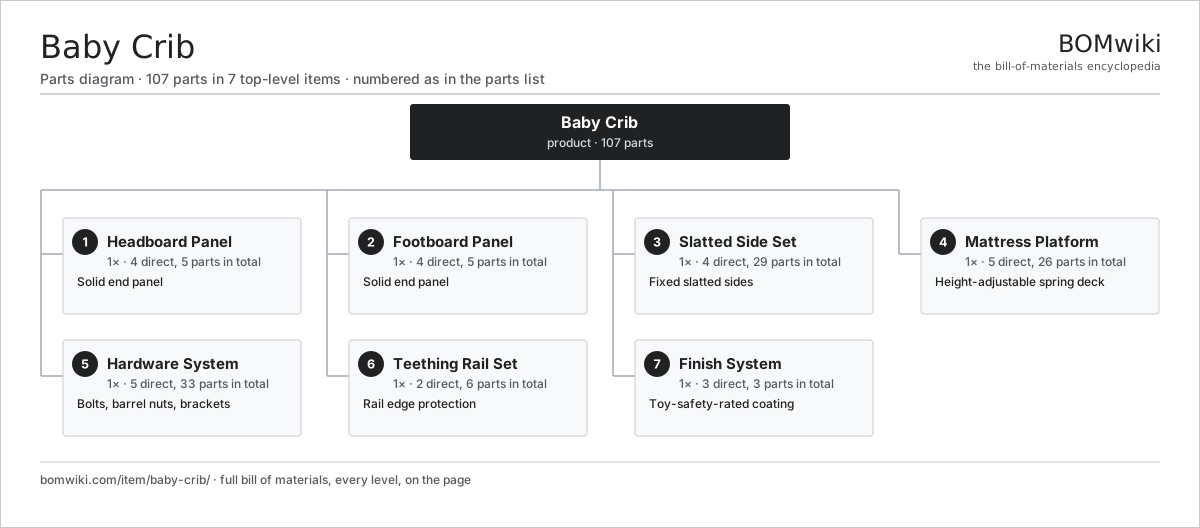
| # | Part | Qty | What it does |
|---|---|---|---|
| 1 | Headboard Panel 4 parts | 1× | Solid end panel |
| 2 | Footboard Panel 4 parts | 1× | Solid end panel |
| 3 | Slatted Side Set 4 parts | 1× | Fixed slatted sides |
| 4 | Mattress Platform 5 parts | 1× | Height-adjustable spring deck |
| 5 | Hardware System 5 parts | 1× | Bolts, barrel nuts, brackets |
| 6 | Teething Rail Set 2 parts | 1× | Rail edge protection |
| 7 | Finish System 3 parts | 1× | Toy-safety-rated coating |
3D model
No 3D model yet. Have a CAD file of this? Add a 3D model. STL renders right on this page; STEP, FreeCAD, and OpenSCAD sources are welcome too (openly licensed, like all 3D models on BOMwiki).
Build & assembly graph
expand / collapse · shared sub-assemblies converge · links to related products · est. labourTap an assembly to expand/collapse · tap a part to open it · use “Open page” for any node · drag to pan, scroll to zoom.
Bill of materials for Baby Crib
7 top-level lines · 34 rows shown · 107 parts total · indented to 3 levels| # | Item / sub-assembly | Part no. | Qty/assy | Ext. qty | Parts | Type |
|---|---|---|---|---|---|---|
| 1 | Headboard Panel 4 parts | baby-crib-headboard | 1× | 1 | 5 | assembly |
| 1.1 | End Post | baby-crib-end-post | 2× | 2 | · | part |
| 1.2 | End Panel Board | baby-crib-end-panel-board | 1× | 1 | · | part |
| 1.3 | Top Cap Rail | baby-crib-top-cap-rail | 1× | 1 | · | part |
| 1.4 | Bracket Hole Row | baby-crib-bracket-hole-row | 1× | 1 | · | part |
| 2 | Footboard Panel 4 parts | baby-crib-footboard | 1× | 1 | 5 | assembly |
| 2.1 | End Post | baby-crib-end-post | 2× | 2 | · | part |
| 2.2 | End Panel Board | baby-crib-end-panel-board | 1× | 1 | · | part |
| 2.3 | Top Cap Rail | baby-crib-top-cap-rail | 1× | 1 | · | part |
| 2.4 | Bracket Hole Row | baby-crib-bracket-hole-row | 1× | 1 | · | part |
| 3 | Slatted Side Set 4 parts | baby-crib-side-set | 1× | 1 | 29 | assembly |
| 3.1 | Top Side Rail | baby-crib-side-rail-top | 2× | 2 | · | part |
| 3.2 | Bottom Side Rail | baby-crib-side-rail-bottom | 2× | 2 | · | part |
| 3.3 | Side Slat | baby-crib-slat | 24× | 24 | · | part |
| 3.4 | Slat Spacing Gauge Record | baby-crib-slat-spacer-check | 1× | 1 | · | part |
| 4 | Mattress Platform 5 parts | baby-crib-mattress-platform | 1× | 1 | 26 | assembly |
| 4.1 | Platform Frame | baby-crib-platform-frame | 1× | 1 | · | part |
| 4.2 | Spring Wire Grid | baby-crib-spring-grid | 1× | 1 | · | part |
| 4.3 | Height Bracket | baby-crib-height-bracket | 4× | 4 | · | part |
| 4.4 | Coil Spring | coil-spring | 16× | 16 | · | part |
| 4.5 | Platform Bolt | baby-crib-platform-bolt | 4× | 4 | · | part |
| 5 | Hardware System 5 parts | baby-crib-hardware-system | 1× | 1 | 33 | assembly |
| 5.1 | Frame Bolt | baby-crib-frame-bolt | 8× | 8 | · | part |
| 5.2 | Barrel Nut | baby-crib-barrel-nut | 8× | 8 | · | part |
| 5.3 | Bolt Cover Cap | baby-crib-bolt-cover | 8× | 8 | · | part |
| 5.4 | Hex Assembly Key | baby-crib-allen-key | 1× | 1 | · | part |
| 5.5 | Anti-Loosen Washer | baby-crib-anti-loosen-washer | 8× | 8 | · | part |
| 6 | Teething Rail Set 2 parts | baby-crib-teething-rail-set | 1× | 1 | 6 | assembly |
| 6.1 | Teething Rail | baby-crib-teething-rail | 2× | 2 | · | part |
| 6.2 | Teething Rail End Cap | baby-crib-rail-end-cap | 4× | 4 | · | part |
| 7 | Finish System 3 parts | baby-crib-finish-system | 1× | 1 | 3 | assembly |
| 7.1 | Base Stain | baby-crib-base-stain | 1× | 1 | · | part |
| 7.2 | Non-Toxic Topcoat | baby-crib-topcoat-nontoxic | 1× | 1 | · | part |
| 7.3 | Finish Test Certificate | baby-crib-finish-test-cert | 1× | 1 | · | part |
Something wrong in this list? Report a problem with this BOM.
Related products
same domain, ranked by shared parts Baby High Chair
45 parts · shares 1 with this page
Baby High Chair
45 parts · shares 1 with this page
 Barber Chair
59 parts · shares 1 with this page
Cantilever Patio Umbrella
34 parts · shares 1 with this page
Cinema Recliner Seating
61 parts · shares 1 with this page
Barber Chair
59 parts · shares 1 with this page
Cantilever Patio Umbrella
34 parts · shares 1 with this page
Cinema Recliner Seating
61 parts · shares 1 with this page
 Drafting Table
55 parts · shares 1 with this page
Drafting Table
55 parts · shares 1 with this page
 Ergonomic Office Chair
48 parts · shares 1 with this page
Ergonomic Office Chair
48 parts · shares 1 with this page
Sourcing: possible vendors
Browse the supplier directory → Prices, MOQ, and lead times are algorithmic estimates, not quotes, and not claims about these companies. Company mappings are curated by keyword; est. price band $50–$3k. How estimates work| Vendor | HQ | Specialty | MOQ | Lead time |
|---|---|---|---|---|
| steelcase.com ↗ | Grand Rapids, US | Office furniture | 200 units | 6–12 wks |
| millerknoll.com ↗ | Zeeland, US | Furniture (Herman Miller) | 200 units | 6–12 wks |
|
🇺🇸Haworth
haworth.com ↗
|
Holland, US | Office furniture | 200 units | 6–12 wks |
|
🇺🇸HNI
hnicorp.com ↗
|
Muscatine, US | Furniture & hearth | 200 units | 6–12 wks |
| ikea.com ↗ | Älmhult, SE | Furniture manufacturing | 200 units | 6–12 wks |
820-word article