Baby High Chair
ProductOverview
The baby high chair is a feeding seat designed to position infants and young toddlers at table height while securely restraining them during meals. High chairs serve a critical developmental role: they support the transition from bottle/breastfeeding to self-feeding with utensils around 6–8 months of age. The elevated seat ensures proper swallowing posture, places the child at eye level with caregivers, and keeps food and crumbs contained on a removable tray.
Modern high chairs prioritize safety with multi-point harness systems, stability-focused design, and washable upholstery to manage the inevitable spills and messes of infant feeding.
Seat Design & Positioning
The Seat Pad is a molded bucket, contoured to support an infant's torso and prevent tilting. The Seat Shell provides structural rigidity; the Seat Foam, typically 2–3 inches of high-density foam, offers cushioning without being so soft that it compromises posture.
The Seat Cover, usually waterproof vinyl or fabric, is machine-washable, a practical necessity. Formula, baby food, and drool mean upholstery gets soiled daily; removable, washable covers prevent the chair from becoming unsanitary.
The Recline Mechanism allows 3–5 positions from fully upright to 45° recline. Newborns and very young infants (under 4 months) are typically fed in a reclined position to reduce choking risk. As the child matures, more upright positions encourage active participation and eventual self-feeding.
Safety Harness
The five-point Harness System includes two shoulder straps, two lap straps, and a central crotch strap, all converging at a Harness Buckle fastened at the infant's abdomen. This geometry prevents infants from slipping sideways, backward, or downward. The buckle typically uses a large button release, easily operated by an adult wearing one hand.
Harness Strap materials are nylon webbing, soft and non-slip. Strap Padding on shoulder and lap areas prevents chafing and spreads force over larger body areas, improving comfort during extended sitting.
A critical safety consideration: the harness is no substitute for supervision. Infants and toddlers can still injure themselves if the chair tips, if the tray pinches, or if they manage to slip lower than intended. Proper installation and routine inspection of strap stitching prevent failures.
Height Adjustment
Many high chairs feature a Recline Mechanism that also adjusts seat height, allowing the Meal Tray to align with the caregiver's working surface (typically a dining table or counter). As the child grows from 6 months to 2–3 years, height adjustment ensures the seat and tray remain positioned correctly relative to the child's limbs and mouth.
Some models achieve height adjustment through a manually adjusted bracket; others use a spring-loaded mechanism that can be adjusted without tools. Budget models may have only two or three fixed positions.
Tray & Feeding Surface
The Meal Tray is a removable platform with a Tray Edge rim containing spills. Two Cup Holder inserts hold sippy cups or water bottles, preventing them from tipping into the infant's lap.
The tray attaches via Tray Bracket, a quick-release mechanism allowing removal without tools. This facilitates both in-chair feeding (tray close to body) and open access (tray removed for caregiver to assist with self-feeding practice).
Tray materials are polypropylene (easy to clean, dishwasher-safe) or wood. Polypropylene is standard for safety and hygiene; wooden trays are found on high-end models and are typically finished with food-grade sealant.
Mobility & Stability
The Caster Base is a four-point platform on Caster Wheel, swivel-mounted for 360° movement. This allows caregivers to roll the chair to the dining table, kitchen, or playroom without lifting.
A foot-operated Brake Lever engages brake pads, locking two or more wheels simultaneously. The brake is essential: the chair must not roll during feeding when the caregiver is balancing the infant's head or guiding a spoon. Many high-chair tips occur when the chair was not properly braked.
The Frame Structure, typically welded steel or aluminum tube, is designed with a wide, stable footprint, 20 x 18 inches or larger. This low center of gravity and wide base resist tipover when a toddler shifts weight or twists.
Practical Considerations
Modern high chairs often fold for storage and transport, important for homes with limited space or families who travel. Folding mechanisms typically require collapsing the frame and detaching the Seat Pad.
Cleaning is critical to hygiene. The Seat Cover can be removed and machine-washed. The Meal Tray is often dishwasher-safe. The Frame Structure and Caster Base can be wiped with damp cloth; crevices where food accumulates should be cleaned periodically.
Typical use spans from 6 months (first solid foods) to 2–3 years (transition to booster seat at regular chair). As children grow taller, even the maximum seat height may become cramped. By 3 years, most children graduate to a booster seat on a standard chair.
Routine inspection of Harness Strap stitching, Brake Lever function, and Tray Bracket integrity ensures safety over the product's multi-year lifespan.
Baby High Chair parts and their functions
6 top-level parts · 45 parts in total · full bill of materials below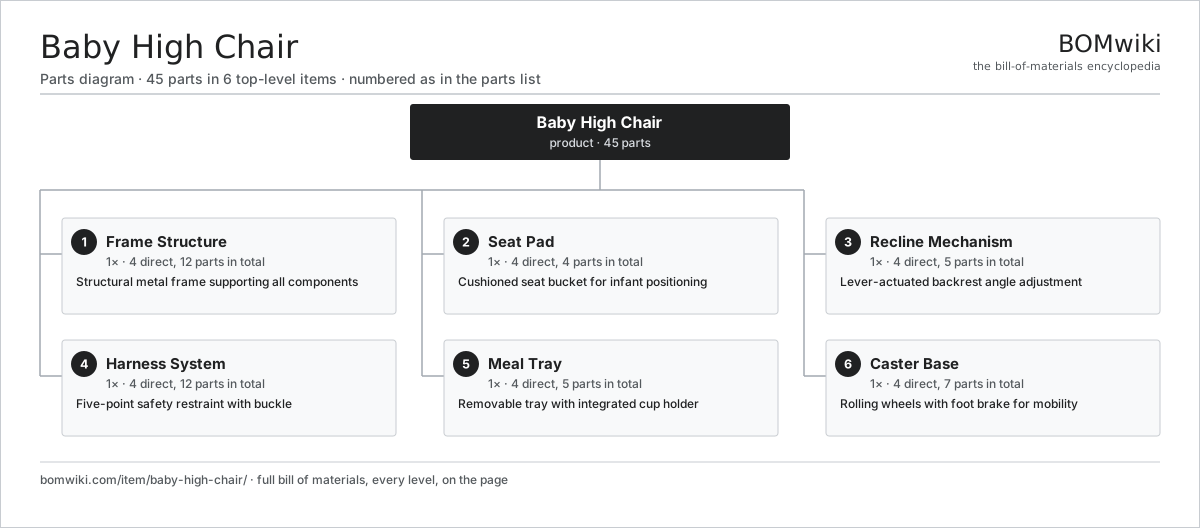
| # | Part | Qty | What it does |
|---|---|---|---|
| 1 | Frame Structure 4 parts | 1× | Structural metal frame supporting all components |
| 2 | Seat Pad 4 parts | 1× | Cushioned seat bucket for infant positioning |
| 3 | Recline Mechanism 4 parts | 1× | Lever-actuated backrest angle adjustment |
| 4 | Harness System 4 parts | 1× | Five-point safety restraint with buckle |
| 5 | Meal Tray 4 parts | 1× | Removable tray with integrated cup holder |
| 6 | Caster Base 4 parts | 1× | Rolling wheels with foot brake for mobility |
3D model
No 3D model yet. Have a CAD file of this? Add a 3D model. STL renders right on this page; STEP, FreeCAD, and OpenSCAD sources are welcome too (openly licensed, like all 3D models on BOMwiki).
Build & assembly graph
expand / collapse · shared sub-assemblies converge · links to related products · est. labourTap an assembly to expand/collapse · tap a part to open it · use “Open page” for any node · drag to pan, scroll to zoom.
Bill of materials for Baby High Chair
6 top-level lines · 30 rows shown · 45 parts total · indented to 3 levels| # | Item / sub-assembly | Part no. | Qty/assy | Ext. qty | Parts | Type |
|---|---|---|---|---|---|---|
| 1 | Frame Structure 4 parts | baby-high-chair-frame | 1× | 1 | 12 | assembly |
| 1.1 | Vertical Post | baby-high-chair-vertical-post | 2× | 2 | · | part |
| 1.2 | Cross Brace | baby-high-chair-cross-brace | 6× | 6 | · | part |
| 1.3 | Seat Bracket | baby-high-chair-seat-bracket | 1× | 1 | · | part |
| 1.4 | Fastener Set | fastener-set | 3× | 3 | · | part |
| 2 | Seat Pad 4 parts | baby-high-chair-seat-pad | 1× | 1 | 4 | assembly |
| 2.1 | Seat Shell | baby-high-chair-seat-shell | 1× | 1 | · | part |
| 2.2 | Seat Foam | baby-high-chair-seat-foam | 1× | 1 | · | part |
| 2.3 | Seat Cover | baby-high-chair-seat-cover | 1× | 1 | · | part |
| 2.4 | Fastener Set | fastener-set | 1× | 1 | · | part |
| 3 | Recline Mechanism 4 parts | baby-high-chair-recline-mechanism | 1× | 1 | 5 | assembly |
| 3.1 | Recline Lever | baby-high-chair-recline-lever | 1× | 1 | · | part |
| 3.2 | Backrest Bracket | baby-high-chair-backrest-bracket | 1× | 1 | · | part |
| 3.3 | Coil Spring | coil-spring | 2× | 2 | · | part |
| 3.4 | Fastener Set | fastener-set | 1× | 1 | · | part |
| 4 | Harness System 4 parts | baby-high-chair-harness-system | 1× | 1 | 12 | assembly |
| 4.1 | Harness Strap | baby-high-chair-harness-strap | 5× | 5 | · | part |
| 4.2 | Harness Buckle | baby-high-chair-harness-buckle | 1× | 1 | · | part |
| 4.3 | Strap Padding | baby-high-chair-strap-padding | 5× | 5 | · | part |
| 4.4 | Fastener Set | fastener-set | 1× | 1 | · | part |
| 5 | Meal Tray 4 parts | baby-high-chair-meal-tray | 1× | 1 | 5 | assembly |
| 5.1 | Tray Top | baby-high-chair-tray-top | 1× | 1 | · | part |
| 5.2 | Cup Holder | baby-high-chair-tray-cup-holder | 2× | 2 | · | part |
| 5.3 | Tray Edge | baby-high-chair-tray-edge | 1× | 1 | · | part |
| 5.4 | Tray Bracket | baby-high-chair-tray-bracket | 1× | 1 | · | part |
| 6 | Caster Base 4 parts | baby-high-chair-caster-base | 1× | 1 | 7 | assembly |
| 6.1 | Base Plate | baby-high-chair-base-plate | 1× | 1 | · | part |
| 6.2 | Caster Wheel | baby-high-chair-caster-wheel | 4× | 4 | · | part |
| 6.3 | Brake Lever | baby-high-chair-brake-lever | 1× | 1 | · | part |
| 6.4 | Fastener Set | fastener-set | 1× | 1 | · | part |
Something wrong in this list? Report a problem with this BOM.
Related products
same domain, ranked by shared parts Baby Crib
107 parts · shares 1 with this page
Baby Crib
107 parts · shares 1 with this page
 Barber Chair
59 parts · shares 1 with this page
Cantilever Patio Umbrella
34 parts · shares 1 with this page
Cinema Recliner Seating
61 parts · shares 1 with this page
Barber Chair
59 parts · shares 1 with this page
Cantilever Patio Umbrella
34 parts · shares 1 with this page
Cinema Recliner Seating
61 parts · shares 1 with this page
 Drafting Table
55 parts · shares 1 with this page
Drafting Table
55 parts · shares 1 with this page
 Ergonomic Office Chair
48 parts · shares 1 with this page
Ergonomic Office Chair
48 parts · shares 1 with this page
Sourcing: possible vendors
Browse the supplier directory → Prices, MOQ, and lead times are algorithmic estimates, not quotes, and not claims about these companies. Company mappings are curated by keyword; est. price band $50–$3k. How estimates work| Vendor | HQ | Specialty | MOQ | Lead time |
|---|---|---|---|---|
| steelcase.com ↗ | Grand Rapids, US | Office furniture | 200 units | 6–12 wks |
| millerknoll.com ↗ | Zeeland, US | Furniture (Herman Miller) | 200 units | 6–12 wks |
|
🇺🇸Haworth
haworth.com ↗
|
Holland, US | Office furniture | 200 units | 6–12 wks |
|
🇺🇸HNI
hnicorp.com ↗
|
Muscatine, US | Furniture & hearth | 200 units | 6–12 wks |
| ikea.com ↗ | Älmhult, SE | Furniture manufacturing | 200 units | 6–12 wks |
905-word article