Baggage Tractor
ProductOverview
A baggage tractor (or baggage tug) is a lightweight, electrically or diesel-powered vehicle designed specifically for hauling baggage dolly trains (4–6 standardized baggage carts coupled together) around airport terminals and tarmacs. Unlike heavy aircraft tug tractors (which push or tow aircraft using ballast and high torque), baggage tractors prioritize maneuverability, cost-efficiency, and quick turnaround cycles (20–30 minute round trips, 6–8 loads per 8-hour shift).
Modern baggage tractors are increasingly electric, powered by lithium-ion or lead-acid batteries (48 V typical), reducing fuel consumption, noise, and emissions, critical for airport ground operations where multiple vehicles operate in parallel within terminal buildings. A typical widebody aircraft offloads 400–600 bags per flight; a fleet of 4–6 electric baggage tractors can clear that load in 1–2 hours.
Compact Design & Towing Capacity
The Chassis & Drivetrain is purpose-built for compactness: 2.5–3.5 m long, 1.8 m wide, fitting narrow terminal corridors and apron congestion. Despite small footprint, baggage tractors pull 30–50 ton static load via pintle hitch (same coupling as larger tractors, scaled to lower forces).
Towing physics:
- Typical dolly weight: 8–10 ton (empty), 15 ton (loaded with baggage).
- Typical train: 3–5 dollies = 24–75 ton (depending on load).
- Tractor weight: 3–6 ton (electric), 5–8 ton (diesel).
- Traction: Tire friction + ballast (minimal on baggage tractors) enables pulling.
- Ground-level baggage (apron concrete, terminal tug lanes) coefficient μ ≈ 0.6–0.8.
- Towing force: 5 ton tractor weight × 0.7 friction = 3.5 ton pulling capacity (sufficient for light loads); heavier loads require lower-speed creep or multiple-tractor assists.
Electric baggage tractors use direct-drive or single-speed reduction (no transmission), enabling smooth low-speed control via throttle pedal (modulate motor power 0–100%).
Electric vs. Diesel Variants
Electric baggage tractors (dominant post-2015):
- Battery: 48 V (lithium-ion 200 Ah = 9.6 kWh, or lead-acid 300 Ah = 14.4 kWh).
- Motor: AC induction (5–50 kW) or brushless DC motor.
- Range: 40–60 km per charge (suitable for 6–10 airport service runs before overnight recharge).
- Advantages: Zero emissions, <75 dB(A) noise, minimal maintenance (no oil changes), rapid torque response (smooth creep).
- Disadvantages: High upfront cost ($100k–150k vs. $50k diesel), battery weight (500–800 kg), cold-weather range loss (battery capacity drops 30–40% at −20 °C).
Diesel variants (remaining at secondary airports):
- Engine: 30–50 kW turbocharged diesel.
- Speed: 25+ km/h (higher than electric), enabling faster long-distance apron towing.
- Cost: $50k–70k purchase price.
- Disadvantages: Noise (80–85 dB(A)), emissions (NOx, particulates), higher operating cost (fuel + maintenance), less responsive control (mechanical transmission vs. electric).
Modern terminals mandate electric-only fleets (EU directive, some US airports) due to indoor air quality requirements (terminal building particulate limits).
Steering & Maneuverability
The Steering System (power-assisted hydraulic or electric steering) enables tight 5–7 m turning radius, critical for:
- Navigating 90° turns in terminal corridors (typical width 4–5 m, dolly train ~3 m wide).
- Positioning trains at baggage claim carousels without jackknifing.
- Maneuvering in confined apron holding areas.
Tight-space operation:
- Operator approaches turn slowly (3–5 km/h).
- Applies full steering lock (40–50° front axle angle).
- Train follows in arc; rear dolly tends to swing outward (requires onboard spotter or mirror check for clearance).
- Operator backs up if oversteered, resets, and proceeds.
Poor steering design causes train jackknife (rear dolly swings perpendicular to tractor), damaging adjacent equipment or baggage.
Braking & Parking
The Braking System is typically hydraulic (supplied by electric pump on battery-powered vehicles, or engine-driven on diesel).
Service braking: Proportional foot pedal modulating brake pressure (0–1 m/s² deceleration typical, gentle to avoid baggage tumbling).
Parking brake: Parking Brake engages mechanical spring-applied brake, holding tractor + train static on apron (inclines up to 5% acceptable).
Critical safety requirement: Parking brake must engage automatically if tractor operator dismounts (seat weight sensor trigger, preventing runaway). Many baggage tractors add mechanical wheel lock (towing vehicle cannot start if train is coupled to parked tractor, preventing accidental jerking).
Lighting & Safety
Baggage tractors operate indoors (terminal buildings, ground-level tug lanes) and outdoors (apron, taxiway). Safety lighting is essential:
- Headlights: LED 500–1000 lumens, visible 50+ m (apron night operations).
- Taillights: Red LED 100 lumens continuous, 200 lumens brake flash.
- Amber beacon (Beacon Light): Rotating or strobe, 360° visibility (warns other apron vehicles and personnel).
- Backup alarm: Backup Alarm (85 dB(A) at 1 m) automatically activates in reverse gear, warning bystanders.
Additionally, Mirrors (convex side-view, 180° field) allow operator to monitor train position and clearance to adjacent objects.
Critical hazards:
- Personnel caught between dolly couplers (crushing injury).
- Train dolly overriding tractor rear wheels (jackknife, dolly flips).
- Baggage spillage during sharp braking (items fly forward, injure personnel).
- Battery or fuel system fires (rare, but catastrophic in enclosed terminal).
Operational Patterns
Typical baggage-train cycle (30 minutes, Boeing 737 offload):
Position at aircraft (3 min): Drive 3–4 empty dollies to aircraft cargo door. Couple dolly train to tractor pintle ring (manual safety pin insertion).
Load baggage (10 min): Ground personnel load luggage from aircraft onto dollies (using conveyors, hand-placement). Load ~ 60–80 bags per dolly (average 20 kg/bag = 1200–1600 kg/dolly, approaching rated load).
Transport to baggage claim (8 min): Operator drives train from aircraft (apron) through tunnel to baggage claim area (0.5–1 km distance, 5–10 km/h speed).
Position at carousel (3 min): Back train to carousel, operator waits while baggage handlers unload dolly contents onto carousel belt system.
Return for next load (6 min): Operator decouples empty dolly, drives back to aircraft for next load.
Parallel operations (widebody A380):
- A380 offloads 400+ bags (6–8 dolly trains required).
- Typical 4–6 baggage tractors operating in parallel (multiple train cycles).
- Estimated offload time: 1.5–2 hours per flight.
Battery Management (Electric Tractors)
Electric baggage tractors require disciplined charging protocol:
Daily cycle:
- Morning: Inspect battery pack (voltage, cell balance via onboard BMS display).
- Operate: 6–8 service cycles (40–50 km total distance).
- End of shift: Park at charging station, plug in (standard 240 V 3-phase outlet, 3 kW charger, 8–10 hour recharge).
- Overnight: Battery charges to 100% SOC (state of charge), BMS maintains temperature 15–25 °C (overheating cells degrades lifespan).
Cold-weather operation (−20 °C):
- Preheat battery 30–60 min before use (onboard immersion heater or external heater blanket).
- Range reduces 30–40% (batteries discharge faster in cold).
- Avoid rapid acceleration (stresses cold cells, risk of cell imbalance).
Lifespan:
- Lithium-ion: 2000–3000 charge cycles (5–7 years typical), capacity degrades ~1% per 100 cycles.
- Lead-acid: 500–1000 cycles (2–3 years), heavier maintenance (fluid level checks, equalization charge).
Modern fleet operators rotate battery packs: one pack in tractor, one at charger, one in spare inventory (ensures continuous operation despite charging needs).
Maintenance & Wear Items
| Component | Service Interval | Cost |
|---|---|---|
| Hydraulic Fluid (if hydraulic steering) | 1000 h | $400–600 |
| Brake Fluid | 2 years | $150–300 |
| Tire Replacement | 2000 km | $600–900 (4 tires) |
| Pintle Ring Inspection | 500 h | $200–300 |
| Battery Pack Refurbishment | 5 years | $3000–5000 (rebuild or new) |
| Motor Bearings | 3000 h | $1000–1500 (replacement) |
| Major Overhaul | 5000 h / 8 years | $15,000–25,000 |
Lifespan: Baggage tractors operate 8–12 years (4000–7000 service hours) before major overhaul or scrap. Continuous start/stop cycles, high-load stress (trains pulling hard on pintle), and exposure to weather accelerate wear vs. stationary equipment. Electric tractors' simpler powertrains extend lifespan (no transmission gearbox wear, no engine overhaul needed).
Emerging Technology
- Autonomous baggage tractors: Self-driving (using cameras/LIDAR for navigation, GPS for apron routing) reducing operator labor, improving safety (no human error in tight maneuvering). Pilot programs at Frankfurt, Hartsfield-Atlanta (limited range, supervised operation).
- Battery swapping: Instead of charging, operators swap depleted battery pack for charged one (5-minute turnaround vs. 8-hour charging). Requires infrastructure investment, but enables 24/7 continuous operation.
- Hybrid diesel-electric: Combines diesel engine (backup propulsion) + battery for electric creep. Cost premium, limited adoption due to complexity.
Modern airport terminals increasingly dedicate electric baggage tractor fleets to specific aircraft gates (a fleet of 4–6 tractors per gate), optimizing utilization and reducing capital expenditure vs. centralized fleet model.
Baggage Tractor parts and their functions
8 top-level parts · 74 parts in total · full bill of materials below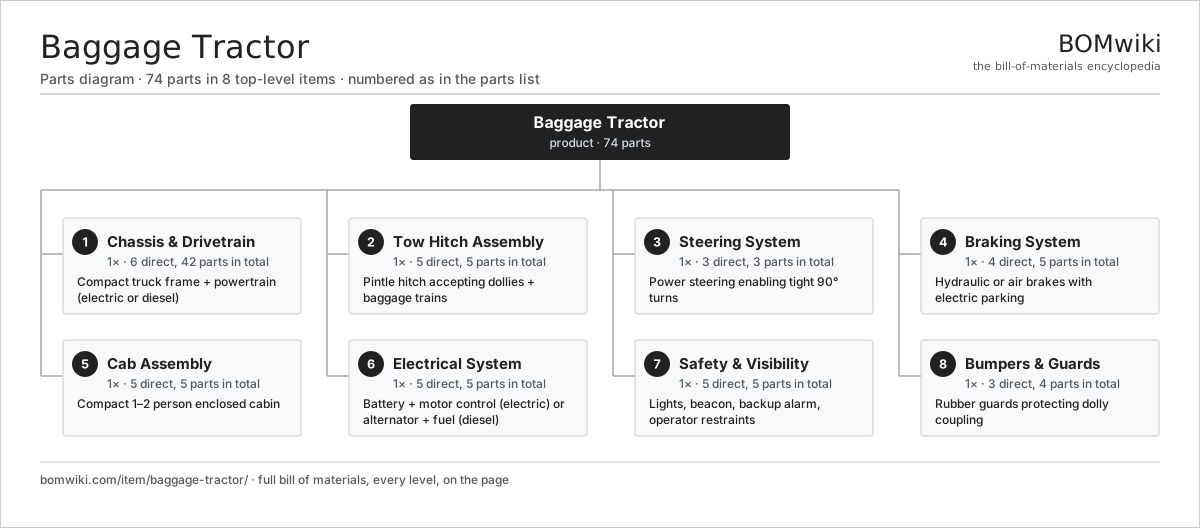
| # | Part | Qty | What it does |
|---|---|---|---|
| 1 | Chassis & Drivetrain 6 parts | 1× | Compact truck frame + powertrain (electric or diesel) |
| 2 | Tow Hitch Assembly 5 parts | 1× | Pintle hitch accepting dollies + baggage trains |
| 3 | Steering System 3 parts | 1× | Power steering enabling tight 90° turns |
| 4 | Braking System 4 parts | 1× | Hydraulic or air brakes with electric parking |
| 5 | Cab Assembly 5 parts | 1× | Compact 1–2 person enclosed cabin |
| 6 | Electrical System 5 parts | 1× | Battery + motor control (electric) or alternator + fuel (diesel) |
| 7 | Safety & Visibility 5 parts | 1× | Lights, beacon, backup alarm, operator restraints |
| 8 | Bumpers & Guards 3 parts | 1× | Rubber guards protecting dolly coupling |
3D model
No 3D model yet. Have a CAD file of this? Add a 3D model. STL renders right on this page; STEP, FreeCAD, and OpenSCAD sources are welcome too (openly licensed, like all 3D models on BOMwiki).
Build & assembly graph
expand / collapse · shared sub-assemblies converge · links to related products · est. labourTap an assembly to expand/collapse · tap a part to open it · use “Open page” for any node · drag to pan, scroll to zoom.
Bill of materials for Baggage Tractor
8 top-level lines · 49 rows shown · 74 parts total · indented to 3 levels| # | Item / sub-assembly | Part no. | Qty/assy | Ext. qty | Parts | Type |
|---|---|---|---|---|---|---|
| 1 | Chassis & Drivetrain 6 parts | baggage-tractor-chassis | 1× | 1 | 42 | assembly |
| 1.1 | Frame | baggage-tractor-frame | 1× | 1 | · | part |
| 1.2 | Propulsion Unit | baggage-tractor-engine-or-motor | 1× | 1 | · | part |
| 1.3 | Transmission | baggage-tractor-transmission | 1× | 1 | · | part |
| 1.4 | Axles | baggage-tractor-axles | 2× | 2 | · | part |
| 1.5 | Wheel Assembly 5 parts | wheel-assembly | 4× | 4 | 9 | assembly |
| 1.5.1 | Alloy Wheel | alloy-wheel | 1× | 4 | · | part |
| 1.5.2 | Tire | tire | 1× | 4 | · | part |
| 1.5.3 | TPMS Sensor | tpms-sensor | 1× | 4 | · | part |
| 1.5.4 | Lug Nut | lug-nut | 5× | 20 | · | part |
| 1.5.5 | Valve Stem | valve-stem | 1× | 4 | · | part |
| 1.6 | Suspension | baggage-tractor-suspension | 1× | 1 | · | part |
| 2 | Tow Hitch Assembly 5 parts | baggage-tractor-tow-hitch | 1× | 1 | 5 | assembly |
| 2.1 | Pintle Ring | baggage-tractor-pintle-ring | 1× | 1 | · | part |
| 2.2 | Hitch Mount | baggage-tractor-hitch-frame | 1× | 1 | · | part |
| 2.3 | Safety Pin | baggage-tractor-safety-pin | 1× | 1 | · | part |
| 2.4 | Breakaway Cable | baggage-tractor-breakaway-cable | 1× | 1 | · | part |
| 2.5 | Coupler Guard | baggage-tractor-coupler-guard | 1× | 1 | · | part |
| 3 | Steering System 3 parts | baggage-tractor-steering-system | 1× | 1 | 3 | assembly |
| 3.1 | Steering Pump | baggage-tractor-steering-pump | 1× | 1 | · | part |
| 3.2 | Steering Cylinder | baggage-tractor-steering-cylinder | 1× | 1 | · | part |
| 3.3 | Steering Valve | baggage-tractor-steering-control-valve | 1× | 1 | · | part |
| 4 | Braking System 4 parts | baggage-tractor-braking-system | 1× | 1 | 5 | assembly |
| 4.1 | Brake Pump | baggage-tractor-brake-pump | 1× | 1 | · | part |
| 4.2 | Brake Cylinder | baggage-tractor-brake-cylinders | 2× | 2 | · | part |
| 4.3 | Brake Valve | baggage-tractor-brake-pedal-valve | 1× | 1 | · | part |
| 4.4 | Parking Brake | baggage-tractor-parking-brake-solenoid | 1× | 1 | · | part |
| 5 | Cab Assembly 5 parts | baggage-tractor-cab-assembly | 1× | 1 | 5 | assembly |
| 5.1 | Cab Shell | baggage-tractor-cab-shell | 1× | 1 | · | part |
| 5.2 | Seat | baggage-tractor-seat | 1× | 1 | · | part |
| 5.3 | Steering Wheel | baggage-tractor-steering-wheel | 1× | 1 | · | part |
| 5.4 | Control Panel | baggage-tractor-control-switch-panel | 1× | 1 | · | part |
| 5.5 | Heater | baggage-tractor-heater-fan | 1× | 1 | · | part |
| 6 | Electrical System 5 parts | baggage-tractor-electrical-system | 1× | 1 | 5 | assembly |
| 6.1 | Battery Pack | baggage-tractor-battery-pack | 1× | 1 | · | part |
| 6.2 | Motor Controller | baggage-tractor-motor-controller | 1× | 1 | · | part |
| 6.3 | Battery Charger | baggage-tractor-charger | 1× | 1 | · | part |
| 6.4 | Lighting Package | baggage-tractor-lighting-wiring | 1× | 1 | · | part |
| 6.5 | Safety Switches | baggage-tractor-safety-switches | 1× | 1 | · | part |
| 7 | Safety & Visibility 5 parts | baggage-tractor-safety-system | 1× | 1 | 5 | assembly |
| 7.1 | Lighting | baggage-tractor-lighting | 1× | 1 | · | part |
| 7.2 | Beacon Light | baggage-tractor-amber-beacon | 1× | 1 | · | part |
| 7.3 | Backup Alarm | baggage-tractor-backup-alarm | 1× | 1 | · | part |
| 7.4 | Mirrors | baggage-tractor-mirrors | 1× | 1 | · | part |
| 7.5 | Operator Belt | baggage-tractor-operator-restraint | 1× | 1 | · | part |
| 8 | Bumpers & Guards 3 parts | baggage-tractor-bumpers-guards | 1× | 1 | 4 | assembly |
| 8.1 | Front Bumper | baggage-tractor-front-bumper | 1× | 1 | · | part |
| 8.2 | Side Guard | baggage-tractor-side-guards | 2× | 2 | · | part |
| 8.3 | Coupler Bumper | baggage-tractor-coupler-bumper | 1× | 1 | · | part |
Something wrong in this list? Report a problem with this BOM.
Sourcing: possible vendors
Browse the supplier directory → Prices, MOQ, and lead times are algorithmic estimates, not quotes, and not claims about these companies. Company mappings are curated by keyword; est. price band $30k–$1.5M. How estimates work| Vendor | HQ | Specialty | MOQ | Lead time |
|---|---|---|---|---|
| oshkoshaerotech.com ↗ | Orlando, US | Airport ground support | made to order | 16–30 wks |
| tld-group.com ↗ | Paris, FR | Ground support equipment | made to order | 16–30 wks |
| textrongse.txtsv.com ↗ | Augusta, US | Ground support equipment | made to order | 16–30 wks |
| vestergaardcompany.com ↗ | Skanderborg, DK | De-icers & GSE | made to order | 16–30 wks |
| mallaghangse.com ↗ | Dungannon, GB | Ground support equipment | made to order | 16–30 wks |
1,394-word article