Checkout Bagging Carousel
ProductOverview
The checkout bagging carousel is a rotating carousel placed at the end of the Checkout Lane Conveyor, allowing cashiers and bagging staff to efficiently organize filled grocery bags for customer pickup. As items move along the conveyor toward the bagging station, staff place them into bags hung on the carousel hooks. Once a bag is full, the next customer's bag is presented by rotating the carousel slightly, clearing space for new items.
The carousel improves workflow by keeping multiple bags in view and preventing congestion at the bagging zone. Each hook can hold 1–3 bags, providing temporary staging before customers pick them up. Optional motorized rotation allows hands-free operation, particularly beneficial during busy checkout periods.
How it Works
A customer's items move along the Checkout Lane Conveyor toward the bagging area. A bagging staff member stands at the end of the conveyor near the Checkout Bagging Carousel, which is positioned at ergonomic height (approximately 36–42 inches). The carousel has 6–8 bag hooks arranged in a circle around a central spindle.
The bagger takes an empty grocery bag (plastic or paper) and drapes the bag handles over one of the available Bag Hook. The Hook Guard Spring (a spring-loaded protective cover) holds the bag in place, preventing it from slipping off as items are placed inside.
As items arrive on the conveyor, the bagger places them into the bag. As items accumulate, the bag fills up. Once full (or when the next customer's items are about to arrive), the bagger manually pushes or spins the carousel, rotating it slightly to the next empty hook. If the carousel is motorized (optional), the bagger presses a footswitch or button, and the Rotating Spindle (Optional) motor gently spins the frame by one bag position, presenting a fresh empty hook.
The fully loaded bag (or bags) from the customer's purchase remain hung on their hooks until the customer is ready to depart, at which point they unhook the bags and carry them from the store. The carousel is now ready for the next customer.
This continuous rotation minimizes congestion: instead of all of a customer's bags piling up on one or two hooks (creating a tangled mass), the bags are spread across multiple hooks, each within reach, and the carousel keeps moving to clear space for new purchases.
Key Subsystems
The Turntable Bearing Assembly is the foundation. A large Slewing Bearing (400–600 mm bore) is a specialized bearing designed for rotating machinery requiring smooth 360-degree rotation under combined radial and thrust loads. The bearing consists of an outer race bolted to the Base & Mounting, an inner race bolted to the bag frame, and Ball Element Set (40–60 precision steel balls or rollers) rolling in raceway grooves. The balls are held in positions by a cage (typically stamped steel or brass).
Slewing bearings are packed with Bearing Grease (NLGI Grade 2 multi-purpose grease) in pockets around the bore. The pockets hold grease that migrates toward the rolling elements under rotation, continuously lubricating the bearing. Bearing Seals (wiper and shield seals) protect the bearing from dirt and moisture ingress, critical in a grocery environment where dust and spillage are common.
The Bag Rack Frame is a welded steel structure bolted to the bearing inner race. It consists of a circular Frame Ring (hollow tube forming the outer perimeter) with six Vertical Post rising vertically, all connected at the top by a Top Ring. This box truss design provides rigidity while minimizing weight.
Six or eight Bag Hook units are distributed around the frame ring. Each hook is a simple U-shaped element (metal or molded plastic) designed to catch and hold plastic or paper bag handles. The hooks are angled slightly inward to prevent bags from sliding off. A Hook Guard Spring (spring-loaded cover) provides additional retention, automatically closing when a bag is removed and opening when the bagger places a new bag.
The Rotating Spindle (Optional) (optional) is a vertical shaft extending from the turntable center. If motorized, a small Spindle Drive Motor (0.1 HP 120VAC geared motor) connects to the spindle via a Spindle Coupling. The motor is mounted on the base (stationary), and a mechanical transmission (not shown in the spindle itself but integral to the motor mount) transfers rotation to the spindle shaft. The spindle in turn is bolted to the carousel frame, causing the entire frame to rotate about the bearing center.
Motorized rotation is gentle: the motor spins slowly (0.5–1 RPM), advancing the carousel by one bag position per footswitch press. A soft-start circuit in the motor controller prevents jerky motion, important for safety and to prevent bags from swinging.
The Base & Mounting provides stability. A weighted version uses a Base Plate (800 × 800 mm steel foot) with a large Ballast Weight (60–100 lbs) mounted underneath. This ballast prevents the carousel from tipping if a bagger applies uneven load (e.g., pulling bags off one side). Four Swivel Caster with Brake (swivel casters with locking brakes) allow the carousel to be rolled into position and then locked in place.
An alternative mounting is a Counter Mount Clamp (C-clamp or toggle clamp) that secures the base directly to the checkout counter edge. This eliminates the need for floor space and allows the carousel to be removed when the counter is not in use.
The Safety Guard Rail is a protective enclosure surrounding the carousel. It consists of three Guard Post (vertical stainless steel posts) and two Guard Bar (horizontal bars forming a top and bottom rail). A Guard Netting (polycarbonate sheet or steel mesh) infills the space, preventing customers or careless staff from reaching into the rotating carousel or catching clothing. The guard is hinged or removable for easy access during maintenance or carousel servicing.
Maintenance
Weekly inspection includes checking that the carousel rotates smoothly and without grinding or unusual noise. If roughness is detected, the bearing may be dry; grease is applied via a fitting on the bearing outer race (if present) or the entire carousel is sent for re-lubrication.
Monthly checks include verifying that caster brakes function and that the carousel frame is not bent or cracked. The bag hooks are inspected for cracks or excessive wear that could damage bags.
The motor (if motorized) is checked for unusual noise or slow operation. Most motors are brushless or sealed, requiring minimal maintenance beyond external cleaning.
The bearing is the critical wear item. Under normal use, slewing bearings last 5–7 years. Signs of impending failure include increasing resistance to rotation (motor labors more), audible grinding, or visible play in the frame. Once a bearing fails, replacement requires removing the frame bolts, lifting the frame off the old bearing, and installing a new bearing. The bearing itself costs $150–400 depending on size and quality; bearing replacement is typically a full-day service requiring a technician.
Vibration pads under the base feet degrade over time and can be replaced inexpensively ($5–20 per pad) to reduce noise transmission to the checkout counter.
Related Products
Bagging carousels work directly with Checkout Lane Conveyor systems. The conveyor delivers items to the bagging zone, and the carousel organizes the bags. In some modern checkout configurations, the carousel is bypassed entirely in favor of a flat surface (e.g., a belt conveyor moving bags away from the register), but the carousel remains the standard in traditional grocery checkout lanes.
Some systems integrate the carousel with a label printer that automatically weighs and prices produce items as they move along the conveyor, eliminating the need for pre-labeling at the produce department. Others pair the carousel with a Meat Wrapping Machine in stores where deli items are bagged separately.
The carousel is typically the last piece of equipment in the checkout workflow before the customer exits, making it an important part of the overall store layout and customer experience.
Checkout Bagging Carousel parts and their functions
5 top-level parts · 52 parts in total · full bill of materials below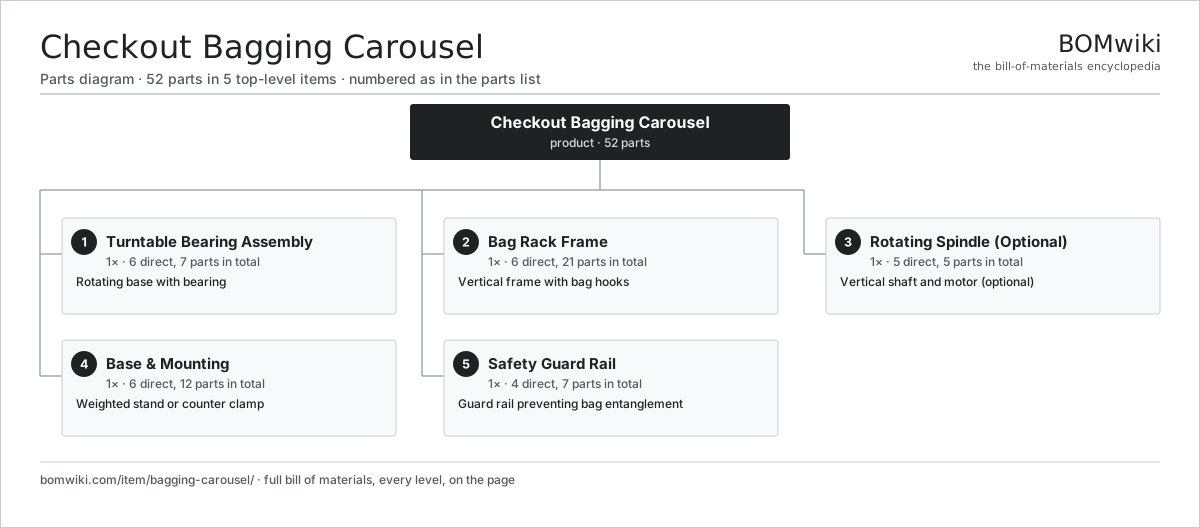
| # | Part | Qty | What it does |
|---|---|---|---|
| 1 | Turntable Bearing Assembly 6 parts | 1× | Rotating base with bearing |
| 2 | Bag Rack Frame 6 parts | 1× | Vertical frame with bag hooks |
| 3 | Rotating Spindle (Optional) 5 parts | 1× | Vertical shaft and motor (optional) |
| 4 | Base & Mounting 6 parts | 1× | Weighted stand or counter clamp |
| 5 | Safety Guard Rail 4 parts | 1× | Guard rail preventing bag entanglement |
3D model
No 3D model yet. Have a CAD file of this? Add a 3D model. STL renders right on this page; STEP, FreeCAD, and OpenSCAD sources are welcome too (openly licensed, like all 3D models on BOMwiki).
Build & assembly graph
expand / collapse · shared sub-assemblies converge · links to related products · est. labourTap an assembly to expand/collapse · tap a part to open it · use “Open page” for any node · drag to pan, scroll to zoom.
Bill of materials for Checkout Bagging Carousel
5 top-level lines · 32 rows shown · 52 parts total · indented to 3 levels| # | Item / sub-assembly | Part no. | Qty/assy | Ext. qty | Parts | Type |
|---|---|---|---|---|---|---|
| 1 | Turntable Bearing Assembly 6 parts | bagging-carousel-turntable-assembly | 1× | 1 | 7 | assembly |
| 1.1 | Slewing Bearing | bagging-carousel-slewing-bearing | 1× | 1 | · | part |
| 1.2 | Bearing Inner Race | bagging-carousel-bearing-race-inner | 1× | 1 | · | part |
| 1.3 | Bearing Outer Race | bagging-carousel-bearing-race-outer | 1× | 1 | · | part |
| 1.4 | Ball Element Set | bagging-carousel-ball-element-set | 1× | 1 | · | part |
| 1.5 | Bearing Seals | bagging-carousel-bearing-seals | 2× | 2 | · | part |
| 1.6 | Bearing Grease | bagging-carousel-lubricant | 1× | 1 | · | part |
| 2 | Bag Rack Frame 6 parts | bagging-carousel-bag-rack-frame | 1× | 1 | 21 | assembly |
| 2.1 | Frame Ring | bagging-carousel-frame-ring | 1× | 1 | · | part |
| 2.2 | Vertical Post | bagging-carousel-vertical-posts | 6× | 6 | · | part |
| 2.3 | Top Ring | bagging-carousel-top-cap-ring | 1× | 1 | · | part |
| 2.4 | Bag Hook | bagging-carousel-bag-hook | 6× | 6 | · | part |
| 2.5 | Hook Guard Spring | bagging-carousel-hook-guard | 6× | 6 | · | part |
| 2.6 | Fastener Set | fastener-set | 1× | 1 | · | part |
| 3 | Rotating Spindle (Optional) 5 parts | bagging-carousel-rotating-spindle | 1× | 1 | 5 | assembly |
| 3.1 | Spindle Shaft | bagging-carousel-spindle-shaft | 1× | 1 | · | part |
| 3.2 | Spindle Drive Motor | bagging-carousel-spindle-motor | 1× | 1 | · | part |
| 3.3 | Spindle Coupling | bagging-carousel-spindle-coupling | 1× | 1 | · | part |
| 3.4 | Spindle Thrust Bearing | bagging-carousel-spindle-bearing | 1× | 1 | · | part |
| 3.5 | Fastener Set | fastener-set | 1× | 1 | · | part |
| 4 | Base & Mounting 6 parts | bagging-carousel-mounting-base | 1× | 1 | 12 | assembly |
| 4.1 | Base Plate | bagging-carousel-base-plate | 1× | 1 | · | part |
| 4.2 | Ballast Weight | bagging-carousel-base-weight | 1× | 1 | · | part |
| 4.3 | Swivel Caster with Brake | bagging-carousel-caster-set | 4× | 4 | · | part |
| 4.4 | Counter Mount Clamp | bagging-carousel-counter-clamp | 1× | 1 | · | part |
| 4.5 | Vibration Isolator | bagging-carousel-vibration-pad | 4× | 4 | · | part |
| 4.6 | Fastener Set | fastener-set | 1× | 1 | · | part |
| 5 | Safety Guard Rail 4 parts | bagging-carousel-safety-railing | 1× | 1 | 7 | assembly |
| 5.1 | Guard Post | bagging-carousel-rail-post | 3× | 3 | · | part |
| 5.2 | Guard Bar | bagging-carousel-rail-bar | 2× | 2 | · | part |
| 5.3 | Guard Netting | bagging-carousel-rail-netting | 1× | 1 | · | part |
| 5.4 | Fastener Set | fastener-set | 1× | 1 | · | part |
Something wrong in this list? Report a problem with this BOM.
Sourcing: possible vendors
Browse the supplier directory → Prices, MOQ, and lead times are algorithmic estimates, not quotes, and not claims about these companies. Company mappings are curated by keyword; est. price band $50–$15k. How estimates work| Vendor | HQ | Specialty | MOQ | Lead time |
|---|---|---|---|---|
|
🇯🇵Canon
canon.com ↗
|
Tokyo, JP | Imaging & optics | 500 units | 8–12 wks |
|
🇯🇵Ricoh
ricoh.com ↗
|
Tokyo, JP | Office imaging | 500 units | 8–12 wks |
|
🇺🇸Xerox
xerox.com ↗
|
Norwalk, US | Printers & copiers | 500 units | 8–12 wks |
|
🇯🇵Epson
epson.com ↗
|
Suwa, JP | Printers & projectors | 500 units | 8–12 wks |
|
🇯🇵Brother
brother.com ↗
|
Nagoya, JP | Printers & sewing | 500 units | 8–12 wks |
1,369-word article