Baitcasting Reel
ProductOverview
A baitcasting reel is a precision mechanical device that holds fishing line under tension, releases it at high speed during casting, and retrieves it with mechanical advantage. The core mechanism is a rotating spool paired with a gear train; the handle turns at 1× rotation, the pinion gear meshes with a larger spur gear, and the spool responds at a 5:1 or 6:1 ratio. A magnetic and friction brake system prevents the spool from overrunning during the cast, which would cause a backlash tangle or "birds nest." The drag stack slips when tension exceeds a preset limit, protecting the line from breaking during a hard fight.
Spool Assembly
The spool is a cylindrical aluminum barrel that holds 100–200 yards of line depending on test weight. The spool rotates on a bearing mounted in the reel frame, and the line is wound in tight helical layers. The spool arbor, a steel mandrel at its center, connects to the rotating shaft driven by the gear train.
Spool diameter and width influence casting distance and line capacity. A 1.25-inch-diameter, 0.6-inch-wide spool is typical for freshwater baitcasting reels; wider spools (0.8 inches) reduce line pressure and allow longer casts. The arbor is hardened steel and can withstand peak torques of 50+ foot-pounds during a hard retrieve against a large fish.
Braking System
The brake is the reel's most complex subsystem. Magnetic braking works by mounting permanent neodymium magnets on the spool flange; as the spool rotates, the magnets pass near brass or aluminum fins mounted in the frame, inducing eddy currents that create a retarding force. The strength is adjustable: rotating a dial on the side plate changes the gap between magnets and fins, from 1 mm (maximum braking) to 5 mm (minimum).
Friction braking uses cork or carbon composite pads pressed lightly against the rotating spool shaft or flange, providing additional deceleration as the cast slows. The spring-loaded pads add 1–2 pounds-force of drag independent of rotation speed, damping any residual wobble in the final stages of the cast.
Together, magnetic and friction braking reduce spool speed from peak (200+ rpm during release) to zero over the course of the cast. Skilled anglers calibrate the brake for their casting weight: too light, and overrun occurs; too heavy, and distance is sacrificed.
Gear Train and Mechanical Advantage
The gear train converts handle rotation into spool rotation. A 24-tooth pinion gear is keyed to the handle crank shaft; it meshes with a 144-tooth spur gear attached to the spool arbor. The ratio is 144 ÷ 24 = 6:1. One full turn of the handle rotates the spool six times. At this ratio, one crank turn retrieves approximately 26 inches of line (the spool circumference × 6). This mechanical advantage reduces the force needed to land a large fish; even a child can retrieve against 50 pounds of drag load.
The gears are hardened steel, heat-treated to 48–52 HRC, and honed for smooth mesh. Backlash is held to ±0.005 inches through precision manufacturing and bearing preload. The pinion gear rotates on the handle shaft, supported by two ball bearings; the spur gear rotates on a shaft in the frame, also on two bearings. Total friction loss in the gear train is 3–5%, meaning the angler's crank effort is reduced by that amount.
A smaller synchronization gear on the level-wind gear is driven by the spur gear, rotating at a different speed to create the reciprocating motion of the level-wind wiper. This gear is typically half the size of the spur, so the level wind oscillates back and forth multiple times per spool revolution.
Level Wind and Line Distribution
The level wind is a reciprocating guide that moves back and forth across the spool as it rotates, distributing line into neat parallel layers. The wiper is a small aluminum block with a polished guide eye, sliding on a stainless steel post. A cam mechanism driven by the synchronization gear converts the rotational motion into linear motion: a follower arm rides a rotating cam, and as the cam rotates, the arm pushes and pulls the wiper.
The wiper travels 0.6 inches (15 mm) back and forth, depositing each wrap of line beside the previous one. Without the level wind, line would bunch in clumps on one side of the spool, creating uneven load distribution and reducing capacity. The level wind ensures uniform winding and allows predictable line-guide alignment during casting.
Drag Mechanism
The drag stack is the safety mechanism that protects the line when fighting a large fish. It consists of alternating friction discs (composite) and steel washers, stacked in sequence. A knob on the handle side tightens the stack, compressing all discs and increasing the slipping tension. The drag is calibrated by spinning the spool by hand and gradually tightening the knob until slipping begins at the desired force, typically 1/3 to 1/2 the line's breaking strength.
If a fish pulls with more force than the drag is set for, the friction discs slip relative to the steel washers. This controlled slipping lets line peel off the spool at constant tension, preventing the sudden shock that would snap the line. The friction coefficient of the composite discs is 0.4–0.6, high enough to provide smooth, progressive slipping without chatter.
Frame and Bearings
The frame is constructed of aluminum alloy (or sometimes graphite composite for lighter weight) in two side plates joined by the handle stem and reel foot. The reel foot is a machined base that clamps into the rod's reel seat via two thumb screws. The side plates have machined pockets for the pinion and spur gear shafts, spool arbor, and all bearing stacks.
Ball bearings reduce friction at every rotating element. A typical baitcasting reel has 8–11 ball bearings:
- Two on the spool arbor (spool rotation)
- Two on the pinion gear shaft (handle crank)
- Two on the spur gear shaft (spool drive)
- One or two on the level-wind synchronization shaft
- One on the drag spindle (if present)
Each bearing is shielded to exclude salt spray and dirt, and preloaded with thin steel shims to eliminate radial play. Bearing life exceeds 1,000 hours of fishing at typical casting cadences.
Materials and Corrosion Resistance
Modern baitcasting reels balance weight, cost, and durability. Aluminum is the primary structural material, anodized for corrosion resistance. Saltwater-rated reels add stainless steel fasteners, stainless spool arbors, and corrosion-resistant coatings on all steel parts. The level-wind post is typically stainless steel 304. Gears are hardened steel, not stainless, but are sealed from direct water exposure by the housing and drain holes that allow water to escape without pooling.
The handle crank is steel or aluminum, often with a cork or EVA foam grip for comfort in wet conditions. The grip is screwed onto the crank arm for easy replacement if it wears or becomes slippery.
Performance and Casting Distance
Casting distance is determined by line diameter, lure weight, and brake calibration. A light baitcasting outfit (20 lb test line, 0.5 oz lure, optimal brake) can achieve 70–90 feet with a skilled cast. Heavier lures (1–2 oz) cast farther due to greater momentum. The magnetic brake's adjustment dial allows anglers to dial in the optimal setting: maximum distance for smooth braking at the optimal lure weight.
Retrieve speed varies with gear ratio and crank length. A 6:1 reel with a 5-inch handle arm and a 1.25-inch spool diameter recovers 26 inches per crank, or 78 feet per minute at a 3-crank-per-second pace (a comfortable retrieve speed).
Baitcasting Reel parts and their functions
8 top-level parts · 51 parts in total · full bill of materials below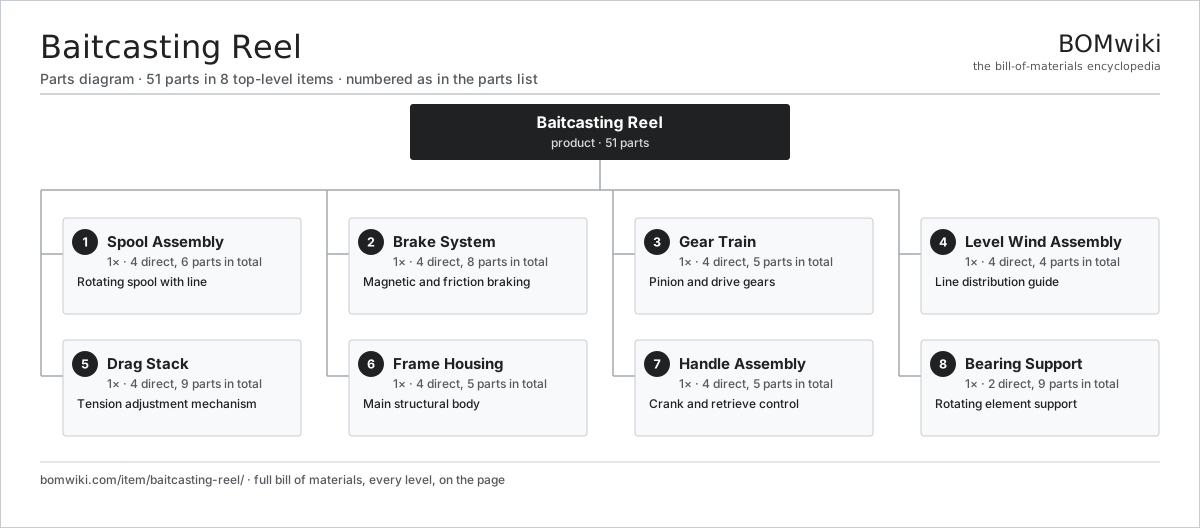
| # | Part | Qty | What it does |
|---|---|---|---|
| 1 | Spool Assembly 4 parts | 1× | Rotating spool with line |
| 2 | Brake System 4 parts | 1× | Magnetic and friction braking |
| 3 | Gear Train 4 parts | 1× | Pinion and drive gears |
| 4 | Level Wind Assembly 4 parts | 1× | Line distribution guide |
| 5 | Drag Stack 4 parts | 1× | Tension adjustment mechanism |
| 6 | Frame Housing 4 parts | 1× | Main structural body |
| 7 | Handle Assembly 4 parts | 1× | Crank and retrieve control |
| 8 | Bearing Support 2 parts | 1× | Rotating element support |
3D model
No 3D model yet. Have a CAD file of this? Add a 3D model. STL renders right on this page; STEP, FreeCAD, and OpenSCAD sources are welcome too (openly licensed, like all 3D models on BOMwiki).
Build & assembly graph
expand / collapse · shared sub-assemblies converge · links to related products · est. labourTap an assembly to expand/collapse · tap a part to open it · use “Open page” for any node · drag to pan, scroll to zoom.
Bill of materials for Baitcasting Reel
8 top-level lines · 38 rows shown · 51 parts total · indented to 3 levels| # | Item / sub-assembly | Part no. | Qty/assy | Ext. qty | Parts | Type |
|---|---|---|---|---|---|---|
| 1 | Spool Assembly 4 parts | baitcasting-reel-spool-assembly | 1× | 1 | 6 | assembly |
| 1.1 | Spool Barrel | baitcasting-reel-spool-core | 1× | 1 | · | part |
| 1.2 | Spool Flange | baitcasting-reel-spool-flange | 2× | 2 | · | part |
| 1.3 | Ball Bearing | ball-bearing | 2× | 2 | · | part |
| 1.4 | Spool Arbor | baitcasting-reel-spool-arbor | 1× | 1 | · | part |
| 2 | Brake System 4 parts | baitcasting-reel-brake-system | 1× | 1 | 8 | assembly |
| 2.1 | Magnet Pad | baitcasting-reel-magnet-pad | 4× | 4 | · | part |
| 2.2 | Brake Dial | baitcasting-reel-magnet-adjuster | 1× | 1 | · | part |
| 2.3 | Brake Friction Pad | baitcasting-reel-brake-pad | 2× | 2 | · | part |
| 2.4 | Pad Tension Spring | baitcasting-reel-brake-spring | 1× | 1 | · | part |
| 3 | Gear Train 4 parts | baitcasting-reel-gear-train | 1× | 1 | 5 | assembly |
| 3.1 | Pinion Gear | baitcasting-reel-pinion-gear | 1× | 1 | · | part |
| 3.2 | Spur Gear | baitcasting-reel-spur-gear | 1× | 1 | · | part |
| 3.3 | Level Wind Gear | baitcasting-reel-level-wind-gear | 1× | 1 | · | part |
| 3.4 | Gear Shafts | baitcasting-reel-gear-shafts | 2× | 2 | · | part |
| 4 | Level Wind Assembly 4 parts | baitcasting-reel-level-wind | 1× | 1 | 4 | assembly |
| 4.1 | Level Wind Wiper | baitcasting-reel-level-wind-wiper | 1× | 1 | · | part |
| 4.2 | Level Wind Post | baitcasting-reel-level-wind-post | 1× | 1 | · | part |
| 4.3 | Cam Link | baitcasting-reel-level-wind-link | 1× | 1 | · | part |
| 4.4 | Level Wind Spring | baitcasting-reel-level-wind-spring | 1× | 1 | · | part |
| 5 | Drag Stack 4 parts | baitcasting-reel-drag-stack | 1× | 1 | 9 | assembly |
| 5.1 | Drag Disc | baitcasting-reel-drag-disc | 6× | 6 | · | part |
| 5.2 | Drag Knob | baitcasting-reel-drag-adjustor-knob | 1× | 1 | · | part |
| 5.3 | Drag Preload Spring | baitcasting-reel-drag-spring | 1× | 1 | · | part |
| 5.4 | Drag Backing Plate | baitcasting-reel-drag-washer | 1× | 1 | · | part |
| 6 | Frame Housing 4 parts | baitcasting-reel-frame-housing | 1× | 1 | 5 | assembly |
| 6.1 | Side Plate | baitcasting-reel-side-plate | 2× | 2 | · | part |
| 6.2 | Reel Foot | baitcasting-reel-frame-foot | 1× | 1 | · | part |
| 6.3 | Handle Stem | baitcasting-reel-handle-stem | 1× | 1 | · | part |
| 6.4 | Fastener Set | fastener-set | 1× | 1 | · | part |
| 7 | Handle Assembly 4 parts | baitcasting-reel-handle-assembly | 1× | 1 | 5 | assembly |
| 7.1 | Crank Arm | baitcasting-reel-handle-arm | 1× | 1 | · | part |
| 7.2 | Handle Knob | baitcasting-reel-handle-grip | 1× | 1 | · | part |
| 7.3 | Handle Bearing | baitcasting-reel-handle-bearing | 2× | 2 | · | part |
| 7.4 | Crank Nut | baitcasting-reel-crank-fastener | 1× | 1 | · | part |
| 8 | Bearing Support 2 parts | baitcasting-reel-bearing-set | 1× | 1 | 9 | assembly |
| 8.1 | Ball Bearing | ball-bearing | 5× | 5 | · | part |
| 8.2 | Bearing Shim | baitcasting-reel-bearing-shim | 4× | 4 | · | part |
Something wrong in this list? Report a problem with this BOM.
Related products
same domain, ranked by shared parts Compound Bow
50 parts · shares 2 with this page
Compound Bow
50 parts · shares 2 with this page
 Power Ice Auger
37 parts · shares 2 with this page
Power Ice Auger
37 parts · shares 2 with this page
 Rappel Descender
26 parts · shares 2 with this page
Rappel Descender
26 parts · shares 2 with this page
 Rope Ascender
29 parts · shares 2 with this page
Rope Ascender
29 parts · shares 2 with this page
 Spinning Fishing Reel
44 parts · shares 2 with this page
Spinning Fishing Reel
44 parts · shares 2 with this page
Sourcing: possible vendors
Browse the supplier directory → Prices, MOQ, and lead times are algorithmic estimates, not quotes, and not claims about these companies. Company mappings are curated by keyword; est. price band $20–$2k. How estimates work| Vendor | HQ | Specialty | MOQ | Lead time |
|---|---|---|---|---|
|
🇺🇸Coleman
coleman.com ↗
|
Chicago, US | Camping gear | 1,000 units | 6–10 wks |
| thenorthface.com ↗ | Denver, US | Outdoor apparel & gear | 1,000 units | 6–10 wks |
|
🇺🇸YETI
yeti.com ↗
|
Austin, US | Coolers & drinkware | 1,000 units | 6–10 wks |
| decathlon.com ↗ | Villeneuve-d'Ascq, FR | Sporting goods | 1,000 units | 6–10 wks |
|
🇺🇸Garmin
garmin.com ↗
|
Olathe, US | GPS & wearables | 1,000 units | 6–10 wks |
1,318-word article