Ballast Cleaning Machine
ProductOverview
Ballast cleaning is a specialized track rehabilitation process distinct from undercutting: instead of replacing all ballast, cleaning machines excavate ballast, separate it into reusable stone and waste (fines/clay), and return clean stone to the track bed. This approach recovers 80–90% of original material investment, significantly reducing disposal costs and material procurement compared to full replacement.
Cleaning is particularly valuable on:
- Secondary/branch lines with budget constraints (material cost savings are critical).
- Environmentally sensitive areas (reduced transport and virgin stone extraction).
- Recycled ballast networks: Lines that have been ballasted multiple times; stone is inherently dirty but mechanically sound.
Modern cleaning machines employ two-stage screening decks: coarse (25 mm) separation removes oversized debris, fine (5 mm) separation ejects fines and dust, returning only clean 5–50 mm stone.
Ballast Degradation & Cleaning Necessity
Fines Migration & Compaction
New ballast (clean 25–50 mm stone) has:
- Void ratio: ~0.75 (space ratio volume to solid volume).
- Permeability: ~100 mm/sec (water drains rapidly).
- Bearing capacity: ~50 MPa (under wheel loads).
After 20–30 years of service:
- Fines accumulation: Breakage generates dust; this migrates downward into voids. Typical fines content increases from <1% to 10–20% over service life.
- Void reduction: Reduced void ratio (~0.6) impairs drainage; capillary rise carries moisture upward, creating muddy ballast layer.
- Bearing degradation: Compacted, wet ballast loses strength; bearing capacity drops to 20–30 MPa.
Cleaning reverses this: Removing fines restores void ratio to ~0.70 and permeability to ~80 mm/sec, nearly matching new ballast.
Environmental Rationale
Full ballast replacement requires:
- Excavation of 1 m³ ballast per 40 linear meters (at 2.6 m width × 300 mm depth ÷ 1 m³): ~26 m³ per 1 km.
- Disposal: Old ballast trucked to landfill (~€15–€25/ton disposal cost).
- New material procurement: Fresh stone from quarry (~€20–€30/ton including extraction and transport).
Cleaning recovery:
- Recovered stone: 80–90% of volume (~23 m³ per km).
- Avoided landfill: 23 m³ × 1.6 ton/m³ × €20/ton = €736/km saved.
- Avoided new procurement: 23 m³ × €25/ton = €920/km saved.
- Total savings: ~€1,650/km, or €16,500–€33,000 for a 10–20 km project.
Material Grading Specification
Post-cleaning ballast must meet:
- EN 13450 (Railway Ballast): Aggregate size distribution, with 85% in 25–50 mm range.
- Cleanliness: <1% passing 0.063 mm sieve (fines content reduced from 15–20% to <1%).
- Shape: Angularity index <20% (plate-like stones removed by screening).
- Strength: Los Angeles abrasion loss <25%.
Well-cleaned ballast from recycling typically exceeds these specs, suitable for relaying.
Cleaning Machine Process
Excavation Phase
The bucket chain conveyor operates at 40 rpm, lifting excavated ballast from below the lifted rails onto the vibrating screen deck:
- Cutting depth: 300–400 mm (operator adjusts via proportional lift cylinder pressure feedback).
- Flow rate: At 40 rpm, each 500 mm³ bucket collects ~0.3 m³/min, or ~20 m³/hour throughput.
Excavated material (coarse ballast + fine ballast + fines + moisture) is immediately conveyed upward to the screen.
Screening Cascade
The two-stage vibrating screen deck employs:
Upper deck (25 mm mesh):
- Vibrates at 10–20 Hz (electronically or mechanically driven).
- Ballast >25 mm (coarse) is retained and slides downslope toward return conveyor.
- Material <25 mm falls through to lower deck.
Lower deck (5 mm mesh):
- Vibrates in phase with upper deck (synchronized).
- Ballast 5–25 mm (mid-range, reusable) passes to return conveyor.
- Fines <5 mm (dust, clay, silt) fall through grate to spoil discharge.
Return & Spoil Handling
Return conveyor (clean stone):
- The return belt descends behind the machine at ~1 m/sec.
- Gravity assists: Return chute directs stone back onto cleaned bed immediately behind the machine.
- Placement uniformity: Width of chute (~2.5 m) ensures stone spreads across full ballast width; minimal manual redistribution needed.
Spoil conveyor (fines + clay):
- The spoil chain elevates fines/debris at 40° angle to 8 m³ hopper.
- Hopper filling time: ~20 minutes at 20 m³/hour spoil generation; operator arranges truck-loading pause mid-shift.
- Fines are typically discarded (low-value) or donated to aggregate plants for concrete filler use.
Machine Subsystems & Controls
Hydraulic System Architecture
The main pump (180 kW engine, 70 cc/rev) supplies:
- Excavating chain: 40–60 cc/s @ 280 bar via hydraulic motor.
- Vibrating screen: 10–20 cc/s to electric motor (7.5 kW AC vibrator, powered from alternator on engine).
- Return conveyor: 15–25 cc/s to motor drive.
- Spoil conveyor: 20–30 cc/s to spoil motor.
- Track drive: Variable flow to track motors for advance/retreat.
Load-sensing pump regulates pressure proportionally: if spoil conveyor is at rest (blocked hopper), pump unloads to ~20 bar; if excavation load spikes, pump maintains 280 bar. This reduces heat generation and fuel consumption vs. fixed-displacement designs.
Operator Interface & Feedback
Onboard control console includes:
- Pressure gauges: Real-time readout of excavation, conveyor, and track motor pressures.
- Motor speed displays: RPM feedback on each drive motor (excavation, vibrating screen, return, spoil).
- Hopper level sensor: Visual or audible alert when load cell detects hopper >80% full.
- GPS receiver (optional): Position tracking for productivity logging and automated reports.
Operator controls are manual levers or electric joysticks, providing intuitive multi-axis adjustment.
Operational Workflow
Per-Sleeper Cycle
- Positioning (3–5 sec): Machine aligns over sleeper.
- Rail lift (3–5 sec): Lift cylinders raise rails 60–80 mm, exposing ballast below sleeper.
- Excavation (8–15 sec):
- Bucket chain rotates, scooping ballast.
- Material conveyed to vibrating screen.
- Screening occurs in real-time as material lands on deck.
- Return placement (5–8 sec):
- Clean stone from return conveyor descends, re-filling cleaned bed behind machine.
- Material automatically distributed across ballast width.
- Rail lowering (3–5 sec):
- Lift cylinders retract.
- Rails compress fresh ballast elastically, seating firmly.
- Advance to next sleeper (2–3 sec):
- Track motors advance 2.4 m (standard sleeper spacing).
Total cycle time: 25–40 seconds per sleeper (slower than tamping due to excavation complexity).
Production rate: 90–150 sleepers/hour = 220–360 m/hour = ~1.8–3 km per 8-hour shift.
Hopper Management
When load cell signals hopper >80% full:
- Machine pauses in-place (engines remain idling).
- Operator signals to trackside crew or truck operator.
- Vacuum tanker or standard dumper truck positions under hopper discharge chute.
- Hopper bottom gate is manually opened (or hydraulically via solenoid valve).
- Fines gravity-discharge at ~5 m³/min (hopper empties in ~1.5 minutes).
- Gate closed, machine resumes operation.
Downtime: ~5–10 minutes per 8-hour shift (1–2 hopper changes), reducing net productivity by ~2%.
Material Recovery & Economics
Stone Recovery Rate
At 20 m³/hour excavation flow:
- Coarse ballast (>25 mm): ~8 m³/hour (40%) → return conveyor.
- Fine ballast (5–25 mm): ~10 m³/hour (50%) → return conveyor.
- Fines (<5 mm): ~2 m³/hour (10%) → spoil discharge.
Net reuse: 90% of excavated volume (18 m³/hour of clean stone).
By EN 13450 spec, acceptable reuse ballast is typically coarse + fine (>5 mm), so 90% recovery is achievable on well-maintained ballast. Heavily contaminated ballast (30%+ fines by weight) recovers only 60–70%.
Cost Analysis (10 km Project)
Excavation & screening:
- Cleaning cost: €10–€12/km (machine + operator time + fuel).
- Material recovery: 90% of 26 m³/km = 23.4 m³/km recovered stone.
Avoidance cost:
- Landfill (10% waste @ €20/ton × 1.6 ton/m³): 2.6 m³ × 1.6 × €20 = €83/km.
- New ballast procurement (70% × 26 m³ = 18.2 m³ @ €25/ton × 1.6): €728/km.
- Total avoided cost: €811/km.
Net cost of cleaning: €811 - €10 = €801/km savings, or €8,010 total for 10 km project.
In contrast, full undercutting + fresh ballast: €5,000–€8,000/km, sometimes more. Cleaning is economically competitive and environmentally superior.
Practical Challenges
Wet Ballast & Drainage
Waterlogged ballast (muddy, saturated) is difficult to screen:
- Moisture reduces flow: Wet material clogs mesh screens; vibration alone cannot separate efficiently.
- Operator adaptation: Reduce feed rate (slow excavation speed), allow longer screening dwell (reduce deck speed to 5–10 Hz instead of 15–20 Hz).
- Drainage pre-work: Some authorities conduct preliminary ballast drainage (vacuum extraction or suction) before cleaning to dry out ballast.
Large Stone & Obstructions
Occasionally, ballast bed contains oversized stone (60–80 mm) or non-ballast debris (rail dog spikes, fasteners):
- Oversized stone: May jam bucket chain if diameter >600 mm. Manual removal by crew before machine arrival is typical.
- Metal debris: Ferrous objects (spikes, nails) are magnetically separated post-excavation or manually picked from return conveyor by operators.
Recycling Limitations
After 3–4 cleaning cycles (60–80 years of original service), stone becomes too fragmented for reuse:
- Shape degradation: Angularity index exceeds 25% (too many rounded pebbles).
- Strength loss: Repeated breakage reduces LA abrasion performance below EN 13450 limit.
At this point, no further cleaning is economical; full ballast replacement is necessary.
Environmental & Sustainability Angle
Carbon Footprint Reduction
Cleaning recovers ~90% of in-situ ballast, avoiding:
- Virgin quarrying: 20–30 tons CO₂/ton of new stone (extraction, crushing, transport).
- For a 10 km project: 18 m³/km × 1.6 ton/m³ × 10 km × 25 kg CO₂/ton = 72 tons CO₂ avoided.
Cleaning machine operation generates ~50 tons CO₂ (fuel + indirect), netting 22 tons CO₂ reduction per project.
Circular Economy Model
Cleaning aligns with EU circular-economy directives (Directive 2008/98/EC):
- Waste minimization: 90% recovery vs. 10% reuse in typical demolition.
- Embodied energy: Reused stone avoids energy-intensive new production.
- Closed-loop: Stone circulates multiple times before final retirement.
Standards & Compliance
Cleaned ballast must meet:
- EN 13450: Railway applications – Infrastructure – Aggregate for use in railway track foundation and form.
- EN 933-1: Tests for geometrical properties of aggregates – Determination of particle size distribution – Sieving method.
- EN 1097-2: Tests for mechanical and physical properties of aggregates – Determination of resistance to fragmentation – LA abrasion test.
Post-cleaning, samples are laboratory-tested to verify specs before relaying.
Ballast Cleaning Machine parts and their functions
6 top-level parts · 54 parts in total · full bill of materials below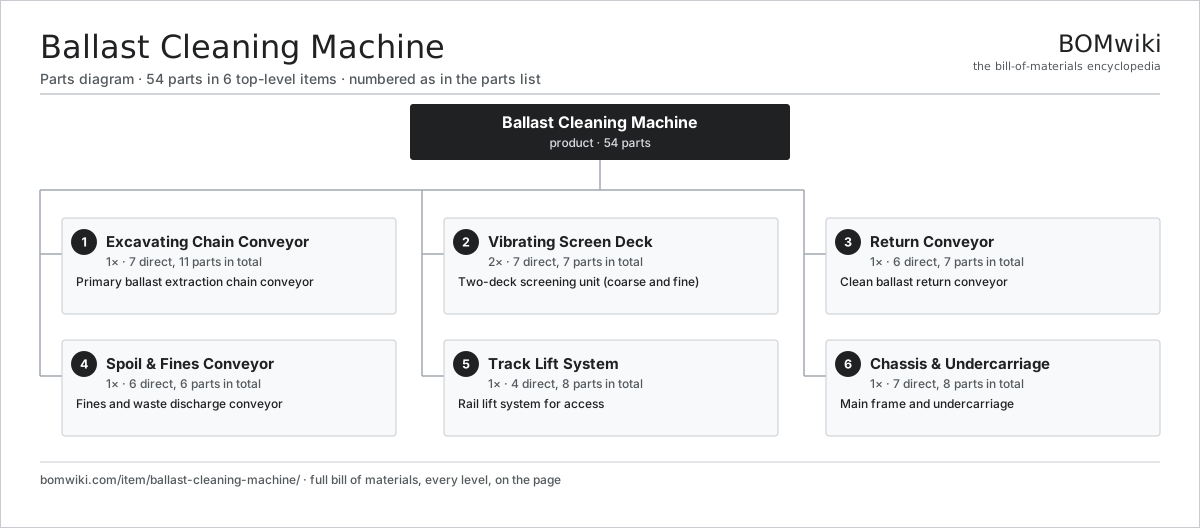
| # | Part | Qty | What it does |
|---|---|---|---|
| 1 | Excavating Chain Conveyor 7 parts | 1× | Primary ballast extraction chain conveyor |
| 2 | Vibrating Screen Deck 7 parts | 2× | Two-deck screening unit (coarse and fine) |
| 3 | Return Conveyor 6 parts | 1× | Clean ballast return conveyor |
| 4 | Spoil & Fines Conveyor 6 parts | 1× | Fines and waste discharge conveyor |
| 5 | Track Lift System 4 parts | 1× | Rail lift system for access |
| 6 | Chassis & Undercarriage 7 parts | 1× | Main frame and undercarriage |
3D model
No 3D model yet. Have a CAD file of this? Add a 3D model. STL renders right on this page; STEP, FreeCAD, and OpenSCAD sources are welcome too (openly licensed, like all 3D models on BOMwiki).
Build & assembly graph
expand / collapse · shared sub-assemblies converge · links to related products · est. labourTap an assembly to expand/collapse · tap a part to open it · use “Open page” for any node · drag to pan, scroll to zoom.
Bill of materials for Ballast Cleaning Machine
6 top-level lines · 43 rows shown · 54 parts total · indented to 3 levels| # | Item / sub-assembly | Part no. | Qty/assy | Ext. qty | Parts | Type |
|---|---|---|---|---|---|---|
| 1 | Excavating Chain Conveyor 7 parts | ballast-cleaning-machine-excavating-chain | 1× | 1 | 11 | assembly |
| 1.1 | Chain Frame | ballast-cleaning-machine-chain-frame | 1× | 1 | · | part |
| 1.2 | Bucket Chain | ballast-cleaning-machine-bucket-chain | 1× | 1 | · | part |
| 1.3 | Chain Motor | ballast-cleaning-machine-chain-motor | 1× | 1 | · | part |
| 1.4 | Chain Gearbox | ballast-cleaning-machine-chain-gearbox | 1× | 1 | · | part |
| 1.5 | Chain Sprocket | ballast-cleaning-machine-chain-sprocket | 2× | 2 | · | part |
| 1.6 | Return Idler Pulley | ballast-cleaning-machine-return-idler | 4× | 4 | · | part |
| 1.7 | Encoder | encoder | 1× | 1 | · | part |
| 2 | Vibrating Screen Deck 7 parts | ballast-cleaning-machine-vibrating-screen | 2× | 2 | 7 | assembly |
| 2.1 | Upper Deck Frame | ballast-cleaning-machine-screen-deck-upper | 1× | 2 | · | part |
| 2.2 | Coarse Mesh Panel | ballast-cleaning-machine-screen-mesh-coarse | 1× | 2 | · | part |
| 2.3 | Lower Deck Frame | ballast-cleaning-machine-screen-deck-lower | 1× | 2 | · | part |
| 2.4 | Fine Mesh Panel | ballast-cleaning-machine-screen-mesh-fine | 1× | 2 | · | part |
| 2.5 | Vibration Motor | ballast-cleaning-machine-vibration-motor | 1× | 2 | · | part |
| 2.6 | Suspension Support | ballast-cleaning-machine-screen-support | 1× | 2 | · | part |
| 2.7 | Deck Tilt Cylinder | ballast-cleaning-machine-deck-tilt | 1× | 2 | · | part |
| 3 | Return Conveyor 6 parts | ballast-cleaning-machine-return-conveyor | 1× | 1 | 7 | assembly |
| 3.1 | Return Frame | ballast-cleaning-machine-return-frame | 1× | 1 | · | part |
| 3.2 | Return Belt | ballast-cleaning-machine-return-belt | 1× | 1 | · | part |
| 3.3 | Return Motor | ballast-cleaning-machine-return-motor | 1× | 1 | · | part |
| 3.4 | Return Idler Pulley | ballast-cleaning-machine-return-idler | 2× | 2 | · | part |
| 3.5 | Return Chute | ballast-cleaning-machine-return-chute | 1× | 1 | · | part |
| 3.6 | Encoder | encoder | 1× | 1 | · | part |
| 4 | Spoil & Fines Conveyor 6 parts | ballast-cleaning-machine-spoil-conveyor | 1× | 1 | 6 | assembly |
| 4.1 | Spoil Frame | ballast-cleaning-machine-spoil-frame | 1× | 1 | · | part |
| 4.2 | Spoil Conveyor Chain | ballast-cleaning-machine-spoil-chain | 1× | 1 | · | part |
| 4.3 | Spoil Motor | ballast-cleaning-machine-spoil-motor | 1× | 1 | · | part |
| 4.4 | Spoil Gearbox | ballast-cleaning-machine-spoil-gearbox | 1× | 1 | · | part |
| 4.5 | Dust Shroud | ballast-cleaning-machine-dust-shroud | 1× | 1 | · | part |
| 4.6 | Discharge Spreader | ballast-cleaning-machine-discharge-spreader | 1× | 1 | · | part |
| 5 | Track Lift System 4 parts | ballast-cleaning-machine-track-lift | 1× | 1 | 8 | assembly |
| 5.1 | Lift Cylinder | ballast-cleaning-machine-lift-cylinder | 2× | 2 | · | part |
| 5.2 | Lift Arm | ballast-cleaning-machine-lift-arm | 2× | 2 | · | part |
| 5.3 | Rail Pad | ballast-cleaning-machine-rail-pad | 2× | 2 | · | part |
| 5.4 | Pressure Sensor | pressure-sensor | 2× | 2 | · | part |
| 6 | Chassis & Undercarriage 7 parts | ballast-cleaning-machine-chassis | 1× | 1 | 8 | assembly |
| 6.1 | Main Frame | ballast-cleaning-machine-main-frame | 1× | 1 | · | part |
| 6.2 | Left Track | ballast-cleaning-machine-left-track | 1× | 1 | · | part |
| 6.3 | Right Track | ballast-cleaning-machine-right-track | 1× | 1 | · | part |
| 6.4 | Track Drive Motor | ballast-cleaning-machine-track-drive | 2× | 2 | · | part |
| 6.5 | Steering Control | ballast-cleaning-machine-steering-control | 1× | 1 | · | part |
| 6.6 | Brake System | ballast-cleaning-machine-brake-system | 1× | 1 | · | part |
| 6.7 | Operator Cab | ballast-cleaning-machine-operator-cab | 1× | 1 | · | part |
Something wrong in this list? Report a problem with this BOM.
Related products
same domain, ranked by shared parts Automated People Mover
450 parts · shares 1 with this page
Automated People Mover
450 parts · shares 1 with this page
 Ballast Tamping Machine
51 parts · shares 1 with this page
Ballast Tamping Machine
51 parts · shares 1 with this page
 Ballast Undercutter
38 parts · shares 1 with this page
Ballast Undercutter
38 parts · shares 1 with this page
 Bus Rapid Transit Vehicle
4,251 parts · shares 1 with this page
Bus Rapid Transit Vehicle
4,251 parts · shares 1 with this page
 Coach Bus
999 parts · shares 1 with this page
Coach Bus
999 parts · shares 1 with this page
 Commuter EMU
14,010 parts · shares 1 with this page
Commuter EMU
14,010 parts · shares 1 with this page
Sourcing: possible vendors
Browse the supplier directory → Prices, MOQ, and lead times are algorithmic estimates, not quotes, and not claims about these companies. Company mappings are curated by keyword; est. price band $500k–$60M. How estimates work| Vendor | HQ | Specialty | MOQ | Lead time |
|---|---|---|---|---|
|
🇨🇳CRRC
crrcgc.cc ↗
|
Beijing, CN | Rolling stock & rail systems | made to order | 40–72 wks |
|
🇫🇷Alstom
alstom.com ↗
|
Saint-Ouen, FR | Rail rolling stock | made to order | 40–72 wks |
| mobility.siemens.com ↗ | Munich, DE | Rail systems | made to order | 40–72 wks |
| stadlerrail.com ↗ | Bussnang, CH | Rail rolling stock | made to order | 40–72 wks |
|
🇺🇸Wabtec
wabteccorp.com ↗
|
Pittsburgh, US | Rail equipment | made to order | 40–72 wks |
1,797-word article