Ballast Undercutter
ProductOverview
Ballast undercutting is a specialized railway maintenance operation that removes deteriorated stone and consolidated fines from beneath sleepers, replacing them with fresh ballast. Unlike tamping (which compacts in place), undercutting physically extracts worn stone, stone that has broken down into fine dust, lost interlocking strength, or absorbed water and become muddy, and provides a clean bed for renewed ballast.
The process extends track life by 5–10 years per maintenance cycle. Modern undercutting machines feature automated cutting chains, spoil conveyors, and fresh ballast hoppers, allowing a single operator to achieve 400–600 m of cut track per working day.
Ballast Deterioration & Replacement Rationale
Stone Breakdown
Railway ballast typically consists of 25–50 mm angular stone (granite, limestone, basalt). Under repeated wheel loads and vibration, stones fracture:
- Primary breakage: Large stones split along planes of weakness over 100,000+ heavy axle loads (HAL).
- Attrition: Angular edges round through rolling friction, reducing mechanical interlock.
- Fines migration: Dust particles from breakage migrate downward through voids, creating a clay-silt layer (mudstone) that impedes drainage and reduces bearing capacity.
After 20–30 years of heavy traffic (e.g., freight mainlines), ballast density in the top 300–400 mm may degrade 15–25%. Undercutting removes this degraded layer entirely.
Fresh Ballast Characteristics
Replacement stone must meet specifications:
- Particle size: 25–50 mm (80% within this range).
- Shape: Angular (flakiness index <20%, meaning <20% of stones are plate-like).
- Strength: LA abrasion loss <25% (Los Angeles mill test).
- Cleanliness: <1% fines by mass (particles <0.063 mm).
Fresh ballast costs €15–30/ton in Europe, making material recovery from undercutting economically important. The spoil conveyor and cyclone separator recover 80–90% of excavated stone for reuse.
Operating Principles
Cutting Head
The dual cutting chains rotate around a U-shaped chain bar mounted perpendicular to the track. Chain speed is 80 rpm (~0.8 m/s tip speed), slow enough to allow stone engagement but fast enough to prevent stalling in dense ballast.
Hardened steel links with tungsten carbide tips (called "teeth") bite into stone and excavate. The oscillation linkage provides ±50 mm lateral reciprocation, allowing the cutting chain to weave side-to-side and break apart tightly interlocked stone clusters. Frequency of oscillation is typically 2–4 Hz, independent of chain rotation.
Load & Depth Control
The operator adjusts depth stops via proportional hydraulic valve, limiting penetration beneath sleeper to prevent rail damage. Typical depth is 300–350 mm; excessive depth risks undermining rail support. Pressure feedback from the cutting drive indicates resistance; excessive pressure suggests an oversized stone or compacted clay layer, triggering operator to reduce feed rate or apply more lateral oscillation.
Conveying & Ballast Distribution
Excavated material (stone + fines + moisture) is immediately transported via the spoil conveyor to a trailing truck or stockpile area. Swarf is not returned to the track, only fresh stone from the hopper.
The spreader conveyor, mounted behind and slightly above the cutting head, distributes fresh ballast evenly across the rail width as the machine advances. A proportional gate valve meters hopper discharge, maintaining consistent ballast depth. Excess stone falls onto cleaned ballast bed, creating a transition zone before the next sleeper undergoes cutting.
System Integration & Workflow
Full Cycle (Per Sleeper)
- Approach: Machine aligns over sleeper. Dual lift cylinders elevate rails 60–80 mm.
- Cutting (8–15 seconds):
- Chains rotate at 80 rpm, oscillating ±50 mm laterally.
- Spoil conveyor evacuates excavated material.
- Fresh ballast is metered onto cleaned bed via spreader.
- Lower & Release (2–3 seconds):
- Lift cylinders retract, lowering rails back onto fresh ballast and compacting initially via dead weight.
- Machine advances to next sleeper.
Total cycle time: 12–25 seconds (varies by stone condition and moisture). For 2.4 m spacing:
- Production rate: 150–300 sleepers/hour = 400–750 m/day.
- Track section: 30 km undercutting requires 40–75 working days (5–10 weeks).
Hydraulic Architecture
The variable pump (180 kW engine, 80 cc/rev pump) distributes pressure to:
- Cutting circuit: 60–80 cc/s to cutting motor.
- Spoil conveyor: 20–30 cc/s to conveyor drive motor.
- Ballast distribution: 10–15 cc/s to gate valve and spreader motor.
- Track lift: 40 cc/s (peak) to lift cylinders.
- Track drive: Variable flow to track motors for advance/retreat.
All circuits merge into a common tank, which drains to the cooler maintaining oil at <55 °C.
Material Handling & Environmental Considerations
Spoil Management
Excavated material contains:
- Reusable stone (60–70%): Unbroken or slightly fractured stone >20 mm, recovered for redeployment.
- Fine ballast (20–30%): Particles 5–20 mm, acceptable for lower ballast layers or other applications.
- Fines & clay (5–10%): Dust <5 mm, contaminated with soil, segregated for landfill.
The cyclone separator uses centrifugal inertia to remove dust from air stream; recovered stone is stockpiled trackside for later reuse or transported by truck to processing plants for crushing and screening.
Dust & Emissions
Excavating ballast releases silica dust (respirable crystalline silica, RCS). Modern machines include:
- Enclosed hopper design: Reduces open-air handling of dusty material.
- Cyclone separator: Captures ~95% of fine particles before discharge.
- Dust suppression spray: Optional water atomization over spoil conveyor.
Operators wear P100 respirators during undercutting operations; many railways enforce mandatory periodic health monitoring (X-ray, spirometry) for workers in ballast cutting roles.
Practical Challenges & Adaptations
Wet Ballast & Mud
Waterlogged ballast and consolidated clay layers resist cutting and may stall the cutting motor. Operators respond by:
- Reduced feed rate: Slower advance (1–2 m/min instead of 5 m/min) allows more cutting cycles per unit length.
- Oscillation intensity: Increasing lateral amplitude to 60–80 mm helps break clay bonds.
- Drainage pre-work: Some rail authorities conduct preliminary ballast drainage work (vacuum extraction) before undercutting in poorly-draining sections.
Stone Size Variability
Occasionally, undersized stone (10–20 mm) or oversized rocks (60–80 mm) appear in ballast bed. The cutting chain handles typical 25–50 mm stone efficiently, but:
- Undersized stone: Falls through cutting zone without engagement, increasing fines in spoil.
- Oversized boulders: May stall motor; operator must manually remove or apply extreme oscillation.
Modern machines include a pre-screening stage (simple mesh vibrator) to remove large rocks before primary cutting.
Maintenance & Field Durability
Chain & Tooth Replacement
Cutting chains wear at 2–5 mm per 50,000 m of cut track, depending on stone abrasiveness. Typical chain life: 200–400 km of continuous undercutting, requiring on-site replacement (2–4 hour job).
Tungsten carbide tooth tips are brazed onto links; when dulled, they are re-sharpened at a facility or replaced as assemblies.
Hydraulic Integrity
The high-pressure hose bundles are exposed to dust, water spray, and UV. Hoses must be inspected weekly for cracks or abrasion. The filter (both high-pressure inlet and tank return) requires cartridge changes every 100–150 hours.
Economics & Deployment Patterns
Cost Structure
- Material cost: Fresh ballast €20/ton × 0.5 ton/sleeper = €10/sleeper.
- Labor: €3–5/sleeper (mostly machine operator time).
- Equipment amortization & fuel: €3–4/sleeper (assuming €500k machine, 5-year life).
- Total cost: €16–19/sleeper, or roughly €6,500–8,000 per km.
For a 30 km trunk line, complete undercutting is €195k–€240k capital cost, justified by extended track life (often 10+ years). European mainlines typically schedule undercutting every 25–35 years.
Deployment Geography
Undercutting is most critical on:
- High-traffic lines: Freight mains experiencing >20M HAL/year (heavy axle loads).
- Poorly-draining sections: Low-lying areas with shallow groundwater; ballast becomes muddy faster.
- Older track: Stock from 1970s–1990s often contains excess fines and requires earlier intervention.
Lightly-trafficked branch lines (2–5M HAL/year) may only require tamping or spot ballast replacement, not full undercutting.
Standards & Certification
European rail authorities (Deutsche Bahn, SNCF, etc.) specify undercutting requirements per section in Track Management Plans (TMPs). Typical specification:
- Replacement stone: EN 13450 (Railway ballast – Technical specification and requirements for the supply and quality assessment).
- Cutting depth: 300–350 mm below sleeper bottom (EN 13481).
- Geometry tolerance: ±20 mm vertical, ±30 mm horizontal alignment after undercutting + ballasting.
Ballast Undercutter parts and their functions
6 top-level parts · 38 parts in total · full bill of materials below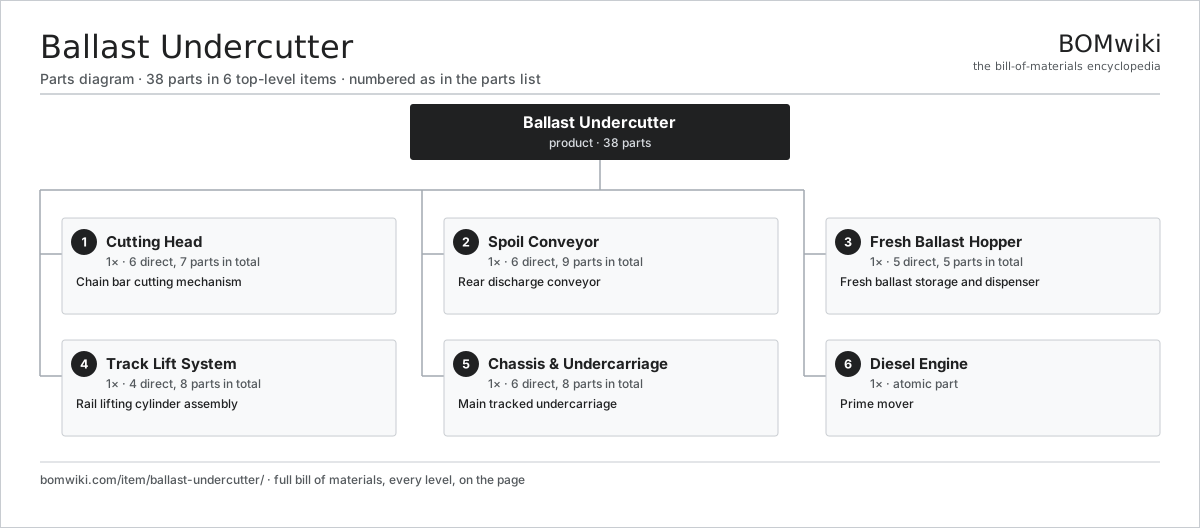
| # | Part | Qty | What it does |
|---|---|---|---|
| 1 | Cutting Head 6 parts | 1× | Chain bar cutting mechanism |
| 2 | Spoil Conveyor 6 parts | 1× | Rear discharge conveyor |
| 3 | Fresh Ballast Hopper 5 parts | 1× | Fresh ballast storage and dispenser |
| 4 | Track Lift System 4 parts | 1× | Rail lifting cylinder assembly |
| 5 | Chassis & Undercarriage 6 parts | 1× | Main tracked undercarriage |
| 6 | Diesel Engine | 1× | Prime mover |
3D model
No 3D model yet. Have a CAD file of this? Add a 3D model. STL renders right on this page; STEP, FreeCAD, and OpenSCAD sources are welcome too (openly licensed, like all 3D models on BOMwiki).
Build & assembly graph
expand / collapse · shared sub-assemblies converge · links to related products · est. labourTap an assembly to expand/collapse · tap a part to open it · use “Open page” for any node · drag to pan, scroll to zoom.
Bill of materials for Ballast Undercutter
6 top-level lines · 33 rows shown · 38 parts total · indented to 3 levels| # | Item / sub-assembly | Part no. | Qty/assy | Ext. qty | Parts | Type |
|---|---|---|---|---|---|---|
| 1 | Cutting Head 6 parts | ballast-undercutter-cutting-head | 1× | 1 | 7 | assembly |
| 1.1 | Chain Bar | ballast-undercutter-chain-bar | 1× | 1 | · | part |
| 1.2 | Cutting Chain | ballast-undercutter-cutting-chain | 2× | 2 | · | part |
| 1.3 | Motor Gearbox | ballast-undercutter-motor-gearbox | 1× | 1 | · | part |
| 1.4 | Oscillation Link | ballast-undercutter-oscillation-link | 1× | 1 | · | part |
| 1.5 | Cutting Depth Control | ballast-undercutter-cutting-depth-control | 1× | 1 | · | part |
| 1.6 | Motor Housing | motor-housing | 1× | 1 | · | part |
| 2 | Spoil Conveyor 6 parts | ballast-undercutter-spoil-conveyor | 1× | 1 | 9 | assembly |
| 2.1 | Conveyor Frame | ballast-undercutter-conveyor-frame | 1× | 1 | · | part |
| 2.2 | Conveyor Chain | ballast-undercutter-conveyor-chain | 1× | 1 | · | part |
| 2.3 | Conveyor Drive | ballast-undercutter-conveyor-drive | 1× | 1 | · | part |
| 2.4 | Return Idler | ballast-undercutter-return-idler | 4× | 4 | · | part |
| 2.5 | Discharge Chute | ballast-undercutter-discharge-chute | 1× | 1 | · | part |
| 2.6 | Encoder | encoder | 1× | 1 | · | part |
| 3 | Fresh Ballast Hopper 5 parts | ballast-undercutter-ballast-hopper | 1× | 1 | 5 | assembly |
| 3.1 | Hopper Bin | ballast-undercutter-hopper-bin | 1× | 1 | · | part |
| 3.2 | Spreader Conveyor | ballast-undercutter-spreader-conveyor | 1× | 1 | · | part |
| 3.3 | Gate Control | ballast-undercutter-gate-control | 1× | 1 | · | part |
| 3.4 | Hopper Vibrator | ballast-undercutter-hopper-vibrator | 1× | 1 | · | part |
| 3.5 | Pressure Sensor | pressure-sensor | 1× | 1 | · | part |
| 4 | Track Lift System 4 parts | ballast-undercutter-track-lift | 1× | 1 | 8 | assembly |
| 4.1 | Lift Cylinder | ballast-undercutter-lift-cylinder | 2× | 2 | · | part |
| 4.2 | Lift Arm | ballast-undercutter-lift-arm | 2× | 2 | · | part |
| 4.3 | Rail Shoe | ballast-undercutter-rail-shoe | 2× | 2 | · | part |
| 4.4 | Pressure Sensor | pressure-sensor | 2× | 2 | · | part |
| 5 | Chassis & Undercarriage 6 parts | ballast-undercutter-chassis | 1× | 1 | 8 | assembly |
| 5.1 | Main Frame | ballast-undercutter-main-frame | 1× | 1 | · | part |
| 5.2 | Left Track | ballast-undercutter-left-track | 1× | 1 | · | part |
| 5.3 | Right Track | ballast-undercutter-right-track | 1× | 1 | · | part |
| 5.4 | Sprocket Drive | ballast-undercutter-sprocket-drive | 2× | 2 | · | part |
| 5.5 | Track Tensioner | ballast-undercutter-track-tensioner | 2× | 2 | · | part |
| 5.6 | Driver Cab | ballast-undercutter-driver-cab | 1× | 1 | · | part |
| 6 | Diesel Engine | ballast-undercutter-diesel-engine | 1× | 1 | · | part |
Something wrong in this list? Report a problem with this BOM.
Related products
same domain, ranked by shared parts Automated People Mover
450 parts · shares 2 with this page
Automated People Mover
450 parts · shares 2 with this page
 Ballast Tamping Machine
51 parts · shares 2 with this page
Ballast Tamping Machine
51 parts · shares 2 with this page
 Bus Rapid Transit Vehicle
4,251 parts · shares 2 with this page
Bus Rapid Transit Vehicle
4,251 parts · shares 2 with this page
 Coach Bus
999 parts · shares 2 with this page
Coach Bus
999 parts · shares 2 with this page
 Commuter EMU
14,010 parts · shares 2 with this page
Commuter EMU
14,010 parts · shares 2 with this page
 Diesel Multiple Unit
12,609 parts · shares 2 with this page
Diesel Multiple Unit
12,609 parts · shares 2 with this page
Sourcing: possible vendors
Browse the supplier directory → Prices, MOQ, and lead times are algorithmic estimates, not quotes, and not claims about these companies. Company mappings are curated by keyword; est. price band $500k–$60M. How estimates work| Vendor | HQ | Specialty | MOQ | Lead time |
|---|---|---|---|---|
|
🇨🇳CRRC
crrcgc.cc ↗
|
Beijing, CN | Rolling stock & rail systems | made to order | 40–72 wks |
|
🇫🇷Alstom
alstom.com ↗
|
Saint-Ouen, FR | Rail rolling stock | made to order | 40–72 wks |
| mobility.siemens.com ↗ | Munich, DE | Rail systems | made to order | 40–72 wks |
| stadlerrail.com ↗ | Bussnang, CH | Rail rolling stock | made to order | 40–72 wks |
|
🇺🇸Wabtec
wabteccorp.com ↗
|
Pittsburgh, US | Rail equipment | made to order | 40–72 wks |
1,471-word article