Ballistic Shield
ProductOverview
The Ballistic Shield is a portable transparent protective barrier designed for tactical personnel during high-threat situations including armed raids, active shooter response, and close-quarters combat operations. Unlike traditional solid ballistic plates that block visibility, this shield combines multiple material layers, UHMWPE composite, ceramic inserts, aramid backing, and a transparent armored-glass viewport, to provide NIJ Level III protection (stopping 7.62 NATO rifle rounds) while maintaining operational visibility.
The shield consists of a Front Panel of ultra-high-molecular-weight polyethylene (UHMWPE) that defeats most standard military rifle ammunition through energy absorption and material deformation. A Ceramic Insert array of silicon carbide or alumina ceramic tiles is optionally mounted on the front face to defeat armor-piercing or specialized ammunition. A Rear Panel of aramid fiber (Kevlar) prevents spall, fragments of the UHMWPE front panel or incoming projectile, from reaching the operator behind the shield.
The Viewport Assembly is the critical component: a 150 mm × 200 mm transparent armored-glass window allows the operator to observe targets, maintain situational awareness, and aim through the shield. The glass is bonded in a steel or aluminum bezel, providing structural support without distortion.
The entire assembly is mounted in an aluminum alloy Frame Structure that integrates all protective panels, handles, and mounting points. A pistol-grip Handle System with forearm support strap allows sustained carrying and positioning for extended operations. An optional Light System tactical LED mounted above the viewport provides target illumination in low-light environments.
How it works
The ballistic shield is deployed in response to armed confrontations where officers or entry personnel face direct-fire threats. A pair of officers typically advances with one shield deployed forward, the second officer providing cover from the side or rear. The shield operator peers through the Viewport Assembly to identify threats and direct fire, while the shield absorbs incoming rounds from the target and hostile forces.
When an incoming projectile strikes the Front Panel UHMWPE surface, the impact creates a hemispherical compression zone in the polymer material. The UHMWPE has exceptional energy absorption properties: the material deforms plastically (permanently), dissipating the projectile's kinetic energy over a larger area rather than allowing point perforation. For typical 7.62 NATO rifle ammunition (approximately 3,000 joules of kinetic energy), the UHMWPE front panel absorbs this energy through distributed material deformation, leaving an indentation on the surface but maintaining structural integrity.
The projectile itself is typically deformed or fragmented by the impact: lead-core rounds flatten, steel-jacketed rounds split, and the forward velocity of the projectile is reduced dramatically. If the projectile penetrates partially into the UHMWPE (which is rare), the Rear Panel aramid backing prevents the remaining projectile or UHMWPE spall from reaching the operator's body.
If the shield is equipped with a Ceramic Insert (four 80 × 80 × 10 mm tiles arranged in a 2×2 array), the ceramic layer provides additional protection against armor-piercing rounds or close-range high-velocity threats. The ceramic tile is harder than steel (Mohs hardness 9 for ceramic vs. 6.5 for steel) and shatters the projectile into fragments that are then arrested by the UHMWPE backing layer. The ceramic sacrifice layer extends shield service life by preventing deep penetration of the UHMWPE core.
The Viewport Assembly optical path allows visible light at 150–700 nanometers to pass through to the operator's eye with > 92% transmission. Anti-glare coatings reduce reflection and glint that would reveal the operator's position to distant observers. The armored glass is typically 12 mm laminate (acrylic bonded to polycarbonate or polycarbonate bonded to acrylic), providing ballistic protection similar to the main panel while maintaining transparency.
Once the threat is neutralized, the shield is lowered, and the operator assesses impacts on the shield surface. The Front Panel UHMWPE layer is inspected for through-holes or delamination; minor surface indentations do not impair protection. If a through-hole or deep crack is visible, the shield is removed from service and sent for replacement or repair.
The Light System tactical LED above the viewport is activated by the operator pressing a Pressure Switch integrated into the pistol grip. This illuminates targets at close range (typical 5–20 meters) without blinding the operator, as the light output is directed forward and slightly downward, not into the operator's eye.
Design rationale
UHMWPE (Dyneema or Spectra material) was selected over steel armor plate because it provides equivalent protection at one-third the weight. Steel plates rated for NIJ Level III protection weigh 8–12 kg per panel; UHMWPE achieves Level III at 3–4 kg. This weight difference is critical for handheld shields, which are held for extended periods by personnel in high-stress tactical situations. A lighter shield reduces operator fatigue and allows faster repositioning and movement.
The ceramic tile insert was added because adversaries increasingly use armor-piercing ammunition (steel-core rounds, tungsten penetrators) specifically designed to defeat polymer armor. Ceramic tiles have no thickness requirement: a thin ceramic layer (10 mm) can defeat rounds that require 19 mm of UHMWPE alone. The two-layer system (ceramic + UHMWPE) provides defense against both standard and specialty ammunition while minimizing total shield weight.
The transparent viewport is the shield's defining feature and primary vulnerability. Glass and acrylic do not absorb impact energy as effectively as solid ballistic plates; a 12 mm armored glass panel rated for NIJ Level III protection stops most standard ammunition but is vulnerable to close-range high-velocity threats or repeated impacts in the same area. The Viewport Frame bezel provides structural support and spread-load distribution, preventing the glass from cracking under impact edge loads.
The anti-glare coating on the glass is essential because uncoated acrylic or polycarbonate reflects about 8% of incident visible light. On a bright day, this reflected glint is visible from hundreds of meters away and reveals the shield's position to adversaries. The anti-reflection coating (a thin dielectric layer) reduces reflection to < 1%, eliminating glint while maintaining optical clarity.
The Frame Structure aluminum frame was chosen over steel or polymer for its stiffness-to-weight ratio. Aluminum maintains rigidity under impact while remaining light enough for handheld use. The frame must not deform under bullet impact: any deflection would open gaps between the protective panels and the viewport frame, potentially allowing a projectile to bypass protection at the seams.
The Handle System ergonomic design reflects operational feedback from law enforcement and military personnel. Early rigid handles caused hand and wrist strain during extended deployment; the current design distributes load across the palm (pistol grip) and forearm (support strap), reducing fatigue and allowing holds up to 4–6 hours without degradation in operator accuracy or stability.
The Light System LED was added to address low-light operations. In building clearance operations, threats are often encountered in dim corridors or rooms with inconsistent lighting. A tactically-directed 200-lumen LED illuminates targets without overwhelming the operator's vision or casting shadows that could hide threats. The momentary pressure switch activation (rather than toggle-on) provides responsive control: the operator illuminates threats on demand and maintains dark adaptation when the light is off.
Operational deployment and limitations
Ballistic shields are employed by law enforcement tactical teams and military units during armed confrontations and high-risk search operations. Typical deployment involves a pair of shields: one forward operator advancing behind a shield while a second officer provides cover fire from the side. The shield operator identifies targets, communicates their position to teammates, and can engage threats through the shield if circumstances permit.
The shield has inherent limitations. First, it protects only the frontal area (typically 0.3 m²), leaving the operator's legs, arms, and sides vulnerable. This vulnerability is managed through tactical positioning: the operator moves behind cover and obstacles, using the shield only when advancing under direct fire. Second, the shield's bulk and weight limit the operator's mobility: a shielded operator cannot run at full speed or navigate confined spaces as easily as an unshielded operative. Third, the viewport dimensions (150 × 200 mm) limit peripheral vision, requiring the operator to move the entire shield to scan new directions rather than turning just the head.
Repeated impacts on the same area (e.g., multiple rounds from the same shooter) degrade the UHMWPE layer cumulatively. After 3–5 strikes in the same region, the material becomes work-hardened and more brittle, and penetration risk increases. Shields are therefore removed from service and replaced after significant combat use, typically every 2–5 years depending on threat exposure.
The Viewport Assembly is the highest-maintenance component because optical clarity degrades with scratches, condensation, and environmental contamination. In cold climates, breath moisture condenses on the inside of the glass and freezes, blocking vision until wiped clear. Anti-fog coatings are applied periodically to mitigate this issue.
Maintenance and field repair
The Front Panel UHMWPE surface is inspected after each deployment for cracks, delamination, or through-holes. Minor surface indentations (depth < 5 mm) do not impair protection and do not require replacement. Cracks propagating perpendicular to the surface or through-holes indicate deep material damage; shields with such damage are removed from service.
The Ceramic Insert ceramic tiles, if present, are inspected for fracture or loosening. Cracked tiles are removed and replaced individually; fractured tiles no longer contribute to protection and can destabilize adjacent tiles. This is a 30-minute field repair: the old tile is drilled out, and a new tile is epoxied and riveted into place.
The Viewport Assembly is cleaned after each deployment using isopropyl alcohol and lint-free cloth to remove dust, blood, or debris that would reduce optical clarity. The glass is dried immediately to prevent mineral deposits from tap water. If deep scratches are visible (depth > 0.5 mm), the entire glass pane is replaced, as scratches refract light and degrade visibility.
The Handle System grip padding is inspected for compression or hardening. If padding becomes hard and uncomfortable, it is peeled away and replaced with new closed-cell foam (a 10-minute task). The pistol grip itself is checked for cracks; if cracked, the entire grip assembly is replaced.
The Light System battery is replaced every 12 months or after 10 deployment uses, whichever comes first. The LED emitter is tested for consistent light output and color temperature; if output drops below 150 lumens, the LED module is replaced. All electrical connections are cleaned of corrosion and treated with a moisture-inhibiting contact spray annually.
The Frame Structure aluminum frame is inspected for bends or cracks, particularly at welds and attachment points. Minor bends can be straightened using a rubber mallet; cracks indicate frame failure and require frame replacement. The frame is touched up with clear epoxy paint annually to prevent corrosion in the aluminum.
Training and deployment standards
Personnel using ballistic shields are trained in their capabilities and limitations. Operators learn that a shield provides protection against rifle and handgun fire from the frontal direction but does not provide complete protection against threats from the side or back. Shields are deployed as part of a coordinated team: one operator with the shield advances under cover fire from teammates, ensuring the shield operator is supported if they become pinned or the shield is penetrated.
Shields are pre-positioned in tactical response vehicles and checked monthly: a functional check confirms the viewport is clear, the LED light activates, and the frame is free of visible damage. Damaged shields are removed and replaced with serviceable units; repairs are performed at the depot level rather than in the field.
Modern doctrine recognizes that shields, while valuable in specific scenarios, are not panaceas. They are most effective in building clearance, hostage recovery, and high-risk warrant service where threats are expected and the environment is confined. They are less useful in open-area operations or against distant threats, where officers can employ cover and return fire more effectively without a shield.
Ballistic Shield parts and their functions
8 top-level parts · 142 parts in total · full bill of materials below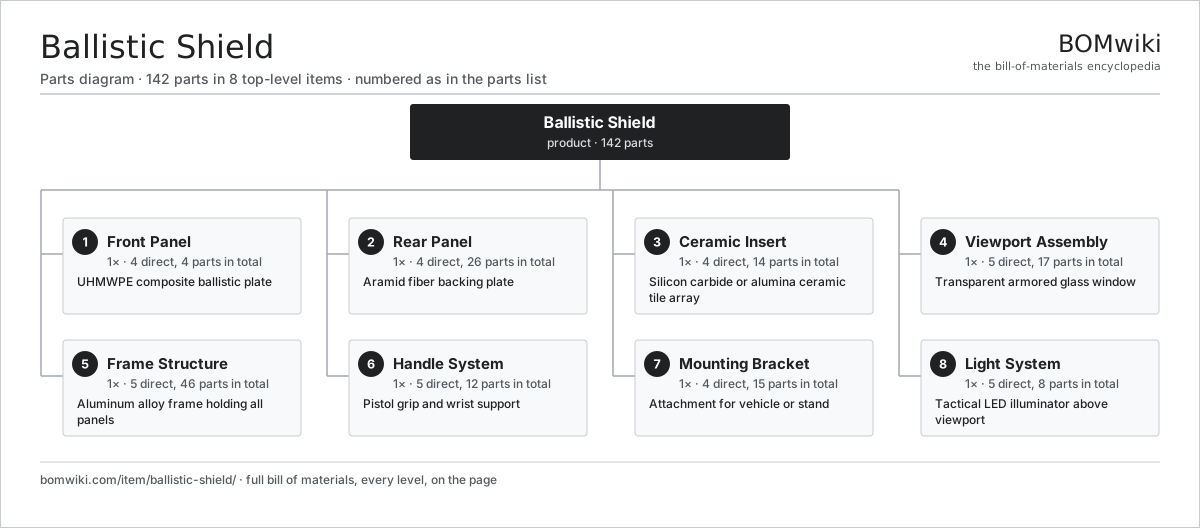
| # | Part | Qty | What it does |
|---|---|---|---|
| 1 | Front Panel 4 parts | 1× | UHMWPE composite ballistic plate |
| 2 | Rear Panel 4 parts | 1× | Aramid fiber backing plate |
| 3 | Ceramic Insert 4 parts | 1× | Silicon carbide or alumina ceramic tile array |
| 4 | Viewport Assembly 5 parts | 1× | Transparent armored glass window |
| 5 | Frame Structure 5 parts | 1× | Aluminum alloy frame holding all panels |
| 6 | Handle System 5 parts | 1× | Pistol grip and wrist support |
| 7 | Mounting Bracket 4 parts | 1× | Attachment for vehicle or stand |
| 8 | Light System 5 parts | 1× | Tactical LED illuminator above viewport |
3D model
No 3D model yet. Have a CAD file of this? Add a 3D model. STL renders right on this page; STEP, FreeCAD, and OpenSCAD sources are welcome too (openly licensed, like all 3D models on BOMwiki).
Build & assembly graph
expand / collapse · shared sub-assemblies converge · links to related products · est. labourTap an assembly to expand/collapse · tap a part to open it · use “Open page” for any node · drag to pan, scroll to zoom.
Bill of materials for Ballistic Shield
8 top-level lines · 44 rows shown · 142 parts total · indented to 3 levels| # | Item / sub-assembly | Part no. | Qty/assy | Ext. qty | Parts | Type |
|---|---|---|---|---|---|---|
| 1 | Front Panel 4 parts | ballistic-shield-front-panel | 1× | 1 | 4 | assembly |
| 1.1 | UHMWPE Sheet | ballistic-shield-uhmwpe-sheet | 1× | 1 | · | part |
| 1.2 | Kevlar Facing | ballistic-shield-kevlar-facing | 1× | 1 | · | part |
| 1.3 | Impact Energy Dissipator | ballistic-shield-impact-energy-dissipator | 1× | 1 | · | part |
| 1.4 | Panel Edge Binding | ballistic-shield-panel-edge-binding | 1× | 1 | · | part |
| 2 | Rear Panel 4 parts | ballistic-shield-rear-panel | 1× | 1 | 26 | assembly |
| 2.1 | Aramid Plies | ballistic-shield-aramid-plies | 16× | 16 | · | part |
| 2.2 | Ply Resin Matrix | ballistic-shield-ply-resin-matrix | 1× | 1 | · | part |
| 2.3 | Rear Panel Backing | ballistic-shield-rear-panel-backing | 1× | 1 | · | part |
| 2.4 | Fastener Set | fastener-set | 8× | 8 | · | part |
| 3 | Ceramic Insert 4 parts | ballistic-shield-ceramic-insert | 1× | 1 | 14 | assembly |
| 3.1 | Ceramic Tile | ballistic-shield-ceramic-tile | 4× | 4 | · | part |
| 3.2 | Ceramic Tile Backing | ballistic-shield-ceramic-tile-backing | 1× | 1 | · | part |
| 3.3 | Tile Positioning Frame | ballistic-shield-tile-positioning-frame | 1× | 1 | · | part |
| 3.4 | Fastener Set | fastener-set | 8× | 8 | · | part |
| 4 | Viewport Assembly 5 parts | ballistic-shield-viewport-assembly | 1× | 1 | 17 | assembly |
| 4.1 | Armor Glass Pane | ballistic-shield-armor-glass-pane | 1× | 1 | · | part |
| 4.2 | Viewport Frame | ballistic-shield-viewport-frame | 1× | 1 | · | part |
| 4.3 | Anti-Glare Coating | ballistic-shield-anti-glare-coating | 1× | 1 | · | part |
| 4.4 | Viewport Seal | ballistic-shield-viewport-seal | 2× | 2 | · | part |
| 4.5 | Fastener Set | fastener-set | 12× | 12 | · | part |
| 5 | Frame Structure 5 parts | ballistic-shield-frame-structure | 1× | 1 | 46 | assembly |
| 5.1 | Main Frame Rail | ballistic-shield-main-frame-rail | 4× | 4 | · | part |
| 5.2 | Cross Brace | ballistic-shield-cross-brace | 4× | 4 | · | part |
| 5.3 | Corner Bracket | ballistic-shield-corner-bracket | 4× | 4 | · | part |
| 5.4 | Panel Ribs | ballistic-shield-panel-ribs | 2× | 2 | · | part |
| 5.5 | Fastener Set | fastener-set | 32× | 32 | · | part |
| 6 | Handle System 5 parts | ballistic-shield-handle-system | 1× | 1 | 12 | assembly |
| 6.1 | Pistol Grip | ballistic-shield-pistol-grip | 1× | 1 | · | part |
| 6.2 | Grip Mounting Bracket | ballistic-shield-grip-mounting-bracket | 1× | 1 | · | part |
| 6.3 | Forearm Support Strap | ballistic-shield-forearm-support-strap | 1× | 1 | · | part |
| 6.4 | Grip Padding | ballistic-shield-grip-padding | 1× | 1 | · | part |
| 6.5 | Fastener Set | fastener-set | 8× | 8 | · | part |
| 7 | Mounting Bracket 4 parts | ballistic-shield-mounting-bracket | 1× | 1 | 15 | assembly |
| 7.1 | Vehicle Mount Adapter | ballistic-shield-vehicle-mount-adapter | 1× | 1 | · | part |
| 7.2 | Ball Swivel | ballistic-shield-ball-swivel | 1× | 1 | · | part |
| 7.3 | Stand Adapter | ballistic-shield-stand-adapter | 1× | 1 | · | part |
| 7.4 | Fastener Set | fastener-set | 12× | 12 | · | part |
| 8 | Light System 5 parts | ballistic-shield-light-system | 1× | 1 | 8 | assembly |
| 8.1 | LED Module | ballistic-shield-led-module | 1× | 1 | · | part |
| 8.2 | Light Mount Bracket | ballistic-shield-light-mount-bracket | 1× | 1 | · | part |
| 8.3 | Battery Pack | ballistic-shield-battery-pack | 1× | 1 | · | part |
| 8.4 | Pressure Switch | ballistic-shield-pressure-switch | 1× | 1 | · | part |
| 8.5 | Fastener Set | fastener-set | 4× | 4 | · | part |
Something wrong in this list? Report a problem with this BOM.
Sourcing: possible vendors
Browse the supplier directory → Prices, MOQ, and lead times are algorithmic estimates, not quotes, and not claims about these companies. Company mappings are curated by keyword; est. price band $200–$100M. How estimates work| Vendor | HQ | Specialty | MOQ | Lead time |
|---|---|---|---|---|
| smithsdetection.com ↗ | London, GB | Security screening | made to order | 24–52 wks |
|
🇺🇸Leidos
leidos.com ↗
|
Reston, US | Security & screening | made to order | 24–52 wks |
|
🇺🇸Rapiscan
rapiscansystems.com ↗
|
Torrance, US | X-ray screening | made to order | 24–52 wks |
|
🇫🇷Thales
thalesgroup.com ↗
|
Paris, FR | Defense electronics | made to order | 24–52 wks |
| baesystems.com ↗ | London, GB | Defense | made to order | 24–52 wks |
2,043-word article