Electric Baseboard Heater
ProductOverview
An electric baseboard heater is the simplest zone-heating device: a resistance element enclosed in a finned steel chassis mounted along the perimeter wall of a room, typically beneath a window. Line voltage electricity (120 V or 240 V) flows through Nichrome or Kanthal wire wound inside a stainless steel sheath, raising the wire to 600–900°C and radiating heat directly and convectively through extended aluminum fins. A built-in or separate room thermostat switches the element on and off to maintain the set temperature. Because electric resistance is 100% efficient at the point of use (no ducting losses, no pilot light), and installation requires only a wall-mounted bracket and 120 V outlet or 240 V hardwired circuit, baseboard heaters are the dominant heating choice in apartments, rental properties, and retrofit applications throughout North America.
The trade-offs are economic: electricity is 3–5 times more expensive per BTU than natural gas or fuel oil, making baseboard heaters expensive to operate in cold climates. However, modular zoning (each room is independently heated) and complete absence of ductwork make them ideal for historic buildings, open-plan condominiums, and situations where forced-air furnaces are impractical. Modern electric baseboard heaters use bimetallic or electronic thermostats for cycling precision and low-cost built-in setpoint control.
How it works
Electricity enters the heater through a terminal block and passes through the thermostat switch. When room temperature drops below setpoint, the bimetallic strip in the thermostat flexes, closing the electrical circuit. Current flows through the resistance element, specifically the Nichrome coil, which begins to glow orange-hot. The sheath and surrounding ceramic insulation limit wire temperature rise and distribute energy smoothly.
Heat radiates directly from the hot element surface (roughly 5–10% of total), while convection dominates. Air in contact with the fin array heats and rises naturally (buoyancy-driven convection), drawing cool air in from the room near the floor and ejecting hot air near the ceiling. This rising plume, combined with radiant warmth, creates a warm envelope around the perimeter of the room. As air temperature rises, the thermostat sensor detects the change, and the switch opens, cutting power. The element cools slowly, and the cycle repeats.
Thermostat and Control
Early baseboard heaters used bimetallic strips (two bonded metals with different thermal expansion coefficients) that bent as temperature changed, mechanically opening and closing an electrical switch. Modern units often incorporate NTC thermistors and electronic relays for more precise setpoint control and reduced on-off cycling. A room-mounted or wall-integrated thermostat dial allows occupants to set their desired temperature (typically 10–35°C or 50–95°F). Some high-end models include programmable thermostats or remote wireless control.
Installation and Safety
Baseboard heaters must be installed on exterior walls (beneath windows preferred) where cold air naturally enters. Placement on interior walls or near doors is inefficient. The insulation pad reduces heat transmission into the wall structure, directing it into the room. The circuit breaker or fuse provides overcurrent protection; a 2 kW heater at 240 V draws roughly 8.3 A, requiring a 15 A circuit; larger units need 20 A circuits.
The front grille is intentionally perforated to allow convection air passage, but also creates a burn hazard: the surface can exceed 60°C (140°F), sufficient to cause injury to skin contact. Thermostatic shut-off switches prevent runaway overheating in case of thermostat failure.
Advantages and Limitations
Advantages: 100% efficient at the point of heat delivery; low installation cost; no ductwork or moving parts; quiet operation (convection air noise is minimal); zero maintenance. Limitations: high operating cost in cold climates (electricity rate typically 3–5× gas); cannot provide air conditioning or humidity control; cannot deliver fresh outside air for ventilation (supplemental ERV needed); thermal response is slow compared to forced-air systems.
Standards and Energy Codes
ASHRAE 90.1 and most energy codes have moved away from electric resistance heating as a primary system in new construction, favoring heat pumps. However, electric baseboard heaters remain common in existing residential stock and are permitted in many jurisdictions for supplemental or backup heating. The circuit breaker and element sheath must comply with UL 1042 (Baseboard Heaters); thermostats with manual on-off are unregulated, but built-in thermostat switches are subject to electrical code requirements.
Electric Baseboard Heater parts and their functions
8 top-level parts · 25 parts in total · full bill of materials below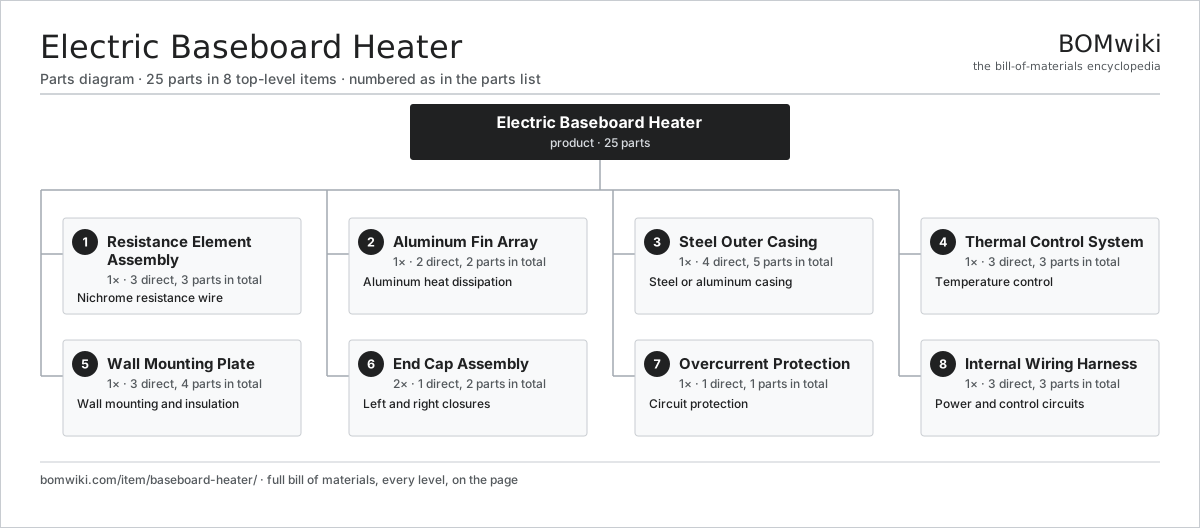
| # | Part | Qty | What it does |
|---|---|---|---|
| 1 | Resistance Element Assembly 3 parts | 1× | Nichrome resistance wire |
| 2 | Aluminum Fin Array 2 parts | 1× | Aluminum heat dissipation |
| 3 | Steel Outer Casing 4 parts | 1× | Steel or aluminum casing |
| 4 | Thermal Control System 3 parts | 1× | Temperature control |
| 5 | Wall Mounting Plate 3 parts | 1× | Wall mounting and insulation |
| 6 | End Cap Assembly 1 parts | 2× | Left and right closures |
| 7 | Overcurrent Protection 1 parts | 1× | Circuit protection |
| 8 | Internal Wiring Harness 3 parts | 1× | Power and control circuits |
3D model
No 3D model yet. Have a CAD file of this? Add a 3D model. STL renders right on this page; STEP, FreeCAD, and OpenSCAD sources are welcome too (openly licensed, like all 3D models on BOMwiki).
Build & assembly graph
expand / collapse · shared sub-assemblies converge · links to related products · est. labourTap an assembly to expand/collapse · tap a part to open it · use “Open page” for any node · drag to pan, scroll to zoom.
Bill of materials for Electric Baseboard Heater
8 top-level lines · 28 rows shown · 25 parts total · indented to 3 levels| # | Item / sub-assembly | Part no. | Qty/assy | Ext. qty | Parts | Type |
|---|---|---|---|---|---|---|
| 1 | Resistance Element Assembly 3 parts | baseboard-heater-element | 1× | 1 | 3 | assembly |
| 1.1 | Nichrome Wire Coil | baseboard-heater-element-wire | 1× | 1 | · | part |
| 1.2 | Ceramic Insulation | baseboard-heater-element-insulation | 1× | 1 | · | part |
| 1.3 | Sheath Tube | baseboard-heater-element-sheath | 1× | 1 | · | part |
| 2 | Aluminum Fin Array 2 parts | baseboard-heater-fins | 1× | 1 | 2 | assembly |
| 2.1 | Fin Stock | baseboard-heater-fins-material | 1× | 1 | · | part |
| 2.2 | Fin Mounting | baseboard-heater-fins-attachment | 1× | 1 | · | part |
| 3 | Steel Outer Casing 4 parts | baseboard-heater-housing | 1× | 1 | 5 | assembly |
| 3.1 | Front Grille | baseboard-heater-housing-front | 1× | 1 | · | part |
| 3.2 | Side Panels | baseboard-heater-housing-sides | 2× | 2 | · | part |
| 3.3 | Back Plate | baseboard-heater-housing-back | 1× | 1 | · | part |
| 3.4 | Fastener Set | fastener-set | 1× | 1 | · | part |
| 4 | Thermal Control System 3 parts | baseboard-heater-thermostat | 1× | 1 | 3 | assembly |
| 4.1 | Temperature Sensor | baseboard-heater-thermostat-sensor | 1× | 1 | · | part |
| 4.2 | Switching Contact | baseboard-heater-thermostat-switch | 1× | 1 | · | part |
| 4.3 | Setpoint Dial | baseboard-heater-thermostat-dial | 1× | 1 | · | part |
| 5 | Wall Mounting Plate 3 parts | baseboard-heater-backplate | 1× | 1 | 4 | assembly |
| 5.1 | Insulation Pad | baseboard-heater-backplate-insulation | 1× | 1 | · | part |
| 5.2 | Wall Bracket | baseboard-heater-backplate-bracket | 2× | 2 | · | part |
| 5.3 | Terminal Block | baseboard-heater-backplate-terminal-block | 1× | 1 | · | part |
| 6 | End Cap Assembly 1 parts | baseboard-heater-endcap | 2× | 2 | 2 | assembly |
| 6.1 | Plastic Endcap | baseboard-heater-endcap-plastic | 2× | 4 | · | part |
| 7 | Overcurrent Protection 1 parts | baseboard-heater-breaker | 1× | 1 | 1 | assembly |
| 7.1 | Miniature Circuit Breaker | baseboard-heater-breaker-device | 1× | 1 | · | part |
| 8 | Internal Wiring Harness 3 parts | baseboard-heater-wiring | 1× | 1 | 3 | assembly |
| 8.1 | Power Conductors | baseboard-heater-wiring-power | 1× | 1 | · | part |
| 8.2 | Thermostat Sensor Wire | baseboard-heater-wiring-control | 1× | 1 | · | part |
| 8.3 | Wire Bundle | wire-bundle | 1× | 1 | · | part |
Something wrong in this list? Report a problem with this BOM.
Related products
same domain, ranked by shared parts Air Curtain
115 parts · shares 2 with this page
Air Curtain
115 parts · shares 2 with this page
 Air Handling Unit
631 parts · shares 2 with this page
Air Handling Unit
631 parts · shares 2 with this page
 Air Purifier
331 parts · shares 2 with this page
Air Purifier
331 parts · shares 2 with this page
 Ceiling Cassette AC
395 parts · shares 2 with this page
Ceiling Cassette AC
395 parts · shares 2 with this page
 Ceiling Fan
104 parts · shares 2 with this page
Ceiling Fan
104 parts · shares 2 with this page
 Centrifugal Chiller
340 parts · shares 2 with this page
Centrifugal Chiller
340 parts · shares 2 with this page
Sourcing: possible vendors
Browse the supplier directory → Prices, MOQ, and lead times are algorithmic estimates, not quotes, and not claims about these companies. Company mappings are curated by keyword; est. price band $100–$20k. How estimates work| Vendor | HQ | Specialty | MOQ | Lead time |
|---|---|---|---|---|
|
🇺🇸Carrier
carrier.com ↗
|
Palm Beach Gardens, US | HVAC | 500 units | 8–14 wks |
| tranetechnologies.com ↗ | Davidson, US | HVAC | 500 units | 8–14 wks |
|
🇯🇵Daikin
daikin.com ↗
|
Osaka, JP | HVAC | 500 units | 8–14 wks |
|
🇺🇸Lennox
lennox.com ↗
|
Richardson, US | HVAC | 500 units | 8–14 wks |
| johnsoncontrols.com ↗ | Milwaukee, US | Building systems | 500 units | 8–14 wks |
756-word article