Bed Bug Heat Treatment System
ProductOverview
A bed bug heat treatment system is a portable, non-chemical method of pest control that heats an entire infested room or structure to a lethal temperature (50–56 °C) sustained for 60–90 minutes. Unlike pesticide sprays, which may miss protected voids and cracks, heat penetrates into all spaces: mattresses, headboards, wall voids, furniture seams, anywhere a bed bug can hide.
The system consists of electric heaters that generate hot air, circulation fans that distribute heat uniformly, wireless temperature probes that confirm lethal temperatures throughout the space, and a programmable controller that enforces time-temperature protocols. The treatment is non-toxic, leaves no residue, and kills bed bugs in all life stages (adults, nymphs, eggs) in a single session.
How it works
The Heater Unit contains multiple Heating Elements (4–8 resistive coils totaling 10–50 kW) mounted in an insulated Heater Chamber. A Heater Blower Fan, typically 3–10 kW, pulls ambient air through an Heater Intake Filter, forces it across the resistive elements, and pressurizes it into the Ducting System system. A Thermostat Cutout prevents overheating by cycling the elements if air temperature exceeds 65 °C.
The Ducting System, made of insulated Flex Duct, distributes heated air from the main unit throughout the room and into adjacent areas via Duct Couplings connectors. Two to four Air Mover (Circulation Fan) fans, each with a Mover Motor (1–2 kW) and Mover Impeller, are positioned strategically to stir the room air and eliminate dead zones where cooler pockets might allow bugs to survive.
Multiple Temperature Sensor Assemblys, typically 3–5 probes using Temperature Probes (K-type thermocouples or PT100 RTDs), are placed in different zones: high, middle, low, and deep inside furniture or wall voids. Each probe transmits data via wired connection or wireless Sensor Transmitter to the Control System, a microcontroller that reads all sensors and modulates the Relay Contactors contactors to switch the heater and movers on/off.
The Control Display Panel, mounted on the heater unit or external Electrical Panel Box, shows real-time temperatures from all zones, elapsed time, and setpoint. The operator programs the controller via Control Buttons to target 56 °C and hold for 90 minutes. The Real-Time Clock tracks elapsed time for compliance documentation.
Once the room stabilizes at lethal temperature (typically 10–20 minutes for a bedroom), the controller maintains setpoint for the hold period. At completion, the heater shuts off and fans run cool to bring the space back to normal operating temperature.
Lethal temperature and protocol
Bed bugs are ectothermic; they cannot regulate body heat and die when exposed to sustained temperatures above 50 °C. The standard protocol is 56 °C for 90 minutes in the warmest zone; cooler zones must reach at least 50 °C. Eggs (most heat-resistant life stage) die at 56 °C within 60–90 minutes. This protocol ensures 100% mortality in one treatment.
The Power Distribution Box box is connected to the facility's main 240 VAC service (single- or three-phase). The Main Breaker (60–100 A) protects the circuit; Branch Breakers (40–60 A each) feed the heater and mover circuits independently.
Advantages and limitations
Heat treatment requires no pesticide application, leaves no residue, and kills all life stages simultaneously. It works in one session, avoiding the multi-week re-spray schedule of chemical treatments. The main limitations are energy cost (10–50 kW running 2–6 hours) and the need to evacuate the structure during treatment. Sensitive items (some plastics, vinyl, wax) may be damaged if directly exposed to air streams >70 °C, so the system typically targets 50–56 °C air temperature for safety.
The technique is highly effective in multi-unit buildings (apartments, hotels) where bed bugs hitchhike between units; a whole-building heat treatment can eliminate the infestation at once.
Bed Bug Heat Treatment System parts and their functions
7 top-level parts · 49 parts in total · full bill of materials below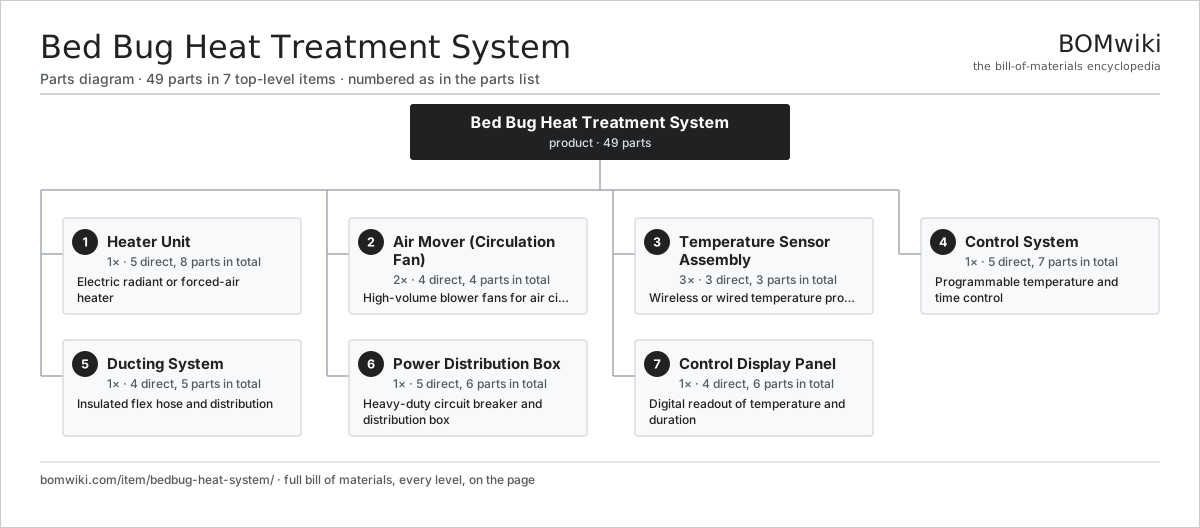
| # | Part | Qty | What it does |
|---|---|---|---|
| 1 | Heater Unit 5 parts | 1× | Electric radiant or forced-air heater |
| 2 | Air Mover (Circulation Fan) 4 parts | 2× | High-volume blower fans for air circulation |
| 3 | Temperature Sensor Assembly 3 parts | 3× | Wireless or wired temperature probes |
| 4 | Control System 5 parts | 1× | Programmable temperature and time control |
| 5 | Ducting System 4 parts | 1× | Insulated flex hose and distribution |
| 6 | Power Distribution Box 5 parts | 1× | Heavy-duty circuit breaker and distribution box |
| 7 | Control Display Panel 4 parts | 1× | Digital readout of temperature and duration |
3D model
No 3D model yet. Have a CAD file of this? Add a 3D model. STL renders right on this page; STEP, FreeCAD, and OpenSCAD sources are welcome too (openly licensed, like all 3D models on BOMwiki).
Build & assembly graph
expand / collapse · shared sub-assemblies converge · links to related products · est. labourTap an assembly to expand/collapse · tap a part to open it · use “Open page” for any node · drag to pan, scroll to zoom.
Bill of materials for Bed Bug Heat Treatment System
7 top-level lines · 37 rows shown · 49 parts total · indented to 3 levels| # | Item / sub-assembly | Part no. | Qty/assy | Ext. qty | Parts | Type |
|---|---|---|---|---|---|---|
| 1 | Heater Unit 5 parts | bedbug-heat-system-heater-unit | 1× | 1 | 8 | assembly |
| 1.1 | Heating Element | bedbug-heat-system-heating-element | 4× | 4 | · | part |
| 1.2 | Heater Chamber | bedbug-heat-system-heating-chamber | 1× | 1 | · | part |
| 1.3 | Thermostat Cutout | bedbug-heat-system-thermostat-switch | 1× | 1 | · | part |
| 1.4 | Heater Blower Fan | bedbug-heat-system-heater-fan | 1× | 1 | · | part |
| 1.5 | Heater Intake Filter | bedbug-heat-system-intake-filter | 1× | 1 | · | part |
| 2 | Air Mover (Circulation Fan) 4 parts | bedbug-heat-system-air-mover | 2× | 2 | 4 | assembly |
| 2.1 | Mover Motor | bedbug-heat-system-mover-motor | 1× | 2 | · | part |
| 2.2 | Mover Impeller | bedbug-heat-system-mover-impeller | 1× | 2 | · | part |
| 2.3 | Mover Shroud | bedbug-heat-system-mover-housing | 1× | 2 | · | part |
| 2.4 | Mover Stand | bedbug-heat-system-mover-stand | 1× | 2 | · | part |
| 3 | Temperature Sensor Assembly 3 parts | bedbug-heat-system-temperature-sensor | 3× | 3 | 3 | assembly |
| 3.1 | Temperature Probe | bedbug-heat-system-sensor-probe | 1× | 3 | · | part |
| 3.2 | Sensor Transmitter | bedbug-heat-system-sensor-transmitter | 1× | 3 | · | part |
| 3.3 | Probe Mount | bedbug-heat-system-mounting-probe | 1× | 3 | · | part |
| 4 | Control System 5 parts | bedbug-heat-system-controller | 1× | 1 | 7 | assembly |
| 4.1 | Control CPU | bedbug-heat-system-cpu | 1× | 1 | · | part |
| 4.2 | Relay Contactors | bedbug-heat-system-relay-bank | 3× | 3 | · | part |
| 4.3 | Power Terminal Strip | bedbug-heat-system-power-terminals | 1× | 1 | · | part |
| 4.4 | Real-Time Clock | bedbug-heat-system-rtc-module | 1× | 1 | · | part |
| 4.5 | SMD Passive (R/C/L) | smd-passives | 1× | 1 | · | part |
| 5 | Ducting System 4 parts | bedbug-heat-system-ducting | 1× | 1 | 5 | assembly |
| 5.1 | Flex Duct | bedbug-heat-system-flex-hose | 1× | 1 | · | part |
| 5.2 | Duct Couplings | bedbug-heat-system-flex-coupling | 2× | 2 | · | part |
| 5.3 | Duct Adapter | bedbug-heat-system-duct-adaptor | 1× | 1 | · | part |
| 5.4 | Duct Sealing Tape | bedbug-heat-system-floor-tape | 1× | 1 | · | part |
| 6 | Power Distribution Box 5 parts | bedbug-heat-system-power-distribution | 1× | 1 | 6 | assembly |
| 6.1 | Electrical Panel Box | bedbug-heat-system-panel-box | 1× | 1 | · | part |
| 6.2 | Main Breaker | bedbug-heat-system-main-breaker | 1× | 1 | · | part |
| 6.3 | Branch Breakers | bedbug-heat-system-branch-breakers | 2× | 2 | · | part |
| 6.4 | Ground Bus | bedbug-heat-system-ground-buss | 1× | 1 | · | part |
| 6.5 | Neutral Bus | bedbug-heat-system-neutral-buss | 1× | 1 | · | part |
| 7 | Control Display Panel 4 parts | bedbug-heat-system-monitoring-display | 1× | 1 | 6 | assembly |
| 7.1 | Display Screen | bedbug-heat-system-display-screen | 1× | 1 | · | part |
| 7.2 | Control Buttons | bedbug-heat-system-display-buttons | 1× | 1 | · | part |
| 7.3 | Display Backlight | bedbug-heat-system-display-backlight | 1× | 1 | · | part |
| 7.4 | Status Indicator LEDs | bedbug-heat-system-indicator-leds | 3× | 3 | · | part |
Something wrong in this list? Report a problem with this BOM.
Related products
same domain, ranked by shared parts Electric Fence Energizer
37 parts · shares 1 with this page
Electric Fence Energizer
37 parts · shares 1 with this page
 Electronic Rodent Trap
31 parts · shares 1 with this page
Electronic Rodent Trap
31 parts · shares 1 with this page
 Greenhouse Heater
50 parts · shares 1 with this page
Greenhouse Heater
50 parts · shares 1 with this page
 Robotic Lawn Mower
136 parts · shares 1 with this page
Robotic Lawn Mower
136 parts · shares 1 with this page
Sourcing: possible vendors
Browse the supplier directory → Prices, MOQ, and lead times are algorithmic estimates, not quotes, and not claims about these companies. Company mappings are curated by keyword; est. price band $80–$5k. How estimates work| Vendor | HQ | Specialty | MOQ | Lead time |
|---|---|---|---|---|
| husqvarna.com ↗ | Stockholm, SE | Outdoor power products | 500 units | 8–14 wks |
|
🇩🇪STIHL
stihl.com ↗
|
Waiblingen, DE | Chainsaws & outdoor power | 500 units | 8–14 wks |
|
🇺🇸Toro
thetorocompany.com ↗
|
Bloomington, US | Turf & outdoor equipment | 500 units | 8–14 wks |
| powerequipment.honda.com ↗ | Tokyo, JP | Engines & outdoor power | 500 units | 8–14 wks |
|
🇨🇳Chervon
chervongroup.com ↗
|
Nanjing, CN | Power tools (EGO, SKIL) | 500 units | 8–14 wks |
700-word article