Sugar Beet Slicer
ProductOverview
The sugar beet slicer is the primary preparation equipment for beet sugar production, converting whole beets (50–100 mm diameter) into thin elongated slices called raschels (4–6 mm thick, 20–30 mm long). A high-speed rotating disc with three cutting knives works against a stationary blade mounted on the frame, shearing beet tissue as the disc rotates. A feed drum with protruding studs advances whole beets into the cutting zone at controlled speed. Unlike centrifuges or presses that squeeze, the raschel slicer maintains cellular structure to maximize juice diffusion in the downstream Cane Diffuser.
How it Works
Whole sugar beets from washing and sorting drop into the hopper, where the Feed Drum rotates at 30 rpm, advancing beets into the cutting zone. The Rotor Disc spins at 200 rpm (6.7 revolutions per second). Three rotating knives mounted on the disc perimeter pass a fixed Stationary Knife blade at the frame. Each beet is shaved incrementally, every rotation of the disc removes one thin slice. The slice thickness is set by the gap between rotor and stationary blade, typically 4–6 mm.
Freshly cut raschels drop through the Discharge Chute chute, where a conveyor carries them to the diffusion vessel. Processing rate is 100–150 kg/min, corresponding to approximately one beet per second.
Engineering Details
Knife Design: Both rotating and fixed knives are high-carbon steel (1.2% carbon), hardened to 60 HRc and honed to 15° included angle. Knives dull after 10–20 tonnes of beets depending on soil content (grit causes rapid dulling). Regular knife changes maintain product quality.
Feed Drum: The studded drum design grips whole beets without crushing them. Studs are spaced at 50 mm, ensuring contact across the beet diameter. Drive is slow (30 rpm) to minimize feed force and vibration.
Rotor Balance: At 200 rpm, rotating imbalance generates significant vibration. The disc is dynamically balanced during manufacturing; bearing wear gradually introduces imbalance, requiring bearing replacement every 3–5 years.
Discharge Geometry: The chute is carefully shaped to guide raschels tangentially away from the rotating disc without interference, preventing re-slicing or jamming.
Quality Factors
Raschel morphology (thin, elongated shape) is superior to chunks or granules for diffusion because it maximizes surface area and minimizes diffusion path length. A 5 mm raschel diffuses faster than a 10 mm chunk by an order of magnitude.
Slice thickness uniformity is critical: thick slices diffuse incompletely (sugar loss); thin slices are structurally weak and fragment during conveying, creating fines that clog downstream equipment.
Beet Cleanliness: Soil and sand on incoming beets greatly accelerate knife dulling. Many beet plants install wet washers upstream of the slicer.
Integration
Raw beets from wash/sort → Sugar Beet Slicer → conveyor → Cane Diffuser (modified for beet diffusion with lower temperature, milder agitation). Beet diffusion operates at 50–60 °C (colder than cane to avoid enzymatic browning) and takes 60–90 minutes (longer than cane, as beets have thicker cell walls).
Limitations
Unlike crushing mills (Sugar Mill Roller) which can process irregular cane, the slicer requires relatively uniform beet size. Oversized beets may jam; undersized beets feed too quickly. Modern plants employ sizing screens to grade beets before slicing.
The slicer is moderately loud (85–90 dB) and generates visible aerosol from cellular juice spray; proper ventilation and guarding are mandatory.
Maximum throughput is limited by knife sharpness and feed drum torque. Typical design handles up to 150 kg/min; larger capacity requires multiple slicers.
Sugar Beet Slicer parts and their functions
6 top-level parts · 19 parts in total · full bill of materials below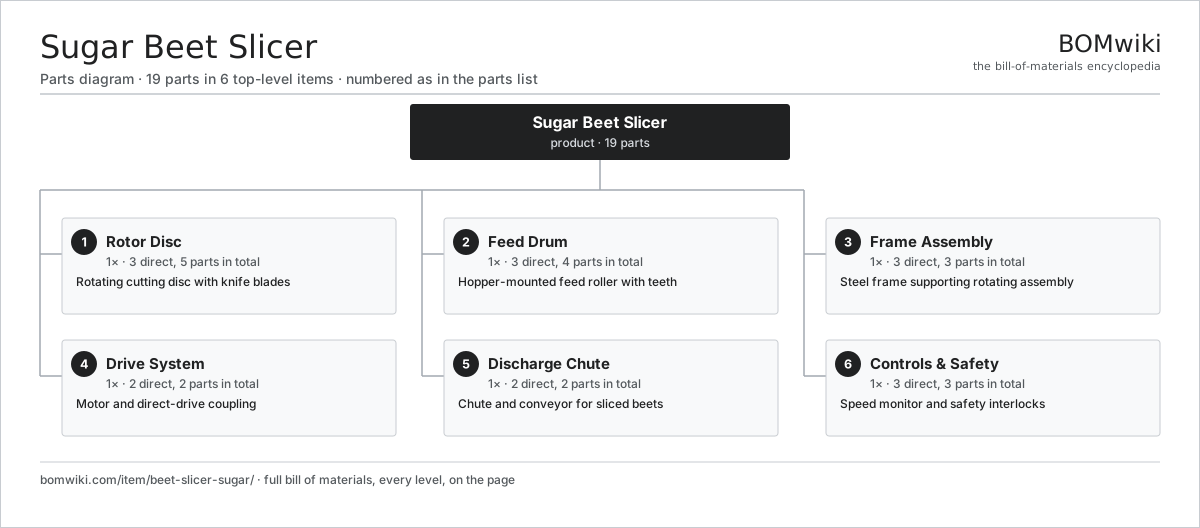
| # | Part | Qty | What it does |
|---|---|---|---|
| 1 | Rotor Disc 3 parts | 1× | Rotating cutting disc with knife blades |
| 2 | Feed Drum 3 parts | 1× | Hopper-mounted feed roller with teeth |
| 3 | Frame Assembly 3 parts | 1× | Steel frame supporting rotating assembly |
| 4 | Drive System 2 parts | 1× | Motor and direct-drive coupling |
| 5 | Discharge Chute 2 parts | 1× | Chute and conveyor for sliced beets |
| 6 | Controls & Safety 3 parts | 1× | Speed monitor and safety interlocks |
3D model
No 3D model yet. Have a CAD file of this? Add a 3D model. STL renders right on this page; STEP, FreeCAD, and OpenSCAD sources are welcome too (openly licensed, like all 3D models on BOMwiki).
Build & assembly graph
expand / collapse · shared sub-assemblies converge · links to related products · est. labourTap an assembly to expand/collapse · tap a part to open it · use “Open page” for any node · drag to pan, scroll to zoom.
Bill of materials for Sugar Beet Slicer
6 top-level lines · 22 rows shown · 19 parts total · indented to 3 levels| # | Item / sub-assembly | Part no. | Qty/assy | Ext. qty | Parts | Type |
|---|---|---|---|---|---|---|
| 1 | Rotor Disc 3 parts | beet-slicer-sugar-rotor-disc | 1× | 1 | 5 | assembly |
| 1.1 | Disc Hub | beet-slicer-sugar-disc-hub | 1× | 1 | · | part |
| 1.2 | Stationary Knife | beet-slicer-sugar-stationary-knife | 1× | 1 | · | part |
| 1.3 | Rotating Knives | beet-slicer-sugar-rotating-knives | 3× | 3 | · | part |
| 2 | Feed Drum 3 parts | beet-slicer-sugar-feed-drum | 1× | 1 | 4 | assembly |
| 2.1 | Drum Shaft | beet-slicer-sugar-drum-shaft | 1× | 1 | · | part |
| 2.2 | Drum Bearings | beet-slicer-sugar-drum-bearings | 2× | 2 | · | part |
| 2.3 | Drum Motor | beet-slicer-sugar-drum-motor | 1× | 1 | · | part |
| 3 | Frame Assembly 3 parts | beet-slicer-sugar-frame | 1× | 1 | 3 | assembly |
| 3.1 | Base Frame | beet-slicer-sugar-base-frame | 1× | 1 | · | part |
| 3.2 | Rotor Bearing | beet-slicer-sugar-bearing-pedestal | 1× | 1 | · | part |
| 3.3 | Safety Guard | beet-slicer-sugar-guard-cover | 1× | 1 | · | part |
| 4 | Drive System 2 parts | beet-slicer-sugar-drive | 1× | 1 | 2 | assembly |
| 4.1 | Main Motor | beet-slicer-sugar-main-motor | 1× | 1 | · | part |
| 4.2 | Shaft Coupling | beet-slicer-sugar-coupling | 1× | 1 | · | part |
| 5 | Discharge Chute 2 parts | beet-slicer-sugar-discharge | 1× | 1 | 2 | assembly |
| 5.1 | Discharge Chute | beet-slicer-sugar-discharge-chute | 1× | 1 | · | part |
| 5.2 | Discharge Conveyor | beet-slicer-sugar-discharge-screw | 1× | 1 | · | part |
| 6 | Controls & Safety 3 parts | beet-slicer-sugar-controls | 1× | 1 | 3 | assembly |
| 6.1 | Speed Sensor | beet-slicer-sugar-speed-sensor | 1× | 1 | · | part |
| 6.2 | Vibration Switch | beet-slicer-sugar-vibration-switch | 1× | 1 | · | part |
| 6.3 | Guard Interlock | beet-slicer-sugar-guard-interlock | 1× | 1 | · | part |
Something wrong in this list? Report a problem with this BOM.
Sourcing: possible vendors
Browse the supplier directory → Prices, MOQ, and lead times are algorithmic estimates, not quotes, and not claims about these companies. Company mappings are curated by keyword; est. price band $1k–$500k. How estimates work| Vendor | HQ | Specialty | MOQ | Lead time |
|---|---|---|---|---|
| gea.com ↗ | Düsseldorf, DE | Process technology | 20 units | 12–20 wks |
| buhlergroup.com ↗ | Uzwil, CH | Food & materials processing | 20 units | 12–20 wks |
| tetrapak.com ↗ | Pully, CH | Food packaging & processing | 20 units | 12–20 wks |
| jbtc.com ↗ | Chicago, US | Food processing equipment | 20 units | 12–20 wks |
| alfalaval.com ↗ | Lund, SE | Heat transfer & separation | 20 units | 12–20 wks |
585-word article