Belt Squat Machine
ProductOverview
A belt squat machine lets a lifter squat heavy loads with zero barbell compression on the spine. The weight hangs from a padded Hip Belt around the pelvis, and a Lever Arm Assembly under the standing platform routes that load down to plate horns. Because the torso carries nothing, the machine is widely used for high-volume leg work, training around back and shoulder injuries, and adding squat frequency without systemic spinal fatigue. Plate-loaded lever designs of this type were popularized by the Westside Barbell ATP and Rogue Echo-style machines; cable-and-stack belt squats exist but the lever architecture dominates because it handles 400+ kg with no cables to wear.
Load path
The lifter stands on the raised Standing Platform over a central Yoke Travel Slot. A chain from the belt's Belt D-Ring drops through the slot to the Belt Attachment Yoke at the nose of the lever arm. The Lever Arm Beam runs rearward to the Lever Pivot Pin in the frame's Pivot Housing, with the two Plate Loading Horn posts positioned along the beam. As the lifter stands, the arm swings up through roughly 30° between its Arm Travel Stop limits.
The lever geometry sets the effective resistance: with horns near the pivot and the yoke far from it, plate weight is transmitted at slightly less than 1:1, and the moment arm changes a few percent across the arc, giving a mild resistance curve, typically lightest at the bottom, where lifters are weakest. Manufacturers publish the ratio so users can compute belt load from plate load. The arc also pulls the belt point a few centimetres rearward at depth, which is why the machine squat tracks the hips more naturally than a fixed vertical cable would.
Frame and platform
The Machine Frame is built like a power rack: a perimeter Base Weldment of 3 mm-wall tube, two Frame Upright posts, and Cross Brace tubes against side load. Anchor Foot Plate plates allow lagging to the slab, though at 160–320 kg machine mass plus stored plates on the Plate Storage Peg set, most installations rely on dead weight.
The Platform Deck Plate sits 250–400 mm up so the arm and chain have room to travel beneath it; the lifter mounts via a Platform Step. An aggressive Anti-Slip Surface surface matters more here than on most machines because maximal leg drive with a hip-height load punishes any foot slip.
Racking and the release lever
The machine's equivalent of J-hooks is the Load Release Mechanism. With the arm resting on the Rack Catch Hook, the belt and Adjustment Chain can be hooked up slack via the Locking Carabiner. The lifter stands tall and throws the Release Hand Lever; the Release Linkage swings the catch clear and the load transfers to the hips. At set end the sequence reverses, stand at lockout, throw the lever, and the catch takes the arm. The lifter can therefore fail a rep safely by simply sinking to the bottom, where the arm meets its stop; there is no pinned barbell to escape from.
Belt interface
The belt is the one user-fitted component. A squat-style padded belt with a forged front D-ring is standard, rated far above machine capacity (≥1,000 kg breaking strength is typical for the webbing and ring). Chain link selection sets effective height for users from ~1.5 to 2 m; choosing a link too long costs range of motion, too short and the lifter cannot reach lockout to operate the release. Screw-gate carabiners are specified rather than snap hooks because the chain sees shock loading when a lifter bounces out of the hole.
Maintenance and wear
Wear concentrates at four points: the pivot Ball Bearing pair (greased annually; play here reads as clunking at turnaround), the Horn Wear Sleeve surfaces abraded by plate bores, belt stitching, and the rack catch faces, which peen from repeated engagement under load. The chain and carabiners are inspected like rigging, any gouged link or sprung gate is replaced. Frame welds at the pivot housing carry the highest stress range in the machine and are the standard inspection point on commercial preventive-maintenance schedules.
Belt Squat Machine parts and their functions
8 top-level parts · 49 parts in total · full bill of materials below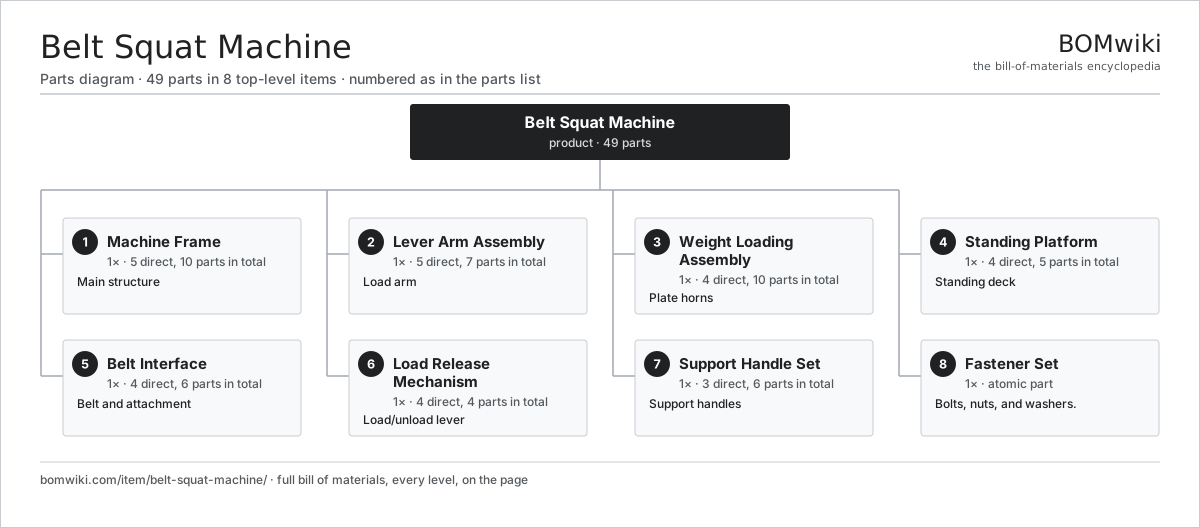
| # | Part | Qty | What it does |
|---|---|---|---|
| 1 | Machine Frame 5 parts | 1× | Main structure |
| 2 | Lever Arm Assembly 5 parts | 1× | Load arm |
| 3 | Weight Loading Assembly 4 parts | 1× | Plate horns |
| 4 | Standing Platform 4 parts | 1× | Standing deck |
| 5 | Belt Interface 4 parts | 1× | Belt and attachment |
| 6 | Load Release Mechanism 4 parts | 1× | Load/unload lever |
| 7 | Support Handle Set 3 parts | 1× | Support handles |
| 8 | Fastener Set | 1× | Bolts, nuts, and washers. |
3D model
No 3D model yet. Have a CAD file of this? Add a 3D model. STL renders right on this page; STEP, FreeCAD, and OpenSCAD sources are welcome too (openly licensed, like all 3D models on BOMwiki).
Build & assembly graph
expand / collapse · shared sub-assemblies converge · links to related products · est. labourTap an assembly to expand/collapse · tap a part to open it · use “Open page” for any node · drag to pan, scroll to zoom.
Bill of materials for Belt Squat Machine
8 top-level lines · 37 rows shown · 49 parts total · indented to 3 levels| # | Item / sub-assembly | Part no. | Qty/assy | Ext. qty | Parts | Type |
|---|---|---|---|---|---|---|
| 1 | Machine Frame 5 parts | belt-squat-machine-frame | 1× | 1 | 10 | assembly |
| 1.1 | Base Weldment | belt-squat-machine-base-weldment | 1× | 1 | · | part |
| 1.2 | Frame Upright | belt-squat-machine-upright | 2× | 2 | · | part |
| 1.3 | Pivot Housing | belt-squat-machine-pivot-housing | 1× | 1 | · | part |
| 1.4 | Cross Brace | belt-squat-machine-cross-brace | 2× | 2 | · | part |
| 1.5 | Anchor Foot Plate | belt-squat-machine-anchor-foot | 4× | 4 | · | part |
| 2 | Lever Arm Assembly 5 parts | belt-squat-machine-lever-arm | 1× | 1 | 7 | assembly |
| 2.1 | Lever Arm Beam | belt-squat-machine-arm-beam | 1× | 1 | · | part |
| 2.2 | Lever Pivot Pin | belt-squat-machine-pivot-pin | 1× | 1 | · | part |
| 2.3 | Ball Bearing | ball-bearing | 2× | 2 | · | part |
| 2.4 | Belt Attachment Yoke | belt-squat-machine-belt-yoke | 1× | 1 | · | part |
| 2.5 | Arm Travel Stop | belt-squat-machine-arm-stop | 2× | 2 | · | part |
| 3 | Weight Loading Assembly 4 parts | belt-squat-machine-loading | 1× | 1 | 10 | assembly |
| 3.1 | Plate Loading Horn | belt-squat-machine-loading-horn | 2× | 2 | · | part |
| 3.2 | Horn Lock Collar | belt-squat-machine-horn-collar | 2× | 2 | · | part |
| 3.3 | Plate Storage Peg | belt-squat-machine-storage-peg | 4× | 4 | · | part |
| 3.4 | Horn Wear Sleeve | belt-squat-machine-horn-sleeve | 2× | 2 | · | part |
| 4 | Standing Platform 4 parts | belt-squat-machine-platform | 1× | 1 | 5 | assembly |
| 4.1 | Platform Deck Plate | belt-squat-machine-deck-plate | 1× | 1 | · | part |
| 4.2 | Anti-Slip Surface | belt-squat-machine-deck-grip | 1× | 1 | · | part |
| 4.3 | Yoke Travel Slot | belt-squat-machine-yoke-slot | 1× | 1 | · | part |
| 4.4 | Platform Step | belt-squat-machine-step | 2× | 2 | · | part |
| 5 | Belt Interface 4 parts | belt-squat-machine-belt-interface | 1× | 1 | 6 | assembly |
| 5.1 | Hip Belt | belt-squat-machine-hip-belt | 1× | 1 | · | part |
| 5.2 | Adjustment Chain | belt-squat-machine-belt-chain | 1× | 1 | · | part |
| 5.3 | Locking Carabiner | belt-squat-machine-carabiner | 2× | 2 | · | part |
| 5.4 | Belt D-Ring | belt-squat-machine-d-ring | 2× | 2 | · | part |
| 6 | Load Release Mechanism 4 parts | belt-squat-machine-release | 1× | 1 | 4 | assembly |
| 6.1 | Release Hand Lever | belt-squat-machine-release-lever | 1× | 1 | · | part |
| 6.2 | Release Linkage | belt-squat-machine-release-linkage | 1× | 1 | · | part |
| 6.3 | Rack Catch Hook | belt-squat-machine-rack-catch | 1× | 1 | · | part |
| 6.4 | Coil Spring | coil-spring | 1× | 1 | · | part |
| 7 | Support Handle Set 3 parts | belt-squat-machine-handles | 1× | 1 | 6 | assembly |
| 7.1 | Handle Bar | belt-squat-machine-handle-bar | 2× | 2 | · | part |
| 7.2 | Handle Grip | belt-squat-machine-handle-grip | 2× | 2 | · | part |
| 7.3 | Handle Mount Bracket | belt-squat-machine-handle-mount | 2× | 2 | · | part |
| 8 | Fastener Set | fastener-set | 1× | 1 | · | part |
Something wrong in this list? Report a problem with this BOM.
Related products
same domain, ranked by shared parts Adjustable Dumbbell
113 parts · shares 1 with this page
Adjustable Dumbbell
113 parts · shares 1 with this page
 Adjustable Kettlebell
47 parts · shares 1 with this page
Adjustable Kettlebell
47 parts · shares 1 with this page
 Climbing Auto-Belay
49 parts · shares 1 with this page
Hack Squat Machine
61 parts · shares 1 with this page
Climbing Auto-Belay
49 parts · shares 1 with this page
Hack Squat Machine
61 parts · shares 1 with this page
 Inversion Table
42 parts · shares 1 with this page
Inversion Table
42 parts · shares 1 with this page
 Leg Press Machine
54 parts · shares 1 with this page
Leg Press Machine
54 parts · shares 1 with this page
Sourcing: possible vendors
Browse the supplier directory → Prices, MOQ, and lead times are algorithmic estimates, not quotes, and not claims about these companies. Company mappings are curated by keyword; est. price band $100–$10k. How estimates work| Vendor | HQ | Specialty | MOQ | Lead time |
|---|---|---|---|---|
| lifefitness.com ↗ | Rosemont, US | Fitness equipment | 200 units | 8–14 wks |
| technogym.com ↗ | Cesena, IT | Fitness equipment | 200 units | 8–14 wks |
|
🇺🇸Peloton
onepeloton.com ↗
|
New York, US | Connected fitness | 200 units | 8–14 wks |
| johnsonhealthtech.com ↗ | Taichung, TW | Fitness (Matrix) | 200 units | 8–14 wks |
|
🇺🇸Precor
precor.com ↗
|
Woodinville, US | Fitness equipment | 200 units | 8–14 wks |
765-word article