Bicycle Rollers
ProductOverview
Bicycle rollers are an indoor training apparatus consisting of three precision-machined cylindrical drums supporting a bicycle. The rider mounts the bicycle and pedals as if riding outside, but instead of rolling on pavement, the tyres power three rotating drums through friction contact. The stand is self-propelled: as the cyclist pedals backward, the pedal motion pushes the bicycle slightly rearward, which increases friction on the drums, providing resistance proportional to pedalling speed.
The foldable steel or aluminium frame supports the three drums (one under the front wheel, two under the rear axle). The rear drums are connected by a synchronisation belt, ensuring both rear wheels spin at identical speeds despite slight tyre-to-drum variations. A magnetic eddy-current brake mounted on the rear-right drum provides variable load: the rider adjusts a resistance dial, which increases or decreases the electromagnetic drag on the spinning drums.
The lateral guide system keeps the bicycle centred on the drums, preventing lateral creep during intense efforts. The levelling feet allow setup on uneven floors.
Rollers are preferred by cyclists seeking bike-handling practice and realistic pedalling dynamics, as they require constant balance and input, unlike stationary trainers, which lock the rear wheel and eliminate forward-backward sway.
How it works
The bicycle sits atop the three drums: front wheel tyre contacts the front drum, rear tyres contact the two rear drums. As the rider begins pedalling, friction between the tyres and the spinning drums accelerates the drums. The drums rotate faster and faster as the rider pedals harder. This creates a self-regulating feedback loop: if pedalling speed increases, the drums accelerate; if the rider eases off, the drums slow and the bicycle naturally drifts slightly rearward, reducing friction.
The front drum is independent. It rotates freely on sealed bearings, with no mechanical coupling to the rear. The rider steers normally; the front drum simply follows the front wheel motion.
The left and right rear drums, however, are connected by a synchronous belt. This ensures both drums spin at identical speeds despite variations in tyre grip or rolling resistance. If not synchronized, the rear wheels would spin at slightly different rates, causing the bicycle frame to twist and yaw, a stability problem. The tensioner pulley maintains optimal belt tension.
The magnetic braking system is the key to load control. A ring of permanent neodymium magnets is bolted to the rear-right drum axle, rotating with the drum. Positioned just outside the magnet rotor is a stationary copper or aluminium conductor ring. As the magnets rotate, they induce eddy currents in the conductor, and these currents create a magnetic field that opposes the rotation, a braking effect proportional to drum speed.
The rider adjusts a resistance dial (a rotary potentiometer), which changes either the electromagnetic field strength (if using an electromagnet) or the gap distance between magnets and coil. Lower resistance settings mean minimal drag at low speeds, allowing easy warm-ups. Higher settings create significant drag, simulating hill climbing or high-intensity efforts.
The lateral guide system is crucial for balance. As the rider pedals, especially under load or during sprints, the bicycle experiences lateral forces from asymmetric muscular push. Without guidance, the bicycle would drift sideways. The guide rails, positioned just outboard of each tyre, carry small elastomer or nylon guide rollers that contact the tyre sidewall. These rollers provide light centering force, enough to prevent drift, but not enough to add significant rolling resistance.
The foldable frame allows the entire stand to collapse: the rear section pivots upward on a hinge, reducing the footprint for storage in a closet or under a bed. This is a major practical advantage over stationary trainers, which often require a dedicated corner of a room.
Riding characteristics and skill transfer
Rollers demand constant active balance; the rider cannot coast or take hands off the bars without risking a fall. This dynamic balance translates well to outdoor riding, as the rider is continuously making micro-adjustments to stay centred on the drums. Over time, this improves pedalling efficiency and bike-handling skill.
The realistic forward-and-backward sway of the bicycle (as pedalling intensity fluctuates) mimics outdoor riding more closely than a fixed stationary trainer. A rider can accelerate or brake by modulating pedal pressure, and the drums respond naturally.
Warm-ups on rollers are particularly efficient, as low resistance at low speed allows free-spinning with minimal load. High-intensity work requires sustained effort, as the magnetic braking provides progressive resistance that resists coasting. Some cyclists prefer high-resistance low-cadence work (simulating climbing), while others favor lower resistance at higher cadence (simulating flat-road speed work).
Variants and design choices
Entry-level rollers (under 100 USD) use simple friction resistance with few adjustment steps. Premium models offer 8 or more resistance levels, electromagnetic fine-tuning, or even wireless connectivity to virtual cycling apps (Zwift, Rouvy), which adjust the resistance automatically in response to virtual terrain.
Some high-end models incorporate passive or active magnetic levelling to automatically adjust tyre contact pressure, improving stability and reducing the skill barrier. Others add fully enclosed guards for safety and noise reduction.
Drum diameter and width vary: larger drums (170–180 mm) are more forgiving for beginners, as they offer more tyre contact surface and wider stability margins. Smaller drums (140–160 mm) require better balance but are lighter and more portable.
Compatibility spans 700c (road), 26-inch, 27.5-inch, and 29-inch (mountain) wheels by simply adjusting the frame height or inserting spacers under the drum mounts.
Bicycle Rollers parts and their functions
6 top-level parts · 42 parts in total · full bill of materials below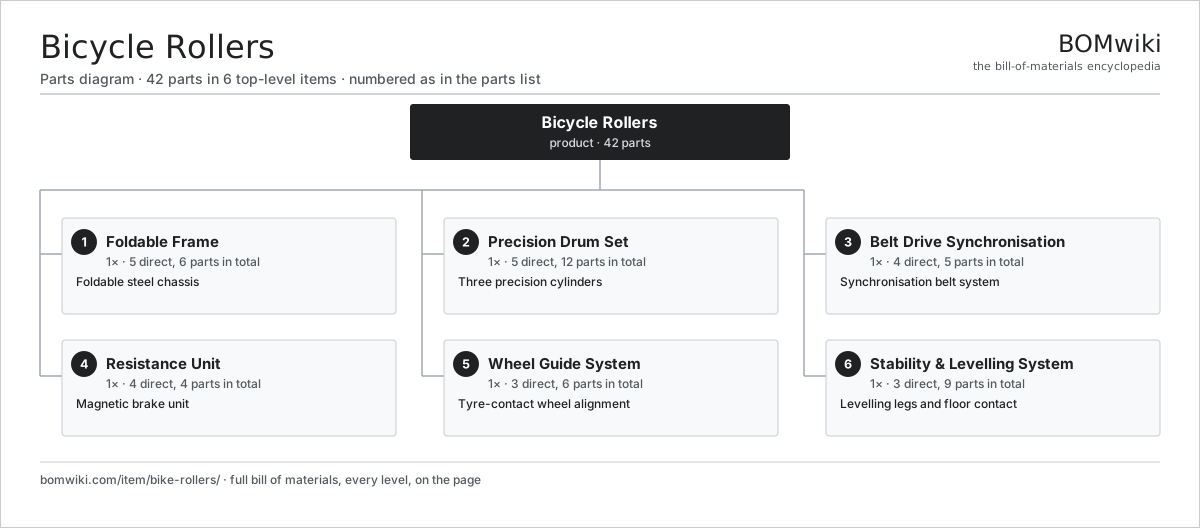
| # | Part | Qty | What it does |
|---|---|---|---|
| 1 | Foldable Frame 5 parts | 1× | Foldable steel chassis |
| 2 | Precision Drum Set 5 parts | 1× | Three precision cylinders |
| 3 | Belt Drive Synchronisation 4 parts | 1× | Synchronisation belt system |
| 4 | Resistance Unit 4 parts | 1× | Magnetic brake unit |
| 5 | Wheel Guide System 3 parts | 1× | Tyre-contact wheel alignment |
| 6 | Stability & Levelling System 3 parts | 1× | Levelling legs and floor contact |
3D model
No 3D model yet. Have a CAD file of this? Add a 3D model. STL renders right on this page; STEP, FreeCAD, and OpenSCAD sources are welcome too (openly licensed, like all 3D models on BOMwiki).
Build & assembly graph
expand / collapse · shared sub-assemblies converge · links to related products · est. labourTap an assembly to expand/collapse · tap a part to open it · use “Open page” for any node · drag to pan, scroll to zoom.
Bill of materials for Bicycle Rollers
6 top-level lines · 30 rows shown · 42 parts total · indented to 3 levels| # | Item / sub-assembly | Part no. | Qty/assy | Ext. qty | Parts | Type |
|---|---|---|---|---|---|---|
| 1 | Foldable Frame 5 parts | bike-rollers-frame | 1× | 1 | 6 | assembly |
| 1.1 | Main Rails | bike-rollers-main-rails | 1× | 1 | · | part |
| 1.2 | Cross Members | bike-rollers-cross-members | 2× | 2 | · | part |
| 1.3 | Drum Mounts | bike-rollers-drum-mounts | 1× | 1 | · | part |
| 1.4 | Hinge Mechanism | bike-rollers-hinge-mechanism | 1× | 1 | · | part |
| 1.5 | Wheel Clamp | bike-rollers-wheel-clamp | 1× | 1 | · | part |
| 2 | Precision Drum Set 5 parts | bike-rollers-drums | 1× | 1 | 12 | assembly |
| 2.1 | Front Drum | bike-rollers-front-drum | 1× | 1 | · | part |
| 2.2 | Rear Left Drum | bike-rollers-rear-left-drum | 1× | 1 | · | part |
| 2.3 | Rear Right Drum | bike-rollers-rear-right-drum | 1× | 1 | · | part |
| 2.4 | Drum Bearing | bike-rollers-drum-bearing | 6× | 6 | · | part |
| 2.5 | Drum Axle | bike-rollers-drum-axle | 3× | 3 | · | part |
| 3 | Belt Drive Synchronisation 4 parts | bike-rollers-belt-drive | 1× | 1 | 5 | assembly |
| 3.1 | Drive Belt | bike-rollers-drive-belt | 1× | 1 | · | part |
| 3.2 | Belt Tensioner | bike-rollers-belt-tensioner | 1× | 1 | · | part |
| 3.3 | Belt Guard | bike-rollers-belt-guard | 1× | 1 | · | part |
| 3.4 | Pulley Wheel | bike-rollers-pulley-set | 2× | 2 | · | part |
| 4 | Resistance Unit 4 parts | bike-rollers-resistance-unit | 1× | 1 | 4 | assembly |
| 4.1 | Magnet Rotor | bike-rollers-magnet-rotor | 1× | 1 | · | part |
| 4.2 | Eddy-Current Coil | bike-rollers-eddy-coil | 1× | 1 | · | part |
| 4.3 | Resistance Dial | bike-rollers-resistance-dial | 1× | 1 | · | part |
| 4.4 | Brake Housing | bike-rollers-brake-housing | 1× | 1 | · | part |
| 5 | Wheel Guide System 3 parts | bike-rollers-wheel-guides | 1× | 1 | 6 | assembly |
| 5.1 | Guide Rail | bike-rollers-guide-rail | 2× | 2 | · | part |
| 5.2 | Tyre Guide Roller | bike-rollers-tyre-roller | 2× | 2 | · | part |
| 5.3 | Guide Bracket | bike-rollers-guide-bracket | 2× | 2 | · | part |
| 6 | Stability & Levelling System 3 parts | bike-rollers-stability-feet | 1× | 1 | 9 | assembly |
| 6.1 | Levelling Feet | bike-rollers-levelling-feet | 4× | 4 | · | part |
| 6.2 | Foot Pad | bike-rollers-foot-pad | 4× | 4 | · | part |
| 6.3 | Anti-Tip Brace | bike-rollers-anti-tip-brace | 1× | 1 | · | part |
Something wrong in this list? Report a problem with this BOM.
Sourcing: possible vendors
Browse the supplier directory → Prices, MOQ, and lead times are algorithmic estimates, not quotes, and not claims about these companies. Company mappings are curated by keyword; est. price band $200–$12k. How estimates work| Vendor | HQ | Specialty | MOQ | Lead time |
|---|---|---|---|---|
|
🇹🇼Giant
giant-bicycles.com ↗
|
Taichung, TW | Bicycles | 500 units | 6–12 wks |
|
🇺🇸Trek
trekbikes.com ↗
|
Waterloo, US | Bicycles | 500 units | 6–12 wks |
| specialized.com ↗ | Morgan Hill, US | Bicycles | 500 units | 6–12 wks |
|
🇹🇼Merida
merida-bikes.com ↗
|
Yuanlin, TW | Bicycles | 500 units | 6–12 wks |
| cannondale.com ↗ | Wilton, US | Bicycles | 500 units | 6–12 wks |
996-word article