Bicycle Repair Stand
ProductOverview
A bicycle repair stand holds a bike off the ground at working height so the wheels spin freely and the mechanic can reach the drivetrain, brakes, and cables from a standing position. The dominant design is the clamp stand: a padded jaw grips the seatpost, a telescoping mast sets the height, and a folding leg base keeps the whole assembly stable while the mechanic applies wrench torque that can exceed 40 N·m at the bottom bracket. The engineering problem is holding a 10–25 kg bicycle cantilevered half a metre from the mast axis, rigidly enough to wrench on, with a structure light enough to carry in one hand.
The load path runs from the Clamp Head through the Rotation Mechanism into the Telescoping Mast and down through the Folding Leg Base to the floor. Every joint in that chain, jaw, rotation collar, height collar, leg latch, is a friction interface, and the perceived quality of a stand is almost entirely the quality of those four locks.
The clamp
The Clamp Head is where the design constraints collide. It must grip hard enough that the bike cannot rotate in the jaws when the mechanic loads a pedal, yet a carbon seatpost begins to delaminate at surface pressures a steel vise would consider gentle. Stands solve this with area and geometry rather than force: the Jaw Covers are V-grooved rubber pads that wrap a substantial arc of the tube, and the Clamp Adjust Screw presets the jaw opening to the tube diameter so the Cam Lever always closes through the same short throw. The cam's over-center action means the lever settles past the force peak, vibration tightens it rather than loosening it. Manufacturer guidance for carbon frames is consistent: clamp the seatpost, never the frame tubes, and if the post cannot be exposed, use a dummy post or a race-style fork-mount stand instead.
The Moving Jaw travels on the screw inside the Head Casting, the most highly stressed component in the stand; failures in cheap stands are almost always cracks at the casting's cam boss or spigot root.
Rotation and height
The Rotation Mechanism lets the mechanic spin the entire bike to work on the underside of the bottom bracket or bleed brakes with the calipers level. A steel Rotation Spigot on the head drops into the Mast Top Socket socket on the mast, with Friction Discs clamped between them by the Rotation Lock Knob. The discs must hold the static torque of a bike clamped off its balance point, a 20 kg bike gripped 450 mm from its centre of mass is roughly 90 N·m, while releasing with half a turn of the knob. A Thrust Washer in bronze takes the axial load so rotation stays smooth under an e-bike's weight.
Height comes from the Telescoping Mast: an Upper Mast Tube sliding inside a Lower Mast Tube, pinched by one or two Quick-Release Collar cam collars. Round-in-round telescopes have a weakness, wrench torque about the mast axis tries to spin the inner tube, so better stands oval the inner tube or add an Anti-Twist Key riding in a groove, leaving the collar responsible only for vertical load. Acetal Mast Bushings at the tube overlap kill the rattle that otherwise telegraphs every hammer blow.
Stability
The Folding Leg Base determines whether the stand survives real use. Three Folding Leg hinged to a cast Leg Hub swing out to a 0.9–1.1 m circle; the geometry must keep the combined centre of mass of stand plus clamped bike inside that triangle even with the bike rotated to its worst position. Tripods self-level on uneven floors, which is why race mechanics prefer them; four-leg bases carry heavier e-bikes but rock on anything that is not flat. The Leg Latch locks the spread, and releasing it folds all legs parallel to the mast for a packed length around 1.1 m, the feature that separates a workshop fixture from a tool that travels to races in a van.
The tool tray
The Tool Tray clips to the mast with a tool-free Tray Clamp and is more consequential than it appears: a bottom bracket overhaul generates a dozen small parts, and the Magnetic Parts Dish dish keeps bearings and bolts from migrating to the floor. Trays are molded with drain holes because degreaser ends up in them on every job.
Variants
Clamp stands dominate home and shop use, but two other families exist. Race stands support the bike under the bottom bracket and fork ends with no clamp at all, faster and kinder to superlight frames, but the bike just rests on them. Bench-mount stands bolt the clamp head and rotation mechanism directly to a workbench, trading portability for absolute rigidity; shops typically run both. Across all of them the clamp head and rotation hardware are the shared, patent-contested core, and replacement Jaw Covers are the one consumable, rubber that lives in a degreaser environment hardens and splits within a few years of shop duty.
Bicycle Repair Stand parts and their functions
6 top-level parts · 39 parts in total · full bill of materials below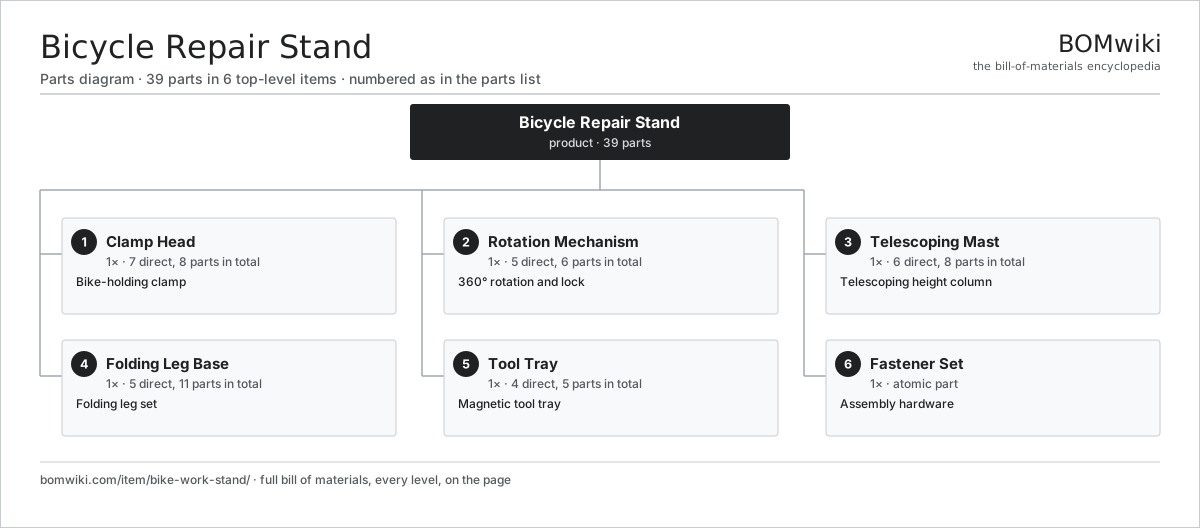
| # | Part | Qty | What it does |
|---|---|---|---|
| 1 | Clamp Head 7 parts | 1× | Bike-holding clamp |
| 2 | Rotation Mechanism 5 parts | 1× | 360° rotation and lock |
| 3 | Telescoping Mast 6 parts | 1× | Telescoping height column |
| 4 | Folding Leg Base 5 parts | 1× | Folding leg set |
| 5 | Tool Tray 4 parts | 1× | Magnetic tool tray |
| 6 | Fastener Set | 1× | Assembly hardware |
3D model
No 3D model yet. Have a CAD file of this? Add a 3D model. STL renders right on this page; STEP, FreeCAD, and OpenSCAD sources are welcome too (openly licensed, like all 3D models on BOMwiki).
Build & assembly graph
expand / collapse · shared sub-assemblies converge · links to related products · est. labourTap an assembly to expand/collapse · tap a part to open it · use “Open page” for any node · drag to pan, scroll to zoom.
Bill of materials for Bicycle Repair Stand
6 top-level lines · 33 rows shown · 39 parts total · indented to 3 levels| # | Item / sub-assembly | Part no. | Qty/assy | Ext. qty | Parts | Type |
|---|---|---|---|---|---|---|
| 1 | Clamp Head 7 parts | bws-clamp-head | 1× | 1 | 8 | assembly |
| 1.1 | Fixed Jaw | bws-fixed-jaw | 1× | 1 | · | part |
| 1.2 | Moving Jaw | bws-moving-jaw | 1× | 1 | · | part |
| 1.3 | Jaw Covers | bws-jaw-covers | 2× | 2 | · | part |
| 1.4 | Cam Lever | bws-cam-lever | 1× | 1 | · | part |
| 1.5 | Clamp Adjust Screw | bws-clamp-screw | 1× | 1 | · | part |
| 1.6 | Coil Spring | coil-spring | 1× | 1 | · | part |
| 1.7 | Head Casting | bws-head-casting | 1× | 1 | · | part |
| 2 | Rotation Mechanism 5 parts | bws-rotation-mech | 1× | 1 | 6 | assembly |
| 2.1 | Rotation Spigot | bws-rotation-spigot | 1× | 1 | · | part |
| 2.2 | Friction Discs | bws-friction-discs | 2× | 2 | · | part |
| 2.3 | Rotation Lock Knob | bws-rotation-knob | 1× | 1 | · | part |
| 2.4 | Thrust Washer | bws-thrust-washer | 1× | 1 | · | part |
| 2.5 | O-Ring Set | oring-set | 1× | 1 | · | part |
| 3 | Telescoping Mast 6 parts | bws-mast | 1× | 1 | 8 | assembly |
| 3.1 | Lower Mast Tube | bws-lower-tube | 1× | 1 | · | part |
| 3.2 | Upper Mast Tube | bws-upper-tube | 1× | 1 | · | part |
| 3.3 | Quick-Release Collar | bws-qr-collar | 2× | 2 | · | part |
| 3.4 | Anti-Twist Key | bws-anti-twist-key | 1× | 1 | · | part |
| 3.5 | Mast Bushings | bws-mast-bushings | 2× | 2 | · | part |
| 3.6 | Mast Top Socket | bws-end-cap | 1× | 1 | · | part |
| 4 | Folding Leg Base 5 parts | bws-leg-base | 1× | 1 | 11 | assembly |
| 4.1 | Folding Leg | bws-legs | 3× | 3 | · | part |
| 4.2 | Leg Hub | bws-leg-hub | 1× | 1 | · | part |
| 4.3 | Leg Latch | bws-leg-latch | 1× | 1 | · | part |
| 4.4 | Leg Pivot Pins | bws-leg-pivots | 3× | 3 | · | part |
| 4.5 | Rubber Feet | bws-feet | 3× | 3 | · | part |
| 5 | Tool Tray 4 parts | bws-tool-tray | 1× | 1 | 5 | assembly |
| 5.1 | Tray Body | bws-tray-body | 1× | 1 | · | part |
| 5.2 | Tray Clamp | bws-tray-clamp | 1× | 1 | · | part |
| 5.3 | Magnetic Parts Dish | bws-tray-magnet | 1× | 1 | · | part |
| 5.4 | Neodymium Magnet | neodymium-magnet | 2× | 2 | · | part |
| 6 | Fastener Set | fastener-set | 1× | 1 | · | part |
Something wrong in this list? Report a problem with this BOM.
Related products
same domain, ranked by shared parts


Sourcing: possible vendors
Browse the supplier directory → Prices, MOQ, and lead times are algorithmic estimates, not quotes, and not claims about these companies. Company mappings are curated by keyword; est. price band $200–$12k. How estimates work| Vendor | HQ | Specialty | MOQ | Lead time |
|---|---|---|---|---|
|
🇹🇼Giant
giant-bicycles.com ↗
|
Taichung, TW | Bicycles | 500 units | 6–12 wks |
|
🇺🇸Trek
trekbikes.com ↗
|
Waterloo, US | Bicycles | 500 units | 6–12 wks |
| specialized.com ↗ | Morgan Hill, US | Bicycles | 500 units | 6–12 wks |
|
🇹🇼Merida
merida-bikes.com ↗
|
Yuanlin, TW | Bicycles | 500 units | 6–12 wks |
| cannondale.com ↗ | Wilton, US | Bicycles | 500 units | 6–12 wks |
871-word article