Biodiesel Processor
ProductOverview
A biodiesel processor converts waste vegetable oil (WVO), used cooking oil (UCO), or animal tallow into fatty acid methyl esters (FAME), a drop-in replacement for petroleum diesel (EN 590 or ASTM D975). The reaction is transesterification: triglycerides in the feedstock react with methanol in the presence of a strong base catalyst (KOH or NaOH), yielding methyl esters (biodiesel, ~85 wt% of feedstock) and glycerin (~10 wt%, a valuable byproduct).
Batch-scale processors (500–5000 L per batch) are common for small-to-medium biodiesel production, decentralized fuel generation, or waste oil recycling. Industrial continuous systems exceed 100,000 L/day throughput but require higher capital and regulatory compliance. A 2000 L batch processor operating 2–3 batches/day yields 4000–6000 L of finished biodiesel, enough for a small fleet or cooperative.
Reaction Chemistry
The transesterification reaction is: ''' C3H5(OCOR)3 + 3 CH3OH → 3 R-COOCH3 + C3H5(OH)3 (Triglyceride + Methanol → Biodiesel + Glycerin) '''
The Reaction Tank provides thermal control and mechanical mixing to drive this equilibrium. The Agitator operates at 5–15 rpm, a slow speed that prevents emulsification and allows gravity separation of the product phases. The reaction is exothermic (~54 MJ/kg of methanol consumed), so the jacket initially supplies heat (60–65 °C optimal for both reaction kinetics and methanol recovery), then transitions to cooling as the reaction progresses.
The Methanol System meters a stoichiometric excess of methanol (typically 0.2 vol eq., or 200 L methanol per 1000 L feedstock oil) and catalyst (0.3–0.5 wt% of feedstock, typically as potassium hydroxide solution in methanol). Pre-mixing methanol and catalyst in the Catalyst Mixer creates a homogeneous catalyst solution, preventing localized caustic concentration that would saponify (irreversibly hydrolyze) triglycerides into soap instead of ester.
The Vent Condenser is critical: methanol boils at 64.7 °C, so as the reactor warms above 60 °C, methanol vapor exits the tank. The reflux condenser captures this vapor, cools it, and returns it to the reactor, maximizing methanol utilization and reducing emissions.
Process Sequence
Reaction Phase (60–120 min)
The Reaction Tank is charged with feedstock oil (preheated to 40–50 °C if wintry). The catalyst-methanol blend is added over 5–10 min while agitation runs. The Heating System maintains 60–65 °C for 60–120 min. The reaction is complete when acid number (titration of free fatty acids) drops below 0.1 mg KOH/g, indicating most triglycerides have been converted.
Settling Phase (4–6 hours)
The reactor contents are transferred to the settling tank, where gravity separates two immiscible phases:
- Top layer: biodiesel (lighter, ~0.88 g/mL)
- Bottom layer: glycerin + residual methanol + catalyst salts (~1.05 g/mL)
The Level Sensor detects the interface; the operator draws off biodiesel first, leaving glycerin for recovery or disposal.
Wash Phase (30–60 min)
The crude biodiesel (still containing 1–5 wt% water, methanol, and soap) enters the Wash Tank. Warm distilled water (40–50 °C, equal to biodiesel volume) is circulated gently via the Wash Pump for 10–15 min. Water dissolves residual methanol and catalyst salts, creating a second emulsion. After settling (20 min), the water layer (now containing methanol and salts) is drained. This wash is repeated 2–3 times until conductivity of the wash water drops below 100 µS/cm.
A final blow-down with compressed air removes residual water from the surface.
Drying Phase (30–60 min)
The washed biodiesel (~1–2 wt% residual moisture) enters the vacuum evaporator operating at 0.05–0.1 bar absolute. At these low pressures, water boils at 30–40 °C (vs. 100 °C at 1 bar), evaporating moisture without thermal degradation of the ester. The rotary-vane pump removes water vapor; the water condenser recovers condensed water and methanol vapors to a separate tank. Target moisture: <500 ppm (measured by Karl Fischer titration).
Filtration Phase (15–30 min)
The dried biodiesel is polished through the cartridge filter, removing remaining particulate (<1 µm), residual soaps, and any polymer formation. The Filter Bypass Valve protects against clogging; a ion-exchange polisher (optional but recommended) further reduces acid number to <0.1 mg KOH/g, meeting EN 14214 fuel-grade specifications.
Final product is transferred to the product tank with a desiccant breather preventing moisture reabsorption.
Byproduct Recovery
Glycerin recovered from settling is a valuable chemical feedstock (soap making, polyester resin, cosmetics). Crude glycerin (containing ~20 wt% water, residual methanol, and soap) can be:
- Esterified into polyglycerol polyesters (lubricants, hydraulic fluids)
- Refined and sold as technical or pharmaceutical-grade glycerin
- Fermented to propionic acid or 1,3-propanediol
Methanol vapor from the reflux condenser is condensed and recycled, reducing feedstock cost and emissions.
Quality Control
Biodiesel is tested per DIN EN 14214 (EU standard) or ASTM D6866 (US standard), requiring:
- Acid number: <0.1 mg KOH/g (free fatty acids)
- Moisture: <500 ppm
- Flash point: >120 °C (safety)
- Kinematic viscosity: 3.5–5.0 mm²/s at 40 °C
- Free glycerin: <0.02 wt%
- Total glycerin: <0.25 wt%
- Ester content: >99.7%
The PLC control system monitors temperature, level, and agitation in real-time, logging data for batch traceability. If any parameter deviates (e.g., temperature exceeds 70 °C), the safety interlocks trigger alarms or automatic shutdowns.
Feedstock Considerations
Feedstock quality determines product yield and purity:
- Free fatty acid (FFA) content: High FFA (>2 wt%) from degraded or aged oils will consume excess NaOH, reducing ester yield. Pre-treatment via acid esterification (H₂SO₄ catalyst, 65 °C, 2 hours) converts FFA to ester before main transesterification.
- Water content: >1 wt% water hydrolyzes sodium methoxide, reducing catalyst effectiveness. Feedstock must be dried beforehand via vacuum or centrifuge.
- Contaminants: Phosphorus (>10 ppm) from lecithin or crude oil foaming agents will form insoluble phospholipid complexes. Filtration or acid-wash pretreatment is required.
Used cooking oil (UCO) from restaurants is the typical feedstock for small processors; collection logistics and variability are the main operational challenges.
Thermal Integration
The thermal circuit recovers waste heat:
- Condenser outlet (methanol vapor at 40–50 °C) pre-heats incoming methanol to 30 °C via the plate-frame heat exchanger.
- Vacuum evaporator condenser outlet (water at 35 °C) heats the wash-tank makeup water to 40 °C.
These integration points reduce thermal input by ~20–30%, improving overall energy efficiency to 90–95% (energy output in FAME vs. thermal input).
Safety Considerations
- Methanol toxicity: Vapor exposure limit is 200 ppm (8-hour TWA). The reflux condenser must be efficient; the storage tank must vent through a desiccant breather, not open air.
- Caustic burn hazard: KOH and NaOH solutions (up to 50% in methanol) cause severe burns. All catalyst lines must be secondary-contained; spill kit (acetic acid or citric acid neutralizer) must be on-site.
- Reaction exotherm: Overcharging methanol or catalyst, or loss of cooling during reaction, can cause temperature runaway (>80 °C), creating methanol vapor explosion risk. The PID thermostat with high-temp alarm is essential.
- Flammability: Methanol, biodiesel, and crude glycerin are Class II flammable liquids. No open flame or hot surface >200 °C within 15 m of feedstock/product handling areas. Sprinkler protection recommended for >1000 L storage.
Economics
A 5000 L/day processor (capacity) processing 2–3 batches/day yields 10,000–15,000 L/week of biodiesel. At $0.80/L production cost (feedstock + methanol + energy + labor) and market price $1.20–1.60/L (vs. $1.10/L diesel equivalent in 2024), margin is $0.40–0.80/L, or $4000–12,000/week gross margin. Capital payback is 2–4 years if feedstock cost is <$0.20/L (waste oil). Risk: feedstock supply volatility and policy changes in biodiesel tax credits or fuel blending mandates.
Regulatory Context
Most countries classify >1000 L/day biodiesel production as industrial; permits, emissions inspections, and fuel certification are required. The EU Renewable Energy Directive (RED III) mandates traceability of used cooking oil to prevent fraud and double-counting. Waste oil sourcing must be documented to prove feedstock origin and avoid co-processing penalties.
Biodiesel Processor parts and their functions
9 top-level parts · 39 parts in total · full bill of materials below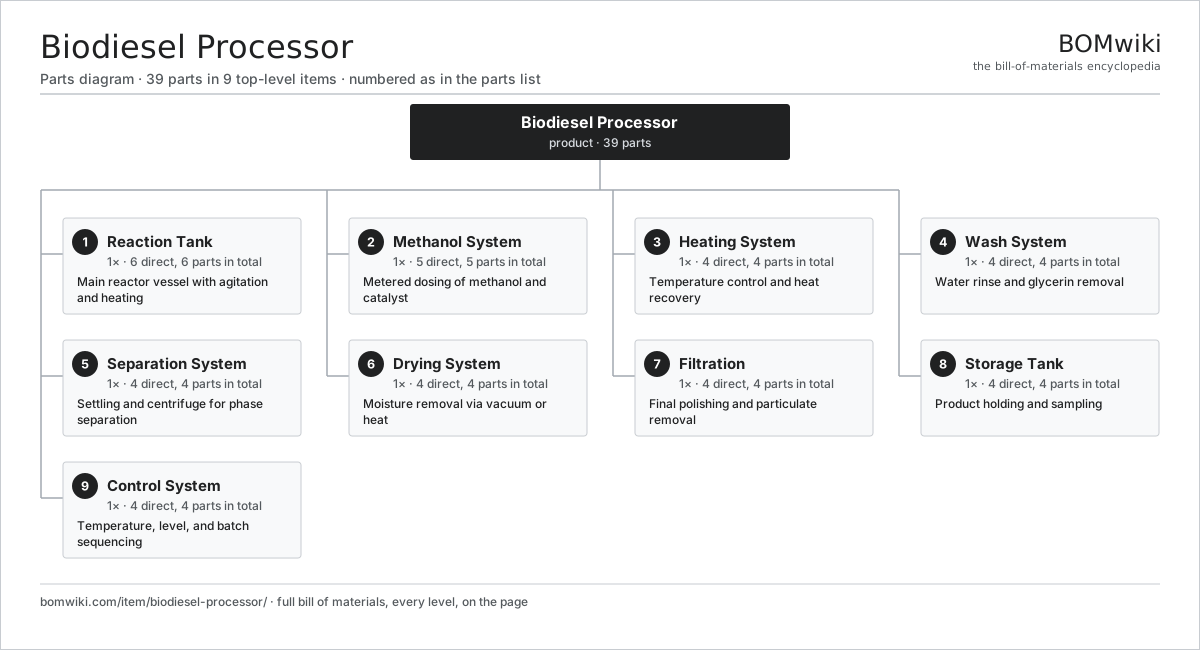
| # | Part | Qty | What it does |
|---|---|---|---|
| 1 | Reaction Tank 6 parts | 1× | Main reactor vessel with agitation and heating |
| 2 | Methanol System 5 parts | 1× | Metered dosing of methanol and catalyst |
| 3 | Heating System 4 parts | 1× | Temperature control and heat recovery |
| 4 | Wash System 4 parts | 1× | Water rinse and glycerin removal |
| 5 | Separation System 4 parts | 1× | Settling and centrifuge for phase separation |
| 6 | Drying System 4 parts | 1× | Moisture removal via vacuum or heat |
| 7 | Filtration 4 parts | 1× | Final polishing and particulate removal |
| 8 | Storage Tank 4 parts | 1× | Product holding and sampling |
| 9 | Control System 4 parts | 1× | Temperature, level, and batch sequencing |
3D model
No 3D model yet. Have a CAD file of this? Add a 3D model. STL renders right on this page; STEP, FreeCAD, and OpenSCAD sources are welcome too (openly licensed, like all 3D models on BOMwiki).
Build & assembly graph
expand / collapse · shared sub-assemblies converge · links to related products · est. labourTap an assembly to expand/collapse · tap a part to open it · use “Open page” for any node · drag to pan, scroll to zoom.
Bill of materials for Biodiesel Processor
9 top-level lines · 48 rows shown · 39 parts total · indented to 3 levels| # | Item / sub-assembly | Part no. | Qty/assy | Ext. qty | Parts | Type |
|---|---|---|---|---|---|---|
| 1 | Reaction Tank 6 parts | biodiesel-reaction-tank | 1× | 1 | 6 | assembly |
| 1.1 | Tank Vessel | biodiesel-tank-vessel | 1× | 1 | · | part |
| 1.2 | Agitator | biodiesel-agitator | 1× | 1 | · | part |
| 1.3 | Heating Jacket | biodiesel-heating-jacket | 1× | 1 | · | part |
| 1.4 | Vent Condenser | biodiesel-vent-condenser | 1× | 1 | · | part |
| 1.5 | Fill Strainer | biodiesel-fill-strainer | 1× | 1 | · | part |
| 1.6 | Sample Valve | biodiesel-sample-valve | 1× | 1 | · | part |
| 2 | Methanol System 5 parts | biodiesel-methanol-system | 1× | 1 | 5 | assembly |
| 2.1 | Methanol Tank | biodiesel-methanol-tank | 1× | 1 | · | part |
| 2.2 | Methanol Pump | biodiesel-methanol-pump | 1× | 1 | · | part |
| 2.3 | Catalyst Hopper | biodiesel-catalyst-hopper | 1× | 1 | · | part |
| 2.4 | Catalyst Mixer | biodiesel-catalyst-mixer | 1× | 1 | · | part |
| 2.5 | Dosing Valve | biodiesel-dosing-valve | 1× | 1 | · | part |
| 3 | Heating System 4 parts | biodiesel-heating-system | 1× | 1 | 4 | assembly |
| 3.1 | Thermal Heater | biodiesel-thermal-heater | 1× | 1 | · | part |
| 3.2 | Circulation Pump | biodiesel-circulation-pump | 1× | 1 | · | part |
| 3.3 | Heat Exchanger | biodiesel-heat-exchanger | 1× | 1 | · | part |
| 3.4 | Thermostat | biodiesel-thermostat | 1× | 1 | · | part |
| 4 | Wash System 4 parts | biodiesel-wash-system | 1× | 1 | 4 | assembly |
| 4.1 | Wash Tank | biodiesel-wash-tank | 1× | 1 | · | part |
| 4.2 | Wash Pump | biodiesel-wash-pump | 1× | 1 | · | part |
| 4.3 | Blower | biodiesel-blower | 1× | 1 | · | part |
| 4.4 | Wash Valves | biodiesel-wash-valves | 1× | 1 | · | part |
| 5 | Separation System 4 parts | biodiesel-separation-system | 1× | 1 | 4 | assembly |
| 5.1 | Settling Tank | biodiesel-settling-tank | 1× | 1 | · | part |
| 5.2 | Centrifuge | biodiesel-centrifuge | 1× | 1 | · | part |
| 5.3 | Level Sensor | biodiesel-level-sensor | 1× | 1 | · | part |
| 5.4 | Product Pump | biodiesel-product-pump | 1× | 1 | · | part |
| 6 | Drying System 4 parts | biodiesel-drying-system | 1× | 1 | 4 | assembly |
| 6.1 | Vacuum Evaporator | biodiesel-vacuum-evaporator | 1× | 1 | · | part |
| 6.2 | Vacuum Pump | biodiesel-vacuum-pump | 1× | 1 | · | part |
| 6.3 | Condenser | biodiesel-condenser | 1× | 1 | · | part |
| 6.4 | Hot Oil Supply | biodiesel-hot-oil-supply | 1× | 1 | · | part |
| 7 | Filtration 4 parts | biodiesel-filtration | 1× | 1 | 4 | assembly |
| 7.1 | Cartridge Filter | biodiesel-cartridge-filter | 1× | 1 | · | part |
| 7.2 | Filter Housing | biodiesel-filter-housing | 1× | 1 | · | part |
| 7.3 | Filter Bypass Valve | biodiesel-filter-bypass-valve | 1× | 1 | · | part |
| 7.4 | Polish Polisher | biodiesel-polish-polisher | 1× | 1 | · | part |
| 8 | Storage Tank 4 parts | biodiesel-storage-tank | 1× | 1 | 4 | assembly |
| 8.1 | Product Tank | biodiesel-product-tank | 1× | 1 | · | part |
| 8.2 | Tank Mixing | biodiesel-tank-mixing | 1× | 1 | · | part |
| 8.3 | Tank Vent Filter | biodiesel-tank-vent-filter | 1× | 1 | · | part |
| 8.4 | Tank Heater | biodiesel-tank-heater | 1× | 1 | · | part |
| 9 | Control System 4 parts | biodiesel-controls | 1× | 1 | 4 | assembly |
| 9.1 | Controller PLC | biodiesel-controller-plc | 1× | 1 | · | part |
| 9.2 | SCADA HMI | biodiesel-scada-hmi | 1× | 1 | · | part |
| 9.3 | Sensor Suite | biodiesel-sensor-suite | 1× | 1 | · | part |
| 9.4 | Safety Interlocks | biodiesel-safety-interlocks | 1× | 1 | · | part |
Something wrong in this list? Report a problem with this BOM.
Sourcing: possible vendors
Browse the supplier directory → Prices, MOQ, and lead times are algorithmic estimates, not quotes, and not claims about these companies. Company mappings are curated by keyword; est. price band $100–$20M. How estimates work| Vendor | HQ | Specialty | MOQ | Lead time |
|---|---|---|---|---|
|
🇩🇰Vestas
vestas.com ↗
|
Aarhus, DK | Wind turbines | 500 units | 12–24 wks |
| firstsolar.com ↗ | Tempe, US | PV modules | 500 units | 12–24 wks |
|
🇨🇳LONGi
longi.com ↗
|
Xi'an, CN | Solar wafers & modules | 500 units | 12–24 wks |
| enphase.com ↗ | Fremont, US | Microinverters & storage | 500 units | 12–24 wks |
|
🇨🇳Sungrow
sungrowpower.com ↗
|
Hefei, CN | Solar inverters & storage | 500 units | 12–24 wks |
1,407-word article