Blindstitch Hemming Machine
ProductOverview
The blind-stitch hemming machine is a specialized flat-bed sewing system designed to create invisible stitches within folded fabric hems, producing garments where thread and stitch are completely hidden on the finished outer surface. Unlike conventional visible stitching, blind stitches penetrate the fold of a turned-up hem, interceding with a tiny portion of the fashion fabric layer, creating a row of interlocks hidden inside the fold.
The machine uses a horizontally oscillating curved needle (bent at a right angle) combined with a vertical ridge-forming blade that holds the fold steady during each stitch. A skip-stitch mechanism allows the needle to penetrate intermittently (every 2–4 stitches), reducing stitch density and maximizing thread concealment. This mechanism, combined with single-thread (bobbin-only) construction and light tension, enables stitches to remain invisible when the garment is worn.
Blind-stitch machines are essential in premium apparel production, dress pants, skirts, shirts, and home textiles where finish quality directly influences perceived garment value. The investment in a dedicated blind-stitch machine signals quality-conscious manufacturing to customers.
How It Works
The blind-stitch cycle involves four synchronized operations:
Curved Needle Penetration
The Curved Needle Bar holds a curved needle (typically a #11–#14 metric 75–100) bent at approximately 90 degrees. As the crankshaft rotates, the needle bar oscillates horizontally, pushing the needle into the folded hem edge at a shallow angle. The curved geometry allows the needle to travel parallel to the fold, piercing only the innermost layer of the fold and a tiny sliver of the fashion fabric layer. This shallow angle is critical: too steep and the stitch becomes visible; too shallow and the stitch security fails.
Ridge Former Holding
Simultaneously, the Ridge Former Blade, a precision blade, oscillates vertically, crimping the folded fabric edge against a guide. This blade serves two purposes: it holds the fold in exact position, preventing shift, and it protects the outer fabric surface from the needle. The ridge former and needle timing must be perfectly synchronized; if the blade retracts before the needle exits, thread breakage occurs.
Skip-Stitch Intermittent Drive
A Skip-Stitch Cam, an intermittent-drive profile, limits needle penetration to every 2–4 crankshaft rotations. The needle bar remains stationary during skip cycles, yet the ridge former and feed dog continue to advance fabric. This skip pattern reduces stitch density and thread bulk inside the fold, maximizing concealment. On some machines, the skip pattern is adjustable via a lever or electronic input, allowing operators to tune stitch spacing for different hem widths and fabric weights.
Feed Dog Advancement
The High-Lift Feed Dog provides high-clearance vertical motion (lifts nearly out of the work area during each stitch) to accommodate the ridge former blade and allow smooth fabric advancement. As the ridge former retracts and the skip mechanism allows the needle to return, the feed dog rises and advances the fold by 2–3 mm, positioning the next stitch location.
Mechanical Design
The Drive Crankshaft is the heart of the machine, integrating two lobed sections: one driving needle bar oscillation and another driving ridge former oscillation. The crankshaft rotates at 500–800 rpm (lower than conventional machines) to provide slow, controlled motion and reduce vibration in the delicate curved needle structure.
All shafts run in sealed ball bearings within a Gearbox Housing containing circulating oil. The low-speed operation and single-thread load mean thermal and frictional losses are minimal, extending bearing life to 10,000+ operating hours.
Controls and Adjustment
The Control Panel Box houses a foot pedal providing proportional speed control from standstill to maximum rate. Unlike high-speed machines, blind-stitch operators rarely exceed 70% maximum speed, preferring precise visual control over the fold position and stitch location.
Stitch skip adjustment is via a mechanical lever or electronic dial, allowing operators to select the skip pattern (every 2, 3, or 4 stitches) depending on hem width and fabric type. Heavier fabrics and wider hems benefit from denser stitch spacing (skip 2), while lightweight fabrics prefer looser spacing (skip 4).
Tension Disc tension is preset light, typically 1–2 on a 0–10 scale, to prevent the thread from puckering the fold or tearing delicate fabric. Operators adjust via a small Tension Adjustment Knob, typically ±20% from the preset.
The Presser Foot
The Presser Foot Assembly is purpose-designed, featuring a raised guide rail that positions the folded fabric edge exactly against the ridge former blade. The guide rail also prevents the presser foot from slipping laterally, ensuring consistent stitch depth and concealment. Without this precision alignment, stitches become visible or seam security is compromised.
Applications
Dress pants: Blind hemming of trouser legs is the industry standard, creating unbroken outer seams and professional appearance.
Skirts and dresses: Blind hemming of skirt hems and dress panels maintains aesthetic continuity.
Shirts: Blind hemming of button-up shirt plackets and cuff edges, especially in premium dress shirt manufacture.
Home textiles: Pillowcase hems, bedsheet edge finishing, and curtain hemming in high-end linens.
Technical apparel: Membrane and laminate fabric garments where visible stitching would compromise waterproofing or aesthetic properties.
Comparison to Manual Hemming
Manual hemming (slipstitch by hand) takes 30–60 seconds per garment and requires skilled labor. A blind-stitch machine operator achieves 8–15 garments per hour, delivering consistency impossible to achieve by hand. The machine's precision and speed justify its capital cost in any volume-production environment.
Maintenance
Daily: Inspect fold positioning; check thread path for kinks; clean ridge former blade.
Weekly: Lubricate external pivot points; remove lint from feed dog and needle bar areas.
Monthly: Inspect curved needle for bending or tip dulling; check ridge former blade for nicks or wear.
Quarterly: Drain and replace gearbox oil; inspect all bearings for play; check crankshaft runout.
Annually: Send for professional overhaul; replace all seals and needle; grind ridge former blade if wear exceeds 0.05 mm.
The sealed gearbox design and reduced operating speed extend service intervals to 12,000–18,000 operating hours before major rebuild, with careful maintenance and appropriate fabric handling.
Blindstitch Hemming Machine parts and their functions
7 top-level parts · 67 parts in total · full bill of materials below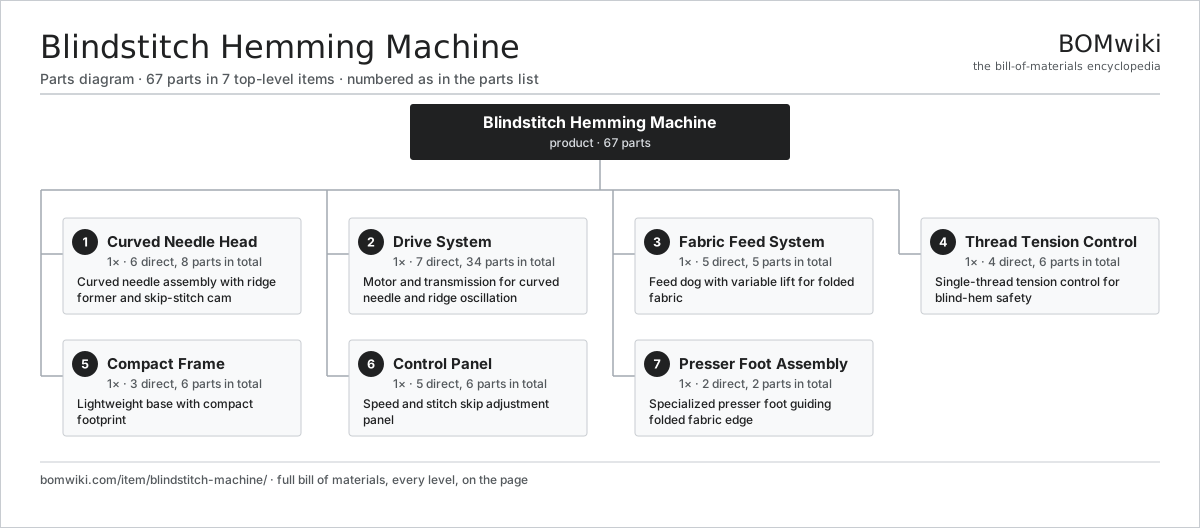
| # | Part | Qty | What it does |
|---|---|---|---|
| 1 | Curved Needle Head 6 parts | 1× | Curved needle assembly with ridge former and skip-stitch cam |
| 2 | Drive System 7 parts | 1× | Motor and transmission for curved needle and ridge oscillation |
| 3 | Fabric Feed System 5 parts | 1× | Feed dog with variable lift for folded fabric |
| 4 | Thread Tension Control 4 parts | 1× | Single-thread tension control for blind-hem safety |
| 5 | Compact Frame 3 parts | 1× | Lightweight base with compact footprint |
| 6 | Control Panel 5 parts | 1× | Speed and stitch skip adjustment panel |
| 7 | Presser Foot Assembly 2 parts | 1× | Specialized presser foot guiding folded fabric edge |
3D model
No 3D model yet. Have a CAD file of this? Add a 3D model. STL renders right on this page; STEP, FreeCAD, and OpenSCAD sources are welcome too (openly licensed, like all 3D models on BOMwiki).
Build & assembly graph
expand / collapse · shared sub-assemblies converge · links to related products · est. labourTap an assembly to expand/collapse · tap a part to open it · use “Open page” for any node · drag to pan, scroll to zoom.
Bill of materials for Blindstitch Hemming Machine
7 top-level lines · 43 rows shown · 67 parts total · indented to 3 levels| # | Item / sub-assembly | Part no. | Qty/assy | Ext. qty | Parts | Type |
|---|---|---|---|---|---|---|
| 1 | Curved Needle Head 6 parts | blindstitch-machine-head | 1× | 1 | 8 | assembly |
| 1.1 | Curved Needle Bar | blindstitch-machine-needle-bar | 1× | 1 | · | part |
| 1.2 | Ridge Former Blade | blindstitch-machine-ridge-former | 1× | 1 | · | part |
| 1.3 | Compact Looper | blindstitch-machine-looper | 1× | 1 | · | part |
| 1.4 | Skip-Stitch Cam | blindstitch-machine-skip-cam | 1× | 1 | · | part |
| 1.5 | Ball Bearing | ball-bearing | 3× | 3 | · | part |
| 1.6 | Fastener Set | fastener-set | 1× | 1 | · | part |
| 2 | Drive System 7 parts | blindstitch-machine-drive | 1× | 1 | 34 | assembly |
| 2.1 | Servo Motor 4 parts | servo-motor | 1× | 1 | 24 | assembly |
| 2.1.1 | Stator Assembly 3 parts + deeper › | stator-assembly | 1× | 1 | 3 | assembly |
| 2.1.2 | Rotor Assembly 4 parts + deeper › | rotor-assembly | 1× | 1 | 19 | assembly |
| 2.1.3 | Encoder | encoder | 1× | 1 | · | part |
| 2.1.4 | Motor Housing | motor-housing | 1× | 1 | · | part |
| 2.2 | Drive Crankshaft | blindstitch-machine-crankshaft | 1× | 1 | · | part |
| 2.3 | Gearbox Housing | gearbox-housing | 1× | 1 | · | part |
| 2.4 | Ball Bearing | ball-bearing | 4× | 4 | · | part |
| 2.5 | Oil Seal | oil-seal | 2× | 2 | · | part |
| 2.6 | Drive Belt | drive-belt | 1× | 1 | · | part |
| 2.7 | Fastener Set | fastener-set | 1× | 1 | · | part |
| 3 | Fabric Feed System 5 parts | blindstitch-machine-feed | 1× | 1 | 5 | assembly |
| 3.1 | High-Lift Feed Dog | blindstitch-machine-feed-dog | 1× | 1 | · | part |
| 3.2 | Feed Drive Cam | blindstitch-machine-feed-cam | 1× | 1 | · | part |
| 3.3 | Feed Connecting Rod | blindstitch-machine-feed-lever | 1× | 1 | · | part |
| 3.4 | Coil Spring | coil-spring | 1× | 1 | · | part |
| 3.5 | Fastener Set | fastener-set | 1× | 1 | · | part |
| 4 | Thread Tension Control 4 parts | blindstitch-machine-tension | 1× | 1 | 6 | assembly |
| 4.1 | Tension Disc | blindstitch-machine-tension-disc | 2× | 2 | · | part |
| 4.2 | Tension Adjustment Knob | blindstitch-machine-tension-knob | 1× | 1 | · | part |
| 4.3 | Thread Guide | blindstitch-machine-thread-guide | 2× | 2 | · | part |
| 4.4 | Fastener Set | fastener-set | 1× | 1 | · | part |
| 5 | Compact Frame 3 parts | blindstitch-machine-frame | 1× | 1 | 6 | assembly |
| 5.1 | Machine Base | blindstitch-machine-base | 1× | 1 | · | part |
| 5.2 | Vibration Isolator | blindstitch-machine-vibration-foot | 4× | 4 | · | part |
| 5.3 | Fastener Set | fastener-set | 1× | 1 | · | part |
| 6 | Control Panel 5 parts | blindstitch-machine-controls | 1× | 1 | 6 | assembly |
| 6.1 | Control Panel Box | blindstitch-machine-control-box | 1× | 1 | · | part |
| 6.2 | Relay | relay | 1× | 1 | · | part |
| 6.3 | Microcontroller | mcu | 1× | 1 | · | part |
| 6.4 | Connector | connector | 2× | 2 | · | part |
| 6.5 | Fastener Set | fastener-set | 1× | 1 | · | part |
| 7 | Presser Foot Assembly 2 parts | blindstitch-machine-presser-foot | 1× | 1 | 2 | assembly |
| 7.1 | Presser Foot Body | blindstitch-machine-presser-foot-body | 1× | 1 | · | part |
| 7.2 | Fastener Set | fastener-set | 1× | 1 | · | part |
Something wrong in this list? Report a problem with this BOM.
Related products
same domain, ranked by shared parts Automatic Fabric Cutting Machine
1,695 parts · shares 5 with this page
Automatic Winding Machine
288 parts · shares 5 with this page
Automatic Fabric Cutting Machine
1,695 parts · shares 5 with this page
Automatic Winding Machine
288 parts · shares 5 with this page
 Chainstitch Machine
82 parts · shares 5 with this page
Feed-Off-the-Arm Machine
87 parts · shares 5 with this page
Chainstitch Machine
82 parts · shares 5 with this page
Feed-Off-the-Arm Machine
87 parts · shares 5 with this page
 Industrial Quilting Machine
1,090 parts · shares 5 with this page
Industrial Zigzag Machine
88 parts · shares 5 with this page
Industrial Quilting Machine
1,090 parts · shares 5 with this page
Industrial Zigzag Machine
88 parts · shares 5 with this page
Sourcing: possible vendors
Browse the supplier directory → Prices, MOQ, and lead times are algorithmic estimates, not quotes, and not claims about these companies. Company mappings are curated by keyword; est. price band $10k–$1M. How estimates work| Vendor | HQ | Specialty | MOQ | Lead time |
|---|---|---|---|---|
|
🇨🇭Rieter
rieter.com ↗
|
Winterthur, CH | Spinning machinery | 10 units | 14–24 wks |
| truetzschler.com ↗ | Mönchengladbach, DE | Textile machinery | 10 units | 14–24 wks |
|
🇧🇪Picanol
picanol.be ↗
|
Ypres, BE | Weaving machines | 10 units | 14–24 wks |
| karlmayer.com ↗ | Obertshausen, DE | Warp knitting machines | 10 units | 14–24 wks |
|
🇨🇭Saurer
saurer.com ↗
|
Arbon, CH | Spinning & embroidery | 10 units | 14–24 wks |
1,018-word article