Blood Coagulator/Dryer
ProductOverview
Blood meal is a premium high-protein ingredient for animal feed and petfood, but only in dry form. Fresh blood, collected at slaughter, is 80% water, unstable, and prone to spoilage. The Blood Coagulator/Dryer system converts fresh blood through three steps: coagulation (thermal denaturation), centrifugal separation (concentrating proteins), and spray drying (final stabilization).
The result is a dark red-brown powder with 85–92% crude protein, superior amino acid balance, and excellent storage stability. Blood meal is more digestible than feather meal and commands premium pricing in aquaculture and petfood formulations.
Coagulation chemistry
Fresh blood is a colloidal suspension of cells (red and white) and proteins (hemoglobin, albumin, globulins) in plasma. The cellular and protein components are emulsified by natural lecithin and other surface-active compounds. At 70–85°C, hemoglobin denatures and cell membranes rupture, releasing contents. The denatured proteins aggregate and settle, breaking the emulsion.
The Coagulation Tank heats blood to 75–80°C with gentle Coagulator Agitator mixing to prevent boiling and foam. Residence time is 10–20 minutes. A distinct separation forms: coagulated protein solids settling below; yellowish serum (containing residual soluble proteins, minerals, and water) above.
Centrifugal separation
The partially separated mixture from the coagulator flows to the Centrifuge Decanter, a three-phase continuous centrifuge spinning at 1500–3000 rpm. The radial force (800–1200 G) rapidly separates three streams:
- Heavy solids (cell debris, denatured hemoglobin): discharged at the bowl apex
- Light solids (fat, tissue particles): intermediate layer, typically recycled or discharged separately
- Liquid (serum): low-density overflow from the center
The Decanter Scroll (internal conveyor) slowly moves heavy solids toward the discharge port, preventing settling and maintaining separation efficiency.
Spray drying
The coagulated solids, a thick, wet slurry (70–80% moisture), are fed to the Spray Dryer chamber. A Rotary Atomizer (rotary disc or pressure nozzle) atomizes the slurry into fine droplets (50–200 μm) at the chamber top.
Hot air (150–200°C inlet, 80–100°C outlet) is supplied by a Hot Air Heater and driven through the chamber by a Dryer Fan. The large temperature gradient and small droplet size drive rapid evaporation. Droplets dry in 3–5 seconds and fall as a dry, free-flowing powder to the chamber floor.
A Collection Cyclone and Filter, a cyclone followed by bag filters, captures product. Fine particles entrained in exhaust are recovered; larger fragments may be recycled.
Vapor and odor management
Drying exhaust is hot and humid, carrying protein volatiles and mercaptans (sulfur compounds). The Condensate Recovery and Odor Control includes a Cyclone Separator separator (removing fine product carryover) and a Condenser Unit (removing moisture via water cooling). An optional Odor Scrubber, a wet scrubber or biofilter, removes residual odors before atmospheric release.
Recovered condensate can be treated as wastewater or burned for energy.
Cooling and packaging
Freshly dried product emerges at 70–90°C. A Product Cooler reduces temperature to 30–40°C for stable storage. The product is then conveyed by Product Conveyor to grinding, bagging, or bulk storage.
Product quality and nutritional profile
Blood meal is analyzed for:
- Crude Protein (Kjeldahl): 85–92% (dry basis), variable by species and processing
- Amino Acids (HPLC):
- Lysine: 6–8% (high, valuable)
- Methionine: 1.5–2.0%
- Tryptophan: 1.0–1.2%
- Arginine: 4–5%
- Iron Content: 150–250 mg/kg (bioavailable mineral)
- Moisture: < 12% (safe for storage)
- Hygiene (CFU/g): reduced by heat treatment during spray drying
Animal nutrition application
Blood meal is highly digestible (85–95% in vitro digestibility) and excels in:
- Aquaculture feeds (especially fish): high lysine, low carbohydrate
- Petfood (especially dog and cat): premium protein source, palatability
- Swine and poultry feeds: supplementary protein, iron fortification
- Ruminant supplements: occasional use due to methionine limitation
The high iron content makes it valuable for anemic animals and for feed fortification in developing markets.
Efficiency and sustainability
Converting fresh blood to shelf-stable meal prevents waste. Slaughterhouses process 500–10000 L blood daily; unprocessed blood poses odor and sanitation challenges. The dried product commands 2–4x the value of the fresh feedstock.
The serum byproduct (from the centrifuge) is often used in plasma protein products for petfood or is concentrated for specialty industrial uses (e.g., adhesives, coatings). Some facilities treat serum anaerobically for methane recovery.
Integration in slaughterhouse logistics
The Blood Coagulator/Dryer system is typically integrated within or adjacent to a slaughterhouse. Fresh blood flows directly from bleeding stations to the coagulator via dedicated piping, maintaining freshness and hygiene. Processed blood meal is stored under dry, cool conditions in sealed bins until shipment.
Heat integration with other rendering operations (e.g., Rendering Cooker) can share steam supply and reduce energy cost per unit product.
Blood Coagulator/Dryer parts and their functions
8 top-level parts · 38 parts in total · full bill of materials below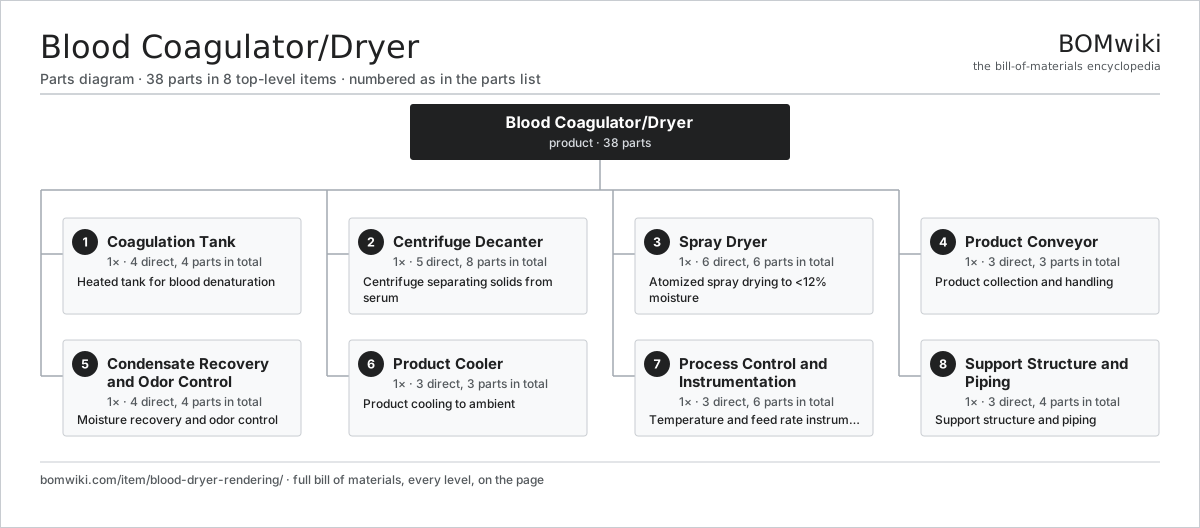
| # | Part | Qty | What it does |
|---|---|---|---|
| 1 | Coagulation Tank 4 parts | 1× | Heated tank for blood denaturation |
| 2 | Centrifuge Decanter 5 parts | 1× | Centrifuge separating solids from serum |
| 3 | Spray Dryer 6 parts | 1× | Atomized spray drying to <12% moisture |
| 4 | Product Conveyor 3 parts | 1× | Product collection and handling |
| 5 | Condensate Recovery and Odor Control 4 parts | 1× | Moisture recovery and odor control |
| 6 | Product Cooler 3 parts | 1× | Product cooling to ambient |
| 7 | Process Control and Instrumentation 3 parts | 1× | Temperature and feed rate instrumentation |
| 8 | Support Structure and Piping 3 parts | 1× | Support structure and piping |
3D model
No 3D model yet. Have a CAD file of this? Add a 3D model. STL renders right on this page; STEP, FreeCAD, and OpenSCAD sources are welcome too (openly licensed, like all 3D models on BOMwiki).
Build & assembly graph
expand / collapse · shared sub-assemblies converge · links to related products · est. labourTap an assembly to expand/collapse · tap a part to open it · use “Open page” for any node · drag to pan, scroll to zoom.
Bill of materials for Blood Coagulator/Dryer
8 top-level lines · 39 rows shown · 38 parts total · indented to 3 levels| # | Item / sub-assembly | Part no. | Qty/assy | Ext. qty | Parts | Type |
|---|---|---|---|---|---|---|
| 1 | Coagulation Tank 4 parts | blood-dryer-rendering-coagulator | 1× | 1 | 4 | assembly |
| 1.1 | Coagulator Vessel | blood-dryer-rendering-coagulator-vessel | 1× | 1 | · | part |
| 1.2 | Coagulator Agitator | blood-dryer-rendering-coagulator-agitator | 1× | 1 | · | part |
| 1.3 | Heating Element | heating-element | 1× | 1 | · | part |
| 1.4 | Fastener Set | fastener-set | 1× | 1 | · | part |
| 2 | Centrifuge Decanter 5 parts | blood-dryer-rendering-decanter | 1× | 1 | 8 | assembly |
| 2.1 | Decanter Bowl | blood-dryer-rendering-decanter-bowl | 1× | 1 | · | part |
| 2.2 | Decanter Scroll | blood-dryer-rendering-decanter-scroll | 1× | 1 | · | part |
| 2.3 | Decanter Motor | blood-dryer-rendering-decanter-motor | 1× | 1 | · | part |
| 2.4 | Ball Bearing | ball-bearing | 4× | 4 | · | part |
| 2.5 | Fastener Set | fastener-set | 1× | 1 | · | part |
| 3 | Spray Dryer 6 parts | blood-dryer-rendering-spray-dryer | 1× | 1 | 6 | assembly |
| 3.1 | Dryer Chamber | blood-dryer-rendering-dryer-chamber | 1× | 1 | · | part |
| 3.2 | Rotary Atomizer | blood-dryer-rendering-atomizer | 1× | 1 | · | part |
| 3.3 | Hot Air Heater | blood-dryer-rendering-heater-air | 1× | 1 | · | part |
| 3.4 | Dryer Fan | blood-dryer-rendering-dryer-fan | 1× | 1 | · | part |
| 3.5 | Collection Cyclone and Filter | blood-dryer-rendering-collection-bin | 1× | 1 | · | part |
| 3.6 | Fastener Set | fastener-set | 1× | 1 | · | part |
| 4 | Product Conveyor 3 parts | blood-dryer-rendering-conveyor | 1× | 1 | 3 | assembly |
| 4.1 | Conveyor Belt | blood-dryer-rendering-conveyor-belt | 1× | 1 | · | part |
| 4.2 | Conveyor Motor | blood-dryer-rendering-conveyor-motor | 1× | 1 | · | part |
| 4.3 | Fastener Set | fastener-set | 1× | 1 | · | part |
| 5 | Condensate Recovery and Odor Control 4 parts | blood-dryer-rendering-vapor-condenser | 1× | 1 | 4 | assembly |
| 5.1 | Cyclone Separator | blood-dryer-rendering-cyclone | 1× | 1 | · | part |
| 5.2 | Condenser Unit | blood-dryer-rendering-condenser-unit | 1× | 1 | · | part |
| 5.3 | Odor Scrubber | blood-dryer-rendering-scrubber | 1× | 1 | · | part |
| 5.4 | Pressure Sensor | pressure-sensor | 1× | 1 | · | part |
| 6 | Product Cooler 3 parts | blood-dryer-rendering-cooler | 1× | 1 | 3 | assembly |
| 6.1 | Cooler Unit | blood-dryer-rendering-cooler-unit | 1× | 1 | · | part |
| 6.2 | Cooling Fan | blood-dryer-rendering-cooler-fan | 1× | 1 | · | part |
| 6.3 | Fastener Set | fastener-set | 1× | 1 | · | part |
| 7 | Process Control and Instrumentation 3 parts | blood-dryer-rendering-controls | 1× | 1 | 6 | assembly |
| 7.1 | Temperature Sensor | blood-dryer-rendering-thermostat | 2× | 2 | · | part |
| 7.2 | Pressure Sensor | pressure-sensor | 1× | 1 | · | part |
| 7.3 | Relay | relay | 3× | 3 | · | part |
| 8 | Support Structure and Piping 3 parts | blood-dryer-rendering-frame | 1× | 1 | 4 | assembly |
| 8.1 | Frame Steel | blood-dryer-rendering-frame-steel | 1× | 1 | · | part |
| 8.2 | Sheet Metal Panel | sheet-panel | 1× | 1 | · | part |
| 8.3 | Fastener Set | fastener-set | 2× | 2 | · | part |
Something wrong in this list? Report a problem with this BOM.
Related products
same domain, ranked by shared parts Bakery Deck Oven
44 parts · shares 3 with this page
Continuous Frying System
118 parts · shares 3 with this page
Dough Rounding Machine
212 parts · shares 3 with this page
Bakery Deck Oven
44 parts · shares 3 with this page
Continuous Frying System
118 parts · shares 3 with this page
Dough Rounding Machine
212 parts · shares 3 with this page
 Edible Oil Refining Line
3,224 parts · shares 3 with this page
Egg Breaking and Separating Line
1,126 parts · shares 3 with this page
Edible Oil Refining Line
3,224 parts · shares 3 with this page
Egg Breaking and Separating Line
1,126 parts · shares 3 with this page
Sourcing: possible vendors
Browse the supplier directory → Prices, MOQ, and lead times are algorithmic estimates, not quotes, and not claims about these companies. Company mappings are curated by keyword; est. price band $1k–$500k. How estimates work| Vendor | HQ | Specialty | MOQ | Lead time |
|---|---|---|---|---|
| gea.com ↗ | Düsseldorf, DE | Process technology | 20 units | 12–20 wks |
| buhlergroup.com ↗ | Uzwil, CH | Food & materials processing | 20 units | 12–20 wks |
| tetrapak.com ↗ | Pully, CH | Food packaging & processing | 20 units | 12–20 wks |
| jbtc.com ↗ | Chicago, US | Food processing equipment | 20 units | 12–20 wks |
| alfalaval.com ↗ | Lund, SE | Heat transfer & separation | 20 units | 12–20 wks |
810-word article