BOMwiki the bill-of-materials encyclopedia

BMX Bike Product

Overview

A freestyle BMX bike is a compact, single-speed bicycle built to absorb the loads of jumps, grinds, and flatland tricks rather than to cover distance. The 20-inch wheel size keeps the bike short and quick to throw around, while the heavy-gauge chromoly construction survives repeated hard landings. There is no gearing to shift and, on most street and park setups, no brakes: the rider runs the machine "brakeless" and scrubs speed with foot or shoe pressure. This build mounts four pegs for grinding ledges and rails, and offers a rear U-brake with a detangler as the alternate cockpit option.

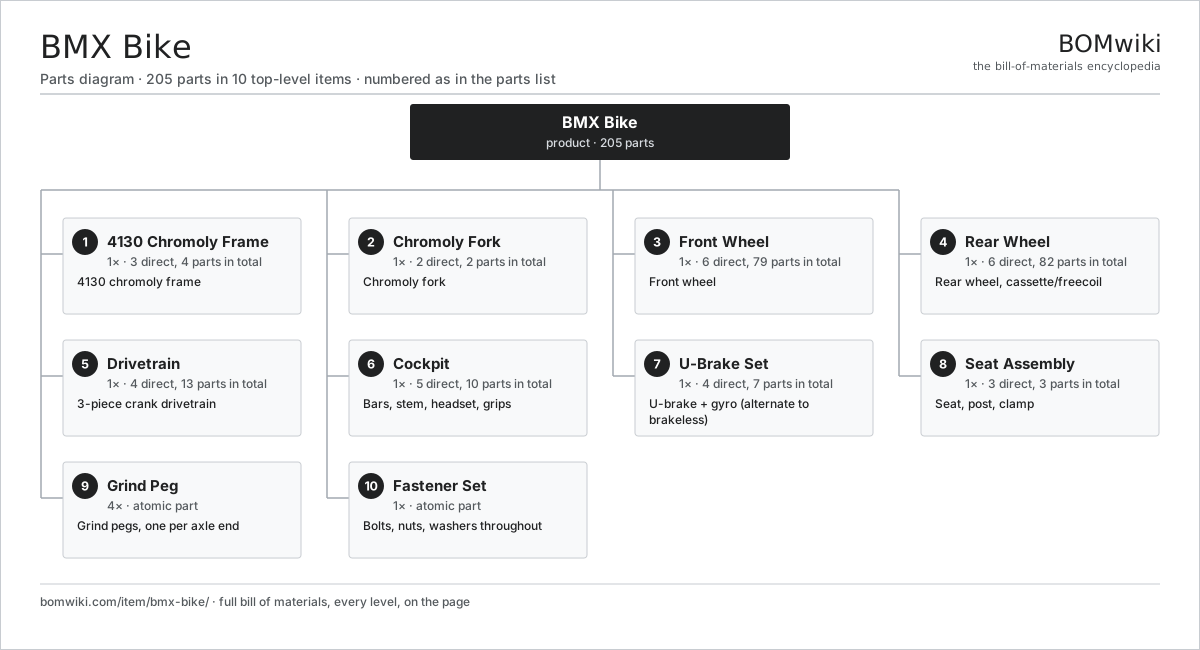
The bike is organised around a stout 4130 Chromoly Frame and matching Chromoly Fork, both welded from 4130 chromoly for fatigue resistance. Power from the Drivetrain reaches the road through a sealed-bearing Rear Wheel running a cassette driver, mirrored by a Front Wheel. The rider steers and balances through the Cockpit, and four Grind Peg units bolt to the axle ends for grinds.

Construction

Every rotating joint runs on sealed cartridge bearings so the bike shrugs off dirt and water. The Drivetrain uses a three-piece chromoly crankset on a 48-spline spindle, turning a 25-tooth sprocket through a half-link chain to a 9-tooth cassette driver — a tall ratio that keeps the chain short and tucked. The integrated Cockpit headset presses its bearings directly into the frame headtube, lowering the front end and removing pressed cups that could loosen. The Seat Assembly is set low and clamped solid, since the rider rarely sits. When fitted, the U-Brake Set routes its cable through a gyro so the bars can spin a full 360 degrees without tangling. Pegs thread over hollow axles, transferring grind loads straight into the heat-treated hubs. ', },

'cargo-ebike': { specs: [ ['Type', 'Long-tail pedal-assist cargo e-bike'], ['Frame material', '6061-T6 aluminum, extended wheelbase'], ['Motor', 'Mid-drive BLDC, 250 W nominal / 750 W peak'], ['Torque', '85 N·m'], ['Battery', '48 V 19 Ah Li-ion (912 Wh)'], ['Range', '45–95 km (28–60 mi) per charge'], ['Assist sensing', 'Bottom-bracket torque + cadence'], ['Drivetrain', '1x9 chain, wide-range cassette'], ['Wheels', '20 in fat-tire, 36-spoke'], ['Tires', '20 x 3.0 in puncture-resistant'], ['Brakes', '4-piston hydraulic disc, 203 mm rotors'], ['Payload', '200 kg (440 lb) gross'], ['Kickstand', 'Center-mount double-leg'], ['Weight', '34 kg (75 lb)'], ], body: '

Overview

A cargo e-bike is a load-carrying bicycle with electric pedal assistance, designed to replace short car trips for hauling groceries, freight, or passengers. This long-tail layout stretches the rear of the frame to create a deck behind the rider, letting the bike carry heavy loads low and centered for stable handling. A mid-drive motor multiplies the rider's pedaling effort rather than replacing it, so the bike feels like a strong tailwind that scales with how hard you push.

The structure is an extended Extended Cargo Frame with an integrated rear rack, fronted by a fat-tire-compatible suspension Suspension Fork. Propulsion comes from the Mid-Drive Motor Unit at the bottom bracket, fed by a 48-volt Integrated Battery Pack and commanded by the Motor Controller. The rider selects assist levels on the Display & Controls, and the Drivetrain carries the combined human and motor power to the rear wheel.

How it works

A strain-gauge torque sensor in the mid-drive measures pedal force and crank cadence many times per second. The controller reads that signal and modulates current through the motor's stator windings using field-oriented control, delivering up to 85 N·m through a planetary reduction gearset onto the chainring. Because the motor drives through the bike's own chain and cassette, it benefits from the gears: low gears multiply torque for steep climbs under load. The fat Fat-Tire Wheel pair adds grip and cushioning, while the four-piston Hydraulic Disc Brake units provide the stopping power a heavily laden bike demands, each lever carrying a cutoff switch that drops motor power the instant the rider brakes. A double-leg Double-Leg Kickstand holds the bike upright for loading, and the Cargo Accessories add panniers and footrests. ', },

'folding-bike': { specs: [ ['Type', 'Compact folding commuter bicycle'], ['Frame material', 'Aluminum/chromoly, central hinge'], ['Wheel size', '16–20 in'], ['Tires', '20 x 1.5 in commuter'], ['Rims', 'Alloy, 28-spoke'], ['Gearing', '3-speed internal hub gear'], ['Drive', 'Chain'], ['Brakes', 'V-brake (caliper rim), front + rear'], ['Suspension', 'Rear elastomer + coil block'], ['Folded size', '79 x 65 x 58 cm'], ['Fold time', '~15 seconds'], ['Pedals', 'Folding platform'], ['Weight', '11.5 kg (25 lb)'], ], body: '

Overview

A folding bike collapses into a compact package so it can be carried onto trains, stored under a desk, or kept in a small apartment. The design trades the large wheels and rigid frame of a conventional bicycle for small wheels and a hinged structure that folds in seconds. Despite the small 16-to-20-inch wheels, a geared hub and an upright riding position make it a practical urban commuter.

The bike folds at two main points. The Folding Frame carries a central Frame Hinge & Latch with a cam-lever clamp that splits the main tube, while the Folding Handlebar Assembly uses a Folding Stem that drops the bars alongside the wheel. A telescoping Seatpost Assembly often doubles as a latch that holds the folded package together, helped by a magnetic catch. Two identical Wheel (16-20 in) units, a chain Drivetrain, and front and rear V-Brake Set V-brakes complete the rolling bike.

Construction

The frame hinge is the heart of the design: two machined plates pivot on a single pin and lock together under a cam clamp, putting the joint in compression so it behaves like a solid tube while riding. Gearing lives inside the rear wheel as a Internal Hub Gear, a three-speed planetary unit that lets the rider shift while stopped and needs no exposed derailleur to snag during folding. A small rear Suspension Block of coil and elastomer takes the sting out of the short-wheelbase ride, since small wheels transmit road shock more sharply than large ones. Mudguards and a rear rack keep the bike practical for daily commuting in any weather. ', },

'road-bike': { specs: [ ['Type', 'Carbon road racing bicycle'], ['Frame material', 'Monocoque carbon fiber'], ['Fork', 'Full carbon, tapered steerer'], ['Wheel size', '700c'], ['Rims', 'Carbon, tubeless-ready, 24-spoke'], ['Tires', '700 x 28c tubeless clincher'], ['Drivetrain', '2x12 wireless electronic'], ['Crankset', '48/35T with power meter'], ['Cassette', '10–33T, 12-speed'], ['Shifting', 'Wireless electronic (servo derailleurs)'], ['Brakes', 'Hydraulic disc, 160 mm center-lock rotors'], ['Power meter', 'Crank-based, dual-sided strain gauge'], ['Cockpit', 'Carbon drop bar + alloy stem'], ['Weight', '7.4 kg (16.3 lb)'], ], body: '

Overview

A road bike is a lightweight, drop-handlebar bicycle optimized for speed and efficiency on paved roads. This is a modern performance build: a carbon-fiber frame for stiffness-to-weight, electronic shifting for precise gear changes, hydraulic disc brakes for all-weather control, and a power meter so the rider can train to measured wattage. Aerodynamics, low weight, and an aggressive riding position all serve the single goal of going fast for less effort.

The chassis is a Carbon Frameset — a monocoque carbon front triangle bonded to a full-carbon fork — that carries two aerodynamic Carbon Wheel units. Propulsion comes from the Electronic Drivetrain, a wireless electronic groupset, and stopping from front and rear Hydraulic Disc Brake assemblies. The rider holds a carbon Cockpit and sits on a Saddle atop a carbon Carbon Seatpost.

How it works

Shifting is fully electronic and wireless. Buttons in each shift lever send a radio signal to a battery-powered servo derailleur, which steps the chain across the cassette with motor-driven precision and no cables to stretch or corrode. The crankset integrates a Power Meter: strain gauges bonded to the crank arms flex under pedaling load, and the bridge circuit converts that flex into a torque reading, multiplied by cadence to broadcast real-time power over ANT+/Bluetooth. Each Carbon Wheel runs a tubeless tire on a carbon rim, laced with bladed spokes to a ratchet freehub for low drag and fast engagement. The hydraulic Hydraulic Disc Brake system pushes fluid from the lever through a sealed hose to twin caliper pistons, clamping pads onto a center-lock rotor for consistent power wet or dry. ', },

'smart-bike-trainer': { specs: [ ['Type', 'Direct-drive smart bike trainer'], ['Resistance', 'Electromagnetic (motor brake)'], ['Max power', '2200 W'], ['Max simulated gradient', '24%'], ['Power accuracy', '±1%'], ['Flywheel', 'Heavy steel, belt-driven'], ['Drive', 'Direct cassette mount (rear wheel off)'], ['Cassette', 'Not included; 8–12 speed compatible'], ['Connectivity', 'ANT+ FE-C, Bluetooth Low Energy'], ['Measured data', 'Power, speed, cadence'], ['Control modes', 'ERG, simulation (SIM)'], ['Axle support', 'QR 130/135 mm, thru-axle 142/148 mm'], ['Power supply', 'External AC adapter'], ['Weight', '17 kg (37.5 lb)'], ], body: '

Overview

A direct-drive smart trainer turns a normal bicycle into a stationary, app-controlled exercise machine. The rider removes the rear wheel and bolts the bike's chain directly onto a cassette on the trainer, so the bike's own chain drives a heavy flywheel braked by an electromagnetic unit. The trainer measures how hard the rider is pedaling, broadcasts that power to training apps, and accepts commands back to vary resistance — simulating climbs, drafting, or a structured workout while the bike stays in one place.

The unit is built on a steel Frame & Base with folding legs for stability. Its Drive Unit carries the cassette and couples it by belt to an inertia flywheel, while the Electromagnetic Resistance Unit applies controllable braking force. A Control Board runs the control loop, a Sensor Pack measures what the rider is doing, and a Connectivity Module links to apps over ANT+ and Bluetooth.

How it works

Pedaling spins the cassette, which drives the flywheel through a belt; the flywheel's mass gives the road-like inertia of coasting and accelerating. Braking torque comes from the Electromagnetic Resistance Unit, an electromagnetic motor-brake whose coils, when energized by the Control Board, induce eddy currents in a permanent-magnet rotor — more current, more drag — and can even drive the flywheel to simulate descents. The Sensor Pack reads true power from a strain-gauge torque sensor on the drive shaft rather than estimating it, hitting ±1% accuracy, alongside a Hall speed pickup and a cadence sensor. The Connectivity Module streams power, speed, and cadence to apps and accepts resistance targets back: in ERG mode it holds a set wattage regardless of gear, and in simulation mode it matches resistance to a virtual course's gradient. The Axle Adapter Kit lets road and mountain frames with different axle standards bolt to the same trainer. ', },

'mountain-bike': { specs: [ ['Type', 'Full-suspension trail mountain bike'], ['Frame material', 'Carbon/alloy, linkage-driven rear'], ['Front travel', '140 mm (air fork)'], ['Rear travel', '130 mm (air shock)'], ['Wheel size', '29 in'], ['Rims', 'Tubeless-ready, 28-spoke'], ['Tires', '29 x 2.4 in knobby tubeless'], ['Drivetrain', '1x12 wide-range'], ['Cassette', '10–52T, 12-speed'], ['Chainring', '32T narrow-wide'], ['Brakes', 'Hydraulic disc, 180 mm rotors front + rear'], ['Seatpost', 'Dropper, 150 mm travel'], ['Headset', 'Tapered, sealed cartridge'], ['Weight', '13.6 kg (30 lb)'], ], body: '

Overview

A full-suspension mountain bike is built to ride rough, unpaved terrain at speed. Both wheels are sprung — a telescopic fork in front and a linkage-driven shock in back — so the wheels track the ground over roots, rocks, and drops while the rider stays composed. A wide-range single-chainring drivetrain handles steep climbs and fast descents, powerful hydraulic disc brakes provide control, and a dropper post lets the rider lower the saddle out of the way on technical descents.

The bike is built around a Suspension Frame, a front triangle linked to a pivoting rear swingarm that compresses the Air Rear Shock. The telescopic Suspension Fork handles the front, two tubeless Wheel units roll the terrain, and the Drivetrain delivers power. The Hydraulic Disc Brake System system stops both wheels, the rider steers through the Cockpit, and a Dropper Seatpost adjusts saddle height on the fly.

How it works

Suspension works by separating spring force from damping. In the Suspension Fork and Air Rear Shock, compressed air acts as the spring while an oil-filled damper cartridge meters the flow through small valves, controlling how fast the suspension compresses and rebounds so it absorbs hits without bouncing. The rear suspension uses pivot bearings in the Suspension Frame so the linkage drives the shock through a tuned leverage curve. The 1x Drivetrain retains the chain on a narrow-wide chainring and indexes it across a wide-range cassette with a clutched rear derailleur that resists chain slap. Each Hydraulic Disc Brake System caliper clamps pads onto a vented rotor under hydraulic pressure, and the Dropper Seatpost drops or raises the saddle from a bar lever via an internal air/oil cartridge.

Build & assembly graph

expand / collapse · shared sub-assemblies converge · links to related products · est. labour
product / assembly shared across products atomic part related product

Tap an assembly to expand/collapse · tap a part to open it · use “Open page” for any node · drag to pan, scroll to zoom.

Bill of materials

10 top-level lines · 60 rows shown · 205 parts total · indented to 3 levels
# Item / sub-assembly Part no. Qty/assy Ext. qty Parts Type
1 4130 Chromoly Frame 3 parts bmx-bike-frame 1 4 assembly
1.1 Chromoly Tubeset bmx-bike-frame-tubeset 1 part
1.2 Integrated Headtube bmx-bike-headtube 1 part
1.3 Rear Dropout bmx-bike-dropout 2 part
2 Chromoly Fork 2 parts bmx-bike-fork 1 2 assembly
2.1 Fork Blades & Crown bmx-bike-fork-blades 1 part
2.2 Steerer Tube bmx-bike-fork-steerer 1 part
3 Front Wheel 6 parts bmx-bike-wheel-front 1 79 assembly
3.1 Front Hub 3 parts bmx-bike-hub-front 1 4 assembly
3.1.1 Hub Shell bmx-bike-hub-shell 1 part
3.1.2 Hub Axle bmx-bike-axle 1 part
3.1.3 Ball Bearing ball-bearing 2 part
3.2 Double-Wall Rim bmx-bike-rim 1 part
3.3 Spoke bmx-bike-spoke 36× 36 part
3.4 Spoke Nipple bmx-bike-nipple 36× 36 part
3.5 BMX Tire bmx-bike-tire 1 part
3.6 Inner Tube bmx-bike-tube 1 part
4 Rear Wheel 6 parts bmx-bike-wheel-rear 1 82 assembly
4.1 Rear Hub (Cassette/Freecoil) 4 parts bmx-bike-hub-rear 1 7 assembly
4.1.1 Hub Shell bmx-bike-hub-shell 1 part
4.1.2 Cassette Driver bmx-bike-driver 1 part
4.1.3 Hub Axle bmx-bike-axle 1 part
4.1.4 Ball Bearing ball-bearing 4 part
4.2 Double-Wall Rim bmx-bike-rim 1 part
4.3 Spoke bmx-bike-spoke 36× 36 part
4.4 Spoke Nipple bmx-bike-nipple 36× 36 part
4.5 BMX Tire bmx-bike-tire 1 part
4.6 Inner Tube bmx-bike-tube 1 part
5 Drivetrain 4 parts bmx-bike-drivetrain 1 13 assembly
5.1 3-Piece Crankset 3 parts bmx-bike-crankset 1 5 assembly
5.1.1 Crank Arm bmx-bike-crank-arm 2 part
5.1.2 Crank Spindle bmx-bike-spindle 1 part
5.1.3 Ball Bearing ball-bearing 2 part
5.2 Front Sprocket bmx-bike-sprocket 1 part
5.3 Chain bmx-bike-chain 1 part
5.4 Platform Pedal 3 parts bmx-bike-pedal 2 3 assembly
5.4.1 Pedal Body bmx-bike-pedal-body 2 part
5.4.2 Pedal Axle bmx-bike-pedal-axle 2 part
5.4.3 Ball Bearing ball-bearing 2 part
6 Cockpit 5 parts bmx-bike-cockpit 1 10 assembly
6.1 Handlebar bmx-bike-handlebar 1 part
6.2 Front-Load Stem bmx-bike-stem 1 part
6.3 Integrated Headset 2 parts bmx-bike-headset 1 4 assembly
6.3.1 Ball Bearing ball-bearing 2 part
6.3.2 Headset Race bmx-bike-headset-cup 2 part
6.4 Grip bmx-bike-grip 2 part
6.5 Bar End bmx-bike-bar-end 2 part
7 U-Brake Set 4 parts bmx-bike-brake-set 1 7 assembly
7.1 U-Brake Caliper 2 parts bmx-bike-u-brake 1 4 assembly
7.1.1 Brake Arm bmx-bike-brake-arm 2 part
7.1.2 Brake Pad bmx-bike-brake-pad 2 part
7.2 Brake Lever bmx-bike-brake-lever 1 part
7.3 Brake Cable bmx-bike-brake-cable 1 part
7.4 Gyro / Detangler bmx-bike-gyro 1 part
8 Seat Assembly 3 parts bmx-bike-seat-assembly 1 3 assembly
8.1 Seat bmx-bike-seat 1 part
8.2 Seatpost bmx-bike-seatpost 1 part
8.3 Seatpost Clamp bmx-bike-seat-clamp 1 part
9 Grind Peg bmx-bike-peg 4 part
10 Fastener Set fastener-set 1 part

Sourcing — likely vendors

Companies that make this · indicative price $200–$12k · MOQ & lead are typical
VendorHQSpecialtyMOQLead time
🇹🇼Giant
giant-bicycles.com ↗
Taichung, TW Bicycles 500 units 6–12 wks
🇺🇸Trek
trekbikes.com ↗
Waterloo, US Bicycles 500 units 6–12 wks
🇺🇸Specialized
specialized.com ↗
Morgan Hill, US Bicycles 500 units 6–12 wks
🇹🇼Merida
merida-bikes.com ↗
Yuanlin, TW Bicycles 500 units 6–12 wks
🇺🇸Cannondale
cannondale.com ↗
Wilton, US Bicycles 500 units 6–12 wks

2,217-word article