Landscape Bollard Light
ProductOverview
Landscape bollard lights are low-voltage pathway and accent fixtures mounted directly into garden, lawn, and hardscape surfaces. Unlike traditional incandescent or halogen landscape lighting, LED bollards offer low power consumption (1–5 W each), long lifespan (100,000+ hours), and consistent cool operation, allowing dense arrays of 10–50 bollards to illuminate large gardens without the heat and electrical load of older technologies.
The LED module sits at the top of the aluminum post body, buried 400–600 mm above grade. Below grade, a stainless anchor collar is set in concrete, and underground-rated landscape cable connects each bollard in series or parallel back to a central low-voltage transformer located near the house or garden shed.
The transformer converts 120 VAC line power down to 12 or 24 VDC, eliminating the need for high-voltage wiring in the garden, a crucial safety advantage. At 24 V, even a short circuit presents no electrocution hazard, and trenching does not require an electrician's license in most jurisdictions.
The directional louver inside each post prevents light from escaping upward, controlling light spill to the night sky and neighbors' properties. This "dark-sky compliant" design aligns with modern outdoor lighting standards emphasizing environmental stewardship (reducing light pollution) and energy efficiency.
Design and installation
A landscape bollard installation typically begins with the central transformer, installed in a weatherproof enclosure near a power outlet (usually GFCI-protected exterior outlet at the house). The transformer may include a photocell or programmable timer, allowing automatic on/off based on sunset/sunrise or a fixed schedule.
From the transformer, direct-bury landscape wire (12 or 10 AWG multi-conductor) runs through underground trenches to each bollard anchor collar. Bollards are typically arranged in series circuits (e.g., 10 bollards in series = 240 V total drop across the circuit, 24 V per bollard), reducing wire gauge requirements and loss. At 24 V and 300 mA per bollard, the total circuit current is only 1–3 A, a negligible load compared to line-voltage landscape lighting.
Installation involves:
- Trenching: Digging trenches 12–18 inches below grade, accounting for frost line depth (varies by geography).
- Cable laying: Laying underground wire in trenches, optionally running through PVC conduit at road crossings or under hardscape.
- Hole boring: Boring holes at bollard positions, inserting anchor collars and securing with concrete.
- Bollard assembly: Screwing post bodies onto buried collars, ensuring plumb (vertical alignment).
- Wiring: Connecting bollard lead wires to landscape wire using waterproof landscape connectors.
- Testing: Powering on and confirming all bollards illuminate, then backfilling trenches.
This modular approach allows bollards to be added, moved, or replaced independently without disrupting the entire garden lighting system.
LED module and thermal management
The LED module consists of one or more high-efficiency LEDs (typically 1–3 W) soldered to a metal-core PCB, which is then bonded via thermal epoxy to the interior of the aluminum post body. Heat generated by the LED (often <1 W at 50% typical brightness) conducts through the PCB copper directly into the post's aluminum walls and internal finned geometry.
The post itself acts as a natural heatsink: the tall, cylindrical aluminum body provides substantial surface area for passive convection cooling. Even with direct burial in soil, which provides some thermal insulation, the post temperature typically remains <60 °C during operation, well below the LED's 85 °C absolute maximum.
This passive design is crucial for bollard reliability in landscape installations: no fans, no moving parts, and no maintenance required. A bollard installed today can operate for 10–15 years without service, a compelling value proposition for large gardens.
Light control via louvers
Without internal louver structures, an LED in a post would emit light in all directions, creating upward spill that wastes energy and contributes to light pollution. The louver assembly comprises 5–8 aluminum fins spaced at 10–15 mm intervals, angled downward to block light rays traveling at shallow angles relative to the post axis.
A typical louver geometry blocks rays at angles >60° from vertical (i.e., rays near the horizon), while allowing rays at <60° (downward, toward the path or landscape) to pass unobstructed. This produces a downward "light cone" approximately 120° wide, sufficient to brightly illuminate the ground immediately in front of and around the bollard while preventing light from reaching neighboring windows or the sky.
An optional frosted acrylic diffuser in the louver opening softens the sharp edge of the light cone, reducing glare from directly above and creating a gentler transition between lit and dark areas. Premium landscape designs use diffusers on all bollards for a uniform, soft aesthetic.
Low-voltage advantages and safety
Traditional line-voltage landscape lighting (120 VAC at the bollard) requires:
- Thick, expensive underground cable (10 AWG or larger)
- Professional electrical installation and permitting
- GFCI protection and ground-fault detection equipment
- Post-installation testing and annual inspections
Low-voltage (12 or 24 VDC) landscape lighting eliminates these requirements:
- Thin, inexpensive underground cable (12 or 10 AWG)
- DIY installation without permits in most jurisdictions
- No GFCI required (24 V DC is inherently safe)
- Minimal maintenance
The tradeoff is that voltage drop becomes significant on long runs: a series circuit running 200+ feet of cable will see >5 V drop, leaving only 19 V at the distant bollards instead of 24 V. Designers account for this by either using larger cable (10 AWG instead of 12), limiting series circuit length, or using parallel sub-circuits with intermediate transformer taps.
Transformer and circuit architecture
The central landscape transformer is typically rated 10–20 A output at 12 or 24 VDC, supporting 10–50 bollards depending on their individual wattage and the circuit configuration chosen.
A simple single-series circuit connects all bollards in series: positive from transformer → bollard 1 → bollard 2 → ... → bollard N → negative back to transformer. Series circuits are cost-effective (single wire run) but are sensitive to a single bollard failure: if one bollard open-circuits, the entire series chain goes dark. Modern landscape installations use series-parallel hybrid topology: the 50 bollards are divided into 5 sub-groups of 10, each sub-group wired in series, and the 5 sub-groups connected in parallel. This balances cost (fewer total wires) with resilience (one group failure does not black out the entire landscape).
An optional photocell or programmable timer in the transformer enclosure controls when the entire system energizes. Photocells automatically turn lights on at dusk and off at dawn, requiring no manual scheduling. Programmable timers allow fixed on/off times, useful for security lighting or energy conservation policies.
A low-voltage DC breaker (5–20 A rated) protects the transformer output against short circuits. If a bollard suffers a ground fault or wire damage short-circuits a circuit, the breaker trips, preventing transformer overheating or fire.
Aesthetic and design integration
Bollard height (400–600 mm above grade) and diameter (80–100 mm) are standardized to allow seamless integration into landscape design. A row of bollards along a garden path creates a defined edge without appearing obtrusive. Taller bollards (600 mm) are used for primary pathways, while shorter ones (400 mm) accent secondary features.
Material choices reflect design intent:
- Anodized aluminum: Contemporary, clean aesthetic; popular in modern landscapes and commercial installations.
- Stainless steel: Coastal or salt-spray environments; resists corrosion and maintains a polished appearance.
- Powder-coated aluminum: Custom colors matching landscape design; darker finishes reduce perceived luminance and visual impact at night.
Color temperature selection also contributes to mood: 2700 K warm white creates an inviting, residential feel, while 4100 K neutral white provides better visibility for security applications. Some high-end installations use tunable bollards capable of switching between 2700 K and 5000 K via a secondary control wire, allowing seasonal or event-based lighting adjustments.
Environmental impact and dark-sky compliance
Light pollution, excessive artificial light spilling into the night sky, disrupts circadian rhythms in wildlife, confuses migratory birds, and obscures stars for astronomers. The louver-controlled design of landscape bollards ensures that 95%+ of emitted light hits the ground or immediate landscape, with <5% spilling upward. This "full cutoff" or "dark-sky compliant" approach aligns with standards like the International Dark-Sky Association (IDA) guidelines, increasingly adopted by municipalities and design-conscious property owners.
Modern LED bollards, consuming 1–5 W each compared to incandescent equivalents at 20–50 W, further reduce the environmental footprint. A typical 30-bollard landscape installation consumes 30–150 W total, less than two incandescent bulbs, yet provides superior visibility and aesthetics.
Maintenance and lifespan
LED bollards require minimal maintenance: occasional wiping of the top cap to remove dust or leaves, and annual inspection of buried wire connections for rodent damage (a rare but possible issue in some climates).
The LED is rated 100,000+ hours L70 (lumen maintenance at 70% of initial output). At typical 12-hour-per-night operation (dusk to sunrise in summer), this yields 23+ years of service before noticeable dimming. In practice, a bollard is unlikely to be replaced for >15 years, making long-term energy and maintenance costs negligible compared to alternatives.
If a single bollard post fails (mechanical damage or internal wiring fault), it can be replaced independently: unscrew the post from the buried collar, screw in a new post, and reconnect the wiring. No excavation or trenching is required, simplifying field replacement.
Landscape Bollard Light parts and their functions
7 top-level parts · 26 parts in total · full bill of materials below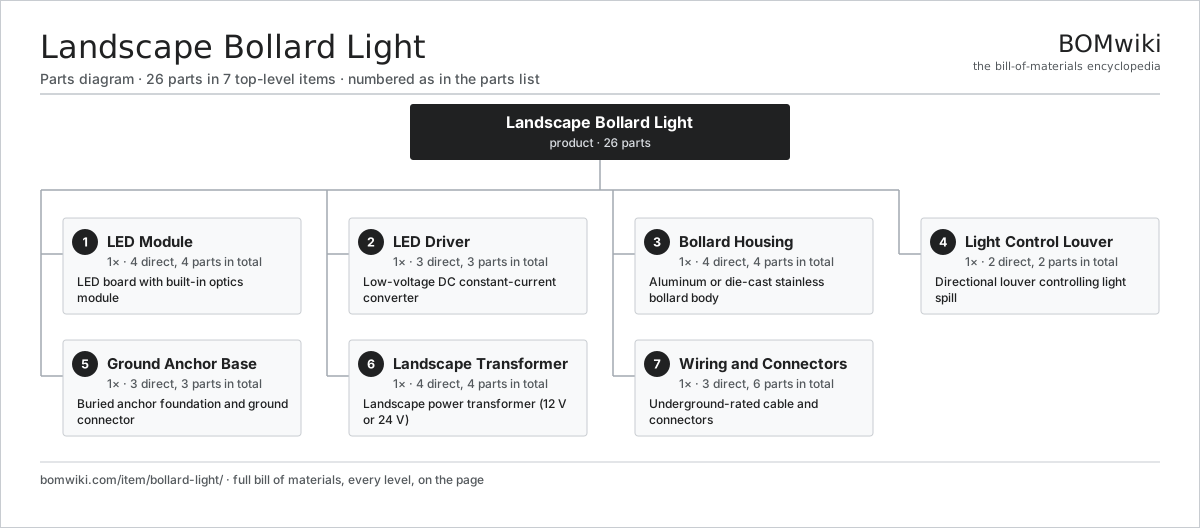
| # | Part | Qty | What it does |
|---|---|---|---|
| 1 | LED Module 4 parts | 1× | LED board with built-in optics module |
| 2 | LED Driver 3 parts | 1× | Low-voltage DC constant-current converter |
| 3 | Bollard Housing 4 parts | 1× | Aluminum or die-cast stainless bollard body |
| 4 | Light Control Louver 2 parts | 1× | Directional louver controlling light spill |
| 5 | Ground Anchor Base 3 parts | 1× | Buried anchor foundation and ground connector |
| 6 | Landscape Transformer 4 parts | 1× | Landscape power transformer (12 V or 24 V) |
| 7 | Wiring and Connectors 3 parts | 1× | Underground-rated cable and connectors |
3D model
No 3D model yet. Have a CAD file of this? Add a 3D model. STL renders right on this page; STEP, FreeCAD, and OpenSCAD sources are welcome too (openly licensed, like all 3D models on BOMwiki).
Build & assembly graph
expand / collapse · shared sub-assemblies converge · links to related products · est. labourTap an assembly to expand/collapse · tap a part to open it · use “Open page” for any node · drag to pan, scroll to zoom.
Bill of materials for Landscape Bollard Light
7 top-level lines · 30 rows shown · 26 parts total · indented to 3 levels| # | Item / sub-assembly | Part no. | Qty/assy | Ext. qty | Parts | Type |
|---|---|---|---|---|---|---|
| 1 | LED Module 4 parts | bollard-light-led-module | 1× | 1 | 4 | assembly |
| 1.1 | LED Die | bollard-light-led-die | 1× | 1 | · | part |
| 1.2 | MCPCB | bollard-light-mcpcb | 1× | 1 | · | part |
| 1.3 | SMD Passive (R/C/L) | smd-passives | 1× | 1 | · | part |
| 1.4 | Thermal Bond | bollard-light-thermal-bond | 1× | 1 | · | part |
| 2 | LED Driver 3 parts | bollard-light-driver | 1× | 1 | 3 | assembly |
| 2.1 | Driver IC | bollard-light-driver-ic | 1× | 1 | · | part |
| 2.2 | Current Sense | bollard-light-current-sense | 1× | 1 | · | part |
| 2.3 | Filter Capacitor | bollard-light-filter-cap | 1× | 1 | · | part |
| 3 | Bollard Housing 4 parts | bollard-light-housing | 1× | 1 | 4 | assembly |
| 3.1 | Post Body | bollard-light-post-body | 1× | 1 | · | part |
| 3.2 | Top Cap | bollard-light-top-cap | 1× | 1 | · | part |
| 3.3 | Internal Heatsink | bollard-light-internal-heatsink | 1× | 1 | · | part |
| 3.4 | Threaded Base | bollard-light-threaded-base | 1× | 1 | · | part |
| 4 | Light Control Louver 2 parts | bollard-light-louver | 1× | 1 | 2 | assembly |
| 4.1 | Louver Grid | bollard-light-louver-grid | 1× | 1 | · | part |
| 4.2 | Diffusing Lens | bollard-light-lens-insert | 1× | 1 | · | part |
| 5 | Ground Anchor Base 3 parts | bollard-light-base | 1× | 1 | 3 | assembly |
| 5.1 | Mounting Collar | bollard-light-mounting-collar | 1× | 1 | · | part |
| 5.2 | Electrical Connector | bollard-light-electrical-connector | 1× | 1 | · | part |
| 5.3 | Threaded Nut | bollard-light-threaded-nut | 1× | 1 | · | part |
| 6 | Landscape Transformer 4 parts | bollard-light-transformer | 1× | 1 | 4 | assembly |
| 6.1 | Transformer Core | bollard-light-transformer-core | 1× | 1 | · | part |
| 6.2 | Transformer Housing | bollard-light-transformer-housing | 1× | 1 | · | part |
| 6.3 | Circuit Breaker | bollard-light-circuit-breaker | 1× | 1 | · | part |
| 6.4 | Timer Module | bollard-light-timer-module | 1× | 1 | · | part |
| 7 | Wiring and Connectors 3 parts | bollard-light-wiring | 1× | 1 | 6 | assembly |
| 7.1 | Landscape Cable | bollard-light-landscape-cable | 1× | 1 | · | part |
| 7.2 | Landscape Connector | bollard-light-wire-nut | 4× | 4 | · | part |
| 7.3 | Conduit Sleeve | bollard-light-conduit | 1× | 1 | · | part |
Something wrong in this list? Report a problem with this BOM.
Sourcing: possible vendors
Browse the supplier directory → Prices, MOQ, and lead times are algorithmic estimates, not quotes, and not claims about these companies. Company mappings are curated by keyword; est. price band $3–$2k. How estimates work| Vendor | HQ | Specialty | MOQ | Lead time |
|---|---|---|---|---|
|
🇳🇱Signify
signify.com ↗
|
Eindhoven, NL | Lighting (Philips Hue) | 2,000 units | 6–10 wks |
| acuitybrands.com ↗ | Atlanta, US | Lighting & controls | 2,000 units | 6–10 wks |
|
🇦🇹Zumtobel
zumtobelgroup.com ↗
|
Dornbirn, AT | Lighting | 2,000 units | 6–10 wks |
| creelighting.com ↗ | Racine, US | LED lighting | 2,000 units | 6–10 wks |
|
🇮🇳Havells
havells.com ↗
|
Noida, IN | Electrical & lighting | 2,000 units | 6–10 wks |
1,661-word article