Book Sterilizer Cabinet
ProductOverview
A book disinfection cabinet is a UV-C sterilization chamber designed to eliminate pathogens (bacteria, viruses, fungi) from library books and paper materials. Particularly valuable during pandemic periods or in institutions with high disease transmission risk (hospitals, elderly care facilities), these systems expose books to germicidal ultraviolet light at 254 nm wavelength, the peak absorption band of microbial DNA and RNA.
Modern library systems increasingly deploy these as part of standard returns processing, especially for high-circulation items where multiple users touch pages in quick succession.
How It Works
A patron or library staff member places books in the Cabinet Enclosure, closes the hinged Door Assembly, and presses the start button. The Exposure Timer & Control begins a preset cycle (typically 15–60 minutes).
The UV-C Lamp Array array, typically 4–8 lamps mounted above and below the Internal Shelf, ignites via the Electronic Ballast electronic ballast. These lamps emit intense 254 nm UV-C radiation.
Simultaneously, the Page Fluttering Fan small fan creates gentle air currents, separating book pages so UV light penetrates between them, not just the outer cover. The Air Filtration & Circulation circulates air through a HEPA Filter, removing ozone byproduct and particulates.
After the timer expires, lamps shut off automatically. The Door Safety Interlock ensures lamps cannot operate if the door is open, preventing accidental UV exposure to staff.
Germicidal UV-C Physics
UV-C at 254 nm is absorbed by the pyrimidine bases in microbial DNA and RNA, causing thymine dimer formation, adjacent thymine bases become covalently linked, preventing DNA replication and killing the organism. At high fluence rates (>100 mJ/cm²), a single exposure kills 99.9% of bacteria and enveloped viruses.
Book disinfection cabinets typically deliver 10–50 mJ/cm² per cycle (adjustable via exposure time), sufficient for most library-encountered pathogens: Staphylococcus aureus, Escherichia coli, enveloped respiratory viruses (influenza, SARS-CoV-2), and fungal spores.
Lamp Technology
The UV-C Germicidal Lamp array uses low-pressure mercury vapor lamps, typically T5 or T8 format (5mm or 8mm diameter tubes). These emit >90% of their power at 254 nm with minor emission at 185 nm (ozone-generating) and visible light.
Each Lamp Reflector backing focuses radiation into the cabinet interior. Reflectors are aluminum anodized to >95% reflectivity.
Lamp life is 8,000–10,000 hours (≈1–2 years in a library setting with 4–8 exposures/day). UV output degrades gradually; after 50% light output loss, lamps are replaced.
Ozone Management
Low-pressure UV lamps emit ~5% power at 185 nm, which converts atmospheric oxygen to ozone (O₃). At high concentrations, ozone is a respiratory irritant. The HEPA Filter in the circulation system contains activated carbon that absorbs ozone, reducing output to <0.05 ppm (well below the 0.1 ppm occupational exposure limit).
The Air Filtration & Circulation operates during and after lamp exposure, purging the cabinet of residual ozone.
Page-Flutter Mechanism
A critical challenge is ensuring UV light penetrates between book pages. A closed book is opaque; even thin paper attenuates UV-C significantly. The Page Fluttering Fan fan creates gentle air currents (0.5–1.0 m/s) that cause pages to flutter and separate slightly, allowing UV to penetrate.
Without page flutter, only the outer cover and perhaps the first 10–20 pages receive significant exposure; interior pages are shadowed. Flutter dramatically improves efficacy, increasing kill rate on interior pages from 80% to >99%.
Exposure Duration & Dose
Exposure time is adjustable (typically 15–60 minutes) and determines UV dose. A 30-minute exposure at 4×20W lamps covers ~25 mJ/cm² at the shelf surface. This is sufficient for nearly all pathogens.
Higher doses (>50 mJ/cm²) risk paper degradation: UV-C can cause polymer chain breaking in cellulose and lignin, yellowing and weakening aged paper. Library-standard settings (25–35 mJ/cm²) balance pathogen kill rate against material preservation.
Modern systems offer preset profiles: "Standard Library" (30 min), "High-Risk" (45 min), "Quick Decontamination" (15 min for emergency returns during outbreaks).
Safety Interlocks
The Door Safety Interlock is a hardwired safety relay connected to a magnetic Door Interlock Switch. If the door opens during lamp operation, the safety relay immediately de-energizes the Electronic Ballast, cutting lamp power in <100 ms. This prevents accidental UV exposure.
The safety relay is independent of the main Power Supply Unit, meaning even if the logic board fails, the interlock functions.
Integration into Library Workflows
High-circulation items (picture books, popular fiction) are placed in the cabinet after return, before shelving. A standard protocol:
- Book returned and scanned at check-in desk
- Placed in cabinet with 5–10 other returns
- 30-minute exposure cycle
- Staff retrieve books and place on hold shelf or re-shelve
- Next patron borrows disinfected copy
The delay (30 minutes) is the primary cost; libraries weigh this against reduced disease transmission and patron confidence.
Effectiveness Against SARS-CoV-2 and Other Pathogens
Laboratory studies (2020–2021 COVID pandemic era) confirmed that UV-C at 254 nm effectively inactivates SARS-CoV-2 and other enveloped viruses. The threshold fluence for 99.9% inactivation is approximately 7–10 mJ/cm².
Most library cabinets operate at 2–3× this threshold, ensuring high margin of safety. Bacterial spores (non-enveloped) require higher doses, but library environments harbor few spore-forming pathogens.
Maintenance & Consumables
Lamp life is the primary maintenance cost. A cabinet with 4 lamps at 5,000-hour life (1–2 years) requires annual lamp replacement (~$100–200/year).
The HEPA Filter requires replacement every 1–2 years ($50–100).
The Electronic Ballast IC electronic ballast is sealed and maintenance-free but may drift in aging systems; recalibration or replacement occurs every 5–10 years ($200–500).
Debate & Adoption Trends
Libraries adopted these systems widely during 2020–2022 COVID-19 pandemic peaks. As pandemic risk subsided, adoption slowed; many libraries mothballed units due to operational burden (staff time for cycling).
Some institutions maintain systems for residual pathogen control (seasonal influenza, RSV), while others use them selectively for high-risk populations (elderly patrons, immunocompromised users).
Effectiveness against non-enveloped pathogens (norovirus, adenovirus) is lower, and effectiveness against pathogens embedded in dried biofilms is uncertain. Academic debate continues on whether cabinet exposure (vs. time-based shelf quarantine) provides meaningful risk reduction.
Book Sterilizer Cabinet parts and their functions
8 top-level parts · 43 parts in total · full bill of materials below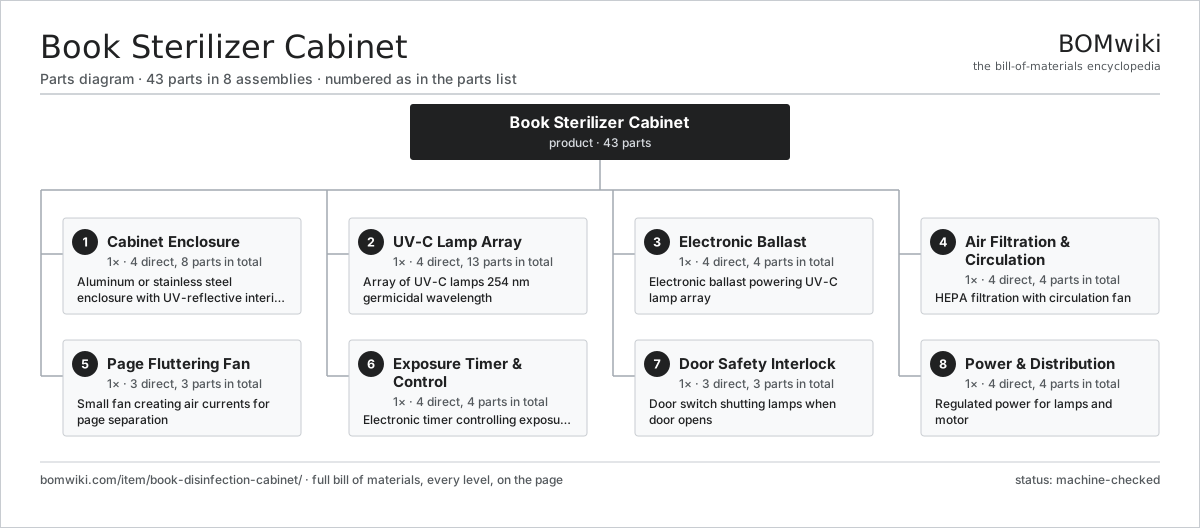
| # | Part | Qty | What it does |
|---|---|---|---|
| 1 | Cabinet Enclosure 4 parts | 1× | Aluminum or stainless steel enclosure with UV-reflective interior |
| 2 | UV-C Lamp Array 4 parts | 1× | Array of UV-C lamps 254 nm germicidal wavelength |
| 3 | Electronic Ballast 4 parts | 1× | Electronic ballast powering UV-C lamp array |
| 4 | Air Filtration & Circulation 4 parts | 1× | HEPA filtration with circulation fan |
| 5 | Page Fluttering Fan 3 parts | 1× | Small fan creating air currents for page separation |
| 6 | Exposure Timer & Control 4 parts | 1× | Electronic timer controlling exposure duration |
| 7 | Door Safety Interlock 3 parts | 1× | Door switch shutting lamps when door opens |
| 8 | Power & Distribution 4 parts | 1× | Regulated power for lamps and motor |
3D model
No 3D model yet. Have a CAD file of this? Add a 3D model — STL renders right on this page; STEP, FreeCAD, and OpenSCAD sources are welcome too (openly licensed, like all 3D models on BOMwiki).
Build & assembly graph
expand / collapse · shared sub-assemblies converge · links to related products · est. labourTap an assembly to expand/collapse · tap a part to open it · use “Open page” for any node · drag to pan, scroll to zoom.
Bill of materials for Book Sterilizer Cabinet
8 top-level lines · 38 rows shown · 43 parts total · indented to 3 levels| # | Item / sub-assembly | Part no. | Qty/assy | Ext. qty | Parts | Type |
|---|---|---|---|---|---|---|
| 1 | Cabinet Enclosure 4 parts | book-disinfection-cabinet-chamber | 1× | 1 | 8 | assembly |
| 1.1 | Cabinet Panel | book-disinfection-cabinet-side-panel | 4× | 4 | · | part |
| 1.2 | Base Frame | book-disinfection-cabinet-base-frame | 1× | 1 | · | part |
| 1.3 | Door Assembly | book-disinfection-cabinet-door-frame | 1× | 1 | · | part |
| 1.4 | Internal Shelf | book-disinfection-cabinet-internal-shelf | 2× | 2 | · | part |
| 2 | UV-C Lamp Array 4 parts | book-disinfection-cabinet-uv-lamps | 1× | 1 | 13 | assembly |
| 2.1 | UV-C Germicidal Lamp | book-disinfection-cabinet-uv-lamp | 4× | 4 | · | part |
| 2.2 | UV Lamp Socket | book-disinfection-cabinet-lamp-socket | 4× | 4 | · | part |
| 2.3 | Lamp Reflector | book-disinfection-cabinet-reflector | 4× | 4 | · | part |
| 2.4 | Ozone Filter | book-disinfection-cabinet-uv-filter | 1× | 1 | · | part |
| 3 | Electronic Ballast 4 parts | book-disinfection-cabinet-lamp-ballast | 1× | 1 | 4 | assembly |
| 3.1 | Electronic Ballast IC | book-disinfection-cabinet-ballast-ic | 1× | 1 | · | part |
| 3.2 | HF Transformer | book-disinfection-cabinet-transformer | 1× | 1 | · | part |
| 3.3 | SMD Passive (R/C/L) | smd-passives | 1× | 1 | · | part |
| 3.4 | Ballast Enclosure | book-disinfection-cabinet-ballast-enclosure | 1× | 1 | · | part |
| 4 | Air Filtration & Circulation 4 parts | book-disinfection-cabinet-air-system | 1× | 1 | 4 | assembly |
| 4.1 | HEPA Filter | book-disinfection-cabinet-hepa-filter | 1× | 1 | · | part |
| 4.2 | Blower Motor | book-disinfection-cabinet-blower-motor | 1× | 1 | · | part |
| 4.3 | Air Duct | book-disinfection-cabinet-duct | 1× | 1 | · | part |
| 4.4 | Flow Damper | book-disinfection-cabinet-damper | 1× | 1 | · | part |
| 5 | Page Fluttering Fan 3 parts | book-disinfection-cabinet-page-flutter | 1× | 1 | 3 | assembly |
| 5.1 | Flutter Fan Motor | book-disinfection-cabinet-flutter-motor | 1× | 1 | · | part |
| 5.2 | Flutter Blade | book-disinfection-cabinet-flutter-blade | 1× | 1 | · | part |
| 5.3 | Vibration Mount | book-disinfection-cabinet-flutter-mount | 1× | 1 | · | part |
| 6 | Exposure Timer & Control 4 parts | book-disinfection-cabinet-timer | 1× | 1 | 4 | assembly |
| 6.1 | Timer IC | book-disinfection-cabinet-timer-ic | 1× | 1 | · | part |
| 6.2 | Timer Display | book-disinfection-cabinet-display | 1× | 1 | · | part |
| 6.3 | Start Button | book-disinfection-cabinet-timer-button | 1× | 1 | · | part |
| 6.4 | Timer Control PCB | book-disinfection-cabinet-timer-pcb | 1× | 1 | · | part |
| 7 | Door Safety Interlock 3 parts | book-disinfection-cabinet-safety-interlock | 1× | 1 | 3 | assembly |
| 7.1 | Door Interlock Switch | book-disinfection-cabinet-door-switch | 1× | 1 | · | part |
| 7.2 | Safety Relay | book-disinfection-cabinet-relay | 1× | 1 | · | part |
| 7.3 | Safety Wiring | book-disinfection-cabinet-interlock-wiring | 1× | 1 | · | part |
| 8 | Power & Distribution 4 parts | book-disinfection-cabinet-power-supply | 1× | 1 | 4 | assembly |
| 8.1 | Power Supply Unit | book-disinfection-cabinet-main-psu | 1× | 1 | · | part |
| 8.2 | Thermal Breaker | book-disinfection-cabinet-breaker | 1× | 1 | · | part |
| 8.3 | Power Supply | power-supply | 1× | 1 | · | part |
| 8.4 | Emergency Stop Button | book-disinfection-cabinet-estop | 1× | 1 | · | part |
Related products
same domain, ranked by shared parts Cash Deposit Machine
64 parts · shares 2 with this page
Check Scanner
83 parts · shares 2 with this page
Coin Counting Kiosk
63 parts · shares 2 with this page
Coin Sorter / Counter
95 parts · shares 2 with this page
Cash Deposit Machine
64 parts · shares 2 with this page
Check Scanner
83 parts · shares 2 with this page
Coin Counting Kiosk
63 parts · shares 2 with this page
Coin Sorter / Counter
95 parts · shares 2 with this page
Sourcing: possible vendors
Prices, MOQ, and lead times are algorithmic estimates, not quotes, and not claims about these companies. Company mappings are curated by keyword; est. price band $50–$15k. How estimates work| Vendor | HQ | Specialty | MOQ | Lead time |
|---|---|---|---|---|
|
🇯🇵Canon
canon.com ↗
|
Tokyo, JP | Imaging & optics | 500 units | 8–12 wks |
|
🇯🇵Ricoh
ricoh.com ↗
|
Tokyo, JP | Office imaging | 500 units | 8–12 wks |
|
🇺🇸Xerox
xerox.com ↗
|
Norwalk, US | Printers & copiers | 500 units | 8–12 wks |
|
🇯🇵Epson
epson.com ↗
|
Suwa, JP | Printers & projectors | 500 units | 8–12 wks |
|
🇯🇵Brother
brother.com ↗
|
Nagoya, JP | Printers & sewing | 500 units | 8–12 wks |
1,090-word article