Bottle Unscrambler
ProductOverview
A bottle unscrambler is the bridge between random bulk bulk-dump containers and precise, single-file, upright orientation required for fillers and seamers. Empty bottles emerge from a depalletizer or layer dissolver in a chaotic jumble of orientations (upside-down, sideways, tilted, nested). The unscrambler must sort this chaos into perfect single-file rows at production speed (300–1,500 bottles/minute), with >99% orientation accuracy. The classic design is the rotating disc: a large horizontal disc spinning at 50–150 RPM with radial flights creating separation, and an angled chute with air-assist jets ensuring bottles stand upright as they exit.
The disc centrifugally throws bottles outward, where they encounter a guide chute. The chute's spiral or funnel geometry forces bottles into upright orientation. Air jets (80 psi solenoid-triggered pulses) blow from chute walls, preventing bottles from tipping sideways. Bottles that can't be oriented (crushed, deformed, or stuck together) are rejected into a separate hopper. The result is a steady stream of upright bottles delivered to the filler at the correct pitch (one bottle every 2–10 milliseconds, depending on speed).
How it works
Disc loading and scrambling: Bulk bottles (in random orientation) are dumped onto the rotating disc from a hopper above. The disc's rotating flights immediately begin moving them radially outward and separating bottles from one another. As bottles spiral outward, centrifugal force presses them against the outer edge; the radial flights prevent them from moving back inward.
Orientation transition: Bottles reach the edge of the disc and flow onto the inclined orientation chute (typically angled 60° from horizontal). As they slide down the chute, gravity and the guide surfaces naturally encourage upright orientation. Some bottles are already upright; some have tipped; some are upside-down. The chute geometry is a smooth curve that herds bottles into single-file rows.
Air-assist orientation: Just as bottles enter the narrowing "throat" of the chute (the single-file section), solenoid-triggered air jets (positioned on the chute walls at 45° angles) fire short bursts (0.1–0.5 seconds) of 80 psi compressed air. These jets blow from multiple directions, knocking upside-down or tilted bottles upright. The timing of air pulses is synchronized to bottle pitch (e.g., one air pulse every 5 ms for a 300 bottle/min line) to optimize orientation without wasting air.
Single-file discharge: Bottles exit the chute throat in perfect upright, single-file orientation and land on a low-speed discharge conveyor (0.1–0.5 m/min). The conveyor carries them gently to the filler infeed, with side guide rails preventing sideways drift. At this point, each bottle is precisely positioned for the filler to grip and fill.
Reject path: Bottles that fail to orient (crushed plastic, nested bottles, or deformed shapes) don't make it through the chute throat. They fall sideways or backwards into a reject chute angled 45° downward, collecting in an external reject hopper for recycling.
Sensitivity to bottle design and condition
Bottle geometry: Tapered bottles (narrower at the top) orient more easily than straight-sided containers; necked bottles (distinct shoulder) provide a natural stop point in the chute. Bottles with irregular bases (if molded with an uneven punt or seam) may rock or tip, requiring higher air-assist pressure.
Bottle condition: Bottles must be dry and free of external nesting (one bottle inside another). Wet bottles (post-decontamination line) have reduced friction and may slip on the chute; an air-dry station upstream helps. Nested bottles (two bottles stuck together) will jam the throat and trigger reject or line stoppage.
Empty sleeves: Plastic bottles sometimes collapse inward (especially thin-walled designs), forming flat "sleeves" that don't orient properly. If the unscrambler cannot physically open these sleeves, they are rejected. Some unscramblers have a gentle pre-expansion stage (paddles or air jets on the disc) to pop collapsed bottles back into shape before the chute.
Speed optimization and throughput
Throughput is controlled by disc rotation speed (via VFD):
- At 50 RPM: ~300 bottles/minute
- At 100 RPM: ~600 bottles/minute
- At 150 RPM: ~1,200 bottles/minute
Increasing speed increases the number of bottles on the disc and chute, but if too fast, bottles don't have time to orient in the chute, causing rejects and jams. Optimization involves:
- Finding the maximum speed where reject rate remains <2%.
- Adjusting air-jet timing and pressure for that speed.
- Tuning discharge conveyor speed to match bottle output (accumulator buffer absorbs any variability).
Most operators run at 80–120 RPM as a balance between throughput and reliability.
Common issues and troubleshooting
High reject rate (>5%): Bottles are not orienting. Causes: disc speed too high (bottles don't dwell in chute), air pressure too low (<75 psi, jets ineffective), or chute wear (roughness changed guide profile). Remedies: reduce speed, increase air pressure, inspect and polish chute surface, verify solenoid timing.
Bottle jams in chute throat: Oversized or irregular bottles, or nested bottles sticking together. Remedies: inspect incoming bottle quality, add pre-expansion paddle on disc, install a jam-detection sensor with alarm, manually clear jam.
Disc imbalance and vibration: Uneven weight distribution (bottles clustered) or worn disc bearing. Causes excessive vibration (>3 mm/s) and bearing noise. Remedies: inspect bearing (replace if worn), balance disc by running it empty and adding lead weights on light side, check isolation mounts for hardening.
Air compressor low pressure: If discharge pressure drops below 70 psi, air jets are weak and orientation fails. Causes: compressor regulator drift, leaking solenoid seals, or kinked air lines. Remedies: recalibrate regulator, inspect and replace solenoid seals, visually inspect all tubing and fittings for leaks.
Discharge conveyor speed mismatch: If conveyor is faster than unscrambler output, it starves for bottles; if slower, bottles back up into the chute. Causes: VFD programming error or speed knob misalignment. Remedies: synchronize conveyor speed to unscrambler (typically 10:1 ratio if unscrambler is 100 RPM disc and conveyor is 0.2 m/min), verify both motors are running at expected frequencies.
Hygienic design and washdown
Some food processing environments require CIP (clean-in-place) or washdown capability. Stainless steel chutes (not painted steel) resist corrosion; sloped surfaces prevent water pooling; drain holes allow wash water runoff. Solenoid valves are mounted above the machine with stainless brackets, protected from direct spray. Some designs include a retractable wash arm for periodic sanitation.
Bottle Unscrambler parts and their functions
8 top-level parts · 47 parts in total · full bill of materials below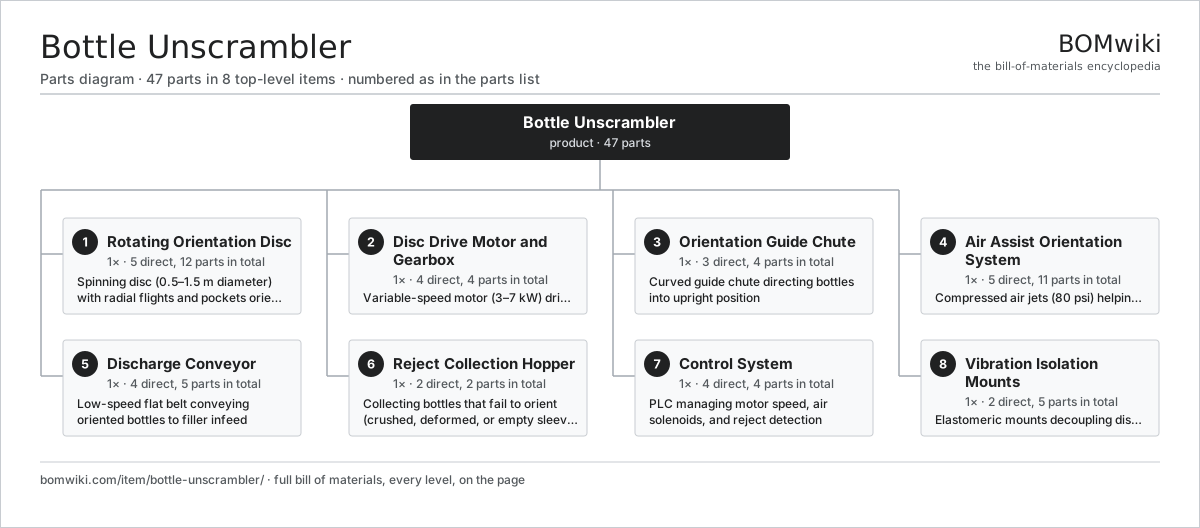
| # | Part | Qty | What it does |
|---|---|---|---|
| 1 | Rotating Orientation Disc 5 parts | 1× | Spinning disc (0.5–1.5 m diameter) with radial flights and pockets orientating bottles |
| 2 | Disc Drive Motor and Gearbox 4 parts | 1× | Variable-speed motor (3–7 kW) driving rotating disc at 50–150 RPM |
| 3 | Orientation Guide Chute 3 parts | 1× | Curved guide chute directing bottles into upright position |
| 4 | Air Assist Orientation System 5 parts | 1× | Compressed air jets (80 psi) helping bottles stand upright on chute |
| 5 | Discharge Conveyor 4 parts | 1× | Low-speed flat belt conveying oriented bottles to filler infeed |
| 6 | Reject Collection Hopper 2 parts | 1× | Collecting bottles that fail to orient (crushed, deformed, or empty sleeves) |
| 7 | Control System 4 parts | 1× | PLC managing motor speed, air solenoids, and reject detection |
| 8 | Vibration Isolation Mounts 2 parts | 1× | Elastomeric mounts decoupling disc vibration from floor structure |
3D model
No 3D model yet. Have a CAD file of this? Add a 3D model. STL renders right on this page; STEP, FreeCAD, and OpenSCAD sources are welcome too (openly licensed, like all 3D models on BOMwiki).
Build & assembly graph
expand / collapse · shared sub-assemblies converge · links to related products · est. labourTap an assembly to expand/collapse · tap a part to open it · use “Open page” for any node · drag to pan, scroll to zoom.
Bill of materials for Bottle Unscrambler
8 top-level lines · 37 rows shown · 47 parts total · indented to 3 levels| # | Item / sub-assembly | Part no. | Qty/assy | Ext. qty | Parts | Type |
|---|---|---|---|---|---|---|
| 1 | Rotating Orientation Disc 5 parts | bottle-unscrambler-rotating-disc | 1× | 1 | 12 | assembly |
| 1.1 | Disc Casting | bottle-unscrambler-disc-casting | 1× | 1 | · | part |
| 1.2 | Radial Flight Separator | bottle-unscrambler-radial-flights | 8× | 8 | · | part |
| 1.3 | Drive Hub | bottle-unscrambler-center-hub | 1× | 1 | · | part |
| 1.4 | Main Disc Bearing | bottle-unscrambler-disc-bearing | 1× | 1 | · | part |
| 1.5 | Drive Shaft | bottle-unscrambler-drive-shaft | 1× | 1 | · | part |
| 2 | Disc Drive Motor and Gearbox 4 parts | bottle-unscrambler-drive-motor | 1× | 1 | 4 | assembly |
| 2.1 | AC Motor | bottle-unscrambler-ac-motor | 1× | 1 | · | part |
| 2.2 | Reduction Gearbox | bottle-unscrambler-gearbox | 1× | 1 | · | part |
| 2.3 | Variable-Frequency Drive | bottle-unscrambler-vfd-controller | 1× | 1 | · | part |
| 2.4 | Motor-Gearbox Coupling | bottle-unscrambler-coupling | 1× | 1 | · | part |
| 3 | Orientation Guide Chute 3 parts | bottle-unscrambler-orientation-chute | 1× | 1 | 4 | assembly |
| 3.1 | Chute Surface | bottle-unscrambler-chute-inner-surface | 1× | 1 | · | part |
| 3.2 | Chute Narrowing Throat | bottle-unscrambler-chute-throat | 1× | 1 | · | part |
| 3.3 | Chute Reinforcement Ribs | bottle-unscrambler-chute-reinforcement | 2× | 2 | · | part |
| 4 | Air Assist Orientation System 5 parts | bottle-unscrambler-air-assist-system | 1× | 1 | 11 | assembly |
| 4.1 | Air Compressor | bottle-unscrambler-air-compressor | 1× | 1 | · | part |
| 4.2 | Solenoid Valve Array | bottle-unscrambler-air-solenoid-array | 4× | 4 | · | part |
| 4.3 | Air Jet Nozzles | bottle-unscrambler-air-jet-nozzles | 4× | 4 | · | part |
| 4.4 | Air Manifold Block | bottle-unscrambler-air-distribution-manifold | 1× | 1 | · | part |
| 4.5 | Air Supply Lines | bottle-unscrambler-air-line-tubing | 1× | 1 | · | part |
| 5 | Discharge Conveyor 4 parts | bottle-unscrambler-discharge-conveyor | 1× | 1 | 5 | assembly |
| 5.1 | Discharge Conveyor Belt | bottle-unscrambler-discharge-belt | 1× | 1 | · | part |
| 5.2 | Belt Drive Motor | bottle-unscrambler-belt-motor | 1× | 1 | · | part |
| 5.3 | Side Guide Rails | bottle-unscrambler-side-guide-rails | 2× | 2 | · | part |
| 5.4 | Return Idler Pulley | bottle-unscrambler-discharge-idler | 1× | 1 | · | part |
| 6 | Reject Collection Hopper 2 parts | bottle-unscrambler-reject-hopper | 1× | 1 | 2 | assembly |
| 6.1 | Reject Deflector Chute | bottle-unscrambler-reject-chute | 1× | 1 | · | part |
| 6.2 | Reject Bin Interface | bottle-unscrambler-reject-bin-interface | 1× | 1 | · | part |
| 7 | Control System 4 parts | bottle-unscrambler-control-system | 1× | 1 | 4 | assembly |
| 7.1 | Control PLC | bottle-unscrambler-plc | 1× | 1 | · | part |
| 7.2 | Local Control Panel | bottle-unscrambler-hmi-panel | 1× | 1 | · | part |
| 7.3 | Bottle Presence Sensor | bottle-unscrambler-proximity-sensor | 1× | 1 | · | part |
| 7.4 | Air Pressure Monitor | bottle-unscrambler-pressure-switch | 1× | 1 | · | part |
| 8 | Vibration Isolation Mounts 2 parts | bottle-unscrambler-vibration-isolation | 1× | 1 | 5 | assembly |
| 8.1 | Elastomeric Isolators | bottle-unscrambler-isolation-mounts | 4× | 4 | · | part |
| 8.2 | Base Frame | bottle-unscrambler-base-frame | 1× | 1 | · | part |
Something wrong in this list? Report a problem with this BOM.
Sourcing: possible vendors
Browse the supplier directory → Prices, MOQ, and lead times are algorithmic estimates, not quotes, and not claims about these companies. Company mappings are curated by keyword; est. price band $1k–$500k. How estimates work| Vendor | HQ | Specialty | MOQ | Lead time |
|---|---|---|---|---|
| gea.com ↗ | Düsseldorf, DE | Process technology | 20 units | 12–20 wks |
| buhlergroup.com ↗ | Uzwil, CH | Food & materials processing | 20 units | 12–20 wks |
| tetrapak.com ↗ | Pully, CH | Food packaging & processing | 20 units | 12–20 wks |
| jbtc.com ↗ | Chicago, US | Food processing equipment | 20 units | 12–20 wks |
| alfalaval.com ↗ | Lund, SE | Heat transfer & separation | 20 units | 12–20 wks |
1,065-word article