Bottle Warmer
ProductOverview
A bottle warmer is an appliance that heats a baby s milk bottle or expressed breast milk to a temperature comfortable for the infant (typically 37–40 °C, matching body temperature). Unlike a microwave, which heats unevenly and can create dangerously hot pockets, a bottle warmer uses circulating hot water or gentle steam to raise the milk temperature uniformly, preventing scalding.
The Heating Chamber is a water bath surrounding the bottle, separated by a thin wall from the Removable Bottle Basket holding the bottle. Heat conducted through the basket and bottle walls warms the milk gradually.
Heating method and thermostatics
The Electric Heating Coil is an electric coil (similar to that in a kettle), typically rated 300–400 watts. When powered, the coil temperature rises rapidly, heating the surrounding water. The Thermostat Control System control system monitors the temperature of the water bath via a Temperature Sensor, a thermistor or resistance thermometer probe submerged in the chamber.
The Control Relay is a switch that toggles the heating element on and off. When water temperature falls below the target Temperature Dial (set by the parent), the relay energizes the heating element. Once the target is reached, the relay de-energizes the element. The system cycles this way throughout the warming process, maintaining a steady-state temperature.
Most warmers preset the temperature to 40–45 °C (a safe default), but some allow adjustment via the Temperature Dial. A parent might adjust to 40 °C if the baby prefers cooler milk, or to 50 °C for a bottle intended to be drunk shortly after warming (allowing time to cool slightly before feeding).
Water bath circulation
In some models, the water bath is static: heat from the Heating Element rises and diffuses through the water by natural convection (hot water is less dense and floats upward, displacing cooler water downward). This slow process can create temperature stratification, hot water near the heating element and cooler water near the top of the chamber.
In others, a small pump circulates hot water continuously through the Water Circulation Path, ensuring uniform temperature throughout the chamber. Circulating warmers heat more quickly and evenly.
Bottle warming kinetics
The rate at which the milk inside the bottle reaches the target temperature depends on the bottle material (glass conducts heat faster than plastic), the bottle shape (thin bottles heat faster than thick ones), and the amount of water in the warmer. Typical warming time is 4–8 minutes for a 120 mL bottle from refrigerator temperature (4 °C) to 40 °C.
Some parents pre-warm the Heating Chamber to the target temperature before placing a bottle in the basket, shortening warming time; others place a cold bottle in the warmer immediately after removing it from the fridge.
Timer and auto-shutoff
The Digital Timer Module allows parents to set a warming duration. The Timer Circuit counts down, and once the time expires, a relay cuts power to the Heating Element. This prevents over-heating and reduces energy consumption.
Most warmers also include an auto-shutoff feature that cuts power if the internal temperature exceeds a safety threshold (around 60 °C), preventing water from boiling and the Heating Chamber from drying out.
Safety considerations
Overheating milk can destroy some nutrients (chiefly proteins and heat-sensitive vitamins) and create hot spots that scald the infant s mouth. A thermometer (not always included) is the best way to verify that the milk has reached the desired temperature before feeding; some parents feel the outside of the bottle, but this is unreliable, the outside can be cool while the inside is dangerously hot.
The Electric Heating Coil never directly contacts the milk; water always separates them, preventing hot spots. However, if a parent leaves a bottle in the warmer for an extended period (an hour or more), the milk inside can become very hot. The Digital Timer Module is designed to prevent this by automatically shutting off after a typical warming duration.
Microwaving bottles or heating milk in a microwave is not recommended because microwave heating is uneven, creating pockets of extreme heat. Bottle warmers distribute heat more evenly, though they are still slower than microwaves.
Bacterial growth during warming
Prolonged warming (above 40 °C but below sterilization temperature ~65 °C) is the "danger zone" for bacterial growth. If a bottle of milk sits in a warmer at 45 °C for more than 1–2 hours, any bacteria present initially (from the collection process or the bottle s prior contents) can multiply. This is one reason a timer is critical: warming time should be limited to 5–10 minutes.
Expressed breast milk (EBM) stored in the refrigerator contains few bacteria if collected and stored correctly, but once warmed, it should be used within 1–2 hours. Formula prepared with warm water can also be warmed this way, though powdered formula heated above 50 °C can form clumps.
Water quality and maintenance
Like a bottle sterilizer, a warmer should be filled with distilled water to prevent limescale buildup on the Heating Element and Heating Chamber. Over many cycles, mineral deposits reduce heating efficiency.
The Temperature Sensor can drift over time, causing the warmer to undershoot or overshoot the target temperature. If warming times become unexpectedly long or short, the sensor may need recalibration or replacement.
The Removable Bottle Basket can become warped with age, preventing bottles from sitting stably. A cracked basket should be replaced to prevent a bottle from tipping and spilling hot water.
The Power Supply Cord and plug can wear; if the warmer does not heat or cycles erratically, the cord or connection may be faulty and should be inspected and replaced if damaged.
Bottle Warmer parts and their functions
7 top-level parts · 38 parts in total · full bill of materials below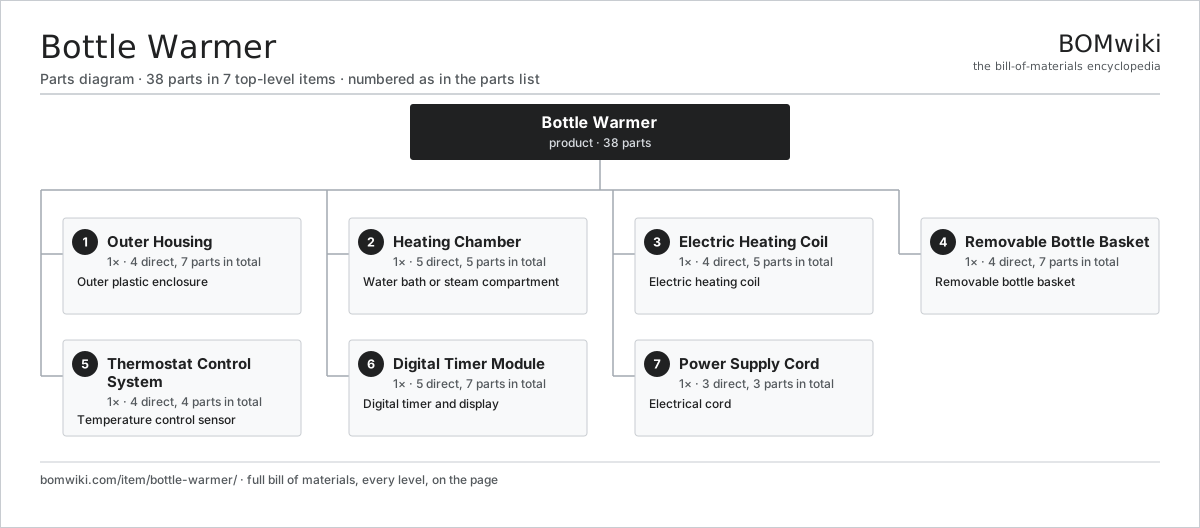
| # | Part | Qty | What it does |
|---|---|---|---|
| 1 | Outer Housing 4 parts | 1× | Outer plastic enclosure |
| 2 | Heating Chamber 5 parts | 1× | Water bath or steam compartment |
| 3 | Electric Heating Coil 4 parts | 1× | Electric heating coil |
| 4 | Removable Bottle Basket 4 parts | 1× | Removable bottle basket |
| 5 | Thermostat Control System 4 parts | 1× | Temperature control sensor |
| 6 | Digital Timer Module 5 parts | 1× | Digital timer and display |
| 7 | Power Supply Cord 3 parts | 1× | Electrical cord |
3D model
No 3D model yet. Have a CAD file of this? Add a 3D model. STL renders right on this page; STEP, FreeCAD, and OpenSCAD sources are welcome too (openly licensed, like all 3D models on BOMwiki).
Build & assembly graph
expand / collapse · shared sub-assemblies converge · links to related products · est. labourTap an assembly to expand/collapse · tap a part to open it · use “Open page” for any node · drag to pan, scroll to zoom.
Bill of materials for Bottle Warmer
7 top-level lines · 36 rows shown · 38 parts total · indented to 3 levels| # | Item / sub-assembly | Part no. | Qty/assy | Ext. qty | Parts | Type |
|---|---|---|---|---|---|---|
| 1 | Outer Housing 4 parts | bottle-warmer-housing | 1× | 1 | 7 | assembly |
| 1.1 | Housing Body | bottle-warmer-housing-body | 1× | 1 | · | part |
| 1.2 | Housing Base | bottle-warmer-housing-base | 1× | 1 | · | part |
| 1.3 | Housing Lid | bottle-warmer-housing-lid | 1× | 1 | · | part |
| 1.4 | Rubber Foot | bottle-warmer-rubber-feet | 4× | 4 | · | part |
| 2 | Heating Chamber 5 parts | bottle-warmer-heating-chamber | 1× | 1 | 5 | assembly |
| 2.1 | Chamber Wall | bottle-warmer-chamber-wall | 1× | 1 | · | part |
| 2.2 | Water Inlet | bottle-warmer-water-inlet | 1× | 1 | · | part |
| 2.3 | Water Outlet | bottle-warmer-water-outlet | 1× | 1 | · | part |
| 2.4 | Water Circulation Path | bottle-warmer-circulation-path | 1× | 1 | · | part |
| 2.5 | Thermal Gasket | bottle-warmer-thermal-gasket | 1× | 1 | · | part |
| 3 | Electric Heating Coil 4 parts | bottle-warmer-heating-element | 1× | 1 | 5 | assembly |
| 3.1 | Heating Element | heating-element | 1× | 1 | · | part |
| 3.2 | Heating Tube | bottle-warmer-heating-tube | 1× | 1 | · | part |
| 3.3 | Heating Terminal | bottle-warmer-heating-terminal | 2× | 2 | · | part |
| 3.4 | Heat Shield | bottle-warmer-heat-shield | 1× | 1 | · | part |
| 4 | Removable Bottle Basket 4 parts | bottle-warmer-basket | 1× | 1 | 7 | assembly |
| 4.1 | Basket Frame | bottle-warmer-basket-frame | 1× | 1 | · | part |
| 4.2 | Bottle Holder | bottle-warmer-bottle-holder | 1× | 1 | · | part |
| 4.3 | Basket Handle | bottle-warmer-basket-handle | 1× | 1 | · | part |
| 4.4 | Basket Foot | bottle-warmer-basket-feet | 4× | 4 | · | part |
| 5 | Thermostat Control System 4 parts | bottle-warmer-thermostat | 1× | 1 | 4 | assembly |
| 5.1 | Temperature Sensor | bottle-warmer-temp-sensor | 1× | 1 | · | part |
| 5.2 | Control Relay | bottle-warmer-control-relay | 1× | 1 | · | part |
| 5.3 | Temperature Dial | bottle-warmer-setpoint-dial | 1× | 1 | · | part |
| 5.4 | Control PCB | bottle-warmer-control-pcb | 1× | 1 | · | part |
| 6 | Digital Timer Module 5 parts | bottle-warmer-timer-module | 1× | 1 | 7 | assembly |
| 6.1 | Timer Display | bottle-warmer-timer-display | 1× | 1 | · | part |
| 6.2 | Timer Microcontroller | bottle-warmer-timer-mcu | 1× | 1 | · | part |
| 6.3 | Timer Button | bottle-warmer-timer-button | 3× | 3 | · | part |
| 6.4 | Timer Circuit | bottle-warmer-timer-circuit | 1× | 1 | · | part |
| 6.5 | Buzzer | bottle-warmer-buzzer | 1× | 1 | · | part |
| 7 | Power Supply Cord 3 parts | bottle-warmer-power-cord | 1× | 1 | 3 | assembly |
| 7.1 | Cord Wire | bottle-warmer-cord-wire | 1× | 1 | · | part |
| 7.2 | Cord Plug | bottle-warmer-cord-plug | 1× | 1 | · | part |
| 7.3 | Cord Strain Relief | bottle-warmer-cord-strain-relief | 1× | 1 | · | part |
Something wrong in this list? Report a problem with this BOM.
Sourcing: possible vendors
Browse the supplier directory → Prices, MOQ, and lead times are algorithmic estimates, not quotes, and not claims about these companies. Company mappings are curated by keyword; est. price band $20–$600. How estimates work| Vendor | HQ | Specialty | MOQ | Lead time |
|---|---|---|---|---|
|
🇦🇺Breville
breville.com ↗
|
Sydney, AU | Kitchen appliances | 2,000 units | 6–10 wks |
| groupeseb.com ↗ | Écully, FR | Cookware & small appliances | 2,000 units | 6–10 wks |
| hamiltonbeach.com ↗ | Glen Allen, US | Small appliances | 2,000 units | 6–10 wks |
| panasonic.com ↗ | Osaka, JP | Electronics & appliances | 2,000 units | 6–10 wks |
|
🇨🇳Midea
midea.com ↗
|
Foshan, CN | Home appliances | 2,000 units | 6–10 wks |
968-word article