Inflatable Bounce House
ProductOverview
An inflatable bounce house (or bouncer) is a fabric enclosure held aloft by air pressure maintained by a continuous Blower Assembly. Children jump on the bouncy floor, where the Fabric Envelope absorbs and returns their kinetic energy, creating the weightless sensation of bouncing. The Interior Safety Net divides the interior and catches them during falls, while theme features like Inflatable Slide, Climbing Wall, and Ball Pit Insert add interactive play. The entire structure is tethered to the ground with Anchor Stake to prevent wind lift or collapse.
The Fabric Envelope is a sealed fabric assembly of PVC-coated polyester or vinyl-coated nylon, stitched and heat-sealed into walls, a floor, and a roof. Unlike a traditional tent, there are no rigid poles; air pressure alone keeps the structure upright. The fabric thickness ranges from 0.5 mm (walls) to 1.0 mm (floor), providing durability against puncture while remaining light enough to transport. All seams are triple-stitched and sealed; stress points (corners, entry tunnel attachment, theme feature tie-ins) receive reinforcement with webbing or double-stitching.
Inflation and pressure balance
The Blower Assembly is a continuous-duty electric fan rated for 12–24 hour operation. Typically a centrifugal or rotary-lobe blower producing 100–300 CFM at modest pressure (0.5–2 kPa absolute gauge, or roughly 0.005–0.02 atmospheres above ambient), it maintains the internal pressure required to keep the Fabric Envelope rigid. A Power Cord, typically 15–30 m long, connects to a grounded 110V or 220V outlet with ground-fault protection.
The Impeller draws in ambient air and pushes it through the Air Valve, a one-way air port on the Fabric Envelope. The blower runs continuously; no active pressure regulation is needed because the slight pressure imbalance (room air escaping through seams and netting gaps) is balanced by the blower intake. If the pressure drops suddenly (from a large puncture), the Fabric Envelope will sag within seconds, visibly alerting supervisors to stop use.
Interior design and safety
The Floor Panel is textured (typically cross-hatched or beaded) to provide grip and distribute pressure. Underneath, the floor panel is bonded to the wall panels, forming a sealed perimeter. The Interior Safety Net is a mesh netting (3–5 mm open weave) sewn or anchored at multiple points inside, dividing the play space and providing a "soft catch" surface. Children bouncing near the net will decelerate against the mesh rather than colliding with hard walls.
The Entry Tunnel is an inflatable ramp or tube allowing children to enter and exit without climbing over walls. The Theme Features assembly might include an inflatable Inflatable Slide (seamed PVC with a smooth interior surface), a Climbing Wall (with velcro or foam patches), and a bounce-house-basketball-hoop with netting. Some designs feature a Ball Pit Insert, a large nylon bag filled with 500–1000 lightweight foam or plastic balls; children land in the soft pit, reducing impact forces.
Tethering and wind resistance
The entire structure must be anchored against wind lift. Four to six Anchor Stake, heavy metal or plastic pegs driven 0.3–0.5 m into the ground, are positioned around the perimeter. Nylon webbing or rope is sewn to Air Valve D-rings on the Fabric Envelope and fastened to the stakes using carabiners or bolts. Anchoring prevents the bounce house from becoming airborne in gusts above 20 km/h (Beaufort force 4). Weight ratings (500–1500 kg depending on envelope volume) account for both children and structural mass; exceeding capacity requires additional anchoring or removal of the unit to indoor venues.
Material properties and durability
PVC-coated polyester is the de facto standard. The polyester provides tear resistance; the PVC coating provides waterproofing and UV protection. Polyester-nylon blends offer better flex fatigue resistance. Most commercial bounce houses are tested to withstand 20,000–50,000 inflation cycles before seams show wear. The Seams are the primary failure point; once a stitch line ruptures, a small tear can propagate under use.
UV exposure degrades PVC; bounce houses stored in sunlight without a cover typically last 5–10 years before the fabric becomes brittle. Storage in shade or under a tarp extends life to 10–15 years. The Motor is the most likely mechanical failure; bearings and windings degrade with dust exposure and humidity. Annual motor inspection and occasional bearing lubrication extend motor life.
Maintenance and repair
Operators inspect visually before each use. Tears or punctures are located by listening for air leak hiss or by submerging suspect areas in soapy water. Small punctures (< 5 mm) are patched using the Repair Kit: the area is cleaned, a vinyl or PVC patch is applied with polyurethane adhesive, and it is weighted for 24 hours. Larger tears or multiple damage points warrant professional repair or replacement.
Monthly maintenance includes checking the Power Cord for cuts or damage, ensuring anchoring hardware is secure, and inspecting the Fabric Envelope for mold or mildew (which requires mild detergent washing). The Blower Housing inlet filter should be cleaned monthly to prevent dust accumulation and motor overheating.
Safety standards and supervision
Most countries regulate inflatable play structures; ASTM F2374 (USA) and EN 14960 (Europe) set stability, pressure relief, ventilation, and marking standards. Manufacturers include warning labels on the Fabric Envelope noting maximum occupancy, age ranges, and supervision requirements. A responsible adult must supervise at all times; children's mass, coordination, and behavior are highly variable, and injuries can result from falls, collisions, or entrapment.
Inflatable Bounce House parts and their functions
8 top-level parts · 529 parts in total · full bill of materials below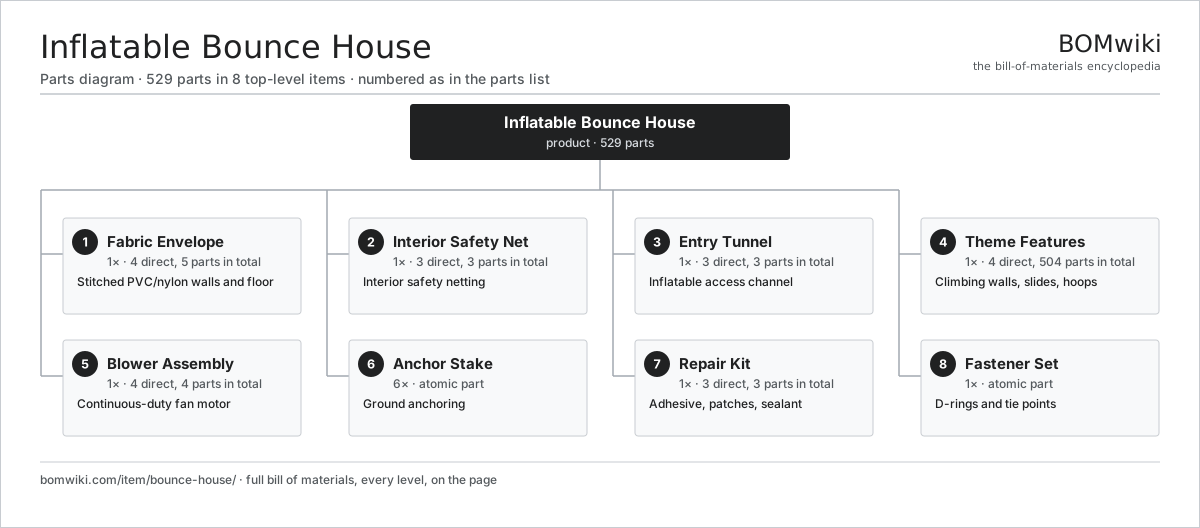
| # | Part | Qty | What it does |
|---|---|---|---|
| 1 | Fabric Envelope 4 parts | 1× | Stitched PVC/nylon walls and floor |
| 2 | Interior Safety Net 3 parts | 1× | Interior safety netting |
| 3 | Entry Tunnel 3 parts | 1× | Inflatable access channel |
| 4 | Theme Features 4 parts | 1× | Climbing walls, slides, hoops |
| 5 | Blower Assembly 4 parts | 1× | Continuous-duty fan motor |
| 6 | Anchor Stake | 6× | Ground anchoring |
| 7 | Repair Kit 3 parts | 1× | Adhesive, patches, sealant |
| 8 | Fastener Set | 1× | D-rings and tie points |
3D model
No 3D model yet. Have a CAD file of this? Add a 3D model. STL renders right on this page; STEP, FreeCAD, and OpenSCAD sources are welcome too (openly licensed, like all 3D models on BOMwiki).
Build & assembly graph
expand / collapse · shared sub-assemblies converge · links to related products · est. labourTap an assembly to expand/collapse · tap a part to open it · use “Open page” for any node · drag to pan, scroll to zoom.
Bill of materials for Inflatable Bounce House
8 top-level lines · 31 rows shown · 529 parts total · indented to 3 levels| # | Item / sub-assembly | Part no. | Qty/assy | Ext. qty | Parts | Type |
|---|---|---|---|---|---|---|
| 1 | Fabric Envelope 4 parts | bounce-house-envelope | 1× | 1 | 5 | assembly |
| 1.1 | Wall Panels | bounce-house-wall-panels | 1× | 1 | · | part |
| 1.2 | Floor Panel | bounce-house-floor-panel | 1× | 1 | · | part |
| 1.3 | Seams | bounce-house-seams | 1× | 1 | · | part |
| 1.4 | Air Valve | bounce-house-valves | 2× | 2 | · | part |
| 2 | Interior Safety Net 3 parts | bounce-house-support-net | 1× | 1 | 3 | assembly |
| 2.1 | Net Fabric | bounce-house-net-fabric | 1× | 1 | · | part |
| 2.2 | Seams | bounce-house-net-stitching | 1× | 1 | · | part |
| 2.3 | Attachment Points | bounce-house-net-tie-points | 1× | 1 | · | part |
| 3 | Entry Tunnel 3 parts | bounce-house-entry-tunnel | 1× | 1 | 3 | assembly |
| 3.1 | Tunnel Fabric | bounce-house-tunnel-fabric | 1× | 1 | · | part |
| 3.2 | Frame Ring | bounce-house-tunnel-frame | 1× | 1 | · | part |
| 3.3 | Fastener Set | fastener-set | 1× | 1 | · | part |
| 4 | Theme Features 4 parts | bounce-house-theme-features | 1× | 1 | 504 | assembly |
| 4.1 | Inflatable Slide | bounce-house-slide | 1× | 1 | · | part |
| 4.2 | Climbing Wall | bounce-house-climb-wall | 1× | 1 | · | part |
| 4.3 | Basketball Hoop | bounce-house-hoop-game | 1× | 1 | · | part |
| 4.4 | Ball Pit Insert 2 parts | bounce-house-ball-pit | 1× | 1 | 501 | assembly |
| 4.4.1 | Pit Bag | bounce-house-pit-bag | 1× | 1 | · | part |
| 4.4.2 | Ball | bounce-house-pit-balls | 500× | 500 | · | part |
| 5 | Blower Assembly 4 parts | bounce-house-blower | 1× | 1 | 4 | assembly |
| 5.1 | Motor | bounce-house-blower-motor | 1× | 1 | · | part |
| 5.2 | Impeller | bounce-house-blower-impeller | 1× | 1 | · | part |
| 5.3 | Blower Housing | bounce-house-blower-housing | 1× | 1 | · | part |
| 5.4 | Power Cord | bounce-house-motor-cord | 1× | 1 | · | part |
| 6 | Anchor Stake | bounce-house-anchor-stakes | 6× | 6 | · | part |
| 7 | Repair Kit 3 parts | bounce-house-repair-kit | 1× | 1 | 3 | assembly |
| 7.1 | Patch Fabric | bounce-house-patch-material | 1× | 1 | · | part |
| 7.2 | Adhesive | bounce-house-adhesive | 1× | 1 | · | part |
| 7.3 | Tools | bounce-house-repair-tools | 1× | 1 | · | part |
| 8 | Fastener Set | fastener-set | 1× | 1 | · | part |
Something wrong in this list? Report a problem with this BOM.
Sourcing: possible vendors
Browse the supplier directory → Prices, MOQ, and lead times are algorithmic estimates, not quotes, and not claims about these companies. Company mappings are curated by keyword; est. price band $20–$3k. How estimates work| Vendor | HQ | Specialty | MOQ | Lead time |
|---|---|---|---|---|
|
🇩🇰LEGO
lego.com ↗
|
Billund, DK | Construction toys | 2,000 units | 6–10 wks |
|
🇺🇸Mattel
mattel.com ↗
|
El Segundo, US | Toys | 2,000 units | 6–10 wks |
|
🇺🇸Hasbro
hasbro.com ↗
|
Pawtucket, US | Toys & games | 2,000 units | 6–10 wks |
| bandainamco.co.jp ↗ | Tokyo, JP | Toys & amusement | 2,000 units | 6–10 wks |
| spinmaster.com ↗ | Toronto, CA | Toys | 2,000 units | 6–10 wks |
963-word article