Bow Press
ProductOverview
A bow press is a mechanical or hydraulic tool compressing a bow's limbs into their strung (deflected) position, reducing internal stress and allowing safe access to components for maintenance, repair, or modification. Without a press, a loaded bow stores 60–150 joules of elastic energy, an explosive force. Attempting to disassemble a bow under full tension risks catastrophic limb failure, ejection of components, and severe hand or eye injury.
The press safely cages this energy: the operator controls compression using a hand crank (manual) or pump handle (hydraulic), maintaining consistent force while the technician works underneath or alongside the compressed limbs. Once maintenance is complete, the operator slowly releases compression, allowing the limbs to return to rest position.
Mechanical Principles
When a bow is strung, the limbs are deflected away from their natural (unstrung) shape, storing elastic potential energy:
Energy calculation:
- Deflection energy = (1/2) × k × x², where k = limb spring constant, x = deflection distance.
- For a 60 lb recurve bow with 28″ draw, limb deflection ≈ 8–10 inches, storing ~60 joules.
- Force released at this energy level = 1,200–1,500 Watts over 0.05 seconds (extremely violent).
The Compression Jaw System apply a controlled external force reversing limb deflection, reducing internal stress:
Stress reduction:
- At rest (unstrung): limbs are straight, stress = 0.
- Fully strung: limbs are deflected 8–10 inches, internal stress = maximum (typically 80–100 MPa in outer fiber).
- Partially compressed (50% deflection): internal stress ≈ 20–25 MPa, safe for work.
By compressing the bow to near-rest position, the press reduces limb stress to 10–15% of maximum, allowing safe disassembly without stored energy explosion.
Press Architecture
The Main Frame is a rigid structure resisting the reaction force. For a 400 lb compression force:
Force path:
- Upper jaw presses down with 400 lbs.
- Bow limbs react upward with 400 lbs (Newton's third law).
- Lower jaw and frame support this reaction, absorbing 400 lbs.
A weak frame deflects under load, reducing compression and creating uneven jaw contact. Quality presses use:
- Steel (1018 or higher carbon) main beam, 2–3 inch diameter.
- Boxed section frames (closed rectangular cross-section) instead of flat bar, maximizing bending stiffness.
- Diagonal bracing preventing side-to-side racking.
A properly designed frame deflects <0.05 inches under full load.
Drive System
The Drive System converts human effort into compression force using mechanical advantage:
Manual Screw Press
Mechanism:
- A ball screw (8–16 mm diameter, 2–5 mm pitch) connects the drive handle to the upper jaw.
- Turning the handle rotates the screw; advancing 1 full turn compresses the jaw 2–5 mm.
- Mechanical advantage = (arm length of handle / screw pitch) ≈ 30:1 to 50:1.
Effort calculation:
- If the operator can apply 40 lbs of force on a 12-inch handle arm, mechanical advantage is (12 inches / 0.2 inch pitch) = 60:1.
- Output force = 40 lbs × 60 = 2,400 lbs (far exceeding the 400 lb needed for limb compression).
Advantage: Simple, reliable, no power source required, intuitive control. Disadvantage: Slow (10–20 turns to fully compress), tiring for frequent use, requires careful operator attention.
Hydraulic Press
Mechanism:
- A hydraulic pump (hand or electric) pressurizes oil in a closed circuit.
- Pressure acts on a piston (large diameter) creating compression force.
- Mechanical advantage = (piston area in pressure chamber) / (piston area in return chamber).
Effort calculation:
- If piston diameter is 3 inches (area = 7 sq in) and pressure is 500 psi, force = 7 × 500 = 3,500 lbs.
- Small hand pump effort (20 lbs) on a 12-inch lever arm, multiple stroke cycles, reaches 3,500 lbs output.
Advantage: Fast (30–60 seconds to full compression), less operator effort, smooth pressure control. Disadvantage: Expensive ($400–800), requires maintenance (oil checks, seal replacement), heavier and bulkier.
Jaw Design & Contact
The Compression Jaw System must distribute compression force evenly across the bow limb:
Jaw geometry:
- Jaw width: 3–5 inches, spanning the limb width (ensuring full limb contact, not point-loading).
- Jaw face radius or flat surface: slight radius (1–2 inch radius) conforms to limb shape without damaging finish.
- Jaw Facing Pads: Soft aluminum (≈ 2–3 HB hardness) or rubber facing prevents marring the bow's finish (typically glossy laminate).
Contact pressure:
- Compression force (400 lbs) / jaw contact area (15 sq in) = 27 psi average contact stress.
- Peak stress at radius contact point ≈ 50–100 psi (within safe limits for bow finish).
Without soft pads, hard steel jaws would create indentations in the bow's surface.
Safety Considerations
A bow press is inherently dangerous because it contains compressed energy and moving parts:
Injury Hazards
- Pinch points: The gap between jaws can trap hands or clothing if operator is inattentive. Safety Guard Assembly encloses this zone.
- Limb failure: If a limb has an internal crack or laminate delamination, compression can cause catastrophic separation. Protective Guard Mesh Insert deflects fragments.
- Sudden release: If the operator loses control of the drive handle (screw slips, hydraulic seal fails), the compressed bow violently expands.
Safety Features
- Depth stop (Limb Position Stop): Mechanical limit preventing over-compression (avoids crushing the bow).
- Guard enclosure (Safety Guard Assembly): Polycarbonate or steel shield surrounding the compression zone.
- Spring-assisted return: Some presses include a return spring automatically opening jaws when compression is released, preventing limb jam.
- Dual-action thumb button (in some models): Operator must hold a button during operation; releasing the button immediately stops compression (fail-safe design).
Professional bow shops use presses with all these features plus emergency stop buttons and dead-man switches.
Maintenance Procedures Enabled
With the bow safely compressed, technicians can access and work on components not accessible in the strung state:
Limb Removal
- Bow is compressed to ~50% deflection.
- Limb pocket fasteners (usually bolts) are exposed and removed.
- Limb tenons are pulled free (requires ~50 lbs sideways force vs. 200+ lbs required when strung).
- Limb is inspected for cracks, delamination, or rot.
String Replacement
- Bow is compressed to near-rest position.
- Old string's end loops are unhooked from limb tips.
- New string is fitted (must be sized correctly: ±0.5 inches in length, wrong length changes draw weight by 5–10 lbs).
- Nocking point is re-marked at correct height (0.5 inch above perpendicular typically).
Riser Maintenance
- Limbs are removed (as above).
- Riser is cleaned, inspected for cracks, and finish touched up.
- Limb pockets are checked for looseness and re-torqued if needed.
Sight Adjustment
- Bow is unstrung or lightly compressed.
- Sight pins are repositioned or replaced without risk of string slap.
Selection & Usage
Manual press selection ($80–150):
- Suitable for: Hobbyists, home archers, occasional maintenance (1–4 times/year).
- Advantages: Affordable, portable, no power source, intuitive.
- Disadvantages: Slow, tiring, less precise pressure control.
- Example task time: 15 minutes to compress and replace a string.
Hydraulic press selection ($400–800):
- Suitable for: Professional bow shops, frequent maintenance, high-volume repairs.
- Advantages: Fast, less operator effort, precise pressure gauge, consistent.
- Disadvantages: Expensive, heavier, requires maintenance.
- Example task time: 5 minutes to compress and replace a string.
Operation protocol:
- Inspect the bow: Check for visible cracks, delamination, or obvious damage. Do not press a damaged bow (risk of catastrophic failure).
- Position bow: Limbs are placed in the Compression Jaw System, centered.
- Set depth stop: Adjust Limb Position Stop so jaws will stop at ~50% limb deflection (bow near rest position but strings still slack).
- Don safety guard: Ensure guard is in place.
- Apply compression: Turn handle or pump slowly, monitoring jaw movement.
- Verify string slack: Once compressed, the string should hang loose with no tension. If string is still tight, compress further.
- Perform maintenance (remove limbs, replace string, etc.).
- Release compression: Slowly reverse the drive mechanism, allowing jaws to open and limbs to relax back to strung position.
- Inspect: Check that all parts have returned to proper position; re-apply string tension if necessary.
Maintenance of the Press Itself
Bow presses are durable but require care:
Manual press:
- Inspect screw threads monthly (wipe clean of dust).
- Lubricate threads annually with light machine oil or lithium grease.
- Check jaw pads for wear (soft aluminum may flatten with age); replace if compressed >0.25 inches.
- Ensure frame and welds are free of cracks (stress cracks can develop at high-use shops).
Hydraulic press:
- Check hydraulic fluid level monthly (add ISO 46 hydraulic oil if low).
- Inspect hoses for cracks or leaks (replace at first sign).
- Bleed air from circuit if pressure feels spongy (air bubbles reduce force transmission).
- Rebuild seals every 5–10 years (shop manual required).
Lifespan: Well-maintained presses last 15–25 years. A heavily-used professional shop press may require rebuilding (~$100–300) after 10 years.
Comparison to DIY Alternatives
Some archers attempt to compress bows without a press:
| Method | Risk | Practicality |
|---|---|---|
| Bow press (manual or hydraulic) | Very low (controlled, safe) | Excellent |
| Bench vise (clamping jaws) | High (may crack limbs, uneven force) | Poor |
| Ratchet strap over limbs | Very high (no control, can snap cord, explosion risk) | Terrible |
| Professional shop press | Very low (engineered, full safety features) | Excellent |
DIY alternatives are dangerous and unreliable. Any archer planning more than one limb removal or string replacement should invest in a press.
Cost-Benefit Analysis
Standalone archer (1–2 presses/year):
- Cost: $100 manual press + time investment ($30–50 labor value) = $150–200 total cost per year.
- Alternative: Pay shop $80–120 per service × 2 = $160–240/year (similar cost, no ownership burden).
Hobbyist archer (5–10 presses/year):
- Press cost: $100 (amortized to $10–20/year over 5–10 year lifespan).
- DIY cost: 0 labor (owner does work).
- Alternative shop cost: $80 × 7 = $560/year (significantly more expensive).
- Verdict: Press investment breaks even quickly.
Professional shop (500+ presses/year):
- Hydraulic press cost: $600 (amortized to <$100/year over 10 years).
- Operator labor: 5 minutes/press × 500 = 42 hours/year at $25/hour = $1,050.
- Revenue: $80–120/press × 500 = $40,000–60,000/year.
- Verdict: Essential investment; enables profitable service business.
Bow Press parts and their functions
6 top-level parts · 17 parts in total · full bill of materials below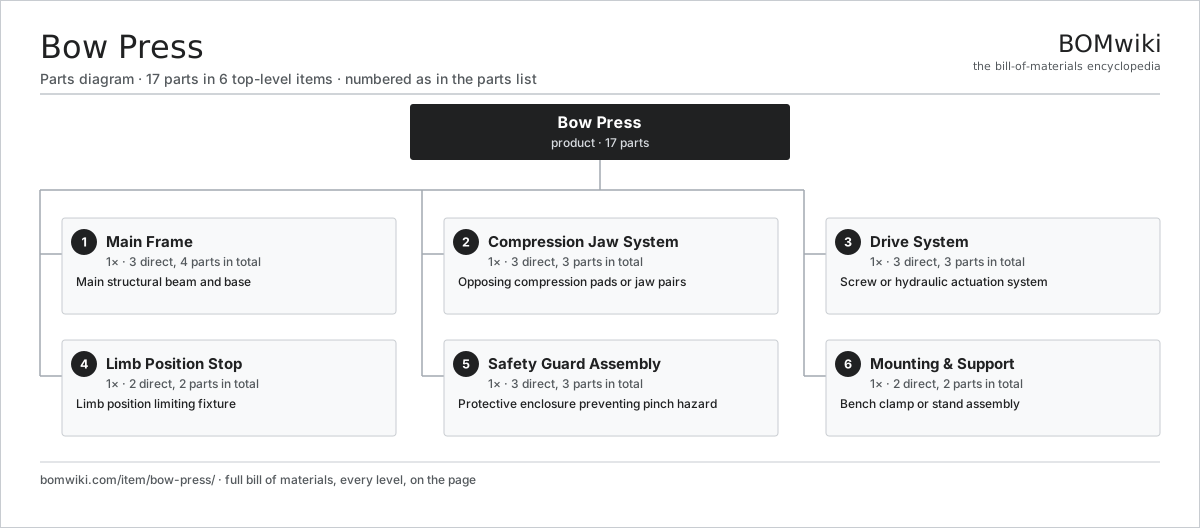
| # | Part | Qty | What it does |
|---|---|---|---|
| 1 | Main Frame 3 parts | 1× | Main structural beam and base |
| 2 | Compression Jaw System 3 parts | 1× | Opposing compression pads or jaw pairs |
| 3 | Drive System 3 parts | 1× | Screw or hydraulic actuation system |
| 4 | Limb Position Stop 2 parts | 1× | Limb position limiting fixture |
| 5 | Safety Guard Assembly 3 parts | 1× | Protective enclosure preventing pinch hazard |
| 6 | Mounting & Support 2 parts | 1× | Bench clamp or stand assembly |
3D model
No 3D model yet. Have a CAD file of this? Add a 3D model. STL renders right on this page; STEP, FreeCAD, and OpenSCAD sources are welcome too (openly licensed, like all 3D models on BOMwiki).
Build & assembly graph
expand / collapse · shared sub-assemblies converge · links to related products · est. labourTap an assembly to expand/collapse · tap a part to open it · use “Open page” for any node · drag to pan, scroll to zoom.
Bill of materials for Bow Press
6 top-level lines · 22 rows shown · 17 parts total · indented to 3 levels| # | Item / sub-assembly | Part no. | Qty/assy | Ext. qty | Parts | Type |
|---|---|---|---|---|---|---|
| 1 | Main Frame 3 parts | bow-press-frame | 1× | 1 | 4 | assembly |
| 1.1 | Vertical Frame Beam | bow-press-frame-beam | 1× | 1 | · | part |
| 1.2 | Frame Braces | bow-press-frame-supports | 2× | 2 | · | part |
| 1.3 | Fastener Set | fastener-set | 1× | 1 | · | part |
| 2 | Compression Jaw System 3 parts | bow-press-compression-fingers | 1× | 1 | 3 | assembly |
| 2.1 | Upper Compression Jaw | bow-press-finger-upper | 1× | 1 | · | part |
| 2.2 | Lower Compression Jaw | bow-press-finger-lower | 1× | 1 | · | part |
| 2.3 | Jaw Facing Pads | bow-press-finger-pads | 1× | 1 | · | part |
| 3 | Drive System 3 parts | bow-press-drive-mechanism | 1× | 1 | 3 | assembly |
| 3.1 | Screw or Hydraulic Pump | bow-press-screw-or-pump | 1× | 1 | · | part |
| 3.2 | Control Handle | bow-press-drive-handle | 1× | 1 | · | part |
| 3.3 | Drive Transmission | bow-press-drive-transmission | 1× | 1 | · | part |
| 4 | Limb Position Stop 2 parts | bow-press-depth-stop | 1× | 1 | 2 | assembly |
| 4.1 | Stop Block | bow-press-stop-block | 1× | 1 | · | part |
| 4.2 | Depth Adjustment Mechanism | bow-press-stop-adjustment | 1× | 1 | · | part |
| 5 | Safety Guard Assembly 3 parts | bow-press-safety-guard | 1× | 1 | 3 | assembly |
| 5.1 | Guard Shield | bow-press-guard-shield | 1× | 1 | · | part |
| 5.2 | Guard Mesh Insert | bow-press-guard-mesh | 1× | 1 | · | part |
| 5.3 | Fastener Set | fastener-set | 1× | 1 | · | part |
| 6 | Mounting & Support 2 parts | bow-press-base-mounting | 1× | 1 | 2 | assembly |
| 6.1 | Clamp or Base Feet | bow-press-clamp-or-feet | 1× | 1 | · | part |
| 6.2 | Stability Reinforcement | bow-press-stability-brace | 1× | 1 | · | part |
Something wrong in this list? Report a problem with this BOM.
Related products
same domain, ranked by shared parts Avalanche Transceiver
35 parts · shares 1 with this page
Avalanche Transceiver
35 parts · shares 1 with this page
 Backpacking Stove
32 parts · shares 1 with this page
Backpacking Stove
32 parts · shares 1 with this page
 Baitcasting Reel
51 parts · shares 1 with this page
Bow Sight
72 parts · shares 1 with this page
Baitcasting Reel
51 parts · shares 1 with this page
Bow Sight
72 parts · shares 1 with this page
 Camping Tent
101 parts · shares 1 with this page
Camping Tent
101 parts · shares 1 with this page
Sourcing: possible vendors
Browse the supplier directory → Prices, MOQ, and lead times are algorithmic estimates, not quotes, and not claims about these companies. Company mappings are curated by keyword; est. price band $20–$2k. How estimates work| Vendor | HQ | Specialty | MOQ | Lead time |
|---|---|---|---|---|
|
🇺🇸Coleman
coleman.com ↗
|
Chicago, US | Camping gear | 1,000 units | 6–10 wks |
| thenorthface.com ↗ | Denver, US | Outdoor apparel & gear | 1,000 units | 6–10 wks |
|
🇺🇸YETI
yeti.com ↗
|
Austin, US | Coolers & drinkware | 1,000 units | 6–10 wks |
| decathlon.com ↗ | Villeneuve-d'Ascq, FR | Sporting goods | 1,000 units | 6–10 wks |
|
🇺🇸Garmin
garmin.com ↗
|
Olathe, US | GPS & wearables | 1,000 units | 6–10 wks |
1,680-word article