Bow Sight
ProductOverview
A bow sight is an aiming device mounted on a recurve bow or crossbow riser enabling precise aim at known distances. Modern sights use multiple adjustable pins, each calibrated to a specific distance (e.g., 20, 30, 40, 50, 60 yards), with fiber optic or tritium light-gathering elements making pins visible in low light. The simplicity and reliability of pin sights have made them the standard for hunting and 3D sport archery, with competition archers favoring larger, more complex optical systems.
Unlike a rifle scope (magnified optics, single reticle adjusted for distance), a bow sight uses multiple fixed pins at different heights. The archer picks the appropriate pin based on estimated distance, aims, and releases, a simpler, more intuitive system for dynamic hunting where distance is often estimated within ±10 yards.
Pin Spacing & Distance Calibration
Pin spacing is determined by the archer's bow setup (draw weight, arrow mass, velocity). The Aiming Pins are positioned vertically such that each pin corresponds to a distance where the arrow will impact if aimed with that pin.
Physics of pin spacing:
Arrow trajectory is parabolic: y = (tan θ) × x − (g × x²) / (2 × v² × cos² θ), where v = arrow velocity.
For a recurve bow shooting at 200 ft/s with a 0-degree elevation angle, the arrow drops:
- At 20 yards (60 feet): 6.2 inches.
- At 30 yards (90 feet): 14 inches.
- At 40 yards (120 feet): 25 inches.
- At 50 yards (150 feet): 39 inches.
Pin spacing needed: 14 − 6.2 = 7.8 inches per 10 yards (at this velocity).
Real-world spacing: For a 50 lb recurve at 200 ft/s, pins are typically spaced:
- 20-yard pin: Reference (0 mm vertical offset).
- 30-yard pin: 0.5 inches below 20-yard pin.
- 40-yard pin: 1.2 inches below 20-yard pin.
- 50-yard pin: 2.0 inches below 20-yard pin.
This spacing (0.4–0.6 inch increments) means the Pin Housing Assembly must hold 3–5 pins within a 1.5–2 inch vertical span. The Pin Dovetail Slots are precision-machined dovetail or screw-based receivers allowing pin cartridge insertion at exact heights.
Fiber Optic Light Gathering
The Fiber Optic Light Collector is the modern innovation enabling pin sights to work in low light (dawn/dusk hunting). Fiber optic strands gather ambient light through a large collector (8–10 mm diameter lens at the front of the sight) and transmit it to the pin element, making the pin glow brightly in low light.
Fiber optics principle:
- Optical fibers (0.5–1 mm diameter, typically PMMA acrylic or glass) are bundled in a single strand or multiple strands.
- Light entering one end bounces internally (total internal reflection) along the fiber length, exiting the opposite end.
- 50–100 fibers bundled together collect light from a large area and concentrate it on a small pin tip, creating a bright point-source.
Light transmission:
- Clear daylight: Fiber efficiently gathers light; pin appears bright green, red, or yellow (color from dye in fiber core).
- Low light (1–10 lux): Pin remains visible and bright due to high fiber efficiency (80–95% light transmission).
- Complete darkness: Pin is barely visible (fibers transmit only starlight, insufficient for aiming); alternatives below.
Advantages:
- No battery required (passive light gathering).
- Reliable (no moving parts, minimal wear).
- Bright pin in any daylight condition.
Disadvantages:
- Ineffective in complete darkness or heavy overcast.
- Color fades over 5–10 years (UV degrades dyes).
- Fiber breakage (rare but difficult to repair; sight is usually replaced).
Tritium Light Gathering
An alternative to fiber optics is tritium, a radioactive isotope (Tritium-3, half-life 12 years) that emits beta particles, causing phosphor to glow. Tritium pins are self-luminous and work in complete darkness.
Tritium characteristics:
- Brightness: ~1/100th of daylight levels, sufficient for aiming in near-total darkness.
- Color: Typically green or yellow (phosphor dependent).
- Longevity: Effective for ~12 years (tritium half-life); brightness decays predictably.
- Safety: Beta radiation from tritium is stopped by thin plastic or aluminum housing; no hazard if intact.
Comparison to fiber:
- Fiber: Bright in daylight, dim in darkness, no power or maintenance.
- Tritium: Moderate brightness in daylight, visible in darkness, degrades over time.
Most modern hunting sights combine fiber optics (for daylight brightness) with tritium backup (for low-light visibility), offering best of both.
Pin Design & Aiming Point Precision
The Pin Tip is the critical aiming element. Pin types vary:
Sharp point pins (standard):
- Diameter: 0.019–0.040 inches (0.5–1 mm).
- Material: Hardened steel or tungsten carbide for durability.
- Sharpness: Needle point or slightly rounded (radius <0.1 mm).
Advantage: Fine aiming point enables precise aim at small targets (bullseye shooting). Disadvantage: Difficult to see in low light without fiber/tritium; requires steady hand (shaky aim compounds error).
Dot pins (large target):
- Diameter: 0.060–0.100 inches (1.5–2.5 mm).
- Material: Colored plastic or resin dot.
- Visibility: Large target, easier to center, but less precise for small targets.
Advantage: Forgiving, bright, good for 3D targets and hunting in poor light. Disadvantage: Slightly lower precision for competition (±0.5 inch worse grouping).
Most hunting sights use 0.019–0.029 inch pins (medium compromise). Competition sights use 0.019 inch ultra-sharp pins.
Adjustment Mechanisms
The Micro-Adjustment System enable fine-tuning after initial setup:
Elevation Adjustment
The Elevation Adjustment Screw moves the entire sight housing vertically, shifting all pins up or down by the same amount. This is used to:
- Initial zero: Adjust the 20-yard (or reference) pin to the bow's impact point.
- Bow tuning compensation: If arrow spine or weight changes, elevation adjustment compensates for the resulting trajectory change.
Screw mechanics:
- Fine-pitch metric screw (M5 × 0.8 mm typical) or imperial (10-32 or 10-40 TPI).
- Each full turn advances sight housing ~0.8–1 mm.
- At 20 yards, 1 mm housing movement ≈ 1 inch arrow impact shift (approximately 50:1 ratio depending on sight geometry).
Windage Adjustment
The Windage Adjustment Screw moves the sight housing horizontally, shifting all pins left or right. Used to:
- Initial zero: Center the pin horizontally under the arrow's impact point.
- Wind compensation: During hunting, if estimating significant crosswind, slight windage adjustment pre-compensates.
Screw mechanics: Similar fine-pitch design to elevation; 1 mm shift ≈ 1 inch at 20 yards.
Adjustment Range
Typical range:
- Windage: ±40 clicks (±0.5 inch increments) = ±20 inches left-right at 20 yards.
- Elevation: Sight housing has sufficient vertical travel (1–2 inches) allowing adjustment from 10 to 70+ yards without fully unscrewing.
A properly tuned sight requires only occasional micro-adjustments (±1–2 clicks) before hunts; major adjustments (>10 clicks) indicate a change in bow setup (new arrow weight, string, or bow damage).
Bracket & Mounting Interface
The Mounting Bracket is the mechanical interface to the bow riser. Types include:
Dovetail mount (most common):
- Sight bracket has a dovetail slider fitting into a dovetail channel on the riser.
- Clamp screw tightens, wedging the bracket in place.
- Advantage: Simple, secure, universal across most brands.
- Disadvantage: Dovetail wear over 10+ years can loosen mount.
Proprietary rail (Picatinny or brand-specific):
- Sight bracket has a clip or latch engaging standardized rail.
- Advantage: Quick-detach, modular (can swap sights easily).
- Disadvantage: Riser must have correct rail type.
Quick-detach brackets (premium):
- Spring-loaded lever locks/unlocks bracket.
- Advantage: Sight can be removed for cleaning or repair without tools.
- Disadvantage: More expensive, slightly more moving parts to maintain.
All mounts must be rock-solid (zero movement under draw tension). A loose mount causes consistent grouping offset as the sight rocks during release.
Yardage Dial & Compensation
Some sights include a Distance Marking Scale system automating distance compensation:
Mechanism:
- A rotating dial on the sight housing is marked with distances (10, 20, 30, 40, 50, 60 yards).
- Rotating the dial mechanically adjusts the elevation screw, moving the sight housing to the correct height for that distance.
- Some premium sights use a cam mechanism (curved follower) instead of a dial, allowing smooth continuous adjustment.
Advantage: Eliminates mental calculation of "which pin for this distance"; archer simply sets dial to estimated range and aims center. Disadvantage: Requires precise distance estimation (±5 yards for accurate aim). In hunting, distance is often unknown; dial is less useful than multiple pins.
Most hunting sights use 3–5 fixed pins (no dial) for simplicity; competition sights use dials or continuous micro-adjustment for fine-tuning.
Durability & Maintenance
Bow sights are robust:
Typical lifespan:
- Mechanical parts (bracket, adjustment screws): 10–20 years (wear extremely slow).
- Fiber optics: 5–10 years (color fades, but remains visible).
- Tritium (if present): 12 years (half-life decay; brightness halves every 12 years).
- Housing and pins: 15–25 years (rarely fail unless impacted).
Maintenance:
- Clean lens/collector regularly (dust reduces light transmission).
- Check screw tightness before each hunt (recoil and vibration can loosen bracket).
- Inspect fiber for cracks (rare, but broken fiber requires sight replacement).
- Store in a dry location (moisture can fog optics, though most sights are sealed).
Cost of repairs:
- Pin replacement: $10–20 per pin (if cartridge-based).
- Bracket damage: $30–60 for replacement bracket.
- Full sight replacement: $80–400 (new sight often cheaper than repair if housing is cracked).
Hunting Applications
In the field, bow sights enable ethical hunting:
- Distance estimation: Hunter estimates distance to game (20–60 yards typical). Within ±5 yards, pin placement is accurate.
- Pin selection: Archer mentally selects the appropriate pin (20, 30, 40-yard) based on distance.
- Aiming: Pin is placed on vital area (heart/lung zone, 3–4 inches behind front leg, upper third of body height).
- Release: Trigger is squeezed, arrow launches.
Example scenario (30-yard shot at deer):
- Archer estimates distance at 32 yards (close to 30-yard pin).
- Aims with 30-yard pin, placing pin center on vital zone.
- Arrow impact will be within 2–3 inches of pin (due to ±2 yard estimation error and shooter precision).
- Clean, ethical kill results (vital zone is 4–5 inches, so ±3 inch error is acceptable).
Without a sight, aiming relies on instinctive point-of-aim (muscle memory) or gap shooting (aiming high/low to compensate for distance). These methods are less precise; sights dramatically improve hunting ethical standards.
Competition Use
Target archery (indoor and outdoor) uses larger, more complex sights:
Competition sight features:
- Magnification (4–8×) via mounted lens, enlarging target image.
- Adjustable aperture (iris or peep sight) controlling depth-of-field and glint.
- Micro-adjust turrets with 1/4 MOA or 1/10 inch increments (far finer than hunting sights).
- Sight tape (printed distance chart) marking pin positions for 5–70+ yards in 1-yard increments.
Performance impact:
- Hunting sight: 4–6 inch 3D target zones, 30–40 yard effective range.
- Competition sight: 2–3 inch bullseye, 70+ yard range, grouping <1 inch at 20 yards (archer-skill limited).
Competitive archery sights cost $300–1,000+ and are specialized for their sport.
Troubleshooting Common Issues
| Problem | Cause | Solution |
|---|---|---|
| Pin inconsistently visible | Fiber faded or collector dirty | Clean lens with soft cloth; replace sight if fiber is cracked |
| Arrow impacts left/right of pin | Windage misaligned | Adjust windage screw ±2–5 clicks per inch error |
| Arrow impacts above/below pin | Elevation misaligned | Adjust elevation screw ±2–5 clicks per inch error |
| Sight rocks during draw | Bracket loose | Tighten bracket clamp screw; check for bent bracket |
| Pin appears blurry | Eye focus or aperture misalignment | Move sight closer/farther from eye; check eye alignment |
| All pins group low (long distance impact) | Spine mismatch or arrow weight change | Verify arrow spine rating; consider heavier point weight |
Most issues are user error (wind, poor distance estimation) or shooter skill, not sight defects.
Bow Sight parts and their functions
7 top-level parts · 72 parts in total · full bill of materials below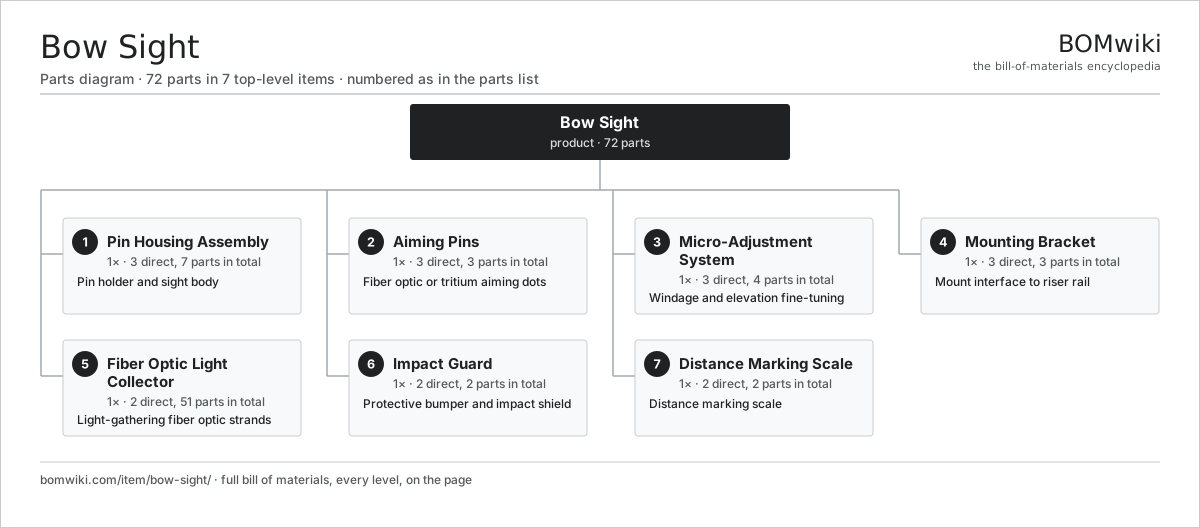
| # | Part | Qty | What it does |
|---|---|---|---|
| 1 | Pin Housing Assembly 3 parts | 1× | Pin holder and sight body |
| 2 | Aiming Pins 3 parts | 1× | Fiber optic or tritium aiming dots |
| 3 | Micro-Adjustment System 3 parts | 1× | Windage and elevation fine-tuning |
| 4 | Mounting Bracket 3 parts | 1× | Mount interface to riser rail |
| 5 | Fiber Optic Light Collector 2 parts | 1× | Light-gathering fiber optic strands |
| 6 | Impact Guard 2 parts | 1× | Protective bumper and impact shield |
| 7 | Distance Marking Scale 2 parts | 1× | Distance marking scale |
3D model
No 3D model yet. Have a CAD file of this? Add a 3D model. STL renders right on this page; STEP, FreeCAD, and OpenSCAD sources are welcome too (openly licensed, like all 3D models on BOMwiki).
Build & assembly graph
expand / collapse · shared sub-assemblies converge · links to related products · est. labourTap an assembly to expand/collapse · tap a part to open it · use “Open page” for any node · drag to pan, scroll to zoom.
Bill of materials for Bow Sight
7 top-level lines · 25 rows shown · 72 parts total · indented to 3 levels| # | Item / sub-assembly | Part no. | Qty/assy | Ext. qty | Parts | Type |
|---|---|---|---|---|---|---|
| 1 | Pin Housing Assembly 3 parts | bow-sight-pin-housing | 1× | 1 | 7 | assembly |
| 1.1 | Housing Body | bow-sight-housing-body | 1× | 1 | · | part |
| 1.2 | Pin Dovetail Slots | bow-sight-pin-slots | 5× | 5 | · | part |
| 1.3 | Fastener Set | fastener-set | 1× | 1 | · | part |
| 2 | Aiming Pins 3 parts | bow-sight-pins | 1× | 1 | 3 | assembly |
| 2.1 | Pin Cartridge | bow-sight-pin-cartridge | 1× | 1 | · | part |
| 2.2 | Fiber Optic or Tritium Element | bow-sight-pin-fiber | 1× | 1 | · | part |
| 2.3 | Pin Tip | bow-sight-pin-point | 1× | 1 | · | part |
| 3 | Micro-Adjustment System 3 parts | bow-sight-adjustment-screws | 1× | 1 | 4 | assembly |
| 3.1 | Elevation Adjustment Screw | bow-sight-elevation-screw | 1× | 1 | · | part |
| 3.2 | Windage Adjustment Screw | bow-sight-windage-screw | 1× | 1 | · | part |
| 3.3 | Coil Spring | coil-spring | 2× | 2 | · | part |
| 4 | Mounting Bracket 3 parts | bow-sight-bracket | 1× | 1 | 3 | assembly |
| 4.1 | Bracket Base | bow-sight-bracket-base | 1× | 1 | · | part |
| 4.2 | Bracket Clamp | bow-sight-bracket-clamp | 1× | 1 | · | part |
| 4.3 | Fastener Set | fastener-set | 1× | 1 | · | part |
| 5 | Fiber Optic Light Collector 2 parts | bow-sight-fiber-bundle | 1× | 1 | 51 | assembly |
| 5.1 | Fiber Optic Strands | bow-sight-fiber-strands | 50× | 50 | · | part |
| 5.2 | Fiber Shield Tube | bow-sight-fiber-shield | 1× | 1 | · | part |
| 6 | Impact Guard 2 parts | bow-sight-guard | 1× | 1 | 2 | assembly |
| 6.1 | Rubber Bumper | bow-sight-bumper | 1× | 1 | · | part |
| 6.2 | Shield Hood | bow-sight-shield-hood | 1× | 1 | · | part |
| 7 | Distance Marking Scale 2 parts | bow-sight-yardage-dial | 1× | 1 | 2 | assembly |
| 7.1 | Dial Wheel | bow-sight-dial-wheel | 1× | 1 | · | part |
| 7.2 | Yardage Scale | bow-sight-dial-markings | 1× | 1 | · | part |
Something wrong in this list? Report a problem with this BOM.
Related products
same domain, ranked by shared parts Backpacking Stove
32 parts · shares 2 with this page
Clay Pigeon Thrower
47 parts · shares 2 with this page
Backpacking Stove
32 parts · shares 2 with this page
Clay Pigeon Thrower
47 parts · shares 2 with this page
 Inflatable Kayak
71 parts · shares 2 with this page
Inflatable Kayak
71 parts · shares 2 with this page
 Portable Water Filter
23 parts · shares 2 with this page
Portable Water Filter
23 parts · shares 2 with this page
 Power Ice Auger
37 parts · shares 2 with this page
Power Ice Auger
37 parts · shares 2 with this page
Sourcing: possible vendors
Browse the supplier directory → Prices, MOQ, and lead times are algorithmic estimates, not quotes, and not claims about these companies. Company mappings are curated by keyword; est. price band $20–$2k. How estimates work| Vendor | HQ | Specialty | MOQ | Lead time |
|---|---|---|---|---|
|
🇺🇸Coleman
coleman.com ↗
|
Chicago, US | Camping gear | 1,000 units | 6–10 wks |
| thenorthface.com ↗ | Denver, US | Outdoor apparel & gear | 1,000 units | 6–10 wks |
|
🇺🇸YETI
yeti.com ↗
|
Austin, US | Coolers & drinkware | 1,000 units | 6–10 wks |
| decathlon.com ↗ | Villeneuve-d'Ascq, FR | Sporting goods | 1,000 units | 6–10 wks |
|
🇺🇸Garmin
garmin.com ↗
|
Olathe, US | GPS & wearables | 1,000 units | 6–10 wks |
1,960-word article